Showing posts with label Donald Barthelme. Show all posts
Showing posts with label Donald Barthelme. Show all posts
Sunday, January 8, 2017
On "Shower of Gold" by Donald Barthelme (3500 words) *****
Here's a fun and absurd story about a man who agrees to go on television to make a little money, which he needs. But in between, we're provided into people's opinions about the show and even into some information about the president. Read the story here.


Sunday, December 11, 2016
On "The Dolt" by Donald Barthelme (2189 words) ***
An exploration of the difficulties involved in writing
narratives, this one centers around a man preparing for an examination. Read
the story here.
Saturday, November 19, 2016
On "Robert Kennedy Saved from Drowning" by Donald Barthelme(3022 words) ****
More a fictional expose on a real-life figure than a story per se, this was one of the stories that vaulted Barthelme toward fame. Think of "Thirteen Ways to Look at a Blackbird"; then think of a character sketch for a popular magazine. That's essentially how this fun piece reads, which you can read too here.
Thursday, October 27, 2016
On "The Party" by Donald Barthelme (1648 words) ****
Some stories demand to be read closely, and this is one of them. The language is incredibly dense. But what a joy to listen and watch along with the narrator of this social gathering. Read the story here.
Monday, October 10, 2016
On "King of Jazz" by Donald Barthelme (1226 words) *****
One of my favorite comic pieces by Barthelme, this one is about hipsters battling it out to play the coolest jazz in town. There are solos and riffs, and who will come out on top is not really the point. The point is getting there. Read it here.
Wednesday, August 31, 2016
On "Glass Mountain" by Donald Barthelme (1503 words) ***
Man climbs skyscraper. Man retells fairy tale of ascending great heights against odds. Man does the incredible. So is this story. Read it here.
Friday, July 8, 2016
On "Rebecca" by Donald Barthelme (1361 words) ****
Not sure if much of this story adds up, but it's an interesting one, an exploration of friendship--the way that jealousy and intimacy and worries about inferiority can sneak into a relationship and make it hurt and last. Read the story here.
Friday, June 3, 2016
On "The School" by Donald Barthelme (1213 words) ***
This one is about death--and most precisely, about the deaths that children witness and worry about in their lives and in the classroom. It is, in short, about life--and how we learn, or rather how we don't know what we are supposed to learn when confronted with the mystery of death. Read the story here.
Thursday, April 7, 2016
On "Me and Miss Mandible" by Donald Barthelme (4192 words) ****
Long before Adam Sandler went back to elementary, long before Brock Clarke wrote about something similar, Barthelme did it in this tale. Here, a man returns to sixth grade, which as it turns out is full of sexual seethings. Women are vying for his attention, but most especially the teacher. Try as he might to convince people that he is not a minor--having served in the military among other life achievements--he is stuck in class, much to Miss Mandible's disadvantage. Read the story here.
Tuesday, February 16, 2016
On "Game" by Donald Barthelme (1916 words) *****
An absolutely wonderful story by Barthelme, this one involves two men with the joint key to world destruction--the key to a nuclear bomb in a silo. Day in, day out, they keep tabs on each other, in case one of them does something crazy. They have the means to annihilate the other if something goes wrong. It is a perfect metaphor for the Cold War at its height. Read the story here.
Monday, January 18, 2016
On "At the End of the Mechanical Age" by Donald Barthelme (2725 words) ****
This tale is everyone's tale at the end of the world. Our loved ones die, and we fill them in with others. We cling to each other, and we play our roles--in marriage and divorce. This particular story concerns the not-so-heavy "love" affair between Mrs. Davis and the narrator. Read the story here.
Monday, December 7, 2015
On "The Balloon" by Donald Barthelme (1767 words) ****
One of many of Barthelme's stories available on the Web, this one is about a balloon that engulfs a city and the reactions of various people to it. Or so it seems. It's really about art and how people react to it and why it gets written in the first place, for these external presentations are often simply, as Barthelme puts it, "spontaneous autobiographic disclore[s]." Read the story here.
On "Sixty Stories" by Donald Barthelme ***
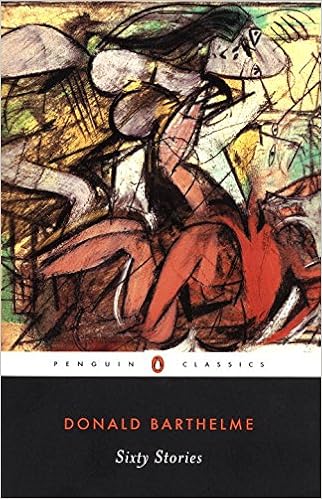
Overall, I found the collection fun and intriguing, by as I find with that genius Faulkner's novels, it didn't feel like much of anything added up. These are stories that often just drop off, without any kind of epiphany. Barthelme, I'm sure, was eschewing that element of the form, an element that in its ubiquity almost seems trite. And yet, I find a story without some kind of gravitas ending to be, well, an anecdote. It doesn't tend to stick with me, no matter how clever or absurd the premise and execution.
My favorite stories of this collection generally managed to do something that thing that was clever or absurd, and they were often funny in a smile sort of way. Others were hard to stick to. Among the one that were hardest to stick with, for me, were those that consisted wholly of dialogues. Not only was it difficult sometimes to follow the conversations (often with non sequiturs) but the conversations often didn't seem to go much of anywhere. Now, if I managed to become engaged in the topic of the conversation, and sometimes I did, the dialogue could be quite funny in the smile sort of way. A masterpiece of this form was "The Farewell," which consisted of two people talking about getting into an exclusive institution--only it's not so exclusive as it once was. We see a good deal of awkward and mean competition between two "friends."
My favorite piece in the collection by far was one drawn from what I believe to be one of Barthelme's novels. It was called "A Manual for Sons." It is essentially a summation of fatherhood--what "father" means. I don't know exactly what it is that Barthelme does here that makes the piece so intriguing. It's simply an definition essay on fathers, but the way that he goes about setting out that definition, with its specificity and, many times, ridiculous appeals to history or anecdote fascinates like poetry.
Characteristic of the collection is the very first story, "Margins," which is about two men discussing character and handwriting analysis. If handwriting shows who we are, why bother reforming ourselves--instead, reform our handwriting. The story is an exploration on inner versus outer, surface versus depth--the margins. How can or does one reflect the other? And yet, Barthelme seems to provide no real answer--there's just a lot of talk. And one is left nodding the head, saying, Interesting. Maybe even beautiful. But so what?
Subscribe to:
Posts (Atom)

 Posts
Posts


