Showing posts with label Jamie Quatro. Show all posts
Showing posts with label Jamie Quatro. Show all posts
Thursday, August 16, 2018
On "Holy Ground" by Jamie Quatro (about 6400 words) ***
In “Holy Ground” a woman decides to literally run away. She's been having an affair of sorts (on the phone) and feels a need somehow to make good. Her husband and kids stay home. She runs to a poorer area down the hill, in another town, where she hopes to live for a week, getting a sense of how others live and helping them. Instead, she finds herself helped of a sort. Read the story here.


Saturday, March 10, 2018
On "Caught Up" by Jamie Quatro (964 words) ***
The lead story in Quatro's first collection is a short one about a woman whose phone affair with a stranger and advice from her mother leads to a less-than-satisfactory end. It's a startling piece in some ways, because the wife opens by talking about the many things she loves about her husband. I was left wondering why she would dally with another man--and on the phone at that. What is it that her husband lacks? Read the story here at Tin House.
Monday, January 22, 2018
On "Here" by Jamie Quatro (about 4500 words) ***
This story recounts a family trip to a cabin. It's a trip made regularly, but this is the first time that the family's mother, who has died, is not with the members of the family. The dad in the story attempts to come to peace with his new role. Read the story here.
Monday, January 1, 2018
On "Better to Lose an Eye" by Jamie Quatro (4192 words) ****
Quatro is often at her best with stories involving religion. "Better to Lose an Eye" takes a rather standard look at hypocrisy among Christians, but what is not standard is the point of view. Lindsey's mother's boyfriend shot her mom, leaving her a quadriplegic with a tracheotomy. Now Lindsey has been invited to a pool party, and she's too embarrassed to go with her mom in tow, especially knowing all the questions she's going to be asked. But grandma insists. It's hard not to feel for a girl in this situation--or for a mom. Read the story here at Blackbird.
Wednesday, January 18, 2017
On "The Anointing" by Jamie Quatro (3553 words) *****
One of the most impressive stories from Quatro's collection is this one. What I like so much about this story is that it takes faith seriously, at the same time that we can see the main character struggle with it. The protagonist's husband is a doctor who had gotten addicted to prescription narcotics and lost his license and who is now is a near constant state of depression. Hoping to resolve the problem, the protagonist goes to her church elders for help and healing--anointing. By the story's end, we're not sure who needs help more or whether the calls for help will work. Read the story here at Guernica.
On "I Want to Show You More" by Jamie Quatro ***
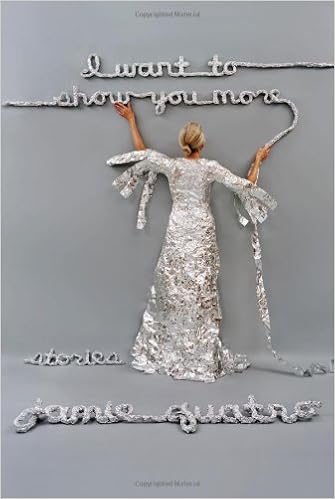
The lead story is a short one about a woman having a phone affair with a stranger, which becomes the setting for many other stories throughout the book.
The next story, "Decomposition: A Primer for Promiscuous Housewives," expands on this theme. Here, the lover takes on the form of some kind of body, a wax figure, that decomposes in the couples bed and then elsewhere in the house, constantly reminding the couple of what was. There is no escaping the affair, even as it fades into oblivion.
That kind of odd metaphorical realism extends into the next story, "Ladies and Gentleman of the Pavement," wherein a woman runs a marathon with a statue tied to her back. In fact, that's the vogue: everyone carries a statue while running--a burden, a work of art. One is not allowed to run without it. At the end the connection between art and running becomes more apparent. One must finish the race, as hard as it is, but there seems no way to do so without compromising.
Beginning with the next story, "Here," the collection takes a more traditional turn. "What Friends Talk About" is yet another story involving a woman's affair with a phone caller. In this one, she takes her children to the park to play so that she can have phone sex with her audio lover.
"1.7 to Tennessee" revolves around an eighty-nine-year-old woman who opts to walk a letter protesting a war to the post office. The story reminded me in some ways of Eudora Welty's tale (the name of it escapes me at the moment) of an older walker along the side of the road. Along the way, the woman meets various people and thinks about her past.
"Imperfections" is a very short piece that again returns to Quatro's frequent focus: a mostly nonphysical affair. Here, a woman meets up with a man in person, along with his wife, but works the situation around so that she and the man are, at last, alone. Does the hope measure up to reality? Does it matter?
And "You Look Like Jesus" is yet another piece with a focus on an affair that is exclusively via technology--this one online, over the Internet. A woman recounts the photographs she sent and received from her paramour, the pictures she won't show her husband, the pictures she eventually deleted, one supposes, probably in an effort to save the marriage.
Quatro is at her best with stories involving straight-up religion (without the kink). "Better to Lose an Eye" takes a rather standard look at hypocrisy among Christians, but what is not standard is the point of view. Lindsey's mother's boyfriend shot her mom, leaving her a quadriplegic with a tracheotomy. Now Lindsey has been invited to a pool party, and she's too embarrassed to go with her mom in tow, especially knowing all the questions she's going to be asked. But grandma insists. It's hard not to feel for a girl in this situation--or for a mom.
“Georgia the Whole Time” continues with the theme of disease that works through many of the stories in Quatro's collection. In this case, a couple has to find a way to break it to their kids that mom's cancer has returned and that she's likely to die.
“Sinkhole” won an O'Henry Prize, but the story didn't much speak to me. It returns to some of the oddball pieces that kick off Quatro's collection. Here, a boy who is a magnificent runner has a “sinkhole” in his chest that allows him to hear God and that he feels must be healed, a healing he finds via relations with a girl.
“Sinkhole” introduces a set of stories that explicitly deal with religion that end the collection. Here, the motifs of sexual deviance, religion, and running come together. And it is here that the oddities of those early stories begin to make sense, for the suggestion seems to be that religion involves a kind of oddness of thought, an oddness that pulls us toward transcendence, the way that sex or death supposedly do (as George Battaile would have argued). “Demolition” is about just that. It starts as a story about the loss of faith--or the finding of “true” faith. A deaf man joins a church and then leaves it. Meanwhile, the church's stained glass begins to fall apart, but seemingly for no reason. The church congregation decides to do the most “logical” thing--get rid of the building and go into nature, the deaf man as their guide.
In “Relatives of God” a woman thinks back on her phone sex affair with a certain acceptance, an end, I suppose, to a collection that focuses so often on the mix of feelings attached to such an affair.
Subscribe to:
Posts (Atom)

 Posts
Posts


