Showing posts with label Japan. Show all posts
Showing posts with label Japan. Show all posts
Wednesday, September 24, 2008
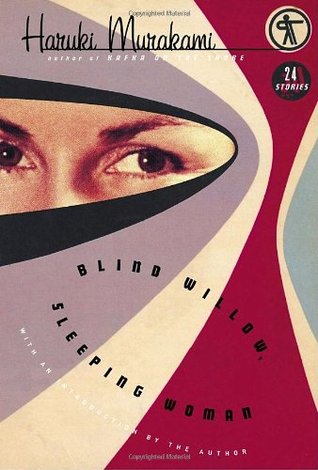
On "Blind Willow, Sleeping Woman" by Haruki Murakami *****


Sunday, September 14, 2008
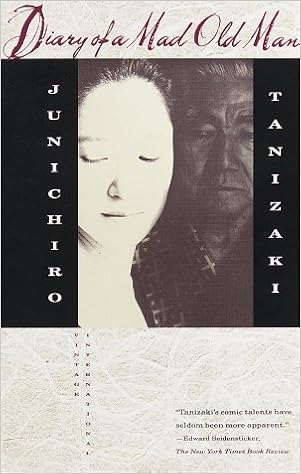
On "Diary of a Mad Old Man" by Junichiro Tanizaki ****
Thursday, September 11, 2008
On "The Key" by Junichiro Tanizaki *****

Where it gets strange, however, is in the husband's goding his wife into an affair and his wife's reaction. One could say, be careful what you wish for. I'm thinking of the Inman diaries in particular, where Arthur Inman encouraged a close friendship between his wife and his doctor and was then enraged when he found out years later that the two were carrying on an affair--this despite the fact that Inman himself had had numerous affairs and at least in part encouraged his wife to go out with the doctor in an effort to further his untoward relationships. In Tanizaki's book, however, whatever jealousy exists merely seems to be more fodder for lust. But the consequences are still dire, just not in the manner that they turned out for Inman.
Monday, September 8, 2008
On "Lizard" by Banana Yoshimoto, translated by Ann Sherif ***

Friday, September 5, 2008
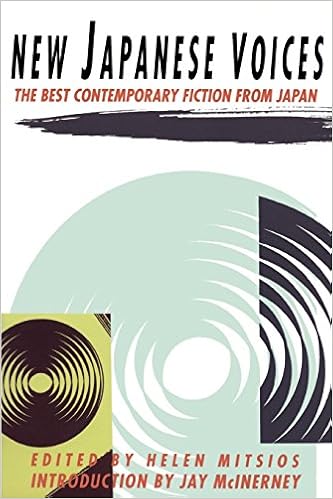
On "New Japanese Voices" edited by Helen Mitsios ***
"A Callow Fellow of Jewish Descent" by Masahiko Shimada
"On Meeting My 100 Percent Women One Fine April Morning" by Haruki Murakami
"Swallowtails" by Shiina Makoto
"God Is Nowhere; God Is Now Here" by Itoh Seikoh
"X-Rated Blanket" by Eimi Yamada
"Yu-Hee" by Yang Ji Lee
"On a Moonless Night" by Sei Takekawa
"Living in a Maze" by Kyoji Kobayashi
"The Imitation of Leibniz" by Genichiro Takahashi
"The Unsinkable Molly Brown" by Tamio Kageyama
"Wine" by Mariko Hayashi
"Kitchen" by Banana Yoshimoto
On the whole, the book presents an interesting smorgasbord of fiction writers in Japan in the late eighties and early nineties. But I can't say that the stories on the whole really hooked me. Standing out the most was probably Murakami's, but that story, which has never seemed that impressive to me before, perhaps stood out here because I've read it two or three times before. Other stories I can remember, now, days after reading them, include Shimada's piece, about a Japanese man who befriends a Jewish man in France (only in the end, we're told the man isn't what he seems, which in turns causes us to rethink the whole story).
I really enjoyed Kobayashi's "Living in a Maze," which recounted the story of a man whose nightmares become his everyday life. Such is an old story form, but the dream here was interesting enough that I was drawn in. The man's date becomes a cow, and then so too do the rest of the people, just as in the movie Jacob's Ladder, all the people become lizards. Cows don't seem nearly as creepy or interesting as giant lizards, and yet the manner in which Kobayshi describes all these events--so realistically--makes the ludicrous and silly seem both horrifying and funny.
Kageyama's "Unsinkable Molly Brown" is about a woman who is so fat that when she takes scuba lessons the instructor's have to take various measures to stop her from floating. Hayashi's "Wine" is about a woman who accidentally buys a very expensive bottle of wine and then can't figure out what to do with it (after all, it's too expensive to drink, and it's too expensive to give as a gift for any but the most special person or special occasion). Takekawa's "On a Moonless Night" is about a woman being eaten by insects--told in a "shocking" manner but, for me, makes it seem over the top. Yamada's "X-Rated Blanket" is more like a prose poem--about a woman's lover (i.e., he is her blanket). "Swallowtails" was about a kid with problems at school who grows butterflies as a hobby at home and probably comes closest to the kind of quieter stories one might expect from an American MFA student or from the master Kawabata.
Monday, September 1, 2008
On "The Woman in the Dunes" by Kobo Abe ****

Wednesday, August 27, 2008
On "Palm-of-the-Hand Stories" by Yasunari Kawabata ***

I think of another short story craftsman--and especially of his collection of really sharpened bits, What We Talk about When We Talk about Love--Raymond Carver. Even in Carver's oeuvre there are many stories that, while good alone, don't stand out within a whole collection. But there are also ones that do. I think the difference is that Carver's commonplace is often strange. I can say, that's the one about the couple pouring Teachers over one in the motel room. That's the one about the couple buying a living room set in the front yard.
I don't feel like I can do that so easily with Kawabata, given that the commonplace really is commonplace. Right now, because these stories are fresh in my head (having read them today as opposed to yesterday), I can say, That's the one about the blue jay that fell from the tree and the girl saves it. Or that's the one about the kid making paper boats and wanting them to fight, and a crippled woman who had a fiancé who appears to have backed out of the wedding. That's the one about the man who drew pictures of flying horses with a girl when he was young--she never went on to marry, but he did--and now, in his old age, suddenly knowing loneliness, he's having visions of flying horses and a girl on them, a girl in black, an old woman. That last story, I remember, I think, because it managed to be chilling by its end. The first two I remember in part because this is the second time I've read them.
And that leads me to another point. Perhaps, in reading the collection through only once I have missed something. The fact is that those stories I had read before stuck out more. It's possible that were I to read this book again, I might just feel quite differently about it, might find it not just pleasant but incredible.
Saturday, August 23, 2008
On "My Beatles" by Makoto Satoh ***
This is the second of two plays I read tonight. Written in the 1960s, it maintains much of the absurdity that contemporary drama is often known for. I think of playwrights like Sam Shepard and Samuel Becket. I like the former, and the latter has his moments. Satoh's play has its moments too and on the whole seems quite entertaining. I think I'd enjoy seeing this staged. It's a play within a play, and sometimes a play within a play within a play. It involves actors practicing a play; it involves an audience breaking in and insisting on watching the practice. And it involves an audience actually taking part in the play, forcing it to its conclusion. And did I mention that that audience is the Beatles? Yes, that's right, the Fab Four. You couldn't have a better audience than that.
On "Chushingura: The Forty-Seven Samurai" adapted by Nakamura Matagoro II and James R. Brandon **
I finally, this weekend, after several weekends of either heavy freelance work or heavy socializing (out-of-town visitors; great concerts), have a chance to read a couple of Japanese plays I've had my eye on but which appear in a book much too large for me to simply take with me, in my backpack, to work so that I could read them on the bus or during lunch. Alas, I did take a walk this evening and have a girl in a car who I made eye contact with or who made eye contact with me gesture for me to come over and talk. Shy self that I am, I merely waved. Maybe I could have had a date. Instead, I rushed home to finish what I'd planned--to read these two Japanese plays. My date, this evening was with Chushingura and with Makoto Satoh. One could do worse, I suppose.
The version of Chushingura that I read was adapted for the stage in 1979. The play itself is a traditional one that has been adapted for stage over the course of the last two and a half centuries. Modern versions shorten it for modern audiences (the full play can take fourteen hours). The story is that of a famous series of incidents that occurred in Japan between 1701 and 1703. One nobleman slightly injures another (in the play, it is because the other is making passes at the first nobleman's wife); as a result, the first nobleman is ordered to kill himself by the shogun. The nobleman's samurai/retainers feel obliged to revenge their master's death and so plot to kill the other nobleman. The samurai, in avenging their master's death, do something noble but also break the law. The result is that they too are ordered to kill themselves. In Japan, at this time, ritual suicide is an honorable death--as compared to simply being killed by one's enemies. This adaptation covers only up to the point where the forty-seven samurai get their revenge. Chushingura is a kabuki play, and I can see why none of the other anthologies of Japanese literature contained kabuki within them. It is does not translate very well to our traditions. I credit the adaptors with bringing something to the stage that would allow people to watch the play more easily. But for me, sword fighting and martial arts theater is a hard sell, and Chushingura, unfortunately, never made it past that for me (unlike, say, a film like Hero, which ends up seeming like so much more).
The version of Chushingura that I read was adapted for the stage in 1979. The play itself is a traditional one that has been adapted for stage over the course of the last two and a half centuries. Modern versions shorten it for modern audiences (the full play can take fourteen hours). The story is that of a famous series of incidents that occurred in Japan between 1701 and 1703. One nobleman slightly injures another (in the play, it is because the other is making passes at the first nobleman's wife); as a result, the first nobleman is ordered to kill himself by the shogun. The nobleman's samurai/retainers feel obliged to revenge their master's death and so plot to kill the other nobleman. The samurai, in avenging their master's death, do something noble but also break the law. The result is that they too are ordered to kill themselves. In Japan, at this time, ritual suicide is an honorable death--as compared to simply being killed by one's enemies. This adaptation covers only up to the point where the forty-seven samurai get their revenge. Chushingura is a kabuki play, and I can see why none of the other anthologies of Japanese literature contained kabuki within them. It is does not translate very well to our traditions. I credit the adaptors with bringing something to the stage that would allow people to watch the play more easily. But for me, sword fighting and martial arts theater is a hard sell, and Chushingura, unfortunately, never made it past that for me (unlike, say, a film like Hero, which ends up seeming like so much more).
Friday, August 22, 2008
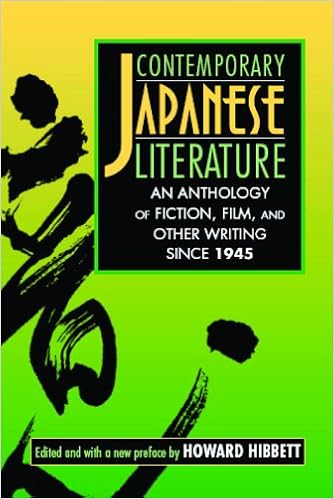
On "Contemporary Japanese Literature: An Anthology of Fiction, Film, and Other Writing since 1945" edited by Howard Hibbett ***
Yoshikichi Furui, "Wedlock" (story)
Taeko Kono, "Bone Meat" (story)
Kobo Abe, Friends (play)
Shotaro Yasuoka, "Prized Possessions" (story)
Nobuo Kojima, "The American School" (story)
Akira Kurosawa, Ikuru (screenplay)
Yasujiro Ozu, Tokyo Story (screenplay)
Taijun Takeda, "To Build a Bridge" (story)
Yumiko Kurahashi, "To Die at the Estuary" (story)
Yukio Mishima, "The Boy Who Wrote Poetry" (story)
Yasunari Kawabata, "The Pomegranate," "The Camellia," "The Plum," "The Jay," "Summer and Winter," "The Bamboo Leaves," and "The Cereus" (stories)
Mitsuhara Kaneko, "Song of Loneliness," "The Sun," and "The Receiver" (poems)
Hiroshi Sekine, "Abe Sada," "The Golden Pavilion," and "Dream Island" (poems)
Ryuichi Tamura, "The Man with a Green Face" and "Human House" (poems)
Minoru Yoshioka, "Still Life" (1), "Still Life" (2), "Paul Klee's Dining Table," and "Nude Woman" (poems)
Mieko Kanai, "The House of Madam Juju" (poem)
Akira Abe, "Peaches" (story)
Junichiro Tanizaki, "The Bridge of Dreams" (story)
Tatsuo Nagai, "Brief Encounter" (story)
Junnosuke Yoshiyuki, "In Akiko's Room" (story)
Kenzaburo Oe, "Aghwee the Sky Monster" (story)
Akiyuki Nosaka, "American Hijiki" (story)
Highlights of the anthology included the first piece, by Furui, which was about a fairly young couple living in an apartment building among young rowdy workers. The couple's male half, who typically spends his days at work, gets sick, so he gets to spend time learning what his wife's life is like during the day.
Another interesting one was Kobo Abe's play Friends. The situation essentially involves a family that decides that its duty is to help out people who live alone, people who must obviously be lonely. The way to do this is to move in with the single person and make him part of your family. (Never mind that in this case, the man had a fiancée.) So this family comes and takes over his apartment, and the man is unable to get rid of them. They live off all that he earns, eat all that he brings home for food. The play is rather absurd, as many plays are, but enjoyable. It reminded me in a way of a Japanese film I did not like called Audition, in which a woman "auditions" to be a man's girlfriend (he poses as a director in order to find a girlfriend, auditioning each one); the situation soon becomes disturbing as she proves to be psychotic. (In the play's rather absurd premise it also reminds me of a great Japanese film that I loved called After Death, but I won't go into that here.) Friends is a pleasant and light play; Audition is not pleasant or light--it is horrifying. But they both share that same dubiousness regarding connection and family and duty, all of which I would guess carry much heavier feelings of obligation than they do in the West. Hence, by the end of the play, when the man is literally caged, like an animal, to teach him a lesson (if only he'd appreciated the family that had moved in with him, he could have just enjoyed the experience rather than being so miserable and having to be punished), one gets a sense the author is drawing some sort of parallel to the idea of family within the culture as a whole.
Akira Kurosawa's screenplay was also really good--and, I think, more concisely written than Abe's play. I've only Kurosawa's Ran. It's these stories of traditional Japan for which he seems most famous here in the States, but the editor of the anthology notes that Kurosawa actually prefers his films about contemporary Japan. For my taste, if most of them are like this screenplay, I can see why. I was not a huge fan of Ran, but I really liked Ikuru. The film is about a man who works for a bureaucratic section of the government. The job of government employees seems to be mainly to avoid letting people get help--each employee just passes customers to the next employee and on it goes down the line. One of these bureaucrats, however, learns he's dying of cancer and doesn't have long to live. So the rest of the film, he's questioning his purpose in life. And by the end, he has found it--fighting the bureaucracy of which he is a member. It was a pretty upbeat movie, with a share of funny moments.
Of the poetry, Mieko Kanai's "The House of Madam Juju" stood out the most to me--an exploration of Japanese beauty, as it has been commercialized for women.
Akira Abe's story "Peaches" is about memory--one memory. The character thinks about a time when his mother and he pushed a stroller of peaches down a hill, and it was a cold winter night, and his mom put her shawl around him. But then he deconstructs the memory, noting that the events could not have happened as he remembered them. There would not be peaches in winter. So which part of the memory is he making up? He circles round and round, trying to sort out all the various events that may have led to this one memory. In the end, he never does figure it out. Sometimes, I think keeping a diary could be of use for precisely this. I know that one time I was recounting something I'd done, and then I went back and checked a diary I had kept of the events and realized I'd merged several days of events into one day. But I don't generally keep a diary. I wonder how many other events have gotten merged and messed up in my head over the years. "Peaches" was an interesting exploration of how our minds trick us.
Perhaps the best short story in the book was by Kenzaburo Oe. I say this with some surprise, having read Nip the Buds, Shoot the Kids a few years ago and not having been that moved by it. It was fine, but nothing that made me want to read more of his stuff. But "Aghwee the Sky Monster" is a piece I think I will remember for a while. It's about a man hired to take care of a musician who has supposedly gone insane--the musician has a baby in the sky who comes to visit him from time to time; conversations ensue, which, of course, embarrass the young caretaker. But there's a big back story that readers slowly discover, which makes the intriguing and ridiculous situation even more interesting. I'll have to give another Oe novel a read.
The last story, "American Hajiki," is a humorous piece that echoes some of the themes of Friends, but puts those themes in a political context. It's about a man who lived during World War II whose wife has invited some Americans to take a Japanese vacation at their home. The wife had previously visited them in America and has been a pen pal for some time. The husband is none too pleased by the wife's offer. The lead-up to the visit and eventual visit are mixed with the man's memories of the early postwar days. The man comes to wonder why it is that, in the end, who always ends up "serving" his American masters--and so wanting to serve them, despite the fact that they killed his father. There's quite a bit of humor amid the various cultural misunderstandings that go on.
Wednesday, August 6, 2008
On "Sad Toys" by Takuboku Ishikawa, translated by Sanford Goldstein and Seishi Shinoda ****
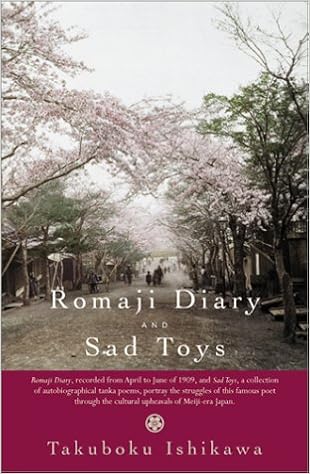
Start just with the title. Toys--that is poems. For poems really are in many ways a poet's toys. For some who write poetry, poems are word puzzles. You take them apart, put them back to better, try to find the best way for all the words to fit, and there's no end to the process. Now, take a poet like Ishikawa, put him in a hospital at a time when he's becoming increasingly aware of his mortality, and clearly, such toys become sad--sad because that's all there is of his life, sad because he's dwelling on sadness. Many of the poems talk about his hospital stay. Many about his coming death, his desire for death (to relieve himself of pain) and his desire to keep on living. And some poems talk about the change in perspective that comes with such events. In one of my favorites, number 75, Ishikawa talks of reading old love letters. His observation? (All of the poems are typically Japanese, typically short--they're tanka.) So many spelling errors. And how true, really, years down the road, when we're no longer madly in love with someone we're just getting to know, all those little peccadilloes come to the fore. We don't speed through a letter the same way; rather, we say, You know, that woman/man never did spell very well! Such are the observations throughout this little gem.
On "Romaji Diary" by Takuboku Ishikawa, translated by Sanford Goldstein and Seishi Shinoda **
Sunday, August 3, 2008
On "Narrow Road to the Interior and Other Writings" by Matsuo Basho, translated by Sam Hamill ***
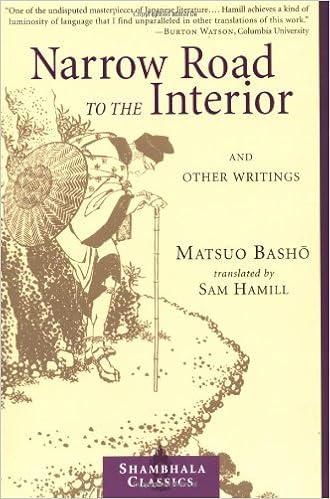
This book features a selection of Basho's haiku, along with a few of his prose travel writings, many of which contain haiku within them and explanations of how those haiku arose. I'm not much of a fan of the travel writing. With the exception of Parker's The Oregon Trail and the Lewis and Clark journals (albeit in abridged form), I don't know that I've encountered any pre-twentieth-century travel writing I've greatly enjoyed--perhaps the observations of such early travelers rarely transfer to me in my context now. Even in the travel writing, Basho is at his best when he delivers to his readers tiny but profound observations that apply to all throughout time, such as this one from his Sarashina Travelogue: "Then the servant mounted the horse, ignoring the danger. He began to doze off and nearly tumbled over a cliff. With every nod of his head, I was stricken with terror. Thinking it over, I ralized that each of us is like the servant as we wade the shifting tides of this stormy world, blind to real danger."
As for the haiku, Basho is wonderful, though my own lack of knowledge of Japanese tradition is somewhat of a barrier to understanding much of their full depth. I'd read somewhere that Japanese haiku works off of certain tropes (the book's introduction discusses some of this)--that if the poem is about spring, for example, it must include a cherry blossom or one of six or seven other things; if it's about winter, it much include a chrysanthemum or one of six or seven other things. Not fully knowing those tropes, I fear I unfortunately lose out on some of what's really going on. But the fact that even without a full knowledge of the culture I can still enjoy the haiku on some level shows Basho's overwhelming skill.
Wednesday, July 30, 2008
On "Five Women Who Loved Love" by Ihara Saikaku ****

The first story in the book is typical. It involves a playboy who eventually finds one true love. They attempt to elope but are caught. Money comes up missing, and the former playboy is blamed and sentenced to death. Soon after, the money is found--he wasn't a thief after all. His lover decides to kill herself (only as is to be expected in all of these stories), but after some discussion is convinced instead to become a nun and live a spiritual, monastic life.
It's seventeenth-century fiction, and it's pretty good. It's probably a little sappy, but because I'm reading it in modern translation, it doesn't come across nearly so bad as such melodrama might come off in the original tongue--or maybe the Japanese are simply better at keeping the stories simple than the English are. Whatever the matter is, Ihara Saikaku's point seems to be that love is born in tragedy, and without the possibility of loss, the value of love can't be weighed.
Tuesday, July 29, 2008
On "The Tale of Genji" by Murasaki Shikibu, translated and abridged by Edward G. Seidensticker ***

He does have his enemies, namely the emperor's first wife, who wants her own son placed on the throne. Genji is thus demoted to commoner status, though he has court privileges (not being an expert on ancient Japanese affairs, how some things work in the novel are a little lost on me). This is to his own good, as far as love life is concerned. Without responsibilities, he has time to woo five to ten ladies at any given time and even knock up his father's concubine (the son that results from the affair later becomes emperor).
Genji has a wife too. She's pretty cold, but no doubt, as much as Genji may complain about her and blame her for his seeking solace in the company of others, his continued dalliances with other women only add to her coldness. It is only when she dies as a result of childbirth that he finally finds some way to appreciate her and that mostly through excessive grief. Is it guilt that drives him? I don't know. It seems a short repentance, for within a year or so, he's back to his philandering ways, and this brings its share of troubles, which I won't go into here. At some point, we learn that a soothsayer has told him he will have three children (all by different women apparently)--two to become emperors. And the abridgment ends at a convenient spot, with Genji no longer quite as interested in romantic affairs, wishing to leave court life, but now devoted to seeing that his children are well provided for.
This is a novel written a thousand years ago. The mannerisms seem foreign, but the characters and passions involved seem as current as ever--save that much of the seduction takes place by the point of a pen (forget what the women look like--how nice is their handwriting?).
Seidensticker notes that if the abridgment causes one to want to read the full book, he's done his job. I can't say he quite worked his magic on me. I enjoyed his abridged version, and I'm curious to know where the story goes from here, but I'd be just as happy to read a synopsis of the rest of the plot as to read the other thirty-seven chapters.
An online version of another translation of the book is available here.
Monday, July 21, 2008
On "Anthology of Japanese Literature," compiled and edited by Donald Keene ****
Ancient Period (to 794 A.D.)
Man'yoshu
The Luck of the Sea and the Luck of the Mountains
Kaifuso
Heian Period (794-1185)
Kukai: Kukai and His Master
The Tales of Ise
Kokinshu
Ki No Tsurayuki: TheTosa Diary
Poetry from Six Collections
The Mother of Michitsuna: Kagero Nikki
Murasaki Shikibu: Yugao (from The Tale of Genji, which is available here)
Sei Shonagon: The Pillow Book
Murasaki Shikibu: Diary (available here)
The Daughter of Takasue: The Sarashina Diary (available here or here)
Poetry in Chinese
Ryojin Hisho
The Lady Who Loved Insects
Kamakura Period (1185-1333)
The Tale of Heike
Shinkokinshu
Kamo No Chomei: An Account of My Hut
Tales from the Uji Collection
The Captain of Naruto
Muromachi Period (1333-1600)
Yoshida Kenko: Essays in Idleness
The Exile of Godaigo
Seami Motokiyo: The Art of the No
Kan'ami: Kiyotsugu: Sotoba Komachi
Seami Motokiyo: Birds of Sorrow
Seami Motokiyo: Atsumori
Seami Motokiyo: The Damask Drum
The Bird-Catcher of Hades
Busu
Poems in Chinese by Buddhist Monks
Three Poets at Minase
The Three Priests
Tokugawa Period (1600-1868)
Ihara Saikaku: What the Seasons Brought to the Almanac-Maker
Ihara Saikaku: The Umbrella Oracle
Ihara Saikaku: The Eternal Storehouse of Japan
Matsuo Basho: The Narrow Road of Oku
Matsuo Basho: Prose Poem on the Unreal Dwelling
Mukai Kyorai: Conversations with Kyorai
Haiku by Basho and His School
Chikamatsu on the Art of the Puppet Stage
Chikamatsu Monzaemon: The Loves Suicides of Sonezaki
Ejima Kiseki: A Wayward Wife
Jippensha Ikku: Hizakurige
Takizawa Bakin: Shino and Hamaji
Haiku of the Middle and Late Tokugawa Period
Waka of the Tokugawa Period
Poetry and Prose in Chinese
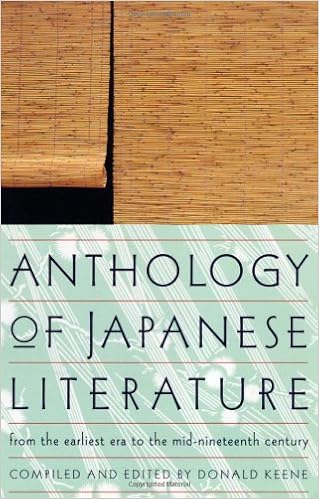
Of the first four sections, I particularly enjoyed the poems selected from Man'yoshu, the passage from the Sarashina Diary, and Kamo No Chomei's "An Account of My Hut." Man'yoshu is one of the first major works in Japanese literature--it's a collection of poetry put together by an emperor, from various sources. And its quality seems outstanding, at least in the selections Keene has chosen. While British literature starts with a story of Grendel, in the epic poem Beowulf, which sounds much more interesting than I ever found it to actually be, and American literature starts with Puritan sermons, Japanese literature starts with poetry. Okay, there are prose pieces that are like myths--some similar to Native American materials (which are usually unintelligible to me and not very interesting)--but most of the early stuff is poetry, simple lyric poetry, short, as Japanese poetry tends to be. And I enjoy it. I think what I like about the poetry as opposed to the more mythic pieces in our English literature is that it's easy to identify, to understand what the poet is writing and experiencing. And that's also part of what's so interesting, these poets thinking about their mortality, about the weather, about love--they're writing over one thousand years ago, and they could be writing now. I don't know if that's comforting or sad or what, the idea that humans struggle with the same issues through time immemorial. Maybe it's just surreal, when I think about how long ago that was and how much similar it was to today, and how, if time goes on, humans will be worrying and thinking about the same thing a thousand years after I'm gone also.
The Sarashina Diary centered around a woman whose parents sent her to the royal court to live. She was older, around twenty-six, and unmarried. She didn't really want to go, but did in deference to authority. She'd heard that many women found husbands there, though she figured herself a bit too old for that. As the plot fell out, it was hard to believe this was a diary, rather than a short story. It seemed complete and thematic and sad, with a rise and climax and fall as in any good story. The woman, as it turns out, does meet a man one day. But it is only for a brief period. They exchange a few messages via poetry, but for whatever reason circumstances don't allow them to actually begin communicating much in person (there are always others around for one). About six months later, without contact, the man shows up at a social function in hopes of seeing her. She doesn't know and so misses him. He comes to visit her, leaves a note. She misses him again but writes a reply. Alas, he is gone by the time its ready. Such a sad story of near meetings. What also struck me about this piece, and many others, however, was how prevalent poetry seems to have been in the society then. People wrote of their day in poetry, and they courted in poetry as well--exchanging haiku and tanka with potential mates. Wouldn't it be a curious world if we did that nowadays? But maybe e-mail is equivalent. Somehow, it just doesn't seem as romantic as a poem.
As for "An Account of My Hut," it was a piece that reminded me a lot of Ecclesiastes. Kamo No Chomei was a Buddhist who, in this short account, thinks heavily about his life, about the happenings in Japan, and about how little of it is of any lasting consequence. Amid all this there are recountings of several distasters that hit Japan during a relatively short span during his life (an earthquake, a plague), as well as recountings of his homes, which get progressively smaller as he ages. In the end, he realizes he needs little more than a ten-foot hut--and he ponders why he's even bother to write. Lots of deep thinking. It's pretty short. I wish there were a translated version available online to share.
From the Tokugawa Period there was also much to admire. Three works in particular stood out for me, two of which I'd like to return to at some point to read the rest of the work. Ihara Saikaku's "What the Seasons Brought to the Almanac-Maker," one section from his novel Five Women Who Loved Love, seemed intriguing to me in part because of its fairly modern-seeming structure. I tend to go for those kind Gertrude Stein-type Three Lives books. This one covers five lives, specifically the erotic parts of them at that--and in seventeenth-century Japan, there is much to be curious about, given the very different times and culture.
I also liked Jippensha Ikku Hizakurige, a tale of two travelers on the road. Apparently Jippenshu wrote a whole series of these, all of the light and humorous but nevertheless providing an entertaining and interesting insight into the Japanese culture of the early 1800s.
Finally, the poems and prose in Chinese were interesting if not for themselves then for the historical perspective that they offered. Keene chooses to end his anthology with a set of works that discuss, in particular, the coming of Westerners, the opening of the ports, and Japan's seeming weakness in the face of these. There is much criticism in these poems and the one short profile offered of the leaders who fail to fight back, who let the barbarian Westerners in. And there is hate--hate of the Dutch and of the Russians and of all the others from the West; and hate also, for Japanese themselves, who feel as if in this dawning of a new age, Japan has lost its way and its power. In some eras, women act like men, one writer intones sadly (contemporary political correctness aside), while in others men act like women.
Friday, July 11, 2008
On "Japanese Literature" by Roger Bersihand ***

Wednesday, July 9, 2008
On "The History of Japan" by Louis G. Perez ****

This difference is especially clear in how the two books cover the 1500s, wherein Japan was involved in extensive civil war. The previous book, as noted, goes into each battle, which makes events hard to follow; Perez just notes it's a period of civil war. By 1600, with the country beginning to unite under the brutal campaign of Nabumura, history becomes much clearer--and that's when the previous book finally starts making sense and become enjoyable.
That's not to say the first book's attention to detail was completely useless. Perez greatly simplifies historical events. One would think, for example, from this Perez's text, that Japan pretty much just happily adopted Buddhism, when, in fact, as Sadler's book, with all its detail, makes clear, Buddhism was accepted only gradually and not without many doubts and battles over the course of a couple of centuries.
Perez's book is part of a series of basic histories on various contemporary nations of importance--The Greenwood Histories of Modern Nations. Books in the series, while they give the entire history of the nation from start to finish, apparently focus most on the more recent past. Indeed, about half of Perez's volume is devoted to the post-1800s (one reason I read Sadler's book was because it was more focused on early history, so I wanted something to balance Perez out). But the early material, while greatly truncated, is still informative enough to be a good outline. I'm impressed enough that I want to check out more volumes in this series. Sadly, the list price of fifty-five dollars means books in the series aren't likely to become part of my personal library.
Thursday, July 3, 2008
On "A Short History of Japan" by A. L. Sadler **
This is the first of a series of books on the history and literature of Japan that I'm planning to read. If the rest of the books turn out like this one--and I know they won't--I will likely be pretty confused. Short, the book is, given that Japan's history goes back centuries. Unfortunately, the author doesn't have a good knack for summary. I know summarizing three thousand years of history in three hundred pages wouldn't be easy, and I'm not sure how exactly how one does that, but some authors manage quite well. With this short history, however, I didn't feel like I really got a sense of the nation. Rather, the story is too full of details--largely an account, in chronological order, of the rise and fall of royal families by name. This strategy would be akin to summarizing American history in two hundred pages by writing a page about each presidential election. In fact, that is almost what happens once the author gets around to writing about the twentieth century--endless paragraphs on who took who's spot in the cabinet with each new administration.
The history was published in 1946, so it breaks off basically with the start of World War II, which is an interesting and seemingly appropriate place to close the book. I'd read this one in part because of its focus on the earlier history of Japan, but much of that was a literal recounting of Japanese mythology, with little attention given to what it actually means. Sadler's book does hit its stride, however, in discussing the Tokugawa Period, the era when Japan finally united under a single Shogun. I'm hoping the next book on Japanese history on my list, which takes things into the current day, will be a bit easier to read for the underinitiated.
The history was published in 1946, so it breaks off basically with the start of World War II, which is an interesting and seemingly appropriate place to close the book. I'd read this one in part because of its focus on the earlier history of Japan, but much of that was a literal recounting of Japanese mythology, with little attention given to what it actually means. Sadler's book does hit its stride, however, in discussing the Tokugawa Period, the era when Japan finally united under a single Shogun. I'm hoping the next book on Japanese history on my list, which takes things into the current day, will be a bit easier to read for the underinitiated.
Subscribe to:
Posts (Atom)

 Posts


