Showing posts with label Four-Star Collections. Show all posts

Thursday, August 6, 2026

On “Tenth of December” by George Saunders ****


I'm referencing the collection in the title, not just the story, which is the last story in this collection.

I first became familiar with Saunders not long after his first collection was published, Civil War Land in Bad Decline. I liked the title, but what really got me to read the book was the fact that a friend of mine was a huge fan of it and thought our story styles were somewhat similar. (That was a huge and unwarranted compliment, honestly, given what Saunders has gone on to be and what I have not.) Alas, I was not that impressed with the collection outside the story “The 400-Pound CEO.” Saunders's stories were weird and dark, but they often didn't really add up to much to me, didn't have much emotional resonance.(What we had in common, in the estimation of my friend, I'm guessing, was the darkly comic and sometimes weird.)

A few years later, I read the story “Pastoralia” in a Best American Stories collection and was very impressed. I love that story. But I never got around to reading Saunders again, until now, with this collection.

Alas, this collection strikes me much as that first collection did. It was enjoyable, but I didn't feel like I got much out of most of the stories.

Except, like the story “Pastoralia,” there is one story that blew me away, and that is the very first, “Victory Lap.” I heard the first part of the story read on a podcast and wasn't that interested. And I wasn't that interested reading that first section this time. But at the first break, that's when things get really interesting. The story is a lot like Joyce Carol Oates's “Where Are You Going, Where Have You Been?” insofar as it involves a young gal taking up with (or better, being taken up by) a much older man in a sinister kidnapping way. But it goes in a different direction from there. The piece is about childhood and about ideals that we have and also about how we reconcile our values, as kids, the sometimes instructions we are given, and what is right and wrong in a given circumstance. And it's about the end of innocence, even as its about its preservation. It's just marvelous.

And with that sort of beginning to the collection, maybe it's natural that the rest of the collection was something of a disappointment. After reading one of the best stories I've ever read, nothing was going to match it and everything was going to be comparatively a disappointment.

Many of the stories focus on class differences, and like “Pastoralia” and “The 400-Pound CEO,” many focus on weird dynamics of work and office and its attendant, sometimes absurd rules. All are dark and many are funny, but like that first collection, many didn't really spark an emotional connection for me.

“Sticks” is a short short about a trash heap and moving. “Puppy,” probably my second favorite in the collection (because it has a modicum of the emotional connection), is about a rich mom and her kids and how she tries to protect them as they go to adopt a puppy—and also about a poor mom and her kid as she tries to sell said puppy. The latter's circumstances are shocking, and some of these go beyond class, I am sure, but much of them go directly to the opportunities that family has had in life versus the first. The misunderstanding and the rich woman's resolve at the end make this piece devastating.

“Escape from Spiderhead” was a sex dream, I suppose, with comments about science and culture and class as well, as prisoners are given drugs that change their emotions in ways that can lead to death and love. “Exhortation” was an absurdist office memo about making better (sales) numbers. “Al Roosten” is about one of those celebrity auctions with local celebrities and a man who feels he hasn't done enough with his life and regrets the action it takes him toward. “The Semplica Girl Diaries” focuses on a family trying to keep up with the Joneses, essentially, which involves a strange form of keeping personalized third-world slaves. “Home”—probably my third favorite—involved a military vet who did something vaguely horrible during his military service that has all his family vaguely disowning him on his return. It shows up the kind of superficial respect we give to the military even as we reject their actual needs. (Probably most heartbreaking is the way in which the man's own wife had run off with someone else while he was away, and now he's locked out of his kids' lives.)

“My Chivalric Fiasco” returns to the office, focusing on a discovered affair and written in faux medieval language. The title story, the final one in the book, returns to the world of teenage fantasy, as a boy wanders out into the woods on a cold day dreaming of a gal and discovers an old man intent on killing himself—only to have the circumstance completely turn on itself.

Monday, August 5, 2019

On "Collected Stories, 1891-1910" by Edith Wharton ****

This collection of writings from the first half of Wharton's writing life runs the gambit of subject matter.

"The Fulness of Life" works off of some fairly banal tropes: A woman at the gates of heaven finds the love she's always wanted, except it means that her husband will have to be alone for eternity because she was his love for all time. Guess what happens?

In "The Lamp of Psyche" a woman in love with her husband discovers that, though able bodied, he did not fight in the Civil War. Why? Her idealistic bubble is burst.

"The Valley of Childish Things" is a series of short vignettes that read almost like jokes. It's a strange piece that I'm not sure adds up to much--but that leave one with lots to ponder.

"The Muse's Tragedy" is about a literary critic who finds the companion of a dead writer he's written extensively about. The companion and he forge a relationship, but as the story proceeds, we move from third person to first and learn the truth of the companion's relationship to the dead writer, which is not, at least as she perceives it, the way that others have perceived it.

"A Journey" is a melodramatic tale about a woman who has to bring her sick, dying husband home but who seems unwilling to let anyone else know he's dead once he kicks the bucket. The piece seemed overwritten to me, like something I'd expect to see in some slick magazine for people looking for "thrilling" writing.

"The Pelican," by contrast, is one of the best Wharton stories I've read. It's a tale about a man's various meetings with a woman over the years, but it's tone is such that it gripped me from start to finish.

"Soul Belated," about divorce and non-remarriage, feels both quite modern and a bit dated, insofar as society standards go. Wharton is a curious figure insofar as her writings about relationships go--her modern sensibility fits in well today, but she was writing in and for a time when views were quite different.

"The Twilight of the God" is a short play and seems out of sort with the stories in the collection. It focuses on the ways in which we idealize relationships of the past to the detriment of those in the present.

"A Cup of Cold Water" is another study in class, which so many of the Wharton stories deal in. Here, as with many of her protagonists, a man has gotten in over his head, taking out a gal whose tastes are far too expensive for his salary, and pays the price.

"The Touchstone" is a novella that touches a bit on class (a man needs money to marry) but even more so it deals with questions of what we owe to the dead and to those who love us, even if we don't love back.

"The Duchess at Prayer" and "The Angel at the Grave" both in their own ways deal with the way that one responds to death and to the legacies that people leave behind, the first a statue of a woman at prayer and the second a man's storied ideas.

Fine art figured large in many works by Edith Wharton, as in "The Recovery," which revolves around a woman who marries a painter whose reputation is such that he is hired to paint for various patrons and even to have a show in Europe. In "The Rembrandt" a woman attempts to sell an "unsigned" Rembrandt--something no museum would be interested in precisely because it lacks the signature. "The Moving Finger" combines with art the macabre, when a man who loses his wife asks that a painting of her be continuously updated so that she ages with him. "Sanctuary" focuses on an architect who is faced with an ethical dilemma.

"The Descent of Man" focuses on the difference between economic considerations and values/science in answer to the question regarding the prostitution of one's writing versus true art.

"The Mission of Jane" is a tale about adoption told from the point of view of the ambivalent (even negative) adoptive father. The story ends with the father finding love within him, as one would expect, but not in the same place where one would usually expect.

"The Other Two" is a fine tale ahead of its time, focusing on a newly married man and his relationship with his divorced wife's two previous husbands. "The Reckoning" continues on that theme, with a woman coming to terms with what it really means to divorce someone after her second marriage ends.

"Expiation" is another piece focusing on writers--this time, on the nature of what makes a particular work popular.

"The Lady's Maid Bell" is a well-put-together ghost story with a ghost that is perhaps a bit more interactive than in most such stories I've read. "The House of the Dead Hand" is another ghost story, but only in its final moments--before then, it is a gothic tale around which the mystery of of a masterpiece makes the piece one that one can't stop reading.

"The Introducers" is a forgettable romance story whose plot is predictable from early on. "The Hermit and the Wild Woman" is another less intriguing story, this one reading like a Catholic fairy tale.

The very fine "The Last Asset" is a kind of psychological horror story, insofar as the main character learns how manipulated he has been when helping a lady with her daughter's wedding. "The Pretext" also works off the idea of love used as an excuse to perform certain actions that are not as genuine as one desires; here, an older, married woman falls for a younger man who also falls for her and who drops a fiance because he can't handle marrying someone else, much to family consternation. Does he love her, or is something else going on?

"The Pot Boiler" returns to the theme of art versus money. Here, an artist is convinced to paint portraits of society ladies for good cash, hence, compromising his artistic vision. Wharton seems to suggest that it's okay for folks without real talent to paint (etc.) for money but that it's a waste for a person with talent, who should live in poverty for art until discovered. I used to have conversations with a roommate on this subject, who viewed folks who wrote pop lit as hopelessly compromised. I wasn't totally convinced then that such a person was sacrificing integrity then, and I'm even less convinced now. After all, why should one's artistic skills only be put to use for the highest ends and not for the everyday? You can do "low-end" stuff and use it to pay for the high end, if that's what you want to do.

"The Best Man" focuses on a similar issue of money versus integrity, this time in politics. A governor has a district attorney few like, a man who had had a scandal a few years before and who the governor hired anyway, at his wife's urging. Now, it has come to light that his wife was paid to urge the governor to hire the man, just as she has again been requested now by another party to help get him fired. The news is about to break. What is the governor to do? Sully his (or rather his wife's) reputation by not firing the D.A. or fire him to avoid the scandal? Or?

"His Father's Son" is about a man living his life through his son, who is doing things he dreamed of doing (moving to the big city and becoming a society man).

In "The Daunt Diana" a man collects artwork, sells it, and re-collects it. "The Debt" focuses on a scientist's assistant who upends all that the scientist has done once he's dead, much to the consternation of the scientist's relatives. What is loyalty? To be true to scientific ends or to be true to someone's legacy? Or is the legacy those scientific ends?

"Full Circle" is a deft exploration of the psychology of guilt, as an author hires another author to write fan letters for him.

"The Legend" is about the cult of authorship, how we often esteem highly what others esteem more than we esteem by any sort of objective criteria (if that's even possible).

"The Eyes" and "Afterward" return to the ghost tale. In the former, a man describes a pair of eyes that look at him at night, mostly when he has run-ins with one family. "Afterward" is about a ghost one doesn't know is a ghost until "afterward."

The long "The Letters" closes the collection, focusing on many of Wharton's themes about love but reminiscent in some ways of the 1944 best-seller Forever Amber in its caustic views.

Wharton stands as a writer at the end of one era and the start of another. Her language is sometimes verbose, but her sensibilities are quite modern. In this sense, I find her fiction a joy to read. 

Wednesday, September 20, 2017

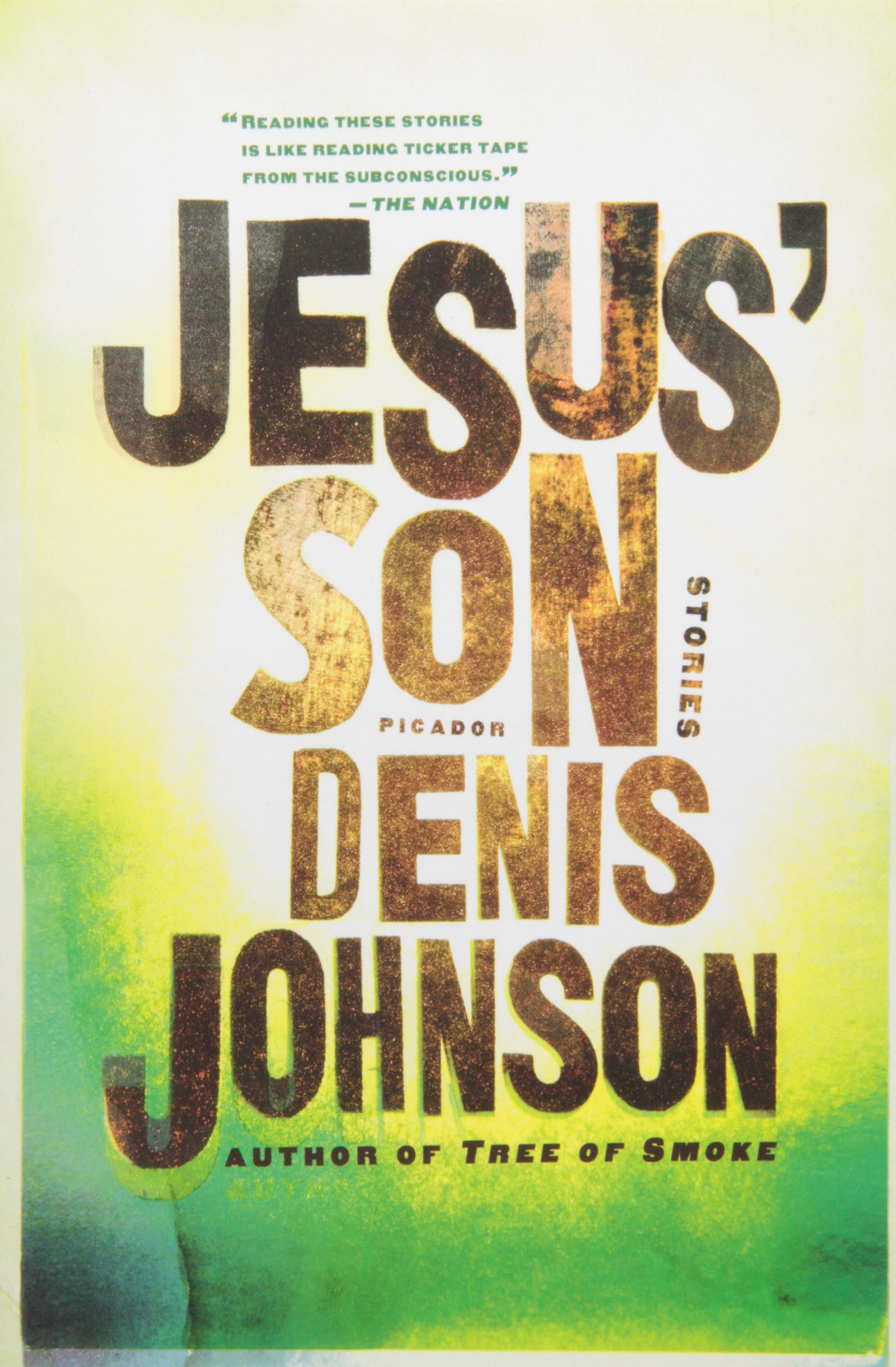
On "Jesus' Son" by Denis Johnson *****

Having read this collection for the fourth or maybe sixth time but the first time in at least ten years and possibly eighteen, I am still astounded by it. It's writing that inspires--or at least, inspired. At one time, I wanted to write as well as Johnson does here, but I have come to see I never will. The collection is a work of poetry in short story form, full of beauty amid the squalor that is described.

I won't bother with a recitation of the contents, as the collection is best absorbed afresh with each reading, even if I generally remember the stories even ten years after the last reading. The book as a whole is about addiction, and it doesn't pretty up. It's a book about a misfit, a young man, coming apart and slowly getting things back together.

My first reading was while I was in graduate school. The book had come out maybe a year or two earlier. I'd seen it in the bookstores, been told how great it was. I found a remaindered copy, and I bought it. It probably took me a few months to get around to reading it. I was not pulled toward it by others' love for it. But once I started reading, it was one of those reading experiences that changes the way one sees the story. I read it again soon after. I read pieces of it separately in other collections, astounded by the individual stories.

I read it again, I know, right after the movie came out. I suspect I read it sometime since then, but I don't recall at the moment. The movie was, I thought, a good adaptation, not insofar as strictly following a book that could not be easily translated into screen but insofar as changing it smartly as necessary so that it would work on screen. A fine movie. But still a finer book.

Saturday, April 1, 2017

On "Locos" by Felipe Alfau ****

I'm not sure how I came to this book, but it showed up in some kind of recommended reading list at some point (on metafiction, perhaps), and I took note of it. And now, here I am, a few years later, reading it. And much of it was great!

Alfau plays with the novel form, as writers of the modernist era often did. I am not sure he wholly succeeds, as the work seems more like a collection of linked stories than a novel. Some read Dubliners as a novel, for instance, but I still think of it as a collection; that said, this piece might be more like Winesburg, Ohio, which while also not fully a novel to me is not also fully a collection of stories that stand on their own. Alfau's stories can be read on their own, but the links are useful to understanding the whole. While the stories can be read in any order, the first half of the book focuses a lot on the process of creating a novel.

We start the book with a character--or person--who is slated to be important. That is his role in life. But no matter what he does, he is ignored, as he is in the story. Instead, we go to a cafe where the rest of the book's characters are introduced to us in various forms.

The next chapter focuses on a character who decides to take over in the absence of the author, who had gone off to enjoy some time with friends, intending to take up with the character later. Alas, the character gets into so much trouble on his own that extricating him proves challenging for the author upon his return. What follows is a confusing muddle. The character meets a person from real life. The person from real life then becomes a character. The character proves to have been another character, who had earlier run off with a different woman. And on and on.

In the process of that story, we are introduced to the character of a beggar, which is the topic of the next story/chapter. In it, a professional beggar manages to find a job. But the job does not begin for a month, so the beggar has plans to continue in the begging profession for a while longer, but he accidentally gives away his last coin to another beggar. Said other beggar is an expert, who lives the life of a rich man when not on the twelve-hour begging shift. The one beggar goes to the other to beg his last coin back, and what ensues is a shift in the nature of begging and professionality. This piece proves much less playful in terms of form than the previous chapters--save for some short comments from the author about how he had ruined the character's plans for himself--which is a good thing insofar as the constant interceding of author and character into each other's narratives can wear thin when overused.

The focus on shifting positions in "The Beggar" plays out again and again. In the next chapter, an expert on "Fingerprints" has his technological expertise and certainty turned against him. Fingerprints don't lie, he asserts, and if his father's memory is to be preserved, he must go through with his actions. Likewise, in the chapter after that, "The Wallet," victims become bandits become heroes. The story is set in Madrid at a time when crime is rappant. Lights go out at night, and everyone takes to committing crimes in the streets. The prefect makes a bet that as soon as a young man leaves his side, he will be mugged. Said mugging in fact occurs--or rather, pickpocketing--but the young man is fast and attacks the would-be thief and recovers his wallet. Only, what he gains is not his wallet but someone else's. So begins a series of crimes and mistakes that will carry through the night.

"Chinelato" is a grand epic of a tale, an adventure story, about a man who spends time in the Philliphines and Spain, a man whose dark skin--but also his dubious morals (he flits from woman to woman, wife to wife)--keeps him marrying a woman he sets his eyes on. We come across him in different ways and from different points of view, and incidents and characters from other stories in this collection flit in and out, giving us small insights into other events that happened elsewhere. But still, this piece failed to hold my interest very well. And in fact, as the stories in the book become less experimental, beginning with this story, Alfau's book becomes almost completely straightforward--no more metafictional destruction of the story as it occurs.

The text ends with a two-part piece called "A Romance of Dogs"--a single character and dogs seeming to be the main items that keep the two parts together. In the first half, the character is in school. Dogs try to bite him before and after each day, add to his nightmares. But the main text of the story is about a priest who commits suicide for unknown reasons, though we suspect it has something to do with his love for one of the nuns, who runs off one day and elopes. The second half of the story involves the same character later in life and his growing insanity, as he obsesses over springtime.

Mary McCarthy's afterword shows how the characters show up in different stories. I was aware of this, but without reading the book a second time, it would be impossible for me to have seen just how much. Many characters have two or three names, so it's hard to keep track of them at times across the stories.

Wednesday, March 22, 2017

On "Where I Live Now" by Lucia Berlin ****

As with the other older collection I read of Berlin's, this ones best stories seem to have been grabbed by the omnibus selected stories that came out a couple of years ago. That said, I still enjoyed reading those that didn't make that larger career-spanning collection. This collection, on the whole, seemed to have more to offer, more accomplished stories, than So Long did.

"Evening in Paradise" essentially recounts the events occurring at a Mexican bar during the filming of a John Huston film. The events are mostly told via the point of view (but third person) of the bar owner, who started off simply and became the owner over the course of his life. He also managed to marry and have a couple of daughters. All is well. Meanwhile, famous actors go in and out of the scenes, and Ava Gardner, who becomes involved with one of the locals. Drunk, she ends up sleeping also with yet another local, and a fight ensues, even as her local boyfriend ends up sleeping with another actress. The bar owner looks on all of the bemusedly. It's the characterizations that make this story feel like slightly more than a curiosity.

"Romance" tells the story of a long-distance love affair and the misunderstandings that spell its eventual doom. Both partners also cannot move from their home states of New York and California because of custody issues with their children, so they tackle love by phone and by cross-country plane trips that take a toll on their finances. When said finances go awry, they have cause to doubt the commitment of the other. As odd as the circumstances are in the story, it seemed true to how many fights in a relationship unfold.

"The Wives" recounts a visit between two ex-wives of one man, as that man is engaged to be married to yet another woman. Will they go to the wedding? Will they support the marriage? Both wives are firm alcoholics, one openly, one not. Their drinking allows them to commune with one another as they grieve the man they lost and celebrate the man they tossed.

"Sometimes in Summer" is a piece about childhood friendship and about love returned, in the form of a man come to visit Mamie. No one in the family wants that bad man around, save for Mamie, who is smitten. But the kids don't know this, so they take the silver dollars the man offers and bring him around to the woman who seems, actually, better off with the man that with a family that seems more intent on keeping everyone down.

"Del Gozo al Pozo" is another Sally story. In this one, her sister Claudia (i.e., Carlotta in most tales) takes care of her while she dies. In the midst of this, Claudia goes to visit a house that Sally had built for herself but that she will never live in. Meanwhile, the help that Claudia grows so close to is in the midst of losing their jobs, as the government changes powerbrokers. All things change--go south, to death, as the story's title suggests.

"A New Life" is about an older woman who decides to change everything about herself. She drops out of existence and takes a new identity--new clothes and hairdo, new ID, new name. She leaves her grown children wondering what happened. She also leaves a note in her diary, suggesting suicide, which neither of the sons believe possible. They go in search, file a missing persons' report. Meanwhile, Mom takes up with two men at a bar, who eventually hatch a plan to get her back to her old life, one that involves extortion. Are the men out for money or just being nice? We're never really sure, though one suspects the former.

"Lost in the Louvre" is a very interesting exercise and one of the collection's better stories not collected elsewhere. It involves a woman who meets death--but not in any sort of fantastic, absurd way. Rather, most of the story consists of a description of the Louvre, as the woman takes daily trips to it during her sojourn in Paris. The descriptions are wonderful, and the narrator's eventual meeting of death is as surprising as it is mundane.

Friday, January 27, 2017

On "See Through" by Nelly Reifler ****

Reifler's stories range from the traditional to the offbeat, from the scary to the mundane. It's when she's walking the line between that line of scary and mundane that she's at her best. Mystery--and more specifically the mystery behind our impulse toward violence--is the major motif of the early stories of this collection, which also are among the best.

"Teeny's" details I'll save for a separate review. It's definitely a story worth reading.

"Baby" tells the story of an extremely smart child who calls into question the mother's reason for living. We get the idea that the baby's philosophical dialogue lines are actually in the mom's head. But such does not stop her from reacting in the most horrible of manners.

"Rascal" revolves around a young man who motorbikes around the country, camping out and meeting new people. The idea seems innocent enough, until the rascal discovers that he can use the knife his mother once gave him to gather goods from other campers. While there may not be maliciousness intended, the rascal's inability to discern what the limits of acceptable behavior are is troubling.

The next three stories take a different turn, focusing on death and disease. “Julian” tells the tale of a boy whose father is dying and whose cousin comes to visit and makes explicit how scary that is. “Memoir” is about a village where the plague or some other disease has broken out and to which people fear to travel. The girl at the center of this tale has some strange sexual proclivities as well, which left me a bit befuddled, that combination of wasting away of doctors and townspeople while she's jumping the bones of random older men. “Splinter” is a more traditional piece, telling of a little girl who manages to get a thorn stuck in her head, while vacationing with her  divorced father in Greece. The latter is befuddled as to what to do and angry that her mother has saddled him with the child precisely because of things like this. The stories climax involves a dwarf--not the kind of person one reads about often and certainly not, by the end, in such a matter-of-fact way.

“Upstream” puts the metaphor of the salmon swimming upstream to full use. It recounts the tale of a young boy watching his parents' marriage dissolve as his father continues to have various deliances with his college students. The boy becomes fascinated by monsters but also by fish, a memory of his last family vacation to the Northwest.

“The River and Una” also uses a fish metaphor but not with as much success. This story reminded me a bit of some of my own early or poorer work—melodramatic and full of expected troubles: an absent father, a runaway sister, a mom who can't deal with said sister, fights between them, and then a dying sister who has gone too far (or was pulled/pushed too far).

“North Curve” seemed a great set-up for a story but disappointed me in ending too soon. I wanted to know more about this woman who grows up to work as a prostitute near where the brothel where her father died. “Summer Job” is about a girl who works at a dirty magazine store owned by a relative for the summer and her phone conversations with a boy she's never met.

"Auditor" returns to the writing about the awkward and scary people on the edge, only in this case, the person has actually gone over the edge. The auditor is a woman who dislikes friendly people and who one day can't take it anymore. Her seeming regret for her action suggests that she has perhaps learned to mitigate her tendency to become annoyed.

Finally, the title story revolves around a woman who works at a porn shop. I'm not exactly sure what to call such places, but they are the locations where women perform/strip for customers behind glass. I liked how Reifler narrated this one, with accounts of the different men, but I wasn't sure, in the end, how the stories added up.

Sunday, January 1, 2017

On "Bewildered" by Carla Panciera ****

Most of the stories in this collection center on loss in some way, and as such have a kind of emotional heft that can be appreciated. The writing tends toward the succinct, which can at times be off-putting, but when Panciera gets going, the manner is effective.

"No Sooner" revolves around a woman who dreams of having affairs while her husband is away from her. Despite her reservations about her in-laws and vice versa, however, she knows how good she has things with the husband she's chosen, even as her sister is watching her own marriage break apart.

The title story is deservedly just that, one of the best in the collection. It recounts the tale of a man who somehow just happens to end up in the right places at the right times. With no real plan in life, but with hard work and dedication, he's ended up well liked and very successful, as well as well married. Or at least, that's how it looks from the outside. Bewildered by his success, he is also bewildered by his seemingly crazy wife, who he both loves and find annoying. Her frequent tantrums with little warning finally, one day, result in her leaving him. What to do is next is not so easy to know, especially for one who has had so many things just work out sans plan.

The very short "Having Your Italy" is a meditation on the ways in which moments in a relationship fade with time, even as we attempt to cherish them.

"Weight" involves a woman dealing with the loss of her partner of many years by spending time with a new man and her brothers. Another story about loss, "Fine Creatures of the Deep," involves two women, neighbors, who despise one another with seeming no explanation. Both lose children. One cannot have another and has replaced it with a dog. In an effort to make peace, she makes soup each day for her neighbor. Do we make such sacrifices, show such love, for another person or for ourselves?

"End of Story" is about a man whose wife has cheated on him and who, as a result, has left the marriage for a younger woman. His recovery from the marriage has not gone well, however, and his pull back into it is something less than satisfactory. The love we had cannot be brought back to what it once was after such damage. I found this one of the more affecting story.

"Singing Donkeys, Happy Families" is about a woman with a crush on a man whose social network is largely a set of hippi families that do child activities together. The woman's attempt to fit into this group lead to strains with her daughters and husband.

"On Being Lonely and Other Theories" is also about infidelity and how such infidelity can destroy the lives of everyone around. Jon Olvey is a cop who is having an affair with his son's schoolteacher whose literal run-in with a dog brings the affair to the community's attention, including his son's, his wife's, and his boss's.

Thursday, December 15, 2016

On “The Empty House” by Nathan Oates ****


The world is not a safe place. Oates's stories are often set overseas and in unfamiliar settings. The strongest ones involve people in over their heads, reminiscent of Paul Bowles's work. While some of the stories are real shockers, the collection unfortunately isn't wholly consistent in quality.

"Nearby, the Edge of Europe" focuses on a man whose wife has become an alcoholic no longer interested in her career or in putting in much work on the marriage, all this on a trip to Europe to see the husband's sister's family. A kind of sadness pervades the story as the narrator comes to grips with his dissolving marriage. The story can be read here at Jstor, with a free membership.

I'm not sure how to take "Looking for Service." Written from the point of view of a conservative businessman who doesn't much care for the liberal persuasion of his children and the like, the story recounts his trip to a third-world nation to resolve yet another issue for the mining company he works for. A subplot involving his need to care for his ailing wife provides a sympathetic side to him. And one can see that it is compassion that causes him to tour parts of the country with a youngish hippie couple. But what we don't see is much of a transformation in the man--he has preconceived notions of the country, of youth, of these two people in particular, and they're all confirmed for him, whether what he believes is true or not. I suppose the one thing we do come to see is that the man is full of fear.

In "A Woman without a Country" Oates hits his stride. The story involves a woman whose sexual escapade becomes part of a hit reality television show so that she is forever trying to escape from a past that it seems everyone knows about. I've often wondered how people who catch a bit of unwanted fame deal with it, and Oates does a good job here of channeling one possible reaction.

"Running Rapids" is a cold-hearted story that deserves its coldness. It's about a couple who go camping in Alaska and who run in with a group of Danish campers. What happens next is chilling in more ways than one. The matter-of-fact tone of the story adds to its macabre, and was the first to remind of some of Paul Bowles's work.

"The Yellow House" is the story that first brought Oates to my attention many years ago. My review of it can be read here, where a link to the story is also available.

"In the World Below" returns to some of the themes in "Looking for Service." In this case, an American with a diplomatic or multinational job of some sort has brought his son to Haiti, and together they sit out an ongoing revolution and all its apparent dangers rather than fleeing to safe American quarters. The story is told from three points of view--the father's, the son's, and their Haitian guide. Such multiple viewpoints are hard to pull off.

"Developing" is one of my favorites insofar as it uses a technique and tells a story I had never quite read before. It's a letter about a man who goes to pick up a set of photos he was not aware he had asked to be developed. The photos include pictures of a woman he does not know--or perhaps does. One is left wondering how to interpret the letter writer's actions to follow. Has he gone to live in his head? Or has his imagination actually come to life? Or is this simply a metaphor for another life he wishes he had? I was reminded of the fantastic realists of Latin America (Cortazar's "Orientation of Cats," in which a man's family is transported into a painting he goes to stare at each day in a museum).

"Hidden in the Trees" is another overseas story, this one about a American couple who tour nontourist areas of foreign lands. The woman is a former drug addict who draws her strength from her husband and who struggles with the lack of strength within herself. "In the Ravine" is about a slacker who realizes that his parents actually know that he is one, as his father takes him on a trip to find and dig up illegal marijuana plants.

The last two stories return to the dark and shocking material recounted in "Running Rapids." "Famous for Crabs," despite its seemingly trifling title is one of the darkest stories I've ever read. It's about a man who goes to visit an old college friend he reconnects with through Facebook. It can be read at here at Jstor with a free membership. The title story is about another man visiting an old college friend in Guatemala during the civil war and about the younger brother, twenty years later, who goes to track down the man who disappeared soon after.

Thursday, July 14, 2016

On "On the Nature of Human Romantic Interaction" by Karl Iagnemma ****

Iagnemma is a deserving winner of multiple prizes. I came to his collection blind, however--and was in for quite a treat. His writing, especially in the first half of the collection, is of a nature that I was fully entranced, hanging on the beauty of the sentences even as the plots themselves unfolded. How does a writer write so well? Iagnemma does more than just tell a good story; he rolls it out like a fine piece of art that feels as if it has weight and importance without being so heavy as to seem ponderous.

The opening/title story is about math--or about how logic interacts with our understanding of relationships, which I believe is essentially nill. The lead character is a former student in love with the daughter of his former advisor, who is in turn in love with an undergrad. The daughter does not want the weight of a relationship; the narrator wants to have the daughter for himself. Why this need to possess things? Why not just enjoy?

"The Phrenologist's Dream" focuses on a nineteenth-century scientist who has great doubts about his career. He travels the country studying women's skulls in order to ascertain the levels at which women can love, and yet he knows that his science is likely quackery, as he can find no real patterns. Enter Sarah, a bald woman on trip to reunite with her husband and who is also something of a scoundrel.

Both these opening stories involve women unwilling to commit to a relationship, which led me to believe that perhaps this theme might run throughout the collection, but the next story, "Zilkowski's Theorem," does not involve such a character and begins to take the collection in new directions.

“The Confessional Approach” takes a break from the math-heavy backround that forges part of the first three stories. This one involves a couple who make mannequins deciding how ethical it is to sell those mannequins to someone who wishes merely to use them for target practice.

"The Indian Agent" simulates the journal of a man sent to Michigan to broker good will and piece between white settlers and a small band of "peaceful" Indians. Alas, distrust between the two and white greed creates a situation the agent begins to lose control of and patience with. Here, a romantic relationship is not the center of the story but rather its lack--the isolation that comes with being alone in a foreign land.

"Kingdom, Order, Species" returns to the science and math world, as a mediocre academic stalks the author of her favorite field guide. Here, we have a romance story of sorts, complete with a happy ending of sorts and, thus, different in tone than most of the other stories.

"The Ore Miner's Wife" deals with a woman whose miner husband takes an interest in science. This interest leads her to believe that perhaps he is cheating on her.

A similar theme creeps into the last story, "Children of Hunger," which recounts the experiments of William Beaumont on an injured man, experiments that allow him to see in to a man's digestive track. So obsessed does he become--so in love with science--that he sacrifices the love of his wife.

And that, I suppose, is what the collection is about, that intersection between science and love, logic and feeling, as if somehow we might be able to quantify love in some mathematical sense.

Tuesday, June 28, 2016

On "The Hospital for Bad Poets" by J. C. Hallman ****

What is billed as a set of philosophical short stories starts out that way with its first piece but then becomes much more straightforward thereafter. And that is probably for the better, as they seem more human. "Ethan: A Love Story" is about an odd uncle who plays Halo and other games with his six-year-old nephew. In one of these games, they find their own family and their own selves. How exactly does one move forward when faced with what one knows?

"Autopoiesis for the Common Man" deals with a young man who has two forty-something girlfriends, both nurses. Scientific jargon about the sex act turns both of them on, and much attention is paid to the idea that sex is in the end a biologic act that furthers the species. The jargon contrasts with the emotions in the piece, hiding the latter, and making the relationships seem much more clinical than they apparently are.

"Manikin" is about a kid whose father leaves one day to go to Tulsa (i.e., backward for "a slut," Mom says). To deal with this, the son begins building a life-size doll.

"Carlson's Team" makes an apparent attempt to reverse our everyday world so that instead of people watching people on television, everyone is on television. That is, we all try to make our lives into television stories. The conceit, however, seems incompletely rendered, and I was left wondering why the story wasn't just told straight the whole way through--it does not seem like it would have lost much. The tale itself involves a soon-to-be father who has joined a basketball team to get into shape and stay there, but who discovers, the more that he plays and practices, just how bad he is.

One of the strongest stories in the collection is "Savages," an oddball story about family breakup. Mrs. McDermott cuts out a hole in the hedge separating her home from the one next door and builds a cave into which she drags one day Chuck's father, who finds many reasons to return. This initiates a string of consequences--upcoming divorce the most expected--and surprises that are shocking, disturbing, and sad. The title essentially says it all, as the humans in this story are reduced to an animal-like behavior that cuts off the basic tenets of what we call civilization, suggesting that the true cost of sexual licentiousness is our humanity.

In fact, it is in the semihorrifying stories about family life that Hallman really seems to succeed. Another strong one is "The Fire." It's a recounting of a fire that swoops down on the hills around Los Angeles, destroying homes in its wake. The story follows one man who decides to stay rather than flee with his family. He and a neighbor pull out hoses and then watch as the lines go dry. What makes this story so powerful, however, is the sideline plot about the man and his wife, who are having marriage problems. He's a lawyer who promised to quit after ten years to take care of the kids so that his wife can pursue her career (as a potter). Even though the wife has no market plan or business (and thus immediate means to support the family), she is insistent that the lawyer quit his job so that she can do her thing. It is in the context of these fights, these threats to leave, that the fire wreaks its havoc on the neighborhood, as if the family spat too threatens to destroy all.

Along a similar line is "Utopia Road," a ghost story of sorts, about an idealic new suburb that begins almost immediately after folks move in to fall apart. Electricity runs where it shouldn't, shocking people. Water goes out. Gutters get pulled off roofs. Eventually, the community comes to believe that Tom Royce, a local boy, is the one playing practical jokes on them. But after beating him up and essentially intimidating the Royce family to move, the troubles continue. Even a witch doctor won't help kick the evil spirit out of the neighborhood. Horror after horror continues, until we're left wondering when we will be next.

Other stories are a bit gimmicky, such as "Double Entendre," an advice story about how to write erotic fiction that also features its share of erotica. The constant cut to instruction, however, interferes with whatever passion we might feel for the storyline.

"The Jockey" is an amusing story about young people who are recruited to act the part of terrorists and victims in a practice session for some police and emergency responders. To what extent, one might ask, does one's betrayal during a fake practice session reveal anything real about one's actual relationship or potential there for?


The last story explores game theory in conjunction to the story itself, book-ending the collection with a tale that is in part philosophical.

Monday, May 16, 2016

On "Cabin, Clearing, Forest" by Zach Falcon ****

These stories about Juneau, Alaska, present readers with a microcosm of small-town living in the Great White North. At their best, they are stories about machismo in an age when there is little call for such. Lesser stories (insofar as they seem somewhat familiar) focus on troubles within family and among children.

The first three stories forge the title of the collection. Each of them seems strange in some way and yet I found none of them wholly satisfying. "Cabin" is about a disintegrating marriage from the point of view of the two under-ten children in the family (a Hansel and Gretel-like pair who wander around the woods to avoid home life); I found it a strange story to open with, since its themes seemed so overdone. "Clearing" focuses on a family that goes away to Pennsylvania and returns to stand out on the road nude and then gets arrested; the point of view is from the town's perspective, so we never quite understand what would cause the family to flip out. The real pleasure in this story, however, comes from the descriptions of the town, a place that lets out in summer, becoming a community of sorts, before the hunkering down each winter. "Forest" focuses on another family in trouble--this time the father has gone missing, and the emotional breakdown that the mother suffers puts the kids in charge, though they seem hardly ready. The real heartbreak in this story revolves around a dog that is tied up and not fed.

The shorter stories in the collection also didn't much satisfy me, even more than the three opening tales. They have neat ideas behind them, but the ideas don't seem fully developed, even if the language can often be beautiful. "What This Guy Said One Night" revolves around a grandfather's last wise words captured inside a bottle for posterity. "The Times of Danil Garland" focuses on a beautiful gal and the young men who look to pursue her and then grow up, dying and disappointing along the way. “Sleight” focuses on a family of magicians and a mother's disappearance, but the title seems to suggest the feel of the story itself. “Dendromancy” is probably the most successful of the shorter stories, in part because it is so shocking.

“Blue Ticket,” along with "Bridge to Nowhere," are my two favorites from the book. In the latter an unemployed lawyer in a bit of a depressive state ends up hanging out with Warren, who has some sort of mental disability. The lawyer sees Warren as a means to kill time and to make himself feel good but not as the friend Warren thinks he is. During the course of the story, the lawyer learns that Warren owns a good chunk of old, undeveloped land, and the two decide to go take a look at it, visions of money stirring in the lawyer's brain. As one might expect, Warren turns out to be much more of a friend to the lawyer than he would ever imagine or acknowledge.

“Roost” reads like a well-accomplished workshop story, which is to say that it is very well written if a bit predictable in a literary way. The tale is one about a married couple who buy a painting of a chicken out of a sense of irony. But that pride in the painting leads others to think them fans of chickens, and so over the years chicken collectables pile up. At what point does irony become love? Meanwhile, the marriage falls apart--and (spoiler here) when one chicken item is given away to a young married couple, we get the sense that bad luck is being passed along.

“A Beginner's Guide to Leaving Your Hometown” and “Knots Pull against Themselves” both deal with people trying to escape Juneau but being unable to. The former focuses on a man on his last night (again) in town, drinking it away, talking about how much he hates the place. “Knots” focuses on a young man who has an opportunity to go away to college in the lower forty-eight but who has to rely on his unreliable brother for a ride because he has too little money to pay for a taxi and his mother doesn't want him to leave. Alas (spoiler) he eventually discovers that he misses the town he so wanted to escape.

The last story, “Every Island Longs for the Continent--Kodiak 1973,” is the longest in the book. It is a tale of a man confined to home after contracting hepatitus. Being a hospital worker, he comes into contact with a woman who loses her baby; this same woman ends up being taken in by his wife, who then grows jealous as the woman and the man seem to grow closer together.

Monday, April 18, 2016

On "Apologies Forthcoming" by Xujun Eberlein ****

This book, written by a Chinese ex-patriot, revolves around the Chinese Cultural Revolution. As such, for a person who has not studied greatly into the subject, the work was immensely interesting. When I was younger, I preferred fiction because I felt that it provided me better insight into a given time and place than history books could. Perhaps, if I were back in school and more focused in my reading, fiction would become my favorite genre again--and books like Eberlein's would be key to making that happen.

My one previous reading into the Cultural Revolution was a paper/memoir written by a classmate in an autobiography class I once took. A Chinese immigrant himself, my classmate decided to focus on his experiences then rather than on the fiction early American narrative we were asked. I wish I'd spent more time reading the work for what it was now, rather than being focused on giving feedback and wondering how the memoir fit into the class assignment.

Eberlein's book contains eight stories of essentially even quality. In the opening story, "Snow Line," a man writes a poem that take the nation by storm--a poem that is not explicitly Maoist. The story is a commentary on art amid all-encompassing political idealism. Unlike most of the stories in the collection, the focus seems more on art than on politics. Many of the stories, including "Pivot Point" and "The Randomness of Love," involve innocent and/or adulterous love

"Feathers" is about a girl who tries to hide from her little sister and grandmother the knowledge that her older sister has died while doing Maoist work in the country, going even so far as to hire someone to pose as her older sister coming back for a visit.

In "Men Don't Apologize," a girl goes to work for a bus manufacturer and discovers why bus accidents often occur. She also finds the man who accused her father of being a capitalist during the revolution, but when she tries to bring the two together to bury the hatchet, she discovers that forgiveness does not come easily.

"Watch the Thrill" discusses harrowing events from the point of view of boys who have no understanding of them--who in fact find joy in watching people beat up, chased, and killed, so much so that they actually prevent one man from running to safety after committing a potentially revolutionary act, if not an act of revenge.

"Disiple of the Masses" focuses on a city girl who goes to live in the country to help out farmers. There, she discovers that rather than being an aid, she is a spy.

The collection ends with a tale told in the United States, many years after the events. This look back seems a particularly good way to draw the work to a close.

Monday, February 22, 2016

On "Sum" by David Eagleman ****

This book's subtitle, Forty Tales from the Afterlives, pretty much sums up the work, but not in the manner in which one might expect, if expecting a standard book of short stories or flash fictions. Eagleman is not as concerned with telling a story in standard fictional form with central characters, rising action, and denouement. Rather, the focus here is more philosophical. As such, I was reminded a bit of Jorge Luis Borges's work, which often eschews standard fictional devices as well. Indeed, there is an element of the strange in macabre throughout much of the book.

What Eagleman does is tell you (the main character) what happens to you after death--forty different versions of this. The best versions of device entail making the reader see afresh his or her own life and the meaning of it. And the early pieces, as new playthings in the mind of the reader, are exceptional. However, as the collection wears on, a pattern begins to emerge, and the stories begin to wear a bit thin. That is, we're told that when we die we go to heaven or hell or that we don't die or that we are reincarnated as something; Eagleman runs through what happens, which turns out to be somewhat unexpected, contrary to what we had thought, and then makes a grand pronouncement at the end that helps us see where we were (are) wrong about our former lives here on Earth.

Some specific stories (spoilers here) revolve around being small beings within a much larger one (essentially the equivalent to bacteria in someone else's body); living again but in discreet units where a lifetime worth of sleeping, eating, reading, toothbrushing, so on is done in a single unit (thus twenty years of sleeping, two days of brushing teeth, etc.); becoming part of a finally egalitarian society that proves to be less-than-satisfying for everyone; wishing to become a simpler being--say a horse--only to discover too late that you are going to miss being able to think about the complexities you wished to avoid; finding that you live on as a computer program, a set of e-mails that have been prewritten to be sent out to people after your death; going to a place where you are kept alive until the last memory of you is expunged and finding that you are luckier than the famous who are never able to disappear or change; finding the key to immortality but not being able to confirm its reality before purchasing it; discovering you are an actor in someone else's life; being yourself simultaneously at all possible ages; being you among all the various incarnations you could have been (successful and unsuccessful, each choice made differently); living your life over but realizing that your memories of it are all wrong and that you understand it as little as you did the first time.

When best written, the stories Eagleman tells really do make you reexamine the assumptions you make about your own life. In that sense, the collection is unique and thought provoking.

Thursday, February 4, 2016

On "The Best Place to Be" by Lesley Dormen ****

I came to this collection sight unseen, and I am happy to have read it. The first couple of stories were especially exquisite, managing to do the usual contemporary story thing not so much with original flair as with sheer skill. Those early stories left me feeling as if I were reading the work of a master whose talent was so genuine, so impressive, that there really is a reason some people go on to find publishing success and others, while good writers, do not. Dormen's every word and phrase was fun to follow, and at the end of the story, chills ran through my body on what seemed a very simple turn of phrase. It's something I don't quite understand, the mystery of that chill, how some people can illicit such a thing at the end of a story that hasn't really gone anywhere in terms of action-filled plot. And Dormen's does over and over, though not quite with every story in the collection.

All the stories revolve around a singular character, a woman who remained single deep into her life and whose eventual marriage to a seemingly wonderful man is generally happy, though tinged with a certain amount of annoyance the longer it continues. The woman is a newspaper columnist and reporter, initially dispensing advice to single women but later just being the go-to on various subjects. She is the product of a single mother, whose three marriages each had the problems--the second man a seeming molester, the third a rich man who enables the mother's egregious spending (a habit her daughter emulates). The first is a man who has virtually now relationship with the woman and her brother until they are adults, which, in one story, is made to appear as if it were mostly the mother's fault. During the course of the stories, the mother dies, and the woman deals with her grief. In all, this is a portrait of a family as seen through the daughter's eyes.

The first story in the collection is my favorite, but I'll write of that one separately. The second story and the last story are my favorites next to that. The second story revolves around the narrator's life as an older single, one who has made bad choices in dating and who now feels as if she has put herself in a position from which she can never return--single forever. The last story in the collection is, in essence, about aging, though in all the stories, the woman appears to be around fifty or just thereafter. In this story, though, she is somewhat less taken with her husband and yet also happy for the security his presence affords her. The cause of this deep thought about her marriage is a newspaper article she agrees to write about marriage researchers.

"Curvy" recounts Alex and his sister going to meet Irv, their biological father, and his wife. Alex resents Irv for leaving them; the sister, a bit older, seems more understanding and even has mixed feelings about him versus her mother. "The Secret of Drawing" focuses on the narrator's start at college and on her mother's second divorce and on her taking up with a third man and on the feelings the narrator has for the man she calls dad (that second husband). "Gladiators" focuses on the siblings fighting one another over inheritance matters after their mother's death, and "General Strike" focuses on a Thanksgiving trip to Italy with her brother, his wife, and the narrator's husband. Here, one gets the feeling that the marriage is no longer so hot for the woman, but she is able to find some solace in reestablishing a relationship with her brother that reminds her of being young again.

It is really the first story that sets the stage for all of the others, by denoting how there are times in life when we are truly happy and how those times are transitory. It is a happiness contrasted immediately with that second story, which seems much less hopeful but which chronologically precedes the events in the first story. Later, those first story events are in the past, and sadness slowly seems to be reaching in again. Transitory, indeed.

Monday, September 7, 2015

On "The Invention of Morel and Other Stories" by Adolfo Bioy Casares ****

I'm not sure how this book ended up on a list of titles I wanted to read. I must have read somewhere that Casares was a friend and collaborator with Jorge Luis Borges. That alone probably would have been enough to ellicit some interest. As such, Casares is in the same Argentinean fantastic realist tradition. He's a writer like Borges--the same pseudointellectualism behind many of the stories, the same tricks of storytelling--but more long winded. Whereas Borges's stories rarely clock in longer than about ten pages, Casares's pieces clock in around thirty, and The Invention of Morel itself is a novella.

If I were writing a paper on this book, I would focus on the use of time in the collection, particularly in reference to space, eternity, and reality. Many of the stories, indeed, seem to focus on the manner in which time is an illusion. We can collapse time through memory and various tricks of the mind. These tricks can thus establish a kind of eternity, an alternate reality. They can bring the "past" into the present or make the present disappear into some other universe.

The novella The Invention of Morel certainly focuses on this. The invention that Morel is responsible for is some kind of machine that allows people to continue living. It "steals" life and replays it on a continuous loop. But these people are not really people once their souls are stolen. They are shadows of another world that we can see and walk among but that we cannot really interact with. The story itself is not focused as much on the invention, however, as on the narrator's discovery of it. The narrator, for adventure and exploration, goes to an island from which no one has escaped alive. Conceivably he too gets pulled in by Morel's invention, although somehow he manages to pass a missive off to others that becomes the scholarly description of the place. Much of the story focuses on his fascination with one particular woman--one of the illusions--with whom he wishes to forge a relationship.

The novella was not particularly to my taste. I actually much preferred Casares's shorter pieces. My favorite of those pieces was the story "In Memory of Pauline," which details a man's lifelong friendship with a gal and his disappointment as a jilted lover (spoilers follow). It is his expectation that they will marry, but instead, one night, he introduces her to a friend, and this friend and she fall for each other, and that's that. In despair, the narrator goes overseas for a couple of years. When he returns, Pauline is waiting for him. She apologizes for running off with the other man and slips into the narrator's bed. The next day, the narrator goes in search of Pauline and of the story of what's happened during the two years that he's been gone. He finds out that Pauline is in fact dead, that her lover killed her. So this becomes a ghost story. Not so fast. As the narrator puts the facts together, he discovers certain details that cannot have been true. There's a gift that he gave Pauline that shows up in the apartment in a place where it should not be; they make love to the sound of rain but there is no rain on the ground when he goes outside afterward; his image in the mirror is shady; she speaks more like the narrator's friend than the way the narrator remembered her speaking. What he discovers is that Pauline didn't just die but that her lover, now in prison, killed her, jealous of the narrator. It is the narrator's projected jealousy that has visited him. Pauline never loved the narrator, he realizes, and their consummation upon his return was merely an illusion of the jealous man's mind. This is where, of course the mind takes over, changing our conception of time and reality.

I liked the rest of the stories to different degrees, though not nearly as much. "The Future Kings" is about a spy novelist who becomes a spy when he goes to visit some old friends who are believed to be involved in some kind of plot; they turn out to be people who can speak telepathically to seals. "The Idol" involves an antique dealer who gets hold of a wood sculpture with a dog's head that seems to have supernatural powers (to make one fall in love with the owner's daughter, to kill one in one's sleep, etc.). "The Celestial Plot" involves the crossing of parallel worlds, where a pilot lands in a universe where none of his friends know him, while another pilot lands in a universe where he is flying a different plane than the one he took off in, and so on. The paragraph ending of this story summarizes many of the book's themes quite well. It talks of "old notions" of planetary and spherical worlds versus "bundles of parallel spaces and times." "The Other Labryinth" is a story that unfolds slowly and that I found difficult to get through, but the last ten pages upend the entire piece, and what one thought one was reading turns out to be something entirely other. In the story, a man is obsessed with a manuscript that may or may not be a fraud. We think we know that the fraud was put upon the man by his rival, but the true author of the fraud turns out to be someone quite different. And in "The Perjury of Snow," a poetry critic recounts the murder of a famous poet; as with the previous story and several others in the collection, our perception of the tale is changed significantly at the end, when the interpretation offered of the story of the murder is upended so that another murderer is revealed. And as in those others stories, time plays a key role here, as one man cuts his family off from the rest of the world in order to impose an eternity on his loved ones so that his daughter won't die. It is when that outside world impinges on that man's house, that time reestablishes its power over the family's life.

Monday, March 16, 2015

On "What Solomon Saw and Other Stories" by Mary Dean Cason ****

What was hard for me to believe, after finishing this collection, is that there is no acknowledgments section that lists off places where these stories have previously appeared. I'm guessing that this fact demonstrates how difficult it can be to find homes for longer stories that are well written but not in some way exceptionally strange, unless you already have a pedigree and a name to go with it. Every one of Cason's stories reads like that of someone who has mastered the form, and at least one of them managed, at least for me, to be truly masterful in terms of eliciting actual tears--that is an emotional response in addition to the usual intellectual nod of the head with regard to how well put together the story is.

The stories themselves range across place but seem most often to be set in the American South. They concern characters of various ages and appear to run chronologically in the sense that the first stories are about children and the later stories are about elderly people, such that I thought at first that I was going to be reading a book of coming-of-age stories.

And in a way, that's a bit of a shame, because Cason hits her stride really with the stories in the middle of the collection, the ones involving adults at middle age.

The early stories present characters who are often too innocent to understand what's really going on. In the title story, for instance, Martha finds out that the may have to give up her tree house because a frenemy fell from it and ended up going to the hospital. Of course, what was really going on was some sort of attempted seduction pulled off by her brother, but for various class and religious reasons, no one will acknowledge such. My guess is that the story is the lead one because it's beginning is so utterly captivating and its voice so strong, but the payoff, for me, proved a bit disappointing in the end. The next story also involves a child, in this case one trapped in a restaurant when a jilted husband attempts to shoot his cheating wife. There's a great deal of tension in this story, as there is in many of Cason's, and it's when we hit the next stories that the collections really took off for me.

"Oh, Canada" involves lovers mixed up with the mob, a story which takes the tension of the previous piece and ups the ante many times more. However, as with most of Cason's pieces, the endings usually don't turn to the dark side, as I would have expected. In some cases, there may have been a bigger emotional payoff for me if they had, but perhaps that is just my taste. "Oh, Canada" was nevertheless gripping from start to finish.

A couple of stories involve motherhood--the inability to have children, the desire to have children. One involves a priest who almost gives up his calling for a woman. One involves a man who takes pity on a woman who is crippled by a stroke and thereby cheats on his wife. Each of these stories, though seemingly familiar content, are so well told and so singular in their characterizations that they seem original again.

The story that most got to me, however, was "Avalanche." In it, a woman finds out that her late husband, who died in a skiing accident, left behind a locker of goods that includes a very fancy pair of woman's boots. It doesn't take much detective work for the woman to realize that this tragic events has actually revealed that her doting husband was in fact having an affair. The emotional toll is, of course, devastating--but Cason turns the story around in other ways that eventually lead to a conclusion that is as tear-jerking as it is redeeming. I look forward to reading more of Cason's work. Hopefully, some will show up in magazines and journals so that her readers won't have to wait for her next book.

Sunday, August 18, 2013

On "Safe as Houses" by Marie-Helene Bertino ****

Winner of the 2012 Iowa Short Fiction Award, Bertino's collection shines with stories often tongue-in-cheek and usually a bit odd in their telling, if not their focus on the strange narrator. The best stories in the collection manage to present psychological ideas in very literal ways.

Perhaps the best of examples of this ("This Is Your Will to Live")--though it is better as an idea than in execution--involves a salesman literally laying his heart on a platter for a woman. Another example--and a truly fun story to boot--is "The Idea of Marcel," which involves a couple going out with their ideal selves, that is, with the person they would like to date instead of the person the person is. How far are we willing to stray from ideal for a relationship? And how much of an ideal fades simply because we get to know a person? There is a certain joy in a first date admittedly.

In "Free Ham" a family deals with the burning down of a house. "Sometimes You Break Their Hearts, Sometimes They Break Yours" is more a collection of great lines than a story, which the narrator admits right from the beginning. And the lines are good enough that the "story" remains compelling enough to complete reading. In "North Of," probably my favorite story in the collection, a woman brings Bob Dylan home to visit her family--a mom who is clueless as to who Dylan is and a brother whose growing hatred of life doesn't allow him even to enjoy meeting a visit by his idol. In "Great, Wondrous" young folks perform secret superhero-like miracles at a college, at the cost of a life. "Safe as Houses" involves burglars who break into homes not to steal things of monetary value but to break things of emotional value so that families will come to appreciate one another. And in "Carry Me Home, Sisters of Saint Joseph" involves a gal trying to get over a boyfriend by living in a convent and teaching Catholic school.

Wednesday, June 19, 2013

On "Everything Ravaged, Everything Burned" by Wells Tower ****

This book was the rage two or three years ago. Not being in an MFA program, however, I was out of the loop. I heard about it from a couple of people who were in an MFA program. I was at the beach. They had the book. I read it--or part of it, two stories. Good stuff. But I didn't run out immediately and buy it or read it. Now I have read it.

What can be said? Tower has a way with words--and with characters. He also writes in a way that is in some respects maddening. By that I mean that I found the work here Faulkneresque. And by that I mean not that Tower writes in cryptic garbled-up stream-of-consciousness that demands you've read everything else Tower has written before you know who in the world these people are the narrator keeps referring to. No, I mean that I'd get to the end of the story and think, That's it? That's really the ending? In other words, many of the stories didn't seem to have definitive ends. They just drew to a close. But you know, in a way that was refreshing. Everything ventured, nothing learned.

That's not the case with two stories in the collection, one of which is my favorite and one of which probably could be used as a frame to interpret all the other pieces in the collection. My favorite was "Down through the Valley," a tale in which a man goes to visit his daughter over at his ex-wife's place; the ex-wife left him for another man, and now she needs her ex-husband to take care of their daughter and this new man for a short while. Sounds like a normal, messed-up family story. And then it gets real messed up. They go to a bar and grill. The new man, Barry, gets involved in someone else's fight, and before the tale's over, the narrator's entire life is headed in a completely new and desperate direction, one he hardly seems responsible for.

The other story is the title story. I had been told it was one of the weaker stories in the collection, and I think I would generally concur. It involves Norsemen going to pillage a town. Having just read a huge chunk of Icelandic sagas this past year, the information here seems not atypical. There's a lot of murder and carnage. What's different is that Tower puts a contemporary sensibility on it, which means we get the gory descriptions. In the end, however, the main characters come to think a bit more deeply about their way of life, the pain that they cause to others. They meet a family they tore apart a few years earlier. And yet, that doesn't stop one of the men from kidnapping the one (now one-armed) daughter that the farmer has left for himself. In the concluding remarks, the narrator acknowledges, now a provider for his own family, his fear of pillagers coming to his own village and destroying his own family. Indeed, I think of it as one of the fears I've long held with regard to having a wife and children. Just how well could I provide, and could I really offer any protection? It seems we're more often victims to whatever a perpetrator wishes to put over on us.

The other stories all have intriguing plot points and characters to dig into. "The Brown Coast" involves a man who, after his father's death, has messed up his life--losing his job and his wife--and who is now trying to rebuild, starting slowly with an aquarium he puts into his new home. "Retreat" involves two brothers who haven't, historically, gotten along so well; now adults, the older brother invites the younger to a cabin he's purchased, and the two go hunting together, while the older tries to convince the younger that the cabin land is a good investment. In "Executors of Important Energies" the narrator's stepmom wrangles a way to reunite son and father; unfortunately, the father's mind isn't all there, and it seems more likely that the stepmom is simply dumping Dad on son. In "Leopard" a kid plays hookey from school but still has to deal with the stepdad he can't stand. In "Door in Your Eye" an eighty-two-year-old dad takes up living with his daughter and succumbs to the temptation to visit the hooker who lives across the street. In "Wild America" (perhaps my second favorite in the collection) a teen-aged girl competes with her cousin for affection; each of them want a boy, it seems, only to keep the other one from having him. And each finds herself doing dangerous things with older men in order to garner attention, things she knows she'll likely regret but can't let anyone else know. "On the Show" involves traveling fair workers and customers in an ensemble story.

Wednesday, September 12, 2012

On "The Bloody Chamber and Other Stories" by Angela Carter ****

I came to this collection through a book of criticism on werewolves. The critical analyses of these stories seemed to make these tales stand above most other such fantastic pieces in that vein. And now having read the collection, I can certainly say that Carter is a writer whose style makes her one of a kind. I'm most amazed, in this book, by how she so adeptly adapts fairy tales to her own purposes. The tales don't necessarily become modern in place, but they become certainly something different, something literary, than what they are in the homespun versions one gets used to reading.

A large theme tying these stories together is sex and relationships. Psychologists, of course, have long seen connections to sex and death in fairy tales, reading into them vast archetypes that all humans apparently live as. Carter takes that psychological spin, the generality, and respins it into something singular for each of the characters involved--but with the sex more clearly, more overtly part of the tale.

The best story in this collection--by far and away head and shoulders above the others--is the title story. In it, a very young woman goes to live with her new noble husband. Lucky her, marrying a rich man, marrying up--until she discovers he isn't quite what he seems. After the night in which her virginity is taken, the husband gives her keys to every room in the house, but he tells her that one key is not to be used. One can only guess what happens next, when he goes out of town. The woman discovers the grizzly reason her husband has been married so many times. Can she now save herself?

Other tales are more along the lines of reworkings of classic fairy tale plots and characters. In "The Courtship of Mr. Lyon," a young woman fails to return to visit her beast as promised, who subsequently comes close to dying of a broken heart. In "The Tiger's Bride," a man loses his daughter to a beast in a game of cards; the beast asks only one thing of her once she is in his custody: to strip naked for him. "The Lady of the House of Love" is a tale of a female vampire who catches a young man in her web (or does he catch her?). "The Werewolf" involves a girl who finds out that her grandmother is just such a thing. "The Company of Wolves" involves a whole family of them, and one woman finally settling on a wolf of her own, as she strips herself into his lair. And "Wolf-Alice" involves a girl raised by wolves who goes to live with a werewolf for lack of a more appropriate place of residence.

Saturday, September 10, 2011

On "Dream of the Wolf" by Scott Bradfield ****

I fell in love with Scott Bradfield's novel The History of Luminous Motion when I was around age 20. It was a book on a sales rack with a cool cover, and inside the first paragraphs were, well, luminous. The power of the writing simply continued straight through.

Fast forward ten years, when I finally reread that wonderful book. I was no longer as impressed or into it. Certain books speak to us more at certain times of our lives than others. Some say different things. Some continue to amaze me (On the Road, Great Gatsby), which is probably a reason they're considered classics. Others, for whatever reason, fade with age, fade because the thing inside that titillated no longer carries with it the same power, be it a particular life imagined or a beautiful mess of words or a technique previously unfamiliar.

Anyway, here it is twenty years later, and I'm finally getting around to reading Bradfield's book a stories, a book I'd contemplated reading many times back when I was twenty and in love with Luminous Motion. What can I say? It's Scott Bradfield--he's a craftsman of the sentence. This book is full of beautiful lines. As for the stories themselves, they're cool; they're interesting; and sometimes they don't seem wholly there, as if Bradfield decided simply to stop writing at a certain page.

Each of the stories revolves in some way around dreams, which may be part of the reason the stories end as they do, abruptly, at seemingly nonsensical moments, the way our own dreams often do. The title story, a fantastically interesting tale, revolves around a man who dreams of being a wolf and whose dreamlife begins to take on a reality more intense than his mundane waking life. But that's just the beginning. It gets weird (or perhaps, I should say weirder).

"The Darling" is another disturbing and interesting piece, the tale of a serial husband killer. "Unmistakably the Finest" is a finely wrought piece, one of the few that ends with a kind of emotional heartstopper, about a girl whose father leaves the family to take up with another woman, about the job that girl takes that summer to support herself and her mom, and about her mom's new dating life and her mom's drinking. "Ghost Guessed" deals with a man's double--someone akin to the double in Fight Club, bold and careless where the man is not. "Greetings from Earth" recounts a woman's outer-body experiences. "The Other Man" focuses on similar themes to these two--a man's obsession with his wife's imaginary lover. In "Dazzle" we follow a dog's life; in "White Lamp" an old woman's and her philandering son. "The Wind Box" recounts a man's experiences with a Scientology-like society. Each of these stories has a gimmick of sorts that makes them interesting, and each is spellbinding in its own way, even when they don't feel as if they completely add up.

The last story, "The Secret Life of Houses," is possibly the best in the collection. In it, a young girl takes care of her ailing mom in the hospital and returns to her house each night to act the part of a grown woman. We're warned early in the story that Aunt Fergie will show up when the mom is dying and will steal everything that the mom has worked to give to her daughter as an inheritance, and so when Fergie does show up, midway through the story, a kind of dreaded horror takes over more harrowing than if we were reading about, well, werewolves or something of that nature. The story compels one's reading, even as one doesn't want to see the seemingly inevitable conclusion.