Showing posts with label Four-Star Poetry Collections. Show all posts

Wednesday, May 10, 2023

On "The Collected Works of Billy the Kid" by Michael Ondaatje ****

When I set out to read a group of Westerns, a genre I have had little experience reading, I mostly intended to focus on the pulp fiction, and indeed, most of the books so far that I've ready have fit into that category, but now, for the last few, I'm moving toward reading "high-brow" Westerns, those that intend to be Literature with a capital L. Ondaatje's work certainly fits into that because it's not a Western aiming for a popular audience, with a heavy-handed plot and a likeable character at its center. Rather, it's a book of poetry, with the legendary Western antihero Billy the Kid at its center.

The book, in large part, is a kind of "found poetry," extracts from real-life documents rearranged in a poetic format. Ondaatje aims to describe the final days of Billy from multiple points of view, as his partners are gunned down and he is taken prisoner by and then escapes from his one-time friend and now sherriff Paul Garrett. All this seeps through what narrative is provided, because, this being poetry, we're more focused on the thoughts of the people at any given moment than on what's happening. In that sense, not having read Billy's history, I found the earlygoing parts of the book difficult to follow, but as I read on, I began to understand who was talking when and how events came to be.

As a piece of descriptive and experimental literature (Ondaatje includes various types of prose, rhyming poetry/lyrics, free verse, photographs), the Collected Works works admirably. One gets a pretty good set of views of the young man--from his friend, lovers, enemies, and self--while also coming to see how real-life people enter into myth. It was an enjoyable read, though I can't say that the work made me empathize too much with anyone or made me want to read a ton more about Billy.

Thursday, April 29, 2021

On "The Selected Poems of Li Po" by Li Po, translated by David Hinton ****

This work selects individual poems by one of the greatest Chinese poets, one who was active some 1400 years ago. Hinton introduction points out a lot of pertinent biographical details--Li Po's identification to Taoism (versus his friend Tu Fu's greater identification with Confucianism); his relationship with Tu Fu (he wrote two poems about Tu Fu, while Tu Fu wrote many more about Li Po, so the relationship seems to have been more meaningful coming from the other direction); Li Po's wandering ways and use of wine to reach states of ecstasy so that he could write better about the present moment; Li Po's political and military life and how in the civil wars of his later adulthood, he was exiled for the stances he'd taken; his disillusionment with war; and finally his return to solitude and wandering in nature. Interestingly, much of Li Po's written work, which was voluminous, has been lost. That which we have comes down to us from later collections of his material, and most critics think that as much as two-thirds of it is spurious. So much for the grand reputation I'd always thought Li Po had. It seems a shame that the fictional poet became so caught up with the real one such that we don't know whether what we have or how much of it is real.

The poems themselves are very enjoyable to read. What's amazing is the way that Li Po focuses on his surroundings such that the poems generally speak to us now even more than one thousand years later. A description of a mountain lends to thoughts about life and about moments in a given life, ones we share even now. Much is made of such thoughts especially toward the end of the collection, which I think I enjoyed even more than the beginning. Hinton had noted that Li Po's poetry had a certain carefree quality in his youth that was lost midlife as war took its toll. Indeed, the poems about war weren't that intriguing to me, but I found myself slightly more taken by the older Li Po than the younger. Experience leant a certain melancholy to the descriptions of nature that made the pieces seem all the more touching. It is amazing to think about how the wind and stream are the same that people generations ago also experienced and yet also how those things are never the same, even for us, from moment to moment, day to day.

Friday, May 10, 2013

On "The Kalevala" by Elias Lonnrot ****

Based loosely on ancient epics and folktales, this Finnish epic poem runs from a creation of sorts to a Christ child of sorts, with all its strange tales in between. It is, so I read in the introduction, really the beginning of Finnish literature, insofar as it was the great epic written at a time when Finland was really coming to its own, pressing for its own national identity. One certainly couldn't do much better--it's a marvelous work. The particular translation I read as well, by Keith Bosley, is a lot of fun. Bosley notes that Finnish poetry is heavily alliterative, more even than Old English poetry. Placing rhyme or metric measures onto the work in translation would be to do a disservice to it, as would be trying to mimic completely  the Finnish poetic devices. Instead, he settles on a purely syllabic verse (nine syllables--sometimes five or seven to a line); it seems to work well, especially as lines often repeat, as they would in a rhyming kids' tale (think, for example, of the repetition and refrains in "The Three Little Pigs").

Summing up The Kalevala is difficult, and while I'll try here mostly so that I can one day return to this write-up to refresh my memory, it'll be a sorry recounting. The beauty of the piece is really in the language mixed in with the plot itself, which at times as a bit fuzzy to me.

We start with a kind of creation of sorts, from which springs the old man Vainamoinen. I say "old man," because by the time he gets around to doing anything in the narrative, which is fairly quickly, he is already old in the eyes of others. One of his first acts is to try to find a wife. Unfortunately, in what will become a constant theme for him, the woman, whose father he convinces let him have her, rejects him because he is to old. She chooses, rather, to jump into the sea and kill herself. Vainamoinen builds a boat and goes to sea, and while at sea, finds a mermaid, who turns out to be this woman reincarnated, but he doesn't get the mermaid either.

Enter now the blacksmith Ilmarinen, who goes north to find a woman of his own. After settling in the north country, he goes about his job of forging metal into tools for the people around--and, it seems, of creating the sky. He doesn't get his lady until sometime later, however, when Vainamoinen comes calling. The latter is the better match, the family feels, as Vainamoinen is well off, but the young lady is none to smitten of the idea of being paired with an old man, and so she chooses to marry Ilmarinen.

One more would-be lover yet enters the tale, Lemminkainen. He marries a lady, promising never to go to war if she never runs off to go visiting. The promises, however, are broken on both sides, and Lemminkainen goes off again to find another lady. In the process of trying to woo a lady of the north, he manages to get killed. His mother goes searching for him and, finding him, reconstructs him. He's warned to be more careful, but again he wanders off, this time to Ilmarinen's wedding, where he manages to kill the brother of Ilmarinen's bride. More revenge follows, so Lemminkainen flees his home and wanders a far island for a while, sleeping with various women. When he returns home, finally, after a few years, he finds his home burned.

Ilmarinen, meanwhile, loses his wife to murder. And now the three of them, all sorrowful, Vainamoinen, Ilmarinen, and Lemminkainen wander toward the northlands to seek a certain vengeance of their own. There, they steal something called the Sampo. They do it by use of a pike's comb--the bones of a great fish that Vainamoinen manages to catch. The music puts the people asleep. But Lemminkainen's desire to sing--Vainamoinen, known for his musical abilities, refuses--wakes a bird who wakes the people of the north, who then come chasing after the three thieves. In vengeance, the hag, the northern queen, steals the sun and moon, which the three then go in search of. Ilmarinen tries to forge a new moon and sun, then tools to help Vainamoinen free them, but the hag of the north senses her eventual likely loss and frees them of her own accord.

The story of these men ends there and turns toward the birth of a young child to a virgin, who has eaten a berry that has made her pregnant. Vainamoinen's days are noted as being numbered. The narrator bard exhorts others to join his song and write yet other epics, setting up the Finns for yet more literature.

Alternate translations can be found here, here, here, and here.

Wednesday, August 6, 2008

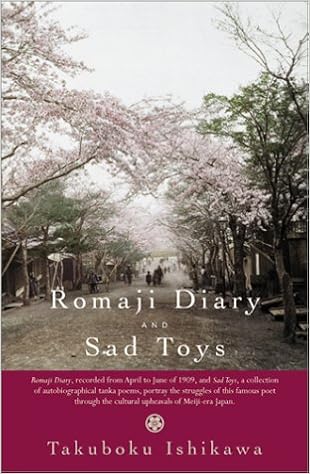
On "Sad Toys" by Takuboku Ishikawa, translated by Sanford Goldstein and Seishi Shinoda ****

Here's the reason I read the Romaji Diary--because Sad Toys was in the same book, and I didn't feel like I could justify just reading the book I was actually curious about, didn't feel like I would be giving Ishikawa full attention if I just read the more appealing work. While the Romaji Diary shows many of Ishikawa's most personal feelings in prose during a time of relative poverty (when was he not poor) but good health, Sad Toys is a collection of poetry put together near the end of his life while he was wasting away in a hospital bed. And Sad Toys is quite amazing.

Start just with the title. Toys--that is poems. For poems really are in many ways a poet's toys. For some who write poetry, poems are word puzzles. You take them apart, put them back to better, try to find the best way for all the words to fit, and there's no end to the process. Now, take a poet like Ishikawa, put him in a hospital at a time when he's becoming increasingly aware of his mortality, and clearly, such toys become sad--sad because that's all there is of his life, sad because he's dwelling on sadness. Many of the poems talk about his hospital stay. Many about his coming death, his desire for death (to relieve himself of pain) and his desire to keep on living. And some poems talk about the change in perspective that comes with such events. In one of my favorites, number 75, Ishikawa talks of reading old love letters. His observation? (All of the poems are typically Japanese, typically short--they're tanka.) So many spelling errors. And how true, really, years down the road, when we're no longer madly in love with someone we're just getting to know, all those little peccadilloes come to the fore. We don't speed through a letter the same way; rather, we say, You know, that woman/man never did spell very well! Such are the observations throughout this little gem.