Showing posts with label Kate Braverman. Show all posts
Showing posts with label Kate Braverman. Show all posts
Friday, November 6, 2015
On "Cocktail Hour" by Kate Braverman (6379 words) ****
Bernie Roth returns from finding out that he is no longer needed at the company he works at and once owned to find that his wife is leaving him, and neither his son nor his daughter are the people he thought they were. In fact, this whole story revolves around the ways in which things are often not what they seem--we are all actors playing our parts. I'm reminded a bit of the stories other men have told me who have lost wives to divorce, often without any real warning. They didn't fight, they say, but the woman one day said that she is not who she was pretending to be all these years. How much do we give up of ourselves to please others? And what are the consequences when we stop? You can read the story at her website here.


On "Lithium for Medea" by Kate Braverman ****
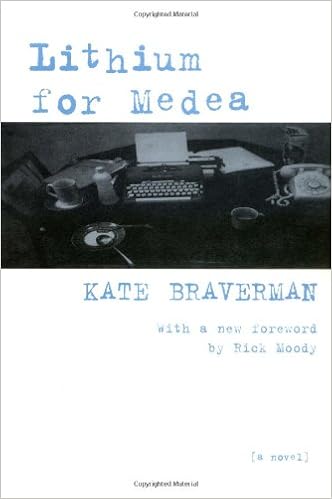
I'm also a bit taken aback by what I was writing at the time, which seems in many ways not unlike this first novel of Braverman's--a tale of family troubles with a dying mom (instead of dad). I feel as if I was probably conjuring Braverman while in her class, though I had not read this book. And I can see also how Braverman's ideas about writing come through in this work. You write good sentences and then you string a plot in afterward--you write the air, and then put a net on it. That seemed true hear. There was lots of air, lots of little chunks of things, that somehow got wrapped into this plot. Such makes for a work in which plot is not a centerpiece. We're not dying to know whether dad will live so much as to know what the next turn of phrase will be. That's why one reads Braverman--for the poetry.
And here, the language, of course, is lovely, as Braverman's language usually is. She makes metaphors seem so effortless and natural. But also what I was struck by with this text is how she uses the short sentence. The sentences are much shorter than I would expect, than I remember, for something so full of poetic language. It's as if she mixes her Hemingway with her Nabokov, and it is wonderful.
Thursday, January 13, 2011
On "Squandering the Blue" by Kate Braverman *****
Braverman's first collection of stories explores the lives of women overcoming drug and alcohol addictions (or giving into them). It explores colors--especially blue. And it explores language, as Braverman's work always does. Of the three books I've read of Braverman's, this one remains my favorite, in part because of the unity of theme, in part because when she hits her stride, the stories sting.
Sure, there are places where Braverman seems almost to get carried away with language, overwrought sections that probably could have been toned back. Her own obsessions are on display in reference to the turn of the millennium, which she mentions in poetic zeal numerous times. And some dialogue is incredibly pretentious, though in ways that make for interesting reading (a woman, in the midst of a nervous breakdown, in "Desert Blues," references theories of poetry and philosophy, and her friend knows exactly what she's talking about--clearly, this is a kind of obsession that afflicts both of these women).
However, the turns of phrase are largely extraordinary. A writer can easily put down lines that simply tell us what someone did or the fact that someone said something, but with Braverman, each line is like an emerald hacked from the center of a poem and then sanded for display, and we're not just talking ten pages of this--we're talking a couple of hundred pages. That's some dense prose, and some beautiful prose. One of my favorite sections of writing comes at the end of a story called "Falling in October," which becomes largely a rant on history that will make one want to sing--or to write something similar.
The best stories in the collection, however, manage to balance the need for story with Braverman's linguistic strengths. There are reasons that "Tall Tales from the Mekong Delta" gets anthologized so often. It has a narrative line, a consistent extended metaphor (that is easy to teach), and a whole lot of energy. The title story of the collection has also long been a favorite of mine, a tale about a girl growing up with an alcoholic mother. But of particular note this time around was a story called "Temporary Light." In it, a woman who has recently overcome an addiction problem suffers from the fallout of her previous life--and it is heartbreaking. She's lost everything, even as she has finally found the strength to start over.
Family also plays a large role in the collection. The affecting "Naming Names" explores the world of a kid growing up in an apartment, where other kids with sick or missing dads live and where residence means embarrassment at a high-class school. "Over the Hill" and "Points of Decision" reflect on a woman's attempts to break away from a abusive and manipulative husband. The families here are not healthy, but the people inside the stories are, by and large, survivors.
Wednesday, January 14, 2009
On "Pagan Night" by Kate Braverman (5063 words) *****
Want to keep your boyfriend? Want to keep doing junk? Want to get rid of a baby? These are the obsessions of this story. Some writers shock you with technique. Some writers shock you with subject matter. Some do both. Read the story here.
Monday, May 26, 2008
On "Tall Tales from the Mekong Delta" by Kate Braverman (6570 words) *****
This story is pretty widely anthologized and for good reason--it's one of Kate Braverman's best. I first came across Braverman while working in a bookstore. Her novel Palm Latitudes was a perennial presence on our sale table; I didn't like the cover and thus wasn't all that intrigued by the book. A short while after that book disappeared from our store, however, Braverman ended up being the teacher of a writing class I took. Then I'd have to buy the paperback at full price, so I could read what it was my teacher was writing. She was a different sort of author than I typically liked at that time--extremely lyrical. And her class was also seemingly difficult.
She taught--in class--with an intensity matched by few others. We'd have to bring in three-page exercises for review, and generally after she was done talking about them in class, we might have a sentence or two left. I wasn't used to that. But her mantra was that if we would learn what not to do, what not to write, we'd be 100 percent better as writers. Basically, it came down to writing what was not expected. I took this as lyricism given her own work and would for awhile adopt a similar voice. It would take many years to learn what she really meant and how to implement it without necessarily using some overly inflated language. And I would have those years, as I would take her class two more times.
As I took her class, I began also to appreciate her own lyrical voice. However, my real appreciation for that voice began with her story collection Squandering the Blue, in which this story is featured. The title story and this story especially managed to situate the lyricism within the simpler language I preferred and into a more quickly graspable conflict and plot. While the former story is one that resonates as very sad, personal, and realistic, the latter story, "Tall Tales," is essentially a tall tale, a story that manages to merge realism and fantasy to create something truly harrowing--a drug addiction, a man addiction, a fall into horror. Read the story here.
Subscribe to:
Posts (Atom)

 Posts


