Showing posts with label Audio. Show all posts

Sunday, February 1, 2026

On “James” by Percival Everett ****

I “read” this book over a weekend car trip via audio listening. It was a great production in terms of the reader being very engaging. The book itself . . .

I'd been wanting to get around to Everett's work since seeing American Fiction (based on his novel Erasure). Of course, all the awards James won made me understand the degree to which I needed even more to get to Everett's work. One presentation I saw recently called his sell-out novel, much like the work discussed in Erasure, insofar as this is a historical novel about the African American experience that tends to gobble up awards and sales.

In James, Everett sets out to retell Huck Finn from Jim's point of view, or at least, that's how it begins. In that sense, the novel is a refreshing retelling of some of the troubling aspects of the iconic novel. As fun as Huck Finn is and as much as Huck Finn sets out to right American wrongs with regard to slavery, its infantalization of Jim has always been disturbing. Perhaps, there are minor signs that Jim isn't the innocent he's portrayed as in that novel, but if those signs exist, Everett makes them explicit here, sometimes to comic effect. The enslaved workers speak in a patois and act stupid around whites, but are elegant and clever around other enslaved people. Everett makes explicit that they are “signifying.” And there are some neat tricks, where Jim, at one point, is forced to pose as a white guy posing as a black guy—with numerous complications.

On the whole, the first half of the book follows Huck Finn's timeline rather closely. In a way, it's great to read the events from Jim's point of view. But there's also a certain predictiveness to it, given that it's simply following another book's plot. The second half of the book, however, breaks significantly with its source material, and the work becomes a slave revenge work. There's power in that, I suppose, but also at points a certain preachiness that makes the piece seem overwritten. I was left feeling torn between my sadness at not seeing the rest of the source novel from Jim's point of view and my relief that this novel went another direction and thus ended up not being as predictable. Neither solution, however, seemed like it would have been wholly satisfactory.

Monday, February 10, 2020

On "The Decline and Fall of the Roman Empire" by Edward Gibbon ****

It's hard not to be astounded by Gibbon's accomplishment--a six-volume work on the history of Roman Empire from the time that the first emperors come on the scene through the final desperate acts as the eastern empire falls to the Turks and into the start of the Italian Renaissance. I listened to this book on a Librivox recording, rather than reading it. Eighteenth-century writing is difficult to read, and in many ways it's even more difficult to listen to. Gibbon, like most writers of the time, is flowery to excess. Worse, many of the readers are not terribly good--some I could barely understand, and others could easily put one to sleep. I often zoned out while listening, and when I finally finished some six months later, I was overjoyed.

Still, I found some sections of the book very compelling, even in audio form. These were mostly sections that I was interested in for my own reasons and thus felt more inclined to put forth the effort to really pay attention.

An exception to that would be Gibbon's account of the emperor Commodus, whose antics were actually fairly comic--he considered himself a sportsman and participated in gladiator events, much to the shock and horror of his patrons.

Otherwise, the portions I found most entertaining had to do mostly with early Christian history, Justinian's restoration of the empire, and Islamic history. In fact, I was rather floored by how much there was about the Muslims, the Mongols, and the Huns, but that's what Gibbon chose to do--not just to write about Rome but to write about the history of Europe, which in many ways is Rome and all that have had interactions with the empire's various iterations throughout its history. The first volume of Librivox recordings are available here.

Sunday, February 3, 2019

On "Necrophil" by Felipe Alfau **** (40 minutes)

"The Necrophil," from Alfau's *Locos,* is about a woman who dies for three months each year. Obsessed with death--she attends the funerals of strangers for fun--she has a kind of love affair with it. A doctor tries to cure her. Read the story here at Miette's Bedtime Story podcast.

Sunday, October 14, 2018

On "Mama" by Lucia Berlin (13 minutes) ***

In "Mama," Berlin returns to some recurring characters of hers. Carlotta here rehearses stories about Mom for her dying sister Sally, whose relationship with their mom was cut off when she married a Mexican--stories about alcoholism but also about love and sacrifice, some of them embellished. Carlotta may have stayed on Mom's good side, but Sally seems the more forgiving. Listen to Berlin read it here at Soundcloud.

Saturday, August 4, 2018

On "La Vie en Rose" by Lucia Berlin (12 minutes) ***

"La Vie en Rose" revolves around two girls on a visit in Europe who are swept up by two young dashing soldiers and are summarily dealt with by their strict father. It's a story about youth--youthful daring and folly--more than about anything sinister or hateful, rebellious or oppressive. Listen to the story here at Soundcloud.

Monday, May 14, 2018

On "Unmanageable" by Lucia Berlin (6 minutes) ****

The perils of a drunk (mother) are the subject of this story--how to get a drink so one can function and then get the kids off to school, all this before most liquor stores are open for the day. Listen to the story here at Soundcloud.

Sunday, January 1, 2017

On "All of a Sudden" by Carla Panciera (3018 words) *****

In "All of a Sudden," the first story from Carla Panciera's collection, Panciera paints the contours of a friendship from grade school into high school, showing how something so meaningful at one age can become something else at another, as we outgrow our various concerns. This is a sad story about the loss of friendship, even as other friendships take its place. Read the story here at New England Review or listen to it here at The Drum.

Tuesday, December 22, 2015

On "The Brother" by Robert Coover (13:36 minutes) *****

My favorite section from Coover's "Seven Exemplary Fictions" involves a retelling of the story of Noah's flood. In this case, a brother has been hired to help Noah build the boat. He works on it until it is done, thinking Noah mostly just a crazy man. Noah gives no real explanation for his actions, so when the brother finds that it is beginning to rain and that everything is disappearing under water, there's a rather grim pity we feel for him.

I could not help but think of the biblical story itself. Noah is regarded as a prophet in the scriptures, so my understanding is that his boat building was accompanied by warnings to those around and by preaching. The real tragedy in Coover's tale is that the brother is clueless--that there is no warning about what is about to happen. But then I think of how we are today surrounded by "prophets" who name an end date for the world that comes and goes. I have to think that one some level, people in Noah's day would have had a similar issue. Was Noah merely one of many predicting the world's end? Which person do we listen to, or should we just ignor them all? Is a proliferation of warnings, many of them false, any better than no warning at all? We live in a sad and pitiable world.

You can listen to Coover himself read the story here.

Friday, September 12, 2014

On "The Mating Behavior of Great Tits" by Joshua Malbin (12:13 minutes) ****

I'm not generally a fan of animal stories--that is, for stories told from the point of view of animals--but Malbin does something fascinating here in terms of really getting into the heads of birds as if they have the same kind of emotions that humans do. Much of what happens is that a bird comes to have peace with the way in which life goes from year to year, the cycle of life. I imagine that this is also the way in which we too come to have a certain piece with the elements of living and dying, with how those we know come and go, all the bits of heartache that come with it and the way that our lives go on. Listen here at the Drum.

Thursday, August 28, 2014

On "Taking" by Alix Ohlin (6:14 minutes) ****

Ohlin turns a childhood game into a metaphor for a much more serious and disturbing life event. The childhood game involves taking an object from a room and seeing if the sister knows what the object is. The narrator is not so good at the game, but some things can be taken that affect one forever thereafter. Listen to the story here at the Drum.

Friday, July 6, 2012

On "Down and Out in the Magic Kingdom" by Cory Doctorow ***

I'd never heard of Cory Doctorow until a few months ago when I was on a site called IWriteLike, where my own writing was compared to Doctorow's. That inspired me to dig this author out and find out a bit more about him. Doctorow, in fact, has a large web presence, but in a world as wide as the web, it's easy not to notice a lot of things. In part, this presence is notable because he's a big supporter of creative commons licensing and has released his own work this way: free to share.

I suppose one could say that Doctorow is a science fiction writer, and certainly this novel fits within that genre. But he's got a certain style as well that makes not only for easy reading but also joy. The writing reminded me a bit of many other contemporaries who focus a lot of popular culture in their literature; Douglas Coupland or Bret Easton Ellis, sans the violence, comes to mind.

Even more, though, this novel reminded me of the movie The Eternal Sunshine of the Spotless Mind. Like most science fiction, the themes and ideas loom large here, larger even than the characters, and like Eternal Sunshine, the book turns the tables on the bliss we usually imagine would accompany such things as eternal life or being able to wipe our minds free of bad memories.

In Down and Out, death has been cured. Bodies are cloned, and brains are stored and backed up like computer drives. This means that every few years, whenever your body crashes, someone else can simply restore your brain to one of the new bodies awaiting you. In a place where people live eternally in young bodies for thousands of years, time is spent not only getting innumerable degrees but also in accumulating popularity and good will (called "Whuffies") from others. More good will means ability to do more in the world, more choices, more luxury.

For the central character, it means spending time at Disney World, enjoying the rides and doing the occasional stint at the Haunted Mansion. It also means living in an eternal past, one that he worries about leaving upon his next reload. For somewhere along the way, he's fallen offline, so he's bound to lose his memories from the past year, when his last backup was done. This means losing the memory of his best friend, Dan, who has decided that eternal life is not worth the bother.

And in that rests one of the major themes of the book. Without our memories, what exactly makes life worth living? If we are the sum total of our experiences, and our experiences can be wiped away, then what are we?

Oh, there's a plot here all right, one that builds well, as one would imagine in a science fiction text. Someone is out to change Disney World, to update it, to, in essence, destroy many of the narrator's memories of a place. And it is this, this quest to keep the past always alive, that motivates our protagonist. But strangely, it is his unwillingness to let go of the present, to relinquish the recent past to return to an even older one, that leads to the book's denouement. Many versions of the book, including audio, are downloadable online here.

Monday, April 4, 2011

On "The Story of My Life" by Helen Keller ***

Helen Keller has becomes part of the national mythos. I've known vaguely, since I was a kid, that she a blind and deaf child who managed somehow to overcome her circumstances to get an education and to be of aid to other handicapped people. I knew Anne Sullivan was her teacher. And that was probably about it.

The focus on language as instinct got me to think about Keller and to various ideas that linguists are exchanging regarding language acquisition. Here, after all, was someone who had not learned language as a baby and yet still mastered it, who had not had a chance to babble--with hands or with tongue, to hear or to see language, and yet who still managed to learn.

But in the end, she does not discount the theories of Pinker or Chomsky, for Keller, as this early autobiography makes clear, had both sight and sound for the first eighteen months of her life. Hence, the instinctualists could claim that those early months were what allowed her access to our language-based world. Keller claims, for instance, that before she had lost sight and sound, she had learned the word for water. She called it "wa-wa." It is how she remembers that word sounding. And she claims to remember certain sights too (this goes against someone else's insights, wherein the author claimed that with the loss of sight, one's memories of it began to fade too).

"Wa-wa" proves to have crucial importance in the book (as it does in various movie adaptations of Keller's life), for it is water that Keller first learns to interpret in sign language--a language she has to learn by feeling her teacher's hands. Before this, apparently, there is some vague usage of signs for specific things, but by an large, Keller is cut off from language as a child, and her frustration with her situation is evident in the various tantrums she throws. How one could bear to live without either sound or sight is beyond me, especially if there is no means to communicate with the world outside one's self. It seems an utterly solitary life, like being buried alive. How Keller finally makes the intellectual leap to understand that signs have meaning and that each item has a name is beyond me. But she does it. It all seems very reasoned out in her autobiography.

A more difficult word for Keller is "doll," for it takes her teacher a bit more skill to convey to her that "doll" is not a specific doll but anything of this particular category that Keller is holding. "Love" proves to be difficult as well, for it demands the Keller begin to grasp that some words refer to things that are abstract rather than concrete. But each symbol is grasped in time. In total, given the reasoned explanations she gives for each step along the way of her learning, she seems one closer to confirming Geoffrey Sampson's claims regarding language than Pinker's.

And really, that is one of the amazing things about Keller's story, for she makes the leap to language not only in terms of learning to feel signs and to read braille but to read lips (with her fingers) and to speak with her own tongue, all of this through much effort rather than some innate ability. Nothing seems beyond this woman. She recounts her difficulties with math in school. Math? I can't imagine trying to do complex algebra in my head, for that seems the only way one could do it without the help of one's eyes.

Another amazing thing is Keller's attitude, which remains so almost completely positive throughout her educational ordeal. She's just happy to talk and to listen and to read. The last half of this book--after she finishes discussing her move into language and her education--is mostly about the books she likes and about the people she's met.

Finally, there is the way that Keller tells her story that is rather fascinating. One realizes just how much our vocabulary depends on verbs revolving around our sense of sight. There is much here in this text about touch and smell--the feel of the waves at a beach, the acidic essence of the air before a thunderstorm, the rattle of the ground near thunder--but Keller often will comment on particular elements she's experienced being the most wonderful thing she's seen, as if she's seen any of it. Moonlight and sunshine--both of these are words that call to our attention chiefly what passes before our eyes--but for Keller they are just as real, even if they are just a feeling on the skin. The book can be read or downloaded here, and the audio version here.

Wednesday, August 25, 2010

On "The House of Mirth" by Edith Wharton *****

In line with William Dean Howells's account of Silas Lapham, Wharton's story tells of a young lady who is ruined by doing right. There is a slight difference, however. Lapham seemed a man of mostly indubitable strength of character with occasional lapses; Lily Bart, of The House of Mirth, is a woman of seemingly weak character who transcends herself through the efforts of a friend and through the ties of love.

Lily Bart has been reared to prize money and to live with and among those who have it. Denied her rightful prize, she has something to trade to obtain what she deserves: good looks. From the start of the book to its end, she sets out to marry a rich man who will make her life as full as it has been promised to be. But in that process, she discovers--sort of--that happiness doesn't consist in the riches one has but in the kind of person one is. I say "sort of" because she seems conflicted about this right up until the very last few pages. Were the story to continue, to be able to continue, one wonders whether Bart would renounce her ideas of happiness in feeling and return to happiness in riches. She seems very closed in by her upbringing and the values that she was reared with.

But I guess that's sort of the point. At one place in the novel, Lily Bart discovers that, raised to be rich, she really has no value as anything but a showpiece. At first, she detests work; later, she comes to see that she can't even do it.

Who Wharton wrote this book for is something I've been wondering. Certainly, the same forces of fate work on Bart to create its miserable end as one might find in many a novel of the period. But Wharton's bitter swipes at the immorality of the upper class would wipe away any sympathy among that set. This leaves the lower classes--or more likely the middle classes, able to have some time to read--as the audience, those able to be swayed by the author's argument that money ain't everything. But isn't it? If money doesn't bring happiness to Lily Bart, it certainly makes life more tolerable, and its lack draws her demise. Sure, she can take a certain comfort in family life, but I'm tempted to see this as a seemingly easy answer meant to squash down the rabble rousers wishing to move forcefully into the higher echelons of American society. Be content, Wharton says. But why?

Or why not? Is not America in part about striving toward being better off? Does not that itself make the American dream a bit of an delusion.

Download the book to read for yourself here or to listen to it here.

Tuesday, April 27, 2010

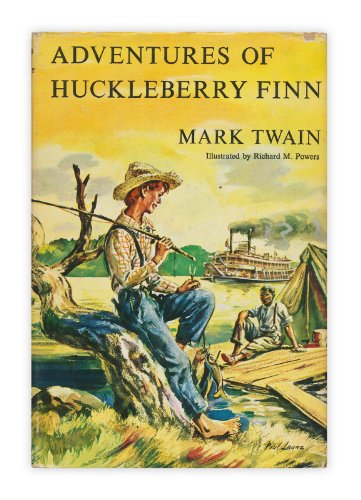
On "The Adventures of Huckleberry Finn" by Mark Twain *****

One of the few books virtually every American has read, the novel has stood the test of time, mostly. I read the book for the first time around age thirteen, and then I read it for class around age fifteen. I hadn't read it since until . . . a year or so ago I was reading for an audio recording, and the text I was to read that day was Huck Finn. The section, as I recall, was one of the chapters having to do with the king and the duke, and I couldn't help laughing at points and having to go back and rerecord. I have to read this again, I thought.

Now here I am reading all these American texts written between 1870 and 1920, mostly books I failed to read while in college but that are iconic nevertheless. Sneaking in a reread of Huck Finn onto this list seemed quite a perfect fit. Twain, writing over one hundred years ago, still seems fresh in the twenty-first century. He plays with dialect. He plays with an unreliable point of view. And he's still funny.

As with most critical assessments, I do find the latter third of the book a little disappointing; once Tom Sawyer shows up, the novel gets rather silly, and the slave Jim, always a bit too childlike so as to be a bit disturbing, becomes downright stupid. And yet, it's possible to read these latter sections as part of Twain's point. Jim, not assessed as a human being by most of the slave society around him, isn't treated any better by the boys; he is infantilized by the racist society, and what for him is a matter of freedom and slavery, life and death, is just fun and games to Tom.

The most humorous passages, though, revolve around the king and the duke, a tiresome duo that take up the middle third of the book. While funny, there's something sad about the dirth of quiet moments in the book once they show up, as the most beautiful passages are those in which Huck and Jim simply float down the river, and we get to listen and look in.

The book may be downloaded here from Project Gutenberg, and the audio here.

Tuesday, March 16, 2010

On "Ragged Dick" by Horatio Alger ****

One hears about Horatio Alger stories in school, but I don't know of anyone who has actually read one. Going into a stint of reading in American literature from 1870 to 1920, especially focused on realism and naturalism, I decided to also include a couple of pieces of popular literature from the period as well in order to get a feel for how realism compares.

Ragged Dick is the name of the book's hero. He's a shoeshine boy (a boot-black, as the novel calls such). At the start, he's an honest chap who likes a good joke and who spends all of his earnings on shows and drinks each night. At some point, he meets with a better-educated young man, and this man instills in Dick a desire to make better of himself. Rather than spend his earnings, he should save them. Then he could rent a room, have nicer clothes, and get an education. And so that's what Dick does, and his fortunes, with minor setbacks, keep getting better and better.

The moral is clear. Get an education and work hard (and be generous with others) and you'll make a success of yourself. Although true in theory and generally true in life, things rarely seem to come as easily, or with as little cost, as they do to Dick. The cynical part of me kept wanting to see Dick fall into a real hole through no fault of his own and truly struggle (as would happen in a naturalist novel), even if he comes out better in the end.

Early in the story, Dick agrees to make change for a man. The clerk in the store where he goes claims that the bill is counterfeit. Now Dick is out of his earnings and in danger of arrest. Here are the makings for a tragic novel and a very interesting plot. But this is Alger's world, where virtue is always rewarded and almost always immediately. As a result, Dick's story becomes more like a picaresque series of episodes than a heavily plotted novel. Dick goes outside and gathers the man who gave him the bill; the man claims the bill wasn't fake; the owner of the store comes out; the clerk gives in and hands the bill over, and then he's fired for attempting to jilt a customer out of money. Honesty prevails, in a city, known in the novel for its array of swindlers.

Yet, despite the episodic nature of the story, the novel is a fun read that rather pulls you in and along. Maybe it's the prospect of seeing Dick rise in the world that does it, or maybe it's that despite the rather corny nature of the whole work, one actually ends up liking Dick and caring for him and being glad when things turn his way.

The text is available for free here, and the audio version here.

Saturday, December 19, 2009

On "Police Operation" by H. Beam Piper (12,438 words) ***

Something is loose and killing farm animals, slashing them to pieces. The folks around the valley are after it. And one man has more at stake than all the others. He knows what the thing is. What is supernatural? Are people who claim to see UFOs seeing something from another planet? Are they seeing something we make right here on Earth? This story has its own answer, and it's no X-Files conspiracy. Read the story here at Project Gutenberg, or listen to it here (part 1), here (part 2), and here (part 3), at Project Gutenberg Audio.

Thursday, January 22, 2009

On "Present at a Hanging and Other Ghost Stories" by Ambrose Bierce (17,528 words) ****

I haven't read many of Ambrose Bierce's writings save the heavily anthologized "Hanging at Owl Creek Bridge" and a few scattered definitions in his Devil's Dictionary, but I can say that I'm going to read more. Give it a year or so, but he's on my list to be read with others of his era, and deservedly so. This short book of ghost stories is reminiscent of many a campfire tale. Or really, for me, I think of such stories not around a campfire but in a dorm at summer camp. The lights are out, and if there's anything, it's merely the eerie glow of someone's flashlight pulsing from underneath a sleeping bag. We're supposed to be sleeping. But instead, one of the folks in the dorm is up telling a story, trying to get us scared. And then . . . the counselor wanders by and we all get into trouble. When he's gone, we go back to telling stories--until he returns. I can't say our storytelling ever reached much of a crescendo, since most were interrupted by the enforcers. Still, these are the kind of stories I imagine being told, complete with endings.

One of my two favorites in this book is "A Man with Two Lives," the story of a man who is killed and returns to the dumbfoundment of those around him. The story has a surreal quality about it insofar as it's not really a ghost story but a story of a person who somehow manages to return to life. The other is "At Old Man Eckert’s," the story of three friends who agree to visit a haunted house--one of them doesn't make it. It's ending words are particularly creepy. All of the stories are short, easily read in five-minute bathroom sittings. You can grab a copy here at Project Gutenberg or even download the audio version here--it's quite well read.

Thursday, January 8, 2009

On "Flight from Tomorrow" by H. Beam Piper (8154 words) ***

A deposed dictator gets away--in a time machine. He'll be back (in Arnold's words)! He's coming back to reap revenge. But there's a problem. The time machine takes him back further than he intended--and then it stops working. So here he is, stuck, in the 1950s. Easy enough, one would figure, for a person with a lot of two-thousand-years-in-future tech savvy to take advantage of virtually anyone. (Though I keep thinking I'd know even less than most people in the 1750s knew about day-to-day getting along. I may know how to use some tech things, but I don't know how to make them!) However, for our dictator, there's a slight problem: all living things in the place where he landed appear to be suffering from disease. Will he succumb and die too? Read the story here at Project Gutenberg, or listen to it here at Project Gutenberg Audio.

On "Five Sci-Fi Short Stories" by H. Beam Piper ***

I haven't read too much science fiction, though I intend one day to get down to reading a list of the absolute classics, much as I did with mysteries and pulp fiction. In the latter case, I actually became a kind of fan. I learned to appreciate a genre I hadn't paid much attention. Certainly, there is plenty of bad crime fiction, but that's not enough reason to dismiss the whole lot. I figure the same is likely true of science-fiction.

About a decade ago, I read Philip K. Dick's Do Androids Dream of Electric Sheep. I enjoyed it quite a bit, though I found the writing style to be pretty unmemorable. What intrigued me about it were the plot and the ideas. And I guess, really that's what science fiction usually excels in--ideas or well-crafted plots. Being a literary fiction person, plot is not something I typically read for; though I do enjoy something that is well put together that way, I'm not motivated generally to seek out such works.

I would say that Piper's work falls into that sci-fi mode. Of the five stories presented in this collection, two I could have probably gone without reading. The plots were derivative, the ideas not terribly fresh. But I was digging on Piper by the third story. Now, suddenly, the plots took on a freshness reminiscent of a good movie. A dictator travels in a time machine and ends up in a place he didn't expect with unexpected consequences. A set of farmers chase after some wild creature, little realizing just what that creature is. A young man's return from education on another planet promises much for his home--or maybe nothing at all. In this latter story, the people's hopes become a taking off point for discussion on what gives us hope and how real that hope is. If Piper's stories faulter anywhere, it's probably in that he sees a need to explain the pseudoscience to his readers. Maybe sci-fi people get into that; for me, however, if it's not real science, I'm not particularly interested in the theoretical aspects of space travel.

Piper's collection is in the public domain. You can listen to the stories here.

Wednesday, December 3, 2008

On "Love among the Chickens" by P. G. Wodehouse ***

Save one story, I haven't read P. G. Wodehouse since high school, and then I only managed to read one book. I remember then being disappointed that I hadn't discovered him earlier. You see, in high school, we had to read four thousand pages a year outside of class to earn an A in English. Senior year was British literature, and our teacher demanded we read only Brits. So I was stuck reading the Victorians--that is, mostly a lot of stuff I didn't particularly care for. In the last quarter of the year, I discovered Evelyn Waugh and P. G. Wodehouse. By then, however, my reading list was coming to an end. Had I known of them at the start of the year, I have a feeling that a good chunk of senior year would have been spent reading their works. I also figure I'd have ended up doing the senior paper on one of them; instead, I settled on Thomas Hardy, the Victorian I could stomach the most.

Why I never made it back to Waugh or Wodehouse, I'm not sure. It's not for lack of reading. And it's not for lack of wanting to read more. I've just been distracted by others, I suppose.

But now, coming to Wodehouse twenty years later, he doesn't seem as fresh or funny, at least not in this particular book. The story of a man who is cajoled into working on a chicken farm with his friend and who in turn falls in love with a local woman seems a bit stock in terms of the characters and even some of the plot twists. Is it me, this book, or Wodehouse that is the reason for my relative disappointment? That I won't know unless I read another. Of course, that might be another twenty years.

The text itself I actually listened to, on my walk home each night, now that it's dark as I leave work. And the audio available online for free is, in fact, quite good. One thing I can say for Wodehouse is that his work, as light and modern as it is, is sure a lot more enjoyable to listen to than one of those verbose Victorians, even if a bit stock. Read the novel here. Listen to it here.