Showing posts with label Collections. Show all posts

Wednesday, November 4, 2026

On “The Brazil Reader” edited by Robert M. Levine and John J. Crocitti ***

There's a second edition of this work with different editors that I realize now may have been better to read insofar as it would have included another twenty years of writing—that is, it would have included the Internet age, which was barely getting started when this first edition came out and plays no role in this volume. I chose the first edition, however, because it seemed organized in a manner more in keeping with what I was looking for. The first five parts are mostly readings that follow the historical development of Brazil, and the last four parts focus on cultural subjects—namely, women, race, economics, and popular culture (mostly music). The other subjects, of course, come up in the first five sections, but there's a nice balance here in terms of giving a reader a very general sense of the Brazilian experience.

I had read chapters about Brazil's history in books about Latin American history, so I didn't think that a book just recounting the history of the country was going to be as helpful to me as a book that would more fully also explore the country's culture. This book was a nice balance. Each of the parts comes with a short introduction, so essentially one stepped through history while reading the book. But then that history was backed up by primary documents from the period in question and sometimes further historical articles on a specific aspect of the period involved.

The first part revolved around Indian life and the explorers. Included among the readings was a creation myth that was more easily approached than many Native American stories in that regard. There were also Western accounts of Indian culture. The second part dealt with the colonial period and the familiar story of how Portugal's monarch actually came to be in Brazil for a while and liked it so much he didn't want to return to Portugal but was forced to do so. Part 3 dealt with slavery and its aftermath. Part 4 dealt with the Vargas period, when Getulio Vargas essentially ruled as a dictator after having come to power in an election. And then part 5 dealt with the military dictatorship that followed and finally the reestablishment of democracy, which at the time this book came out had only been active for about a decade. It was trippy seeing the names of some politicians who are still active in Brazil in that last historical section and to think the Brazilian democracy has managed to survive a couple of decades more.

Along the way one learns about how the arts didn't seem heavily impacted by the dictatorship, which seemed focused more on practical things. As such, subtle critiques of the regime often snuck by in music and literature, before being banned. One learns about racial dynamics in Brazil, which of course mythically are said to be nonissues but really are just like so many other areas of the world: the lighter your skin, the more advantages you have. There's a little about sport, a lot about music, making me wish that I'd more often had access to the Internet while reading so that I could play some of the styles of these songs to know what the authors were writing about.

Overall, one gets the sense of a country that is, unfortunately, like so much of the third world, a study in contrasts: a small very rich class and a large very poor one. There was one essay about a movie from the 1970s that focused on children growing up in the latter milieu and what became of them (though as stars of the film their lives had opportunity to go farther than most others, at least for the star of the film, things ended up badly); the film itself sounded a lot like the 2000s film Children of God but a whole lot more bleak: gangs and crime aplenty, with little way out.

Thursday, August 6, 2026

On “Tenth of December” by George Saunders ****


I'm referencing the collection in the title, not just the story, which is the last story in this collection.

I first became familiar with Saunders not long after his first collection was published, Civil War Land in Bad Decline. I liked the title, but what really got me to read the book was the fact that a friend of mine was a huge fan of it and thought our story styles were somewhat similar. (That was a huge and unwarranted compliment, honestly, given what Saunders has gone on to be and what I have not.) Alas, I was not that impressed with the collection outside the story “The 400-Pound CEO.” Saunders's stories were weird and dark, but they often didn't really add up to much to me, didn't have much emotional resonance.(What we had in common, in the estimation of my friend, I'm guessing, was the darkly comic and sometimes weird.)

A few years later, I read the story “Pastoralia” in a Best American Stories collection and was very impressed. I love that story. But I never got around to reading Saunders again, until now, with this collection.

Alas, this collection strikes me much as that first collection did. It was enjoyable, but I didn't feel like I got much out of most of the stories.

Except, like the story “Pastoralia,” there is one story that blew me away, and that is the very first, “Victory Lap.” I heard the first part of the story read on a podcast and wasn't that interested. And I wasn't that interested reading that first section this time. But at the first break, that's when things get really interesting. The story is a lot like Joyce Carol Oates's “Where Are You Going, Where Have You Been?” insofar as it involves a young gal taking up with (or better, being taken up by) a much older man in a sinister kidnapping way. But it goes in a different direction from there. The piece is about childhood and about ideals that we have and also about how we reconcile our values, as kids, the sometimes instructions we are given, and what is right and wrong in a given circumstance. And it's about the end of innocence, even as its about its preservation. It's just marvelous.

And with that sort of beginning to the collection, maybe it's natural that the rest of the collection was something of a disappointment. After reading one of the best stories I've ever read, nothing was going to match it and everything was going to be comparatively a disappointment.

Many of the stories focus on class differences, and like “Pastoralia” and “The 400-Pound CEO,” many focus on weird dynamics of work and office and its attendant, sometimes absurd rules. All are dark and many are funny, but like that first collection, many didn't really spark an emotional connection for me.

“Sticks” is a short short about a trash heap and moving. “Puppy,” probably my second favorite in the collection (because it has a modicum of the emotional connection), is about a rich mom and her kids and how she tries to protect them as they go to adopt a puppy—and also about a poor mom and her kid as she tries to sell said puppy. The latter's circumstances are shocking, and some of these go beyond class, I am sure, but much of them go directly to the opportunities that family has had in life versus the first. The misunderstanding and the rich woman's resolve at the end make this piece devastating.

“Escape from Spiderhead” was a sex dream, I suppose, with comments about science and culture and class as well, as prisoners are given drugs that change their emotions in ways that can lead to death and love. “Exhortation” was an absurdist office memo about making better (sales) numbers. “Al Roosten” is about one of those celebrity auctions with local celebrities and a man who feels he hasn't done enough with his life and regrets the action it takes him toward. “The Semplica Girl Diaries” focuses on a family trying to keep up with the Joneses, essentially, which involves a strange form of keeping personalized third-world slaves. “Home”—probably my third favorite—involved a military vet who did something vaguely horrible during his military service that has all his family vaguely disowning him on his return. It shows up the kind of superficial respect we give to the military even as we reject their actual needs. (Probably most heartbreaking is the way in which the man's own wife had run off with someone else while he was away, and now he's locked out of his kids' lives.)

“My Chivalric Fiasco” returns to the office, focusing on a discovered affair and written in faux medieval language. The title story, the final one in the book, returns to the world of teenage fantasy, as a boy wanders out into the woods on a cold day dreaming of a gal and discovers an old man intent on killing himself—only to have the circumstance completely turn on itself.

Sunday, September 29, 2024

On “The Edge of Marriage” by Hester Kaplan *****

I was blown away by this collection when I read it about twenty years age, which is why it resides so much in my memory as a great work. This time around, I could see the skill involved—Kaplan is a remarkable writer—but at the same time, I felt more manipulated. I'm not as much of a fan of fiction as I once was. What made me like fiction was that I felt like I was getting a deeper glimpse into the society and the people in it than one could get from nonfiction; these days, though, I tend to feel all the more the writer's use of puppet strings, the artistry of the fiction itself, which rather undoes the mistique of genuiness I used to find in such works.

Most of the stories in Kaplan's first collection, as one might expect from the title, revolve around marriages in some state of disrepair. “Would You Know It Wasn't Love?” subtly hints at a man's growing dimensia even as it revolves around a grown daughter who has come back to live with her parents after her marriage has proven to be somewhat less than satisfactory; the dad is not too keen on this, even while the mother seems perfectly fine with the situation.

“Dysaesthesia” is the most powerful story in the collection and the one that probably sold me most on the book when I first read it. An older first-time wife who married in part just to be able to have a marriage and family finds herself with a husband, an art professor, who is a prolific cheater, even as she attempts to raise their daughter, who idealizes both parents. The issue, however, is that one of those cheating sections goes disastrously awry, and now the wife finds herself the likely caretaker to a mostly disabled and unemployable husband. Were it not for the daughter, I would figure this marriage would be on its way to a quick divorce. As it is, however, one really ends up feeling just awful for this woman and the family in general—and even a bit of the husband's frustration.

“From Where We've Fallen” involves another couple with an adult child, this one a kid who can't hold down a job except as employed by his dad. Alas, even that is tenuous, as the son's actions put his father's business in jeopardy, and the father finds himself lying to protect his family but in the process hurting others.

“Cuckle Me” focuses on an old man and his youngish female caretaker, one who has come to love him almost as a husband, even as the man's son isn't particularly keen on the closeness that has arisen between the two.

The title story focuses on an older couple, the wife of whom has lost her best friend, leaving of course just her husband as her main social conduit. The story basically details how our relationships change with age. “Goodwill” walks a similar line, this time with a daughter grieving her mother's death, as she goes through her mother's things deciding what to keep and what to throw away (probably the weakest story in the collection, insofar as there are no real surprises here, and it seems mostly just a laundry list of items attached to memories).

“Claude Comes and Goes” focuses on a couple and their best friend—an ex-lover of the wife's, who lives a stereotypical bachelor life: different women all the time, never eating at home, and so on. In this case, Claude tries to establish a relationship with a grown daughter of his who had previously never met, but as with so many such storylines, the bachelor finds that his no-connections lifestyle is not conducive to suddenly having a relative care about him.

“The Spiral” focuses on a stairwell in a house's center, and a couple's relationship with it, with the older not-so-healthful husband confined to the downstairs and the wife with her own life upstairs, until of course life changes the way they use the different parts of the house.

“Live Life King-Sized” focuses on a grown son who takes care of a resort that his family owns. But really, it's about that son's relationship with a man and his wife, a man who has decided to live out the rest of his life, what little there is of it, at the resort, scaring away other patrons in the process.

Wednesday, March 1, 2023

On "Beyond the Great Snow Mountains" by Louis L'Amour ***

Only one story in this collection is a Western; most fall under the adventure or crime/detective genres, but this was the only book available by L'Amour in the library, and I wasn't going to skip him in a reading list on Westerns.

A friend of mine growing up was a huge fan of L'Amour, had probably read all of this stuff. The friend could read at an incredibly fast clip, but if he had only read L'Amour, I would likely not be impressed, now that I've read this writer. The reading is not challenging. My friend, though, who had mastered speed reading to such an extent that he could look not just at sentences at a time but whole pages, would read Leon Uris or Charles Dickens novels in a night, so I know that he wasn't sticking just to short, simple books when he bragged of finishing so much so quickly.

That said, his admiration of L'Amour does make me think that perhaps he was more inclined to like heavily plotted material rather than strong characters. Indeed, from the collection, I would get the feeling that that is really all L'Amour was about. Sometimes, character motivations and actions seem secondary and nearly defy logic. Then again, I was reading a book published after L'Amour's death, made up of stories he did not publish in a collection in his lifetime, which suggests that even he may not have thought this his strongest work.

The collection consists of four stories. The sole Western, "Roundup in Texas," involves the familiar tale of a cattle rustlers and a man who sets out to save the cattle for a gal, ending, of course, in a shootout.

Among the adventure stories is "By the Waters of San Toledo," about a woman whose father dies and who is stranded in a faraway place with a man who she doesn't like but who thinks she should not belong to him. There is gunfighting, and a daring escape attempt. "Crash Landing" is about a man attempting to save passengers from a plane wreck that is precariously propped on a mountainside. "Coast Patrol" involves World War II pilots and ship captains and takes the prize for the most ridiculous character transformations--a woman whose father dies (a common trope, it seems, in these stories) is now due to be married to one of the seamen, having known him for a year and come to depend on him; Turk Madden, however, a U.S. flying ace who is flying for Russia, after discovering much of the ship's crew dead, tells her that the seaman is the one responsible and, in fact, that he is a traitor to the United States government who is on Japan's side. The woman immediately, despite receiving nothing but Madden's word, turns sides, taking up for Madden, and disavowing the seaman, her fiancee, despite his protests. After Madden kills the traitor, she and Madden get together. Not sure why she would betray her one true love on the word of a stranger. The title story also fits the adventure model, this one about a woman stranded in a faraway Asian country, who marries a local and who finally has a chance to return to the United States, but whose true desires are very much tested.

"Meeting at Falmouth" involves a twist ending that is hardly worth the fifteen or so pages it takes to get to it.

Two stories involve boxing and tough guys' attempts to make boxers throw fights for gambling money--"Sideshow Circus" and "The Money Punch."

Contemporary crime stories include "Under the Hanging Wall," about the murder of a mining employee, and "The Gravel Pit," about a man whose attempt to take off with a company's payroll goes awry such that he has to kill another man.

A man who writes adventure has to know how to describe a fight, I suppose, and L'Amour was certainly good at that. Much of many of the stories runs through the various punches each character throws, and somehow, one is able to keep track of what is happening. It's good action--but often not much more.


Thursday, March 4, 2021

On "The Pearlkillers" by Rachel Ingalls *****

I read this book decades ago, when I was in the twenties, at the suggestion of the manager of a bookstore where I worked. Although the manager's taste in books was good, I always remained somewhat resistant to her suggestions. I think the reason is that she was an older white lady, which gave me the feeling that she would like tasteful English women's novels. It is not--and was not--a fair stereotype. The books she recommended that I actually got around to reading proved to be extraordinary--and nothing like the dainty works I imagined she would have been into. This is one of those.

All these years after that initial read, I've kept this book on my shelf. I knew I liked it--a lot. Strangely, however, I haven't read it in the ensuing decades, and that same old prejudice has stuck with me on this one. Do I really want to read this book again? What did I see in it? However, I was taking a trip and I needed a book to read, and in my systematic way of rereading, I was on the letter I. I chose Ingalls. What had I liked about it?

Wow. This book is killer--and that quite literally. The title suggests a theme that continues through the four long stories (or novellas) that make up the work. It comes from a passage in the third story in the collection, which is about a woman who goes to meet her deceased mother's family, whom she's barely ever met. One of her aunts tells of people who when they wear beautiful pearls literally kill them--somehow sucking the vitality and life, the sheen, out of the jewel. Such is the family itself, as we come to feel and see, as the story, which has a magical realism feel, winds its way to its end, wherein the family appears to have some sort of secret to immortality, one that involves sucking the life from others.

The central idea, then, conveyed in the collection, is one of killing the people you love in order to manage your own survival. In the first story, a twice-married young woman goes on her honeymoon with her third husband, scared that somehow she is cursed with an ability to kill off lovers but also aware that she doesn't really love the man she is with.

The second story is my favorite of the book--a thriller and an absolute brute of a piece. College friends accidentally kill/bully a young man in their dorm and hide their part in the death. Years later, one of them decides to come clean. What to do? That is the heart of the discussion among the other surviving friends.

The fourth story, the longest, is also quite brutal. It tells the tale of a explorer/sailor returned to his family after a decade missing, the lone survivor of the journey. Or so we are made to believe.

Monday, January 13, 2020

On "Zero db and Other Stories" by Madison Smartt Bell *****

I read this book nearly twenty-five years ago, back when I was in grad school. I went on to read another book of Bell's stories, which was about as good as this one. At the time, however, I don't know that I was necessarily that impressed. Rather, this was a book that stayed with me, the way a movie called The Conversation stayed with me, kept me thinking about it for weeks afterward.

The two stories that are my favorite in this collection fall at the start of the second section, which is my favorite section of the book. The book as a whole is set into three sections, with "three" being something of a motif in this work, as designated by the first and last stories of the first section. Those stories are called Tryptichs--they are stories in three parts.

Triptych I is about a little girl at a hog killing. Where Bell excels throughout the collection is in his somber attention to detail, and that's what makes this otherwise less interesting story impressive. It's set in the South, among black folk and white, and burning and accidents are something of a theme throughout the three disparate parts.

"The Naked Lady" is a powerful piece of wit and writing skill and was the one that most impressed me when I first read the collection. It's about the friend of an artist, their horrific home, the sculptures the artist creates, and the rats they kill.

"Monkey Park" is another sort of hopelessness--this one involving a couple that isn't.

"Triptych II" focuses on different ways of dying, one among peacocks, one an old man, and one a bull. The idea here seems to be that people are little more than animals in the end, facing their final hours. And it mirrors the final story in the collection.

The middle section includes six stories about young men (or a young man, as many of the stories seem to be about the same person and arguably all of them could be) fighting--or perhaps, more so, giving into--depression. "The Structure and Meaning of Dormitory and Food Services" involves a young man who goes off to college, does well for a few months, and then sinks into a morass wherein he stops bothering to attend classes and spends most of his days on the "sad" side of the university cafeteria. Here, a blind man is sat down by him each day, but the blindness is really the narrator's own, as he is lost without knowing how to escape his own lethargy.

"Irene" finds a young man living in a Hispanic neighborhood with cheap rent. The man knows little of his neighbors and few of them, but he forges a kind of fascination with a twelve-year-old girl that is at some level a bit creepy but at the same time a kind of cry for connection--with someone, anyone.

"The Lie Detector" involves a young man who loses his apartment and has to go find a new one. Thing is, his old landlord seems to be trying to stiff him on the deposit; his new landlord seems to be trying to ask for extra kickbacks in order for him to move in; and true to form, the narrator himself begins to apply similar sorts of dishonesty to grift a bit more cash for his needs.

"I Heart NY" involves a young man trying to do just the opposite--that is, to be a responsible and good citizen. He takes real interest in those around, but the city doesn't seem to care much for or about him, and when he tries to help others, it rarely works out. Police don't come to assist. Muggers he catches turn out to be the wrong person, and so on.

"The Forgotten Bridge" focuses on the same young man as in "Lie Detector" after he is in the new apartment--and on the relationships he forges with his Hispanic neighbors. There's a kind of sadness to the tale insofar as it's told from a distant time with a certain amount of nostalgia, though it's nostalgia for a time that was rough on all of the people involved.

"Zero db" is about a man who works on sound for motion pictures and other productions. Here, he's recording people in a bar after a particularly bad day at work.

The final section/story is "Today Is a Good Day to Die" and focuses on an officer in Custer's army out west who is rescued from a snow storm by the Indians Custer has tried to and will try again to kill. This leads to some uncertainty in the officer regarding his role and purpose in life.

Monday, August 5, 2019

On "Collected Stories, 1891-1910" by Edith Wharton ****

This collection of writings from the first half of Wharton's writing life runs the gambit of subject matter.

"The Fulness of Life" works off of some fairly banal tropes: A woman at the gates of heaven finds the love she's always wanted, except it means that her husband will have to be alone for eternity because she was his love for all time. Guess what happens?

In "The Lamp of Psyche" a woman in love with her husband discovers that, though able bodied, he did not fight in the Civil War. Why? Her idealistic bubble is burst.

"The Valley of Childish Things" is a series of short vignettes that read almost like jokes. It's a strange piece that I'm not sure adds up to much--but that leave one with lots to ponder.

"The Muse's Tragedy" is about a literary critic who finds the companion of a dead writer he's written extensively about. The companion and he forge a relationship, but as the story proceeds, we move from third person to first and learn the truth of the companion's relationship to the dead writer, which is not, at least as she perceives it, the way that others have perceived it.

"A Journey" is a melodramatic tale about a woman who has to bring her sick, dying husband home but who seems unwilling to let anyone else know he's dead once he kicks the bucket. The piece seemed overwritten to me, like something I'd expect to see in some slick magazine for people looking for "thrilling" writing.

"The Pelican," by contrast, is one of the best Wharton stories I've read. It's a tale about a man's various meetings with a woman over the years, but it's tone is such that it gripped me from start to finish.

"Soul Belated," about divorce and non-remarriage, feels both quite modern and a bit dated, insofar as society standards go. Wharton is a curious figure insofar as her writings about relationships go--her modern sensibility fits in well today, but she was writing in and for a time when views were quite different.

"The Twilight of the God" is a short play and seems out of sort with the stories in the collection. It focuses on the ways in which we idealize relationships of the past to the detriment of those in the present.

"A Cup of Cold Water" is another study in class, which so many of the Wharton stories deal in. Here, as with many of her protagonists, a man has gotten in over his head, taking out a gal whose tastes are far too expensive for his salary, and pays the price.

"The Touchstone" is a novella that touches a bit on class (a man needs money to marry) but even more so it deals with questions of what we owe to the dead and to those who love us, even if we don't love back.

"The Duchess at Prayer" and "The Angel at the Grave" both in their own ways deal with the way that one responds to death and to the legacies that people leave behind, the first a statue of a woman at prayer and the second a man's storied ideas.

Fine art figured large in many works by Edith Wharton, as in "The Recovery," which revolves around a woman who marries a painter whose reputation is such that he is hired to paint for various patrons and even to have a show in Europe. In "The Rembrandt" a woman attempts to sell an "unsigned" Rembrandt--something no museum would be interested in precisely because it lacks the signature. "The Moving Finger" combines with art the macabre, when a man who loses his wife asks that a painting of her be continuously updated so that she ages with him. "Sanctuary" focuses on an architect who is faced with an ethical dilemma.

"The Descent of Man" focuses on the difference between economic considerations and values/science in answer to the question regarding the prostitution of one's writing versus true art.

"The Mission of Jane" is a tale about adoption told from the point of view of the ambivalent (even negative) adoptive father. The story ends with the father finding love within him, as one would expect, but not in the same place where one would usually expect.

"The Other Two" is a fine tale ahead of its time, focusing on a newly married man and his relationship with his divorced wife's two previous husbands. "The Reckoning" continues on that theme, with a woman coming to terms with what it really means to divorce someone after her second marriage ends.

"Expiation" is another piece focusing on writers--this time, on the nature of what makes a particular work popular.

"The Lady's Maid Bell" is a well-put-together ghost story with a ghost that is perhaps a bit more interactive than in most such stories I've read. "The House of the Dead Hand" is another ghost story, but only in its final moments--before then, it is a gothic tale around which the mystery of of a masterpiece makes the piece one that one can't stop reading.

"The Introducers" is a forgettable romance story whose plot is predictable from early on. "The Hermit and the Wild Woman" is another less intriguing story, this one reading like a Catholic fairy tale.

The very fine "The Last Asset" is a kind of psychological horror story, insofar as the main character learns how manipulated he has been when helping a lady with her daughter's wedding. "The Pretext" also works off the idea of love used as an excuse to perform certain actions that are not as genuine as one desires; here, an older, married woman falls for a younger man who also falls for her and who drops a fiance because he can't handle marrying someone else, much to family consternation. Does he love her, or is something else going on?

"The Pot Boiler" returns to the theme of art versus money. Here, an artist is convinced to paint portraits of society ladies for good cash, hence, compromising his artistic vision. Wharton seems to suggest that it's okay for folks without real talent to paint (etc.) for money but that it's a waste for a person with talent, who should live in poverty for art until discovered. I used to have conversations with a roommate on this subject, who viewed folks who wrote pop lit as hopelessly compromised. I wasn't totally convinced then that such a person was sacrificing integrity then, and I'm even less convinced now. After all, why should one's artistic skills only be put to use for the highest ends and not for the everyday? You can do "low-end" stuff and use it to pay for the high end, if that's what you want to do.

"The Best Man" focuses on a similar issue of money versus integrity, this time in politics. A governor has a district attorney few like, a man who had had a scandal a few years before and who the governor hired anyway, at his wife's urging. Now, it has come to light that his wife was paid to urge the governor to hire the man, just as she has again been requested now by another party to help get him fired. The news is about to break. What is the governor to do? Sully his (or rather his wife's) reputation by not firing the D.A. or fire him to avoid the scandal? Or?

"His Father's Son" is about a man living his life through his son, who is doing things he dreamed of doing (moving to the big city and becoming a society man).

In "The Daunt Diana" a man collects artwork, sells it, and re-collects it. "The Debt" focuses on a scientist's assistant who upends all that the scientist has done once he's dead, much to the consternation of the scientist's relatives. What is loyalty? To be true to scientific ends or to be true to someone's legacy? Or is the legacy those scientific ends?

"Full Circle" is a deft exploration of the psychology of guilt, as an author hires another author to write fan letters for him.

"The Legend" is about the cult of authorship, how we often esteem highly what others esteem more than we esteem by any sort of objective criteria (if that's even possible).

"The Eyes" and "Afterward" return to the ghost tale. In the former, a man describes a pair of eyes that look at him at night, mostly when he has run-ins with one family. "Afterward" is about a ghost one doesn't know is a ghost until "afterward."

The long "The Letters" closes the collection, focusing on many of Wharton's themes about love but reminiscent in some ways of the 1944 best-seller Forever Amber in its caustic views.

Wharton stands as a writer at the end of one era and the start of another. Her language is sometimes verbose, but her sensibilities are quite modern. In this sense, I find her fiction a joy to read. 

Friday, June 7, 2019

On "Scenes from the Heartland" by Donna Baier Stein ***

A standard writing exercise consists of taking an image and writing a description of it. Sometimes this can lead to more, especially as one comes to know the scene or the persons inside the image. This was essentially the process the Stein went through in writing this book. The title of this collection, thus, is an apt one. The scenes here, however, are not photographs but lithographs, all of them created by Thomas Hart Benton, an artist whose work I have only lightly been familiar with before. As an exercise, each story finds success at putting a story to the image. Stein descends into the lives of each character in each piece.

In her afterword, the author notes that she wanted to get out of herself, to write about things that were less familiar to her. The lithographs were a means toward this. The exercise resulted in some very heartfelt meditations. That said, there's a part of me that felt like most of the stories strained at times to overcome a setting in time and place that was not the author's own--by that I mean that many of the tales, while well researched, seemed impersonal and even, to an extent, to fall back on the kind of Hollywood stereotypes one would expect when looking at the image rather than thrusting readers into something unfamiliar and extraordinary.

The best stories, though, do manage to do something to that effect. The most impressive of all is the opener, "A Landing Called Compromise," a tale that seems deceptively mundane but that builds to a great emotional catharsis.

"Trouble at the Dance Hall" explores racial relations at a country bar.

The title "Morning Train" is a play on words, as the story concerns a family whose son is about to go off to war, to the mom's grief and consternation.

"Pointing East, Where Things Happen" revolves around a revival meeting and concerns about faithfulness.

"For Her Own Good" focuses on two children whose father sends his wife (their mother) away for "woman troubles"--as in she has grown dispondent and doesn't do her chores in a satisfactory way. The children, of course, don't care about this--they want mom, and they want to enjoy the fair that they were promised to be able to attend. There's a grief and sorrow that runs throughout this piece, though it's not quite as finally crafted as in some other pieces.

In "The Sweet Perfume of Somewhere Else," it hasn't rained in a long while, and the main character dreams of being somewhere else--or more specifically being with someone else, her teacher. But what she wants proves not to be what she imagined, and the story makes an awful turn that has the girl wishing for childhood.

"Prodigal Son" is a heartbreaking tale about a son who has difficulty dealing with an injury to his father, in some sense blaming himself. The difficulty causes him to desert his family when it needs him most--this for a woman who becomes a quick study in booze and grift.

"Spring 1933" focuses on lost love an abusive father/husband.

The collection ends strongly with "Under the Weight of His Mother's Body," this one about a woman who marries beneath her expectations. I love a story that ends with an opening--especially to more trouble and concern. I'm reminded of a Raymond Carver story called "Neighbors," which ends with a couple who has been doing a bit more than house sitting when taking journeys into another person's house being locked out. That moment bears so much more than the simple pressing against the door. In this tale, an orphan from a small town named Arthur falls for a woman in the big city. A kind man, he's not ready for the demands this woman will make of him or for the demands his small town will either for that matter.

Some common tropes arise throughout the stories. At least two men marry women who then descend into various levels of alcoholism. At least two women mourn over sons. At least two fathers prove abusive of their families to various degrees. In fact, if one were to craft a common trajectory in the stories, it is one of disappointment with life's expectations and hopes. That's not to say the stories are all gloomy--in many cases, the characters find something redeeming among the sad events. Another things Stein does well by the collection is to present us with a view of a community at a particular time and place, the kind of linking that I often enjoy in story collections.

Sunday, May 12, 2019

On "Always Happy Hour" by Mary Miller ***

There is much that I enjoy about Mary Miller's writing. It's accessible; it's gritty; it's realism in the form that I much enjoyed when I was younger: dirty. These are stories about plain, old everyday life. They're not going to wow you with narrative innovations; rather, they're going to plod along wowing with the content of the words.

"Introductions" is a case in point of how good Miller can be when she is "on." This story is about an insecure woman fretting over her fairly secure relationship. Is she smart enough to be with her well-read boyfriend? good enough? pretty enough? Why is he still with her? Will they last? It's true to the feel of a lot of relationships, which makes me wonder to an extent why we live this way, why we want relationships when we don't feel ourselves worthy of them.

"The House on Main Street" focuses on a similar gal, though here insecurity is replaced by a kind of willingness just to be and a longing to be more. The narrator lives with a Yankee, both students in an MFA program in Mississippi. The New York City roommate frets constantly over how backward the South and southerners are, though showing herself not much more sophisticated than those around her at every turn, except in superficial ways (she drinks wine!). The narrator has settled into a pseudorelationship, a friends with benefits relationship, with another grad student who would marry her in a heartbeat. She thinks a lot about her ex-husband, even calls him occasionally, though she also wonders why, since she tells us she no longer knows what she saw in him. We're left wondering why the heart wants what it wants.

As the collection continues, some of the stories fall into a rut, becoming different versions of one another and harder to distinguish. In "Proper Order" a new (visiting?) professor invites students to her house for a party, largely with the intention of sleeping with one of them. She knows this is a horrible idea, but it's beside the point. Her life choices have generally been bad, and she thinks of how her students still have the ability to make the right decisions and choices, leading to better lives--this, even though the teacher is only shortly out of grad school, though not writing, after publishing a first book.

"The Longest Covered "Walkway in the World" seems a somewhat less effective version of the opening story of the collection. A woman goes out with her boyfriend, a divorce with a child he shares with his wife, taking daily turns at custody. The woman expects, at any time, to be rejected, for the man to go back to his wife. She aims to be a better person, worthy of love, but constantly believes she is incapable of that.

By contrast, "Uphill" is a fun story that seems somehow less than the sum of its parts. In it, a woman travels with her boyfriend to do a favor for a "bad guy"--a friend of the boyfriend's--taking a photo of a woman for which a substantial amount of money will be given, because, you know . . . The whole mystery at the center of this tale is part of what makes it so intriguing. Bad things are probably happening, but you're never certain exactly what those things are. As Mark Richard once said in a workshop I took from him, not knowing is often more powerful.

"Dirty" features some really memorable lines and some interesting characters, though the story as a whole doesn't seem to go much of anywhere. It features a gal and her boyfriend and their close other friend, who is dating a fat girl but won't admit it.

"He Says I Am a Little Oven" is about a woman on a cruise with her boyfriend an his parents. As with the main character in most of the stories in this collection, the relationship seems temporal and unsteady, the woman herself unsteady and often unemployed, dependent on the boyfriend.

"Where All of the Beautiful People Go" is a story about a pool party. A gal is hanging out with a much older female friend who debates whether to return the furniture she racked up on her newly dead mom's credit cards, who has prostituted herself because her husband can't get it up anymore, and who had an accident that may have affected her brain years before the narrator and the woman met. It's also a story about how accidents (and accidents of the mind) can change our whole being and circumstances, how utterly unpredictable our lives can be.

"Love Apples" is a story about a woman throwing her life away, at least that's how I read it. She has a fairly decent, if boring, husband, who she is divorcing to run off with a man from the Internet, her "boyfriend," whom she has never met in real life and who doesn't really know what she looks like. It seems to be a story about really bad decisions we make in pursuing dreams or in living them--for the moment.

The weather plays the role of an important secondary character in "Hamilton Pool," where drought has sapped the landscape in which Darcie and her ex-con boyfriend trundle along in survival mode, not really working, trying to deal with a past that was hard and brutal, one the boyfriend tells first wanted then unwanted stories about.

The title story serves as a kind of template for the book as a whole, insofar as it includes a typical female narrator and her boyfriend. The latter is jobless, has a child he shares with an ex, and the former feels very lucky to have him in her life--so much so that she worries about losing him, even as she drinks a lot.

"Little Bear" does something similar in a very short space, but the focus in this one is on the mom (who is actually married) with her child. She thinks on how ephemeral all these family blessings are and hopes desperately that things don't fall apart.

"First Class" is one of my favorites in the collection. Although boyfriends also feature in the background of the story, the focus is on the friendship between two women, one a spendthrift lottery winner and the other her unhappy hanger-on. The two take a trip with each other, the latter traveling on the former's dime. The hanger-on doesn't like her friend or the trips they take, and yet she finds herself oddly compelled to stay. The story answers the question why.

"Charts" focuses on the relationship between two sisters, one adopted, the other a divorcee who relishes the home, the things, she got in the divorce but who like most of the characters in the book has anxiety issues, such that when her sister comes to visit, she does her best to avoid serious social interaction.

In the end, the collection is, as one review states, a book about Texas (and Mississippi) women making bad choices. And in a sense, it is--but those choices are grounded in a sense of anxiety about losing love or not believing in the value of one's mundane life. And if that's one thing about Miller's stories that places them into a sector of fiction, it is the focus on the mundane, which much like Ann Beattie's or Bobbie Ann Mason's work, eventually makes most of them seem much the same.

Tuesday, January 2, 2018

On "Dreams in the Witch House and Other Weird Stories" by H. P. Lovecraft **

I first came across Lovecraft as a clerk in a bookstore years ago, though I was not, at that time, tempted to read him. I am not a fan of horror fiction, and the lurid covers of the two books we carried by him did not impress. However, I've come to know him in other ways, through the work of others who read him and were influenced by him, most notably Paul Bowles. But one can also see echoes of his predescessor Poe and a certain echo in the work of Latin America's fantastic realists. There is a gothicism and faux intellectualism that appeals in a way, as well as a certain ghost-tale folksiness. What does not appeal, for me, is his tendency to play up the weirdness, naming places and people by ancient made-up names, making it all not just surreal but clearly a world of fantasy so that the horror is of little true horror, even as he tells us how scary and horrifying everything is.

Year ago, I finally read a story of Lovecraft's online, a submarine adventure that proved actually really good--I was hoping for more with this book. Alas, it was not to be. The stories were strange but rarely carried much weight beyond that.

The first two tales in this collection introduce readers to Lovecraft's world. They are essentially histories, explanations of peoples and places, more than actual tales. It's with "The Terrible Old Man" that we begin to see actual plotlines and characters.

Many of the stories center on men coming face-to-face with what I might call "the eternal"--be it death or some spiritual force beyond the ability of our physical minds to fathom. This encounter generally results in a man's disappearance--and for those left behind a token of some sort of transformation that has occurred. For Lovecraft, then, this is what horror is: an encounter with the awesome that we should not behold. This doesn't necessarily equate to fear on the part of the reader (in fact, it rarely does) but rather fascination. Such is the case in a story such as "Hypnos," which recounts two men facing their own nightmares. The survivor of the tale finds that his friend is turned into some kind of statuette, one that others think the narrator himself has carved. If one is pulled along by the story it is by the descriptions not so much by suspense of what will happen.

The collection begins to draw to a close with a set of stories about one Randolph Carter, who descends into the land of dreams to search for, once again, "the eternal"--in this case the old ones/gods and the sunset city. The longest of these tales is more of a novella than a short story, "The Dream-Quest of Unknown Kadath." Here, as in many of the stories, familiar scenes and characters from other stories materialize. We visit, multiple times, Ulthar, which has become a land peopled by cats. All of this is in pursuit of the aforesaid sunset city. While a quest might make for good reading--I was reminded quite a bit of Tolkien's Lord of the Rings--here, the work plays out more like a medieval romance. The character undergoes various trials and performs various exploits among ghouls and other grotesque creatures, but the work seems more episodic than one with a culminating plot. In the end, the character finds that what he seeks is actually the landscape of his childhood.

And that's where the next story takes us--to Carter's childhood. Or rather, it is the story of Carter's disappearance as an older man, with a flashback to a time when he discovered "The Silver Key" that allows him to venture into this dream world. The next story, "Through the Gates of the Silver Key," focuses in part on the search for Carter and in part on Carter's adventures once he walks into the land of the silver key, reminiscent of the Kadath story explained above.

The title story of the collection involves a haunted house of sorts--a place wherein the lead character has bad dreams each night, dreams that he slowly comes to realize are in fact a reality of sorts. Too late, however, for he eventually succumbs to the evil. The house is later torn down. The last story in the collection, "The Shadow out of Time," focuses on a man who has amnesia for a few years, taking on the life of another, but who discovers that his body was actually taken over by another for a time, as their is an ancient race that lives on in and through others as it travels across space/time.

The macabre and strange, fanciful elements mixed with seeming historical detail place Lovecraft's New England work in the realm of Nathaniel Hawthorne, while his tone often makes him seem reminiscent of Poe. Both earlier writers have much to recommend them, but both also tend to be less than satisfying on some levels for modern readers, or at least this modern reader. I could say the same of Lovecraft's work.

Sunday, November 5, 2017

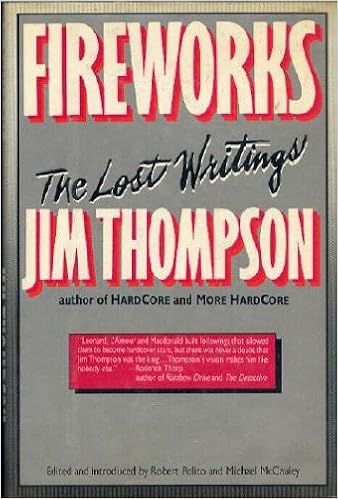
On "Fireworks: The Lost Writings of Jim Thompson" edited by Robert Polito and Mihael McCauley ***

Often, there are good reasons certain works are lost or left unpublished, but fame has a way of making such miscellany valuable to others. Such is the case with this collection of Thompson's uncollected shorter work.

Arranged in a rough chronological order, the first section from his 1930s and 1940s writing, includes quite a bit of nonfiction written in a fictional vein. In "The Strange Death of Eugene King," Thompson takes on the voice of a transient looking to solve the murder of another transient, a technique popular in thriller magazines of the era apparently. "Oil Field Vignettes" and "Thieves of the Field" both provide first-hand insights into the oil industry that I'd likely never have thought much about otherwise. The first is mostly character sketches of oil workers--one who likes complete silence, one who is scared of drilling, and one who is constantly marrying bad women who take advantage of him and leave him. There's something of a folk tale quality to these bits, as in the stories told in "Thieves," where Thompson ruminates on how pipe can be (and is) stolen and sold. "Snake Magee's Rotary Boiler" is a tall tale about a blown-up boiler that sends a man clear back to bed.

The True Detective pieces show how Thompson became the writer he did. There's a quality of the unknown, as is typical of mystery in each of the true crime pieces, a mystery with a twist usually at the end. "Ditch of Doom" explores the life of an insane man who murders his wife--or is it a planned murder for his former wife? "Oklahoma's Conspiring Lovers" follows the unfortunate story of a man beat up by a horse--who in fact is not beat up by said horse. "Illicit Lovers and the Walking Corpse" tries to figure out how a man's wife survives being accidentally killed by the man--and just how many wives the man has.

"A Penny in the Dust" is an unfinished novel from the period. Seemingly autobiographical in its first passages, it lacks for polish, but the ickiness typical of Thompsom becomes apparent in the final scene provided.

"Character at Iraan" recounts life among oil workers between jobs, as they sleep in a cheap hotel, gamble, and drink. Although published in Prairie Schooner, the piece does not seem to fulfill its literary pretensions.

The second section focuses on Thompson's writings during the 1940s and 1950s, which would have included the time of his most productive output. "Death Missed a Beat" is a straight story about a man who in an effort to get to work on time the next day picks up a hitchhiker to drive him and ends up the object of a murder. "Murder Came on the Mayflower" is a short account of an early colonial murder. "Exactly What Happened" plays to a weird twist in a story in which a man attempts to rob his boss by pretending to be a coworker. "The Threesome in Four-C" is an account of a man who has gone insane because of his conscience. "The Dark Stair" is the basis for Thompson's book No More Than Murder; a true story, the mystery hinges on the contents of a movie. "Forever After" revolves around a woman who, tired of her marriage, plots the murder of her husband via her lover but who, as in "Exactly What Happened," finds the situation reversed on her. "John Stink" is about a Native American whose tribe takes him for dead, so much so that when he finds his way out of the shallow grave they take him for a ghost they must ignore so that he'll go away. "Blood from a Turnip" centers on a watch that hustlers attempt to turn for a profit.

"The Cellini Chalice," one of the longest stories in this section, shows Thompson at his top form, as he is in his better novels. The story centers on a hustler named Mitch. He cons a chalice off a woman who thinks him a vagrant in need, a chalice that is worth much more than she knows. Alas, Mitch isn't an antiques expert, so he thinks he fares well getting a thousand dollars for it but is disappointed when he finds out it's worth at least fifteen times that. Mitch learns that there's another chalice like it and aims to get it with the woman's help. What he doesn't know is that the woman is in on the con--of him. Many pages later, Mitch finds himself in some extenuating circumstances that require him to use all the street smarts he has to extricate himself from.

"The Frightening Frammis" picks up where the previous story left off, once again following Mitch on his efforts to con people out of cash. Having been the victim of a recent swindle, Mitch feels down on his luck, but he soon falls into an opportunity to earn fifty thousand dollars. This story doesn't have the same weight as the previous. The circumstances that lead to Mitch's opportunity seem too haphazard: he's hitchhiking, a couple picks him up, the man dies, and Mitch just happens to look like him, and there just happens to be fifty thousand in the car, and so on. Mitch's wife seems too forgiving, after all that he's put her through in both this story and the last. As such, the plot twists overpower the sense of characterization, and the story loses punch, which is a reason I have tended not to care as much for genre fiction in the past.

The same point could be used to denote why "Pay as You Exit" and "The Flaw in the System" are disappointing. The first involves a hitchhiker who aims to rip off the woman he manages to stop by flattening her tire, only to find out that she might well be just as dangerous as he is. The second involves people at a company who are conned.

"An Alcoholic Looks at Himself" seems a bit disorganized, but it is a sad, autobiographical portrait of Thompson as a drinker, a man who has squandered chunks of his life and talent in an effort to get the next bit of the liquid elixir. I say disorganized, but it is in chronological order. It's just that, being "real life," there doesn't seem much in the way of an arc or growth--it's just random discussion of drinking, stopping, then drinking again.

"The Tomcat That Was Treetop Tall" is a crime story about a man who decides to rip off a couple in a bar and the man who decides to stop him. Here, the story's violence seems as if it is on the page for thrills rather than for a purpose inherent to the story.

We then move to the last two decades of Thompson's life and writing. The middle of the book seems the strongest part; by this era, Thompson's work has become something of a parody of itself. "A Horse in the Baby's Bathtub" revolves around an incest story. A young man who is, in his mind, clever and smart, takes an interest in his father's new bride, his stepmom. He kills off dad and takes up with her, but his interest in her is, in part, one of contempt. In the end, he opts to do some violence to the family next door, who has lost a child--and that's where one learns the meaning of the tale's title.

"The Red Kitten" is the start of a longer work--a promising start. A man marries a woman, but with an understanding that the inheritance the two of them will get requires them to stay married. The will is set up in such a way that it essentially forces the two to despise one another but stay married--or find some way to knock the other off. Alas, the piece ends there.

"The Slave Girl in the Cellar" is a summary of a true crime story, a case of modern slavery. The piece is interesting for the case itself.

"Sunrise at Midnight" is a strange piece, a piece that seems in many ways like male wish fulfillment. The first section focuses on a man married to a stripper who is forced into her profession by a crooked cop. But just as the husband begins to build a plan for taking care of matters, the story backtracks to that same man taking an interest in helping out a much-younger woman in a dead-end job. After he buys her new clothes and sets her up rather well, she insists on going to bed with him against his will and then they get married. The man loses his job as a reporter and thus fall the events that force his wife into stripping--and the man into seeking revenge. Like so many of the pieces in this last section, this one seems unfinished.

I didn't much care for "Hell" from Ironside, the one published piece in the last section, a lyrical exploration of killing and crime.

"This World, Then the Fireworks" closes off the collection and might be the most finished of those works falling in the last section. Full of familiar Thompson tropes, the piece seems a bit over the top. It involves a set of twins who witness their father killing a cop who discovers said father cheating with the cop's wife. The wife commits suicide, the dad goes to jail, and the kids grow up to be troubled. They get into the grift, but their main desire is somehow to avenge or to understand their father's deed. And so goes the tale as the male twin opts to get involved with a female cop.

The book made me feel like Jim Thompson's best material was long form and mostly during the period for which he is most famous, when he wrote so many books in such short order. I wouldn't have bothered with the text were it not one of the few available to me to read on my Jim Thompson list. This is a collection, I'd say, largely for Thompson scholars, who can used it to see how his writing developed.

Sunday, August 13, 2017

On "The Complete Stories" by Evelyn Waugh ***

Waugh isn't famous for the short story form, and I can see why. The stories are certainly accomplished, but they don't have a lot of zip and zing to them. They aren't the sort that I'll be coming back and rereading or that greatly made me think or feel.

The collection runs in roughly chronological order starting in 1926, and then has two sections in the back, one of juvenilia and one of college stories. The latter are interesting to read in terms of seeing his development. I've sometimes wondered, reading classic stories from decades before my birth, whether I'd be as unimpressed by the unpublished stuff from the era as I often am by most amateur stories now.

Waugh is not known for being experimental, but the first story in the collection is a foray into that. It feels quite modernist in what it tries to do, which is essentially translate silent film into writing, while also focusing on a couple of audience members. I found it difficult to follow--and unfortunately not interesting enough to really want to try to parse it apart.

From there, we move to more traditional faire. "A House of Gentlefolks" focuses on a man who is hired to be a tutor to an idiot and to accompany him abroad, but once we meet the idiot's parents and family, we have reason to question who in the family is the real dolt.

"The Manager of 'The Kremlin'" is backstory about a man who runs a bar that is reminiscent of Russia. We learn how he was in the army and fell into poverty and the lucky break that got him where he is today. The real power of this story, however, comes in its last line. He's lived a good life, but you come to realize that it is still a life of loss.

The next two stories seem to be somewhat veiled explications of Waugh's first marriage. As such, they are both quite accomplished.

"Incident in Azania" draws from the same characters as Waugh's novel Black Mischief. As such, it is in part about colonialism. In this tale, the daughter of a colonial authority comes to live in the colony and is thus the heartswell of most of the other men who have come from overseas. Her presence proves to be very disruptive, until she disappears, as happens in "these kind of places."

"Bella Fleace Gives a Party" is about a ninety-something woman who decides to throw a ball. Not knowing any of her neighbors and rarely leaving her mansion, the venture brings new life to her. There's a certain sadness at the end of the story, with Fleace's seeming lack of success, but Waugh cuts it down by mostly playing it for irony rather than pity. I could see the tale being something truly cry-worthy in the hands of another master.

I must really like dark and twisted stories because one of my favorites in this collection reminds me much of other stories I like so much. "The Man Who Liked Dickens" is in the realm of many of Paul Bowles's stories; it's about a man who goes overseas and finds himself in a situation far beyond what his own cultural understanding will allow him to deal with. It's a kind of kidnapping story, a story about a trap, a story that takes something we usually love and makes it dreary and scary. In a sense, one could read it as a tale about the dangers of illiteracy and about the even greater dangers of cultural illiteracy.

That story also ended up being the ending of Waugh's novel A Handful of Dust. "By Special Request" brings back the characters of Brenda and Tony Last, giving a separate and happier ending to that Waugh's novel. Having just finished the novel a day earlier when I read the story, it was hard for me to read the story as a piece on its own. Rather, I kept putting it into the context of "alternate ending." As an alternate ending, it did not leave the novel with much in the way of gravitas, as Brenda's horrid actions come to be merely a fun and temporal diversion. The story then hints at Tony's conceivable revenge, though one that is hard to fathom given his ultimate loyalty to his wife. Good it is that the other story became the novel's climax.

"Period Piece" is a forgettable tale about woman who in old age has taken up reading novels in zest. When confronted with how they are so "made up" and ridicilous, she goes on a long diatribe about how life was actually "like that" in the old days. It is the diatribe that makes up most of the story.

"Mr. Loveday's Little Outing" is similarly cruel in its ending, with that ending being its seeming main purpose. Years earlier, Loveday was committed to an asylum for a murderous crime. A woman visiting her father notices how seeming sane Mr. Loveday is. In fact, the asylum director says that the man helps out the staff constantly and would greatly miss the man, who has no desire to leave, though he clearly doesn't need to be locked up anymore. So the woman sets about to free the man, who does not wish to leave save to do one little last thing he greatly desires.

"Winner Take All" is another rather cruel story, one that seems to be something of a recurring theme in Waugh's work: of a passive man taken advantage of by others, most especially by women. Here, that man is the second son of a noble family who sees every piece of good fortune that comes his way redirected to his older brother by his ever-dominating and -interfering mom.

Another of the better stories in the collection is "An Englishman's Home." Save for the trick ending, this story is one the riles the emotion and the brain with its discussion of the dynamics of village life and local politics. Mr. Metcalfe owns a small villa that normally includes about sixty-six acres. But he doesn't really need or want the other sixty and so doesn't buy the adjoining farmland. All is fine on his six acres until a developer one day buys the other sixty, putting the entire community at risk of seeing itself changed overnight. Of course, it being land that normally adjoins Metcalfe's property, the community believes Metcalfe should buy the developer out; meanwhile, Metcalfe, who neither needs nor wants the extra sixty acres, thinks the community should bind together to buy the extra land, that he should only pay about one-fifth of the total property. Fights ensue. Selfishness threatens all.

"The Sympathetic Passenger" is a silly short piece about a man who hates radios but whose hate is compromised when he meets yet another man who hates them to a great, insane degree more.

"Work Suspended: Two Chapters from an Unfinished Novel" isn't really a story but rather exactly what it says it is. In another way, it is about the way that war interrupts life, for it is war that essentially draws the novel to its close, suspends it. The novel itself is about a writer of thrillers who is having a hard time writing, having grown tired of formula. This writer also loses his father in an accident, the man who caused the accident becoming something of an acquaintance and a drain. Meanwhile, the writer falls for a married woman named Lucy, the wife of a friend. He builds a new country home. The two spend much time together, but she has a baby and that's where it ends. And also, there is a sycophantic young woman who is in love with the writer and his work who chases him around until she realizes he loves Lucy. It is a rather great start to a book and a shame in some ways to have come to an abrupt end.

Another story that feels more like a work not completed is "Charles Ryder's School Days," perhaps an unpublished excerpt from Brideshead Revisited or a character study for the work. The story recounts the early years of Ryder, during the First World War, when his mother is killed. Off at boarding school, he is granted a certain sympathy. But the real focus of the story is the pecking order among the boys and the faculty's effect on it. Though three kids are ahead of him (including Ryder) in seniority, O'Malley is chosen to monitor the dorm, because, as the headmaster explains, O'Malley needs discipline. He has less character than the other boys. Ryder is asked to support O'Malley numerous times, both by O'Malley himself and by the teacher. As children (really, teens) refuse to go to bed on time "Tacitor to participate in prayer at the chosen moment, O'Malley is faced with choosing between loyalty to his friends and doing his job, the latter generally being his ultimate decision. But the story does not seem to go beyond that; Ryder is the same kid at the start as at the end, and there doesn't seem to have been any moment of decision or chance to change, which is why this piece ultimately feels less like an independent story to me and more like a descriptive background study.

A long but gorgeous story is "Scott-King's Modern Europe." This piece reminded me a bit of Nabokov's writing. It's about a middle-aged man who teaches classics at a public school, a job that is becoming more obsolete with each passing school year, as fewer students sign up to Greek, Latin, and the classics. Scott-King has taken an interest in an eighteenth-century writer named Bellorius and studies him in his spare time. One day, he receives an invitation from the fictional country of Neutralia, Bellorius's nation, which is to hold a grand festival in the writer's honor. As it turns out, most of the invitees know little of the writer, and as the festivities continue, it becomes clear that the country is in the midst of a civil war of sorts. A scholarly trip to nostalgia turns into a nightmare attempt to escape. Ironically, it is just such escape that moves Scott-King to embrace older times rather than the modern ones.

"Tactical Exercise" is another of Evelyn Waugh's exercises in the clever and macabe. Here, Waugh explains how a couple marries later in life (by mid-twentieth-century standards) and grows to hate one another. Finally, tired, they head off to vacation. Here, the husband plots to kill his wife, setting up rumors about her sleep walking and feeding her drugs, only to find that the circumstances are not as they seem.

"Compassion" reads like a magazine puff piece in parts more than as a story. It is about a military officer who sees his job primarily as one involving military missions but who is slowly won over to aiding displaced Jewish persons in the Yugoslavic areas of Europe as World War II draws to a close. In that conversion, he runs into many a military man who thinks as he once did, and he finds that a lack of success, of being unable to stop suffering, is also a means of learning.

"Love among the Ruins" is a sci-fi story that reads like any other number of works about technologically advanced societies verging on totalitarian: Brave New World and The Clockwork Orange being two that come most readily to mind. Here, people get new faces, get sterilized or have abortions to maintain careers, go through prison reformatory systems, and get free euthanizations by the state because they are bored, bored, bored. Among these people is Mile Plastic, an orphan with a penchant for starting fires who has been sent to prison and reformed. The sole graduate of the program, the state has much interest in touting his successes. But much like the people around, he finds very little meaning to his existence and longs for a return to prison, until love provides something that at least seems real.

"Basil Seal Rides Again" returns to the character of Basil, who figures prominently in the very first story of the collection and who also plays a role in many of Waugh's novels (alas not anything more than a mention in any of the novels that I've read). Here, Basil is concerned about a certain young man named Charles Albright, who seems to be up to no good: he borrows shirts, plays guitar, has little wealth, and so on--in other words, he's like Basil was at an earlier age. The most interesting passages have to do with Basil's going away to a resort to lose weight, however, as his daughter covorts with an unknown suitor. The cruel and self-interested ending, I suppose, is standard behavior for Basil.

The book ends with a collection of Waugh's juvenalia and college stories. The juvenalia supposedly is to show what a genius he was for storytelling at a young age (twelve), but I didn't find the stories all that unusual for a child that age with a literary bent: a heavy emphasis on action, unncessary details when provided. However, by the age of twenty, Waugh's stories start to take on a certain panache. The start of a novel, while beginning with the cliché of a character waking up, displays a mastery of language and actually reminded me a bit of Brideshead Revisited--lop off the slow beginning, and the tale had potential. "An Essay" is a great display/description of a character with something of a twist at the end. Such stories got me thinking about when/how writers bloom, and I think there's something to be said for the maturing that begins to take shape in the early twenties; arguably, it's possible one doesn't advance much beyond the skills one builds by age twenty-five, assuming some good instruction.

That said, the stories in the section of Waugh's college years, while displaying a better mastery of language than the early juvenalia, often (too often) display an overwhelming interest in killing and murder: something rather common, I found, among writers who are young adults when I taught college English. In "Portrait of a Young Man with Career" the protagonist fantasizes about killing a man who has come to visit with him. "Edward of Unique Achievement" is a rundown of how a college man kills his tutor and gets away with it. "Conspiracy to Murder" is a Poe-like story about a man who goes insane thinking his neighbor wants to kill him. "Unacademic Exercise" is about some sort of ritualistic cannibalism cult. And while the last story, about cricket, gets away from these macabre themes, it still isn't at the level of Waugh's adult material.

Saturday, April 1, 2017

On "Locos" by Felipe Alfau ****

I'm not sure how I came to this book, but it showed up in some kind of recommended reading list at some point (on metafiction, perhaps), and I took note of it. And now, here I am, a few years later, reading it. And much of it was great!

Alfau plays with the novel form, as writers of the modernist era often did. I am not sure he wholly succeeds, as the work seems more like a collection of linked stories than a novel. Some read Dubliners as a novel, for instance, but I still think of it as a collection; that said, this piece might be more like Winesburg, Ohio, which while also not fully a novel to me is not also fully a collection of stories that stand on their own. Alfau's stories can be read on their own, but the links are useful to understanding the whole. While the stories can be read in any order, the first half of the book focuses a lot on the process of creating a novel.

We start the book with a character--or person--who is slated to be important. That is his role in life. But no matter what he does, he is ignored, as he is in the story. Instead, we go to a cafe where the rest of the book's characters are introduced to us in various forms.

The next chapter focuses on a character who decides to take over in the absence of the author, who had gone off to enjoy some time with friends, intending to take up with the character later. Alas, the character gets into so much trouble on his own that extricating him proves challenging for the author upon his return. What follows is a confusing muddle. The character meets a person from real life. The person from real life then becomes a character. The character proves to have been another character, who had earlier run off with a different woman. And on and on.

In the process of that story, we are introduced to the character of a beggar, which is the topic of the next story/chapter. In it, a professional beggar manages to find a job. But the job does not begin for a month, so the beggar has plans to continue in the begging profession for a while longer, but he accidentally gives away his last coin to another beggar. Said other beggar is an expert, who lives the life of a rich man when not on the twelve-hour begging shift. The one beggar goes to the other to beg his last coin back, and what ensues is a shift in the nature of begging and professionality. This piece proves much less playful in terms of form than the previous chapters--save for some short comments from the author about how he had ruined the character's plans for himself--which is a good thing insofar as the constant interceding of author and character into each other's narratives can wear thin when overused.

The focus on shifting positions in "The Beggar" plays out again and again. In the next chapter, an expert on "Fingerprints" has his technological expertise and certainty turned against him. Fingerprints don't lie, he asserts, and if his father's memory is to be preserved, he must go through with his actions. Likewise, in the chapter after that, "The Wallet," victims become bandits become heroes. The story is set in Madrid at a time when crime is rappant. Lights go out at night, and everyone takes to committing crimes in the streets. The prefect makes a bet that as soon as a young man leaves his side, he will be mugged. Said mugging in fact occurs--or rather, pickpocketing--but the young man is fast and attacks the would-be thief and recovers his wallet. Only, what he gains is not his wallet but someone else's. So begins a series of crimes and mistakes that will carry through the night.

"Chinelato" is a grand epic of a tale, an adventure story, about a man who spends time in the Philliphines and Spain, a man whose dark skin--but also his dubious morals (he flits from woman to woman, wife to wife)--keeps him marrying a woman he sets his eyes on. We come across him in different ways and from different points of view, and incidents and characters from other stories in this collection flit in and out, giving us small insights into other events that happened elsewhere. But still, this piece failed to hold my interest very well. And in fact, as the stories in the book become less experimental, beginning with this story, Alfau's book becomes almost completely straightforward--no more metafictional destruction of the story as it occurs.

The text ends with a two-part piece called "A Romance of Dogs"--a single character and dogs seeming to be the main items that keep the two parts together. In the first half, the character is in school. Dogs try to bite him before and after each day, add to his nightmares. But the main text of the story is about a priest who commits suicide for unknown reasons, though we suspect it has something to do with his love for one of the nuns, who runs off one day and elopes. The second half of the story involves the same character later in life and his growing insanity, as he obsesses over springtime.

Mary McCarthy's afterword shows how the characters show up in different stories. I was aware of this, but without reading the book a second time, it would be impossible for me to have seen just how much. Many characters have two or three names, so it's hard to keep track of them at times across the stories.

Wednesday, March 22, 2017

On "Where I Live Now" by Lucia Berlin ****

As with the other older collection I read of Berlin's, this ones best stories seem to have been grabbed by the omnibus selected stories that came out a couple of years ago. That said, I still enjoyed reading those that didn't make that larger career-spanning collection. This collection, on the whole, seemed to have more to offer, more accomplished stories, than So Long did.

"Evening in Paradise" essentially recounts the events occurring at a Mexican bar during the filming of a John Huston film. The events are mostly told via the point of view (but third person) of the bar owner, who started off simply and became the owner over the course of his life. He also managed to marry and have a couple of daughters. All is well. Meanwhile, famous actors go in and out of the scenes, and Ava Gardner, who becomes involved with one of the locals. Drunk, she ends up sleeping also with yet another local, and a fight ensues, even as her local boyfriend ends up sleeping with another actress. The bar owner looks on all of the bemusedly. It's the characterizations that make this story feel like slightly more than a curiosity.

"Romance" tells the story of a long-distance love affair and the misunderstandings that spell its eventual doom. Both partners also cannot move from their home states of New York and California because of custody issues with their children, so they tackle love by phone and by cross-country plane trips that take a toll on their finances. When said finances go awry, they have cause to doubt the commitment of the other. As odd as the circumstances are in the story, it seemed true to how many fights in a relationship unfold.

"The Wives" recounts a visit between two ex-wives of one man, as that man is engaged to be married to yet another woman. Will they go to the wedding? Will they support the marriage? Both wives are firm alcoholics, one openly, one not. Their drinking allows them to commune with one another as they grieve the man they lost and celebrate the man they tossed.

"Sometimes in Summer" is a piece about childhood friendship and about love returned, in the form of a man come to visit Mamie. No one in the family wants that bad man around, save for Mamie, who is smitten. But the kids don't know this, so they take the silver dollars the man offers and bring him around to the woman who seems, actually, better off with the man that with a family that seems more intent on keeping everyone down.

"Del Gozo al Pozo" is another Sally story. In this one, her sister Claudia (i.e., Carlotta in most tales) takes care of her while she dies. In the midst of this, Claudia goes to visit a house that Sally had built for herself but that she will never live in. Meanwhile, the help that Claudia grows so close to is in the midst of losing their jobs, as the government changes powerbrokers. All things change--go south, to death, as the story's title suggests.

"A New Life" is about an older woman who decides to change everything about herself. She drops out of existence and takes a new identity--new clothes and hairdo, new ID, new name. She leaves her grown children wondering what happened. She also leaves a note in her diary, suggesting suicide, which neither of the sons believe possible. They go in search, file a missing persons' report. Meanwhile, Mom takes up with two men at a bar, who eventually hatch a plan to get her back to her old life, one that involves extortion. Are the men out for money or just being nice? We're never really sure, though one suspects the former.

"Lost in the Louvre" is a very interesting exercise and one of the collection's better stories not collected elsewhere. It involves a woman who meets death--but not in any sort of fantastic, absurd way. Rather, most of the story consists of a description of the Louvre, as the woman takes daily trips to it during her sojourn in Paris. The descriptions are wonderful, and the narrator's eventual meeting of death is as surprising as it is mundane.