I first/last read this back around 1991, as part of a world literature class. I must have thought well enough of it to have kept the book all these years. Periodically, now, I go back and read books in my personal library, in part as an effort to weed materials out and shrink my library and also give space to newer books, for which there is no room. This one will probably be one I jettison, but not because I did not like it. I'd be keeping it, I suppose, if the work were not in the public domain, but because I can pull it from the Internet, there seems little reason to keep a hard copy, especially when the version I have is pocket sized and not terribly condusve to easy functionality.
The book is interesting enough that I am tempted to try something else of Voltaire's, even if it's unlikely another work is as good as this one. The story is a satire, and the characters are drawn in large strokes. I don't suppose we are to take anything too serious or care too much about anything that's going on.
I long though my world lit professor, who liked to spend most class periods talking about contemporary California politics, didn't really have much to offer. He probably wasn't the greatest professor, but as I reread this, I was reminded that he actually did provide some philosophical context, context I would have loved to have had on this go around. I know that Voltaire was reacting to Leibniz and some other recent thinkers of his time in his account, but I don't remember much of what those folks said or who they were.
The gist of the story, however, involves the travels of Candide, who is greatly under the influence of his teacher Pangloss, who believes that everything always is for the best. Candide is in love with a gal from a rich family, and his impertinence one day in pursuing said gal gets him kicked out of the estate. It's for the best, however, because the land is soon invaded and the gal's family is most all killed off. Luckily, though raped, the gal survives, and Candide is not free to pursue her, as soon as he can get free from his army service.
Travels take them across the ocean, where an important man falls for the same gal and takes her, as poor and young Candide can do nothing to stop him.
Here, the story moves into the territory that I remember, a utopia called Eldorado. (I remembered this tale as similar to Samuel Johnson's Rabelais but now see that this portion of the story falls in its center and is really only a very small section.) Anyway, Candide still pines for his gal, so he leaves utopia--but he's given plenty of money for his journey. This now lets him do things he could not do before, but it also sets him up for constant con games.
In the end, he meets many of the characters from the early portions of the book and finds out all the bad things that have happened to them. Is it really the best of all possible worlds? When Candide finally gets his gal she is washed up. The focus switches then from seeking the best to simply working in one's garden. The ending seems rather stoic.
Thursday, September 3, 2026
On "Candide" by Voltaire ****


Saturday, July 25, 2026
On “The Bourne Identity” by Robert Ludlum ****
Back in my twenties, before I had read much genre fiction, I had a view of it as largely plot based, with little in the way of character development or good turns of phrase (something I would say I found not to so much to be true, as I've aged and read more widely). As I read through the first portions of this book, my feelings were that Ludlum's work would have fit that earlier definition to the tee. The book opens with some overwritten descriptions of the sea (unneeded adjectives, redundant lines). It felt very much like someone were describing in excess the opening shots of a movie. What's more, as I read further into the book and was introduced to the characters, they seemed equally overwrought and yet not really real; they were elements, simply, in and for a plot—a plot that was, for all of its turns and twists—highly ridiculous.
But if Ludlum's first book in the trilogy fits all the stereotypes that I carried of genre fiction, it also lives within its world exceptionally well. I found myself, even knowing that the plot was ludicrous and the characters mostly cardboard (the main character's girlfriend, after all, after being taking hostage by him, gives up everything in her life to pursue him, risking her life, because at some point he saves her life, a situation she wouldn't have been in in the first place if she hadn't been taken hostage)--even knowing all that, and knowing that Bourne will survive, because there are two more books, I found myself drawn into the plot. What's to happen next? What will Bourne do?
The novel involves a case of selective amnesia. A man finds himself with exceptional military and spy-op skills, but he doesn't know who he is and how he came to obtain such skills. Nor does he know why everyone seems to be after him. The journey is thus one of self-discovery and one of survival. The plot really gets going when the man goes to a bank in Zurich, which has an account, the numbers for which are embedded as a chip in his body. Find the account; find out who he is. Or so that's the theory. But by doing so, he alerts others of his presence and so begins the hunt for him. And even knowing his name only gives him that; who is this man with this name. Periodically, as he comes across familiar scenes or people, he gets glimpses into his past, but they remain veiled. This is spies after spies, espionage to the hilt. It doesn't feel like there's much in the way of political, cultural, or social commentary along the way, unlike say in the work of Greene or Le Carre, but unlike the latter's novel that I read, this one is much more approachable, much more entertaining, and much less dreary. I usually looked forward to reading it, and certainly didn't want to put it down as I got closer to its end--a fitting end to my short spy fiction list.
Wednesday, May 13, 2026
On "The Quiet American" by Graham Greene ****
I'm not sure how much this qualifies as a spy novel, though it does have lots of international intrigue. It's focus is really a newspaper reporter and a surreptitious activist (perhaps, he qualifies as a spy). It's really a love triangle story: two guys battling it out for a young Vietnamese gal name Phuong. The story is set in 1950s Vietnam, toward the end of the French role there, as the Americans begin to make a few inroads.
The two men are Fowler and Pyle. Both men are annoying and easy to dislike. Fowler is British, older, the reporter, and has Phuong as his girlfriend. He's married, and his wife (back in Britain) won't allow a divorce. This means that Phuong is nothing but a fling to him. He's using her, stringing her along, saying that one day he'll marry her, as he wants. Pyle is an American, working on distributing plastics that go in to bombs to help the Vietnamese Democratic movement (if it's that). He falls in love with Phuong at first site and sets about to make her his girlfriend and wife, despite the fact that Fowler is already involved with her. Both men are jerks in my view.
The story begins with Pyle's death. Fowler is the immediate suspect, but then the rest of the novel is told in flashback to how these two interacted and came to know each other. Despite the characters being unlikeable and the political discussions seeming somewhat dated (though I suppose they apply to any such colonial situation), the novel brings into focus some big questions about journalistic objectivity and staying outside the news to just observe it. At what point, one asks, does this become a problem as a human being caring about other humans? And at what point does a concern for the general populace become more important than a concern for the individual? These are hard questions.
Sunday, April 5, 2026
On "Road Dogs" by Elmore Leonard ****
I placed this as my last book on my Elmore Leonard list after reading that it had characters from City Primeval, La Brava, and Out of Sight. It also, as it turned out, had a character from Maximum Bob, which I didn't read. But really, the book is one about characters from La Brava and Out of Sight; other characters are simply mentioned.
This is a Jack Foley book, the main character in Out of Sight. Cundo, a violent offender in La Brava, is also here. Now, they're prison pals. Cundo has a good deal of money and a good lawyer, and he sets Foley up with that lawyer on an appeal, who gets Foley out of prison with barely a sentence to his name. Now Foley owes Cundo big time.
Cundo is crazy about some gal named Dawn, a woman who professes to be psychic but who by and large seems largely to be a conman. Dawn wraps Foley into her arms and tries to enlist him in her schemes—one to rip off a grieving actress and another to rip off Cunda. But Dawn is too confident in her appeal as a woman, uses it to get power over a lot of men whom she uses. But it's not enough, by and large. For some money is remains too important. And for Foley, it's a kind of honor. It seems he's determined to go straight, if only he can find a way.
It was probably George Clooney playing Foley in the movie Out of Sight that did it, but he remains my favorite Leonard character. I can't see help but see him playing the role, his cool and suave persona, likeable even if a crook.
Sunday, February 1, 2026
On “James” by Percival Everett ****
I “read” this book over a weekend car trip via audio listening. It was a great production in terms of the reader being very engaging. The book itself . . .
I'd been wanting to get around to Everett's work since seeing American Fiction (based on his novel Erasure). Of course, all the awards James won made me understand the degree to which I needed even more to get to Everett's work. One presentation I saw recently called his sell-out novel, much like the work discussed in Erasure, insofar as this is a historical novel about the African American experience that tends to gobble up awards and sales.
In James, Everett sets out to retell Huck Finn from Jim's point of view, or at least, that's how it begins. In that sense, the novel is a refreshing retelling of some of the troubling aspects of the iconic novel. As fun as Huck Finn is and as much as Huck Finn sets out to right American wrongs with regard to slavery, its infantalization of Jim has always been disturbing. Perhaps, there are minor signs that Jim isn't the innocent he's portrayed as in that novel, but if those signs exist, Everett makes them explicit here, sometimes to comic effect. The enslaved workers speak in a patois and act stupid around whites, but are elegant and clever around other enslaved people. Everett makes explicit that they are “signifying.” And there are some neat tricks, where Jim, at one point, is forced to pose as a white guy posing as a black guy—with numerous complications.
On the whole, the first half of the book follows Huck Finn's timeline rather closely. In a way, it's great to read the events from Jim's point of view. But there's also a certain predictiveness to it, given that it's simply following another book's plot. The second half of the book, however, breaks significantly with its source material, and the work becomes a slave revenge work. There's power in that, I suppose, but also at points a certain preachiness that makes the piece seem overwritten. I was left feeling torn between my sadness at not seeing the rest of the source novel from Jim's point of view and my relief that this novel went another direction and thus ended up not being as predictable. Neither solution, however, seemed like it would have been wholly satisfactory.
Sunday, December 28, 2025
On "Glitz" by Elmore Leonard ****
Having now read six Leonard novels, I'm coming to see a pattern, which is not unlike most novels in the Western genre, even though Leonard moved over to writing crime fiction. At the center of each book is a superhero, some man is simply so full of incredible insight and ability that he makes everything in his world work out for the right. Most of these men also have a bit of a weakness that gets them into a little bit of trouble, and usually that weakness is a woman--though often a source of their strength is also a woman. I go right back to the main character in 52 Pickup, for example, whose affair is really the start of all that man's troubles, but the blackmailers have picked on the wrong guy, and he's helped along throughout his ordeal by his strong wife. Or think of La Brava, who falls for a not-so-good movie star, but again, she and her cronies have picked on the wrong guy.
In Glitz that man is Vincent Mora, a cop from Miami, who is recovering from an injury in Puerto Rico. (The novel starts off with a great hook--Mora getting shot while being mugged on his way home from the grocery store.) He falls for a twenty-one-year-old prostitute who is simply after a money and the better life it will bring. Mora is her ticket, until something better comes along: an opportunity to work in Atlantic City. Like the girls trapped in Epstein's web, this is not the opportunity it appears, Mora warns her, and sure enough, she ends up dead a few days later, which is what brings Mora up to New Jersey to investigate her death. There are a cache of mob characters Mora investigates on his way toward solving the crime, each of whom doesn't really know what he's up against. Tough guys they are, they are no match for the tougher and smarter Mora, who knows how to turn them against one another for his own gain.
But there's also a serial killer on the loose, one who has it out for Mora, who busted him a decade ago and who is out on an easy sentence and constant good fortune that allows him to stay free. And there's a lounge singer with whom Mora takes up. The lounge singer turns out to the be the strong woman who saves/aids Mora, and the serial killer, Teddy, his arch nemesis, whose main skill is not so much smarts as luck. Leonard does a neat, common trick and brings us back to the novel's start at the end, but with echoes of new meaning and resonance.
There is much to like in this book, but as I noted, there does seem like something of a formula to it--and also, the constant violence wears a bit thin. If shootings and deaths and fights really were this common in everyday America we'd be in sad shape and have no reason ever to venture beyond our homes outside of bare necessities. I'm finally getting around to Leonard at a time in my life when I am less willing to give such things as much of a pass.
Wednesday, December 10, 2025
On "La Brava" by Elmore Leonard ****
This one took a bit longer to get into than the previous works I've read of Leonard's. The plot doesn't really get ticking till halfway through. Instead, Leonard spends a good deal of space introducing us to the characters involved. There's Joseph La Brava, the cameraman and ex-government agent. There's his friend Maurice. There's some woman named Jean Shaw, a former actress. And then there's this other plot going on, with Richard Nobles and a guy named Cundo. They're the seeming crooks in this narrative, but it's hard to know exactly what their angle is in terms of what they're plotting other than some small-time bad stuff.
Meanwhile, La Brava finds himself being pulled into Jean Shaw's life--romantically--in part because he was a big fan of hers as a teen, and to be involved with a movie star, even one fifteen or twenty years his senior, is a real turn-on, like being in her movies themselves. But clearly, Maurice, an old friend of hers, has the hots for her too, though she generally just rebuts his advances while taking advantage of his friendship.
About halfway through the book, the plot with the crooks begins to converge, and we learn that things aren't quite what they seem, even as real life begins to converge more and more with Shaw's past films, as the novel becomes almost metafictional. What counts as real? What counts as acting? The book grows hard to put down at that point, until the final, somewhat emotionally unsatisfying close.
Tuesday, December 2, 2025
On "City Primeval" by Elmore Leonard ****
The subtitle of this work is "High Noon in Detroit," which essentially sums up this cop versus robber (or really, killer) novel. Raymond Cruz works in the homocide division of the Detroit Police Department. Clement robs the occasional person and shoots the occasional person for fun.
Clement currently is setting up a scam with an Albanian, but he's interrupted by a lousy driver. His reaction: Shoot the dumb driver--and his passenger. The driver turns out to be a judge. Only, the judge was crooked and not well liked. So you figure maybe folks wouldn't care too much, maybe? But the police go after the killer like any other.
In a whodunit, we'd be wondering, well, who done it? In this work, we know who's done it from the first chapter. In many another book, we might know who done it, but we'd be walking with the police as they figure that out. Neither is true here. The police know pretty quickly the killer. The issue is that the killer is good at snaking out of any charge that is given to him, so the book is mostly about gathering evidence and also about setting Clement up so that he can't slink away.
And that's where Raymond comes in. In a central scene in the novel, the two protagonists square off, and they talk about how if this were the Old West, they'd have a duel. And that's really what this becomes: the wits of one man against another until only one is left. (Without giving much away, I'll say that in a way, the book ends twice. I prefer the first ending, but I think Leonard felt a need to bring it back to that faceoff, so we get a tag that seems unnecessary and less fitting to the circumstances.)
Thursday, November 27, 2025
On “52 Pickup” by Elmore Leonard ****
This is the first crime thriller I've read by Leonard, though of course I've seen several movies based on his work, movies, which I've read, often just lift his dialogue whole. Indeed, this work is quite cinematic: built in scenes, around people and events, not a lot of summary or exposition. As with the two westerns I've read by Leonard, this was a page turner, thrilling pretty much from about five pages in until the very end.
So Mitchell is the owner of a car parts manufacturer, a man who for a brief period uncharacteristically ends up having an affair with a woman one year older than his daughter. Three neerdowells decide that Mitchell is the perfect object of an extortion scheme. You see, the gal he's been carrying on with, she was into adult modeling and, as such, has links to a shady underworld. The three guys hatch a plan, based on photographs they've gotten of the couple together, to insist that Mitchell pay them $100k or the info gets leaked to the press, the family, the company, whatever works to make his life dreadful.
Mitchell, though, is a tough nut, and he's not sure he's ready simply to pay up. He doesn't want to go to the police, either, because things could get messy. He doesn't want to put his family through all that. When he doesn't comply, on time, the three crooks murder the girl and arrange things so that the crime can be easily pinned on Mitchell. Now they want $100k every year. Mitchell says he'll think about it and continues along his usual way, delaying and generally being cool to their attempts to intimidate him. This involves, for example, coming clean with his wife, and it evenually involves him turning the three crooks against one another through various nefarious means so that in essence they do the work of solving the problem for him.
The plot thrills, and the characters are well drawn, and the dialogue is fresh. What's not to like? I was ready to hand this five stars, but the ending was a letdown. The story, I suppose, is over, but there are all kinds of ramifications to what Mitchell has done. He does so much, supposedly, to save his family, but in the process, his wife suffers terrible consequences; he doesn't go to the police, but at some point not going to the police seems more a plot point than mere logic, and in the end, the police will be involved, and how exactly is Mitchell going to come clean? He has a lot of great plans, but it's obvious the crooks know where he lives and have access to his wife and family. They're capable of killing—or at least Mitchell actually believes they are—so why would he not safeguard them, send them away, or whatever? It's these sort of issues that pulled me away from genre fiction when younger, and while I can enjoy thrills, the lack of emotional link to the characters and their feelings makes for a less compelling work.
Sunday, September 28, 2025
On “Leaving Las Vegas” by John O'Brien ****
This is another reread for me from a book read about three decades ago. When I last read it, the movie was a more recent title, and O'Brien's other two books were things more heavily on folks' minds. I did not like Stripper Lessons, which seemed mostly some male fantasy, and I never got to Assault on Tony's, which someone in grad school had recommended and which sounded sort of intriguing, mostly for its ties to the 1992 Los Angeles riots, but which I suspected would not be unlike the other two books in focusing mostly on dreariness and drinking and maybe some hot angelic woman. I was uncertain I would find this book of much interest this time around, and I was surprised by how well it held up.
Having come off reading Tapping the Source, this was a different sort of read. There isn't a strong plot on this title, but it deals with similarly salacious material. I can't say I'm likely to read this one again. In some ways, the plot is laughable and the characters seemingly nonsensicle and the whole thing unceasingly depressing. And yet, on some level, the work still manages to pull a bit at the reader, since it explores such dark and depressing lives and doesn't flinch at looking at them.
This is essentially a love story between an alcoholic and a prostitutee. The prostitute gets beat up. She has men (i.e., the former pimp) from her past show up and expect her to provide them whatever cash she's earning. This is not a glamourous life. It's hard and awful. The alcoholic has lost his wife and his job, though both losses seem mostly due to his drinking. He's chosen to drink above all else, and he has resigned himself to drinking himself to death, and he won't let anything or anyone stop him. He knows he's messed up. He gets the shakes anytime he hasn't had a drink recently enough. He too gets beat up or just stumbles for little reason and as such beats up his own body. (I'm prone to think such a life ridiculous, but having had a friend essentially do just that—drink himself to death—I know now this sort of thing happens, in late-stage alcoholism.)
The prostitute is desperate for companionship. The alcoholic, on some level, seems open to that for a while, but in the end, what he really wants is to be left alone with his drinking, and there's no stopping that. For a short while they meet and share share some moments. The plot never shirks from the inevitable bleak end.
Sunday, October 27, 2024
On “Treasure Island!!!” by Sara Levine ****
This one came recommended to me from various websites that listed great recent novels. In addition, I was familiar with Levine's name—likely through various stories I've read of hers—and the premise sounded cool, so I decided, why not? I don't read much fiction anymore, so this would be a good break, and it was.
The premise? A woman reads Robert Lewis Stevenson's Treasure Island, a “boys' book,” and decides to change her life accordingly, living by its various morals and standards. It's been forty-plus years since I read Treasure Island, though I do remember somewhat enjoying it as a kid, insomuch as I could enjoy a “long” book back in those days (I wasn't much of a reader before my teen years), but I remember liking the live-action Disney technicolor movie from the fifties or sixties. I mean, pirates, after all (the subject still seems of great interest to people, but as a kid, I realized after trying to read some nonfiction about them, they were hardly as intriguing as theme park rides).
As I knew going in, the book was supposed to be funny, and the narrator and central character an incredibly awful woman. These turned out to be true. Turns out modeling one's life after pirates isn't so great an idea. That said, one gets the feeling that the narrator wasn't terribly stable to begin with—a decent-looking woman who uses those looks to hold down jobs and boyfriends, neither of which she appreciates, as she believes herself to be above them. Living by the dictates of a 150-year-old novel means not letting manners get in the way of how highly you think of yourself, which means taking advantage of other people at every turn.
My wife found the book reminiscent of Don Quixote, but shorter and easier to read. It's not entirely predictable, but the narrator's brain seems similarly addled by fiction such that she makes dreadful decisions for all around her. One of the blurbs makes note of its memoir-esque features and, indeed, one can read the book as a sort of parody of self-help memoirs, where someone makes some sort of decision to live by some new standard and change one's life accordingly. This narrator doesn't really change much; she's awful to start, and the book simply gives her an excuse to continue on the same path. Some might question, as such, whether the book is even really a novel, as the main character does not develop. But it's a fun read no matter.
Thursday, March 30, 2023
On “Little Big Man” by Thomas Berger ****

The tale starts when Crabb was a kid whose family is slaughtered by the Indians on a journey out west. He's taken captive and raised as a Native American—a Cheyenne—for about five years. In the process, he becomes something of a warrior, killing one man and saving the village—and specifically a frenemy named Little Bear. For this, Crabb is given the name Little Big Man. Eventually, in a fight with whites, Crabb finds himself in danger of being killed, so he ditches the Cheyenne garb and identity and now again becomes white.
As such, he's put into a preacher's family—really just the preacher and his wife—and raised proper for a short while, but the high living and moralizing doesn't suit him well, so eventually he runs away.
He ends up back with the Cheyenne somehow at some point—actually, at various points—so without rereading, it's exactly to recall what happens when. He does a stint as a businessman, gets ripped off, dallies among the Cheyenne some more. He gets married to a Swedish gal, gets himself mixed up with some bandits, meets Wyatt Earp, is again clobbered by Indians, to whom he loses his wife and kid. He becomes a drunkard, goes searching for gold, befriends a Cheyenne gal and son and marries the gal, and takes up life as a Cheyenne again, having another son by her. Then Custer wipes out his Indian family and he vows revenge. But instead of that, he gets mixed up with his long lost sister (actually, this happens more than once as well), and meets Wild Bill Hickock, who teaches him how to be a marksman, even as they play poker night after night. Meanwhile, he rescues a gal from prostitution. Eventually, Crabb meets up with Custer again and somehow ends up in Custer's calvary, but his desire for revenge has long since died. This takes him to Little Big Horn, where he once again meets his Indian family. In other words, Crabb is a Forest Gump of the western, somehow ending up in every part of history during a certain set of years. Are we to take him seriously? Even the learned scholar responsible for recording the story doesn't know, but it's an intriguing yarn.
Sunday, February 19, 2023
On "Shane" by Jack Schaefer ****

My wife, in her own reading of The Virginian, is the one who first brought up the superhero comparison to westerns, and it made me think a bit about how most of the books I've read so far fall into just that sort of set of cliches. Indeed, there are numerous sites on the internet that claim superhero movies are the new western--and then a whole bunch rebutting that claim (westerns are more varied is the standard reply). But so far, I'd say there's a fairly common throughline with regard to standard western elements. Most involve a super gunslinger, generally mysterious, who saves a woman from some baddies. There are variations, of course. Some involve more than one gunslinger, as in Zane Gray's Riders of the Purple Sage. Some, as in the case of Shane, avoid the woman--the romantic love interest. Here, the gunslinger saves a family.
The work itself is set out on rangeland that is transitioning toward farmland. The resident rancher wants to keep the land free for his cattle to roam, and so he's doing his best to push out the homesteaders who have taken up residence on the vast open federal land with the intention of claiming their 160 acres. Threats of violence and then actual violence follow. The focus of the rancher's attack is the Starret family, because that's where the manliest man of the small and not yet official community resides. When I say, "not yet official," I mean that this is the wild west, land where there is no sherriff to enforce the law. It's neighbor against neighbor. And in that sort of situation, one needs men like Shane to protect the "decent" folk.
The writing here is assured, and the narrative point of view provides a kind of innocence and wonder that works well in what is a kind of tall tale. That gives the work a feeling of genuiness that has seemed lacking in most of the other westerns I've read, so that even if it's much the same story, it feels heartfelt.
Saturday, February 4, 2023
On "The Treasure of the Sierra Madre" by B. Traven ****

But is this book even a western? It's certainly an adventure story, but one could debate whether it qualifies as a strict western. It's set in Mexico, in the mountains but also in the tropics--and in the 1920s. However, in the broader view of what qualifies as a western it would be: it involves bandits, Indians, and a search for gold. Nary a car appears, though oil plays a big role in the start of the book.
The tale focuses on one Dobbs, who, as the story opens, is homeless in Mexico. He begs, gets more than he expects--enough for a restaurant meal. The next day, he asks the same man for money again. The man tells Dobbs he needs to be more frugal. Indeed, Dobbs takes up residence at a cheap place, just a bed. He gets work at an oil field. The employer pays him only a small portion of what he's owed when the job comes to an end--there's promise of more work, though, and he'll get paid fully then (fat chance!). He and another guy essentially threaten the boss to get paid their full wages. Those paid, they settle in at their cheap hotel. Oil work is drying up; they are unsure what to do.
That's when they meet Howard, an old-timey gold prospector. If they can get together $100, they could head to the mountains to mine for gold. Somehow, the two guys wrangle up the money--debts they'd forgotten they were owed--and the three men head into the mountains.
Howard, through a couple of stories, warns them about the ill effects of gold. One can never have enough. Once you have what once seemed like a lot, you'll want more. And you'll do anything to get it. This is obvious foreshadowing.
Once they hit the gold and grab what they can. Howard again warns them. It's one thing to obtain the gold. It's another to actually sell it and cash out. The story involves a lady whose husband is killed for the gold; she hangs on and continues prospecting, making a bundle. When she's ready to cash out, she meets a dashing man who knows of her riches and a marriage is planned. Shortly before the wedding, however, she disappears.
And so it goes. In a way, the gold itself becomes the main character for a while. The story seems to be Dobbs's, but Traven's limited third-person drifts from man to man and eventually to other characters who don't show up till near the end of the book. Gold comes and goes, Traven seems to note; the real treasure is in the respect one has in the community.
Sunday, December 4, 2022
On "The Virginian" by Owen Wister ****

Here I am some thirty years later, and I read it, because Wister's book is known in some circles as the first true Western--a book with all the conventions of a cowboy novel--and actually written in the early 1900s rather than in the 1800s as I had once supposed. And it is a surprisingly good read--difficult to follow in parts but generally not too difficult, and in some ways narratively unconventional.
It is one of the few books I've read that is told from the perspective of a first-person narrator that is actually about a third person. Think Great Gatsby--which is really about Gatsby and Daisy and Tom and not so much about the guy telling the story--or to a lesser extent, On the Road, which in some ways is really about Dean Moriarty more than Sal Paradise, though Sal's ideas play a much larger role than in Gatsby. Here in "The Virginian," our narrator tells us all about a certain class of men that the Virginian perfectly fits and that is disappearing along with the American West. We don't learn too much about the narrator (he's from out east and doesn't really know much about Western ways, at least at the start), and many times in the narrative, the narrator completely disappears, as if he's simply recounting stories he's heard from the Virginian or his friends about the Virginian.
The Virginian is a southerner who for a long while has been a cow-puncher. One-half of the book revolves around his relationship with a man name Trampas, who early in the novel feels insulted by the Virginian at a game of cards. Thereafter, Trampas is forever looking to one-up the Virginian, and the Virginian constantly manages to put him down. Trampas is a brute, a man who only stops stealing cows from the ranch at which the Virginian works because after beinghired by the ranch. One day Trampas says insulting things about a lady from Vermont who has moved to the nearby town to be a school teacher; the Virginian defends her, even though he doesn't know her. He also, at some point, saves her from drowning. These incidents drive the Virginian to take an interest in the woman, even as Trampas again feels put out by the man. An ultimate insult occurs when the Virginian is put in charge of carrying cows east to Chicago with a crew; on the way back, Trampas attempts to abscond with the crew by telling them of the fortunes to be made in a mine. The train on which they travel breaks down; they're stuck. The mine is real temptation. The Virginian manages to keep his crew aboard by going frog hunting and then selling the cooked frog legs for high dollars to the various passengers and by telling a good number of tall tales about the great money to be made from frog legs. On his return to the ranch the Virginian is promoted to foreman.
Eventually Trampas quits, and cows begin disappearing again. Meanwhile, the schoolmarm is drawn to the Virginian but also repulsed. She has no desire in general to marry, but also she is disgusted by the way that our cowboy serves as the law in a place where there is no law--that is, the Virginian occasionally has to kill a man. Such an instance occurs when the Virginian and a crew are sent out to hunt down and kill a cattle rustler gang. They catch two, one of whom is an old friend of the Virginian's, and execution then proceeds.
Trampas is one who manages to get away, though the Virginian has no real proof. Meanwhile, Trampas buys a horse from a financially desperate man who promises to buy the horse back. Trampas treats the horse miserably and eventually kills it. This is the sort of man Trampas is. He also, in the process, realizes Indians are after him, and he departs; the Virginian is not so lucky. His schoolmarm finds him and nurses him back to health and finally falls for him.
This same Trampas executes the man who he has taken in as an accolade in order to escape from the lynch posse. And on the day of the Virginian's wedding tells the Virginian that he has till sundown to get out of town or face his death. And so we have the inevitable duel.
The book ends somewhat surprisingly on a quiet note, focusing mostly on the teacher and her Vermont family. One can think of it, I suppose, as an extended coda. In a sense, that's its proper function. After all, as the narrator states in the first chapter, he's documenting a kind of man who is disappearing from the landscape, as the West is being tamed.
Thursday, July 21, 2022
On “The Day the Sun Died” by Yan Lianke ****
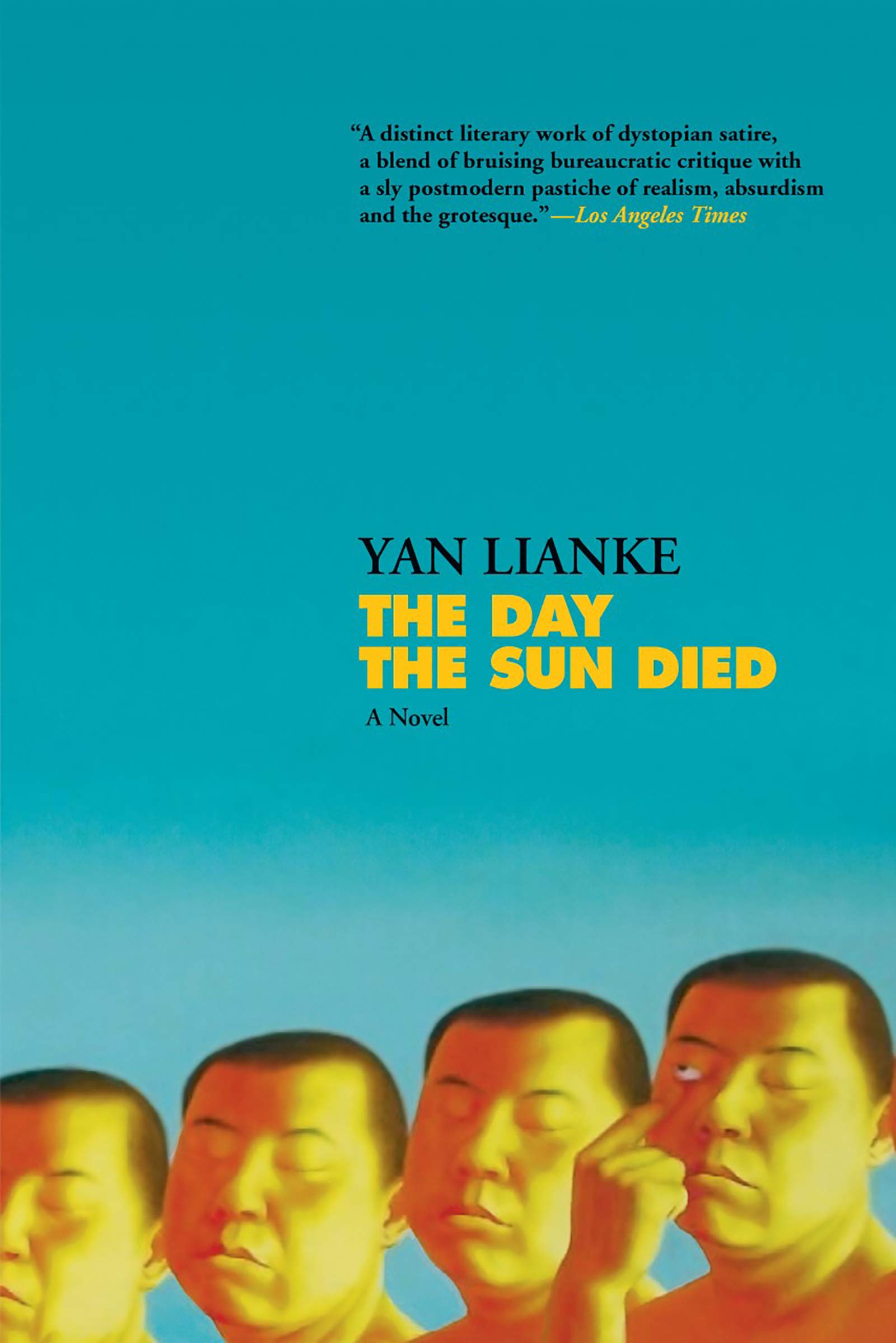
The text centers around a young man, a child maybe, a simpleton, who grows up the son of people who run a funeral accessories store. At one time, his father worked with his brother-in-law in the crematorium business. His job was to inform on people who bury their dead relatives, as the law no longer allows that due to a shortage of land. There was much money in it, but eventually, the father felt too much shame in informing on his neighbors, so he gave it up. His brother-in-law, by contrast, makes good money, burning up bodies. What's left, often, is a bit of oil, much like grease is left when one cooks ground beef. (I'd never thought of that aspect of crematory work.) This oil, he sells for a nice sum. The father decides to buy that oil at an inflated price, as long as the price always remains the same, in part to make up for his once having been an informer. He does nothing with the oil—simply stores it. You know that oil is going to play a role somewhere later in the story, and it certainly does.
The story itself focuses on one long night, when various atmospheric forces block out the sun and result in people falling very easily to sleep. Pandemonium ensues, as people live out their dreams—often killing themselves or others. Others stay awake and take advantage of the situation. This part makes little sense to me, since we don't all start committing crimes because folks are sleepwalking or asleep. Otherwise, every night would be scary indeed. Nevertheless, looting and riots follow.
With no sign of the night ending and fights become more intense, the boy's family tries to come up with a plan to bring back the sun and wake people up.
Perhaps the strangest element of the plot is the author's own namesake taking part in the novel. The boy is a big fan of the author's novels, and were I more of a reader of Yan Lianke, I would know whether the plots, quotes, and titles cited are real or just made up. Nevertheless, the author is there in the town, sleepwalking among the inhabitants—and eventually gathering notes for the novel.
Wednesday, September 1, 2021
On “Three Kingdoms” by Lo Kuan-chung, translated and abridged by Moss Roberts ****
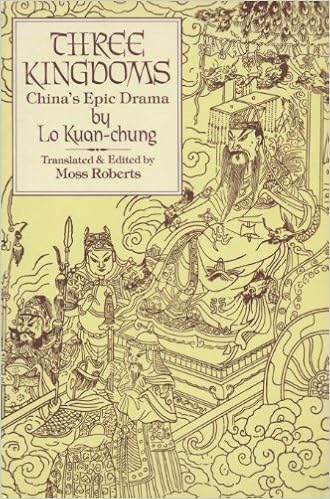
The story recounted here essentially involves the three kingdoms period in China, just as the Han dynasty was ending and three kings fought for control of the land, leading eventually to the short-lived Sung dynasty and the domination of China by the Mongols.
In the book, the Hans are beset by a disloyal general in the north lands Tsao-Tsao. Although he proclaims his loyalty to the emperor, he is most certainly looking to gather power to himself. Poised against him is a southern kingdom that has broken away and Liu Pei, the book's hero. Liu Pei aims to restore the Han dynasty.
The book, however, starts on a more personal note. Liu Pei becomes friends with two men with whom he forges a pact—namely, that they will always look out for each other. These two men thus forge Pei's main helpers during the course of his attempt to restore the empire. However, the pact proves also to be Pei's downfall, as the killing of one of the men means that he has to take revenge for his death by attacking a potential ally, even though his real enemy is Tsao-Tsao. Indeed, it is Tsao-Tsao who got the potential ally to kill the friend, knowing it would distract Pei.
Roberts discusses the various themes in the book and the way in which Pei represents both ultimate duty and honor but also how that intransigence to such order can lead to one's downfall. The other characters have similar links to larger ideas that are played out in the plot of the book.
Tuesday, September 29, 2020
On "The Road to Los Angeles" by John Fante ****
I last read this book in my early twenties, during a Fante fix, when I first discovered him. Alas, outside of Ask the Dust and one of the novellas in West of Rome, his work proved disappointing to me, but three very good works is not a bad record really, in the scheme of of things.
Not much matches Ask the Dust for quality. This work, though, keeps much of what maked that book intriguing. It is another book in the Arturo Bandini saga, but unlike the two of the four, it keeps the narrative voice of Ask the Dust pretty firmly in place (if perhaps with less balance than that one). None of the Bandini novels are particularly consistent among each other with regard to the facts of Bandini's life. In Ask the Dust, Bandini's mom and dad are in Colorado, and he's alone and twenty in Los Angeles. In this book, his father is dead, and his mom and sister live near the beach on the California coast. But as with Ask the Dust, the narrator here is exceptionally bombastic. Everything is superb or awful to the utmost extreme. There is little middle ground with Bandini. And as in Ask the Dust, the narrator is a misogynist and a racist--here, even more disturbingly. He kills animals in cruel and purposeless ways for fun. One can kind of like the characters in Ask the Dust; it's much more difficult to like them in this book--but most especially Bandini.
The main character is a high-school dropout who on some level supports the family. One could feel for such a person whose life has been placed into one of sacrifice for future chances because of his father's death. He works dead-end jobs (cannery work is the central job in this book and is well described). There's a certain intelligence that seems to be going to waste.
And yet, Bandini is also a scoundrel. He steals from his family. He is a slacker at any job he takes and usually quickly loses. He claims to be a writer, but it's clear that he has little talent. He is disrespectful to all and deliberately hurtful. He gloms on to philosophy without really understanding it, the same way that he uses big words for the sake of using big words (sometimes not completely accurately). We see within him a certain maniacal will to power and faith in himself (countered with occasional self-hatred). He is not someone you would want to be friends with.
The empty bravado reminds me a lot of Holden Caulfield. What we really see is a boy who is forced too early to be a man--but who is ultimately still a boy. As his writing is immature, so is he.
Sunday, October 14, 2018
On “The Getaway” by Jim Thompson ****

Unlike The Kill-Off, the characters here seem better drawn. But I think that after reading as much Thompson as I have, I've rather soured on the body count and the murders and the violence. Or maybe I just prefer stories about conmen. I loved The Grifters, and some of my favorite scenes in this book involved a similar con situation, wherein our couple loses their bag of riches to a guy swindling people out of keys to lockers at a train station. It's a gripping middle section that involves no so much violence as mental acrobatics between the characters involved.
Saturday, August 4, 2018
On "The Monkey Wrench Gang" by Edward Abbey ****

And so finally, I've read Abbey's classic, and I can see the appeal to young idealistic Alex. Oh, to be young again.
As I read the book now, the four central characters, conspirers to prevent the destruction of the West through nearly any means necessary (save killing people), come across as essentially terrorists. They do not, for most of the book, seem like heros very much. And they are hypocrites, littering their way across the same landscape they profess to be saving by destroying bridges and wreaking havoc on new construction. For most of the book, I did not have much sympathy for them.
But credit Abbey with somehow making the characters get into you enough that by the end you are cheering for them, hoping they get away with all their bad deeds, even if you don't agree with them. You come to like them in some odd and twisted way. Perhaps, that's because most of the squares come across as unsympathetic foes. (I also credit Abbey with making much of the writing itself absolutely beautiful.)
Still, I do end up wondering where Abbey's real feelings lie. In creating characters who are not entirely good and in naming one of the "squares" after himself, one gets the feeling that while Abbey might sympathize with the views of his four main characters, he does not entirely approve of their means. The character named after himself is a ranger who comes across them and lets them go--the first time--and then who catches one of them the second. Maybe there's hope in a more conservative approach to conservation.

 Posts


