Showing posts with label H. P. Lovecraft. Show all posts
Showing posts with label H. P. Lovecraft. Show all posts
Saturday, June 15, 2019
On "The Terrible Old Man" by H. P. Lovecraft (1150 words) ***
"The Terrible Old Man" is a kind of folk tale. It revolves around three men who go looking for treasure--via the robbing of an old man that everyone else is afraid of. They should have known not to pursue their ends. Read the story here.


Thursday, May 30, 2019
On "The Tree" by H. P. Lovecraft (1634 words) ***
Two artists vie to build a statue, but in the course of their work, one dies--vaguely becoming a tree. The supernatural effects go on to change the community. Read the story here.
Saturday, April 13, 2019
On "The Cats of Ulthar" by H. P. Lovecraft (1350 words) ***
For those who love cats, here's a story about cat revenge. Two townspeople hate cats and murder them at every opportunity, until one day . . . Read the story here.
Thursday, March 14, 2019
On "From Beyond" by H. P. Lovecraft (3046 words) ***
Lovecraft here warns of science and philosophy. Those who don't succeed live on in despair; those who do go crazy. The friend in this story is one of the latter, who invents a machine that makes the invisible visible--in such a way that it kills those who use it. One senses a link to ideas of gnosticism, how the physical cannot grasp the nonphysical without becoming utterly impotent. Read the story here.
Tuesday, February 19, 2019
On "The Other Gods" by H. P. Lovecraft (2037 words) ***
Men scale mountains. In the work of Lovecraft, however, this becomes not an adventure story about men versus the elements or even nature but about men versus the ancient gods who dwell atop those mountains, warning us away. Read the story here.
Sunday, December 23, 2018
On "The Unnamable" by H. P. Lovecraft (2951 words) ***
This tale moves Lovecraft's work into the American everyday. Essentially a kind of ghost story, the piece revolves around a man trying to convince his inconvincible scientifically minded friend that a particular house is haunted by "the unnamable." Read the story here.
Wednesday, November 21, 2018
On "The Nameless City" by H. P. Lovecraft (5032 words) ****
Here a man goes scaling into an ancient cavernous city whose history is described in other Lovecraft tales. As with so many of Lovecraft's stories, the man is eventually nearly torn apart by his encounter. But the descriptions of this odd civilization and the caverns along the way are wonderfully baroque. Read the story here.
Saturday, November 3, 2018
On "The Moon-Bog" by H. P. Lovecraft (3421 words) ****
This is what happens when a man named Denys Bary decides that the legends about an Irish bog are poppycock and in the name of progress and development decides to drain it. Campfire legends are made of this stuff. Read the story here.
Tuesday, October 16, 2018
On "The Shunned House" by H. P. Lovecraft (10,749 words) ****
Similar in some ways to "The Lurking Fear" this story revolves around a single house, one that holds fascination for the narrator growing up. It has a fungal problem, and occasionally, the narrator spies what he thinks is something lurking about inside. He gets the owner to agree to let him spend time in the house, and his uncle, who has an equal interest, comes along. Alas, the narrator loses his uncle to the house. I'm not giving away much, because readers learn this a third of the way into the story, though we don't discover how until the end. Lovecraft is at his best when trying to rationalize the irrational, and the most of this story is just that. But as with so many of Lovecraft's story's the final horror is a bit disappointing in its attempts to be horrifying. Sometimes the unknown is scarier. Read the story here.
Wednesday, October 10, 2018
On "The Horror at Red Hook" by H. P. Lovecraft (8,323 words) ****
Here, detective takes to never again wanting to set foot in a certain kind of home. The story sets out to explain why, for the cause is more than the collapse and resulting psychological illness that is given as a reason. And thus we descend into a piece about a man named Robert Suydam who seems to get younger as the story proceeds, eventually marrying a young bride. How he finds this fountain of youth is the clincher on this one. Read the story here.
Saturday, October 6, 2018
On "In the Vault" by H. P. Lovecraft (3416 words) ****
A shorter but well-done piece by Lovecraft, this one revolves around a gravedigger/mortician who builds cheap coffins and pays the price one night when he accidentally gets locked in the vault where coffins are kept as they await burial. Read the story here.
Tuesday, January 2, 2018
On "The Lurking Fear" by H. P. Lovecraft (8173 words) *****
One of the stronger Lovecraft stories, this one shows off many of Lovecraft's standard techniques and proclivities. It involves a reporter who goes in search of "the lurking fear." An entire village of townsfolk disappears. The reporter goes with some aids, who als disappear. One night, staying in a house, his partner goes to the window upon seeing something intriguing--when he doesn't speak or turn around, the reporter goes up to him and finds his face has been mauled off. The fear, the reporter comes to believe, might have something to do with a family that once lived in the house, specifically with one man who was murdered. But the truth, as the story unfolds, is something ghastlier than a ghost. Read the story here.
On "Dreams in the Witch House and Other Weird Stories" by H. P. Lovecraft **
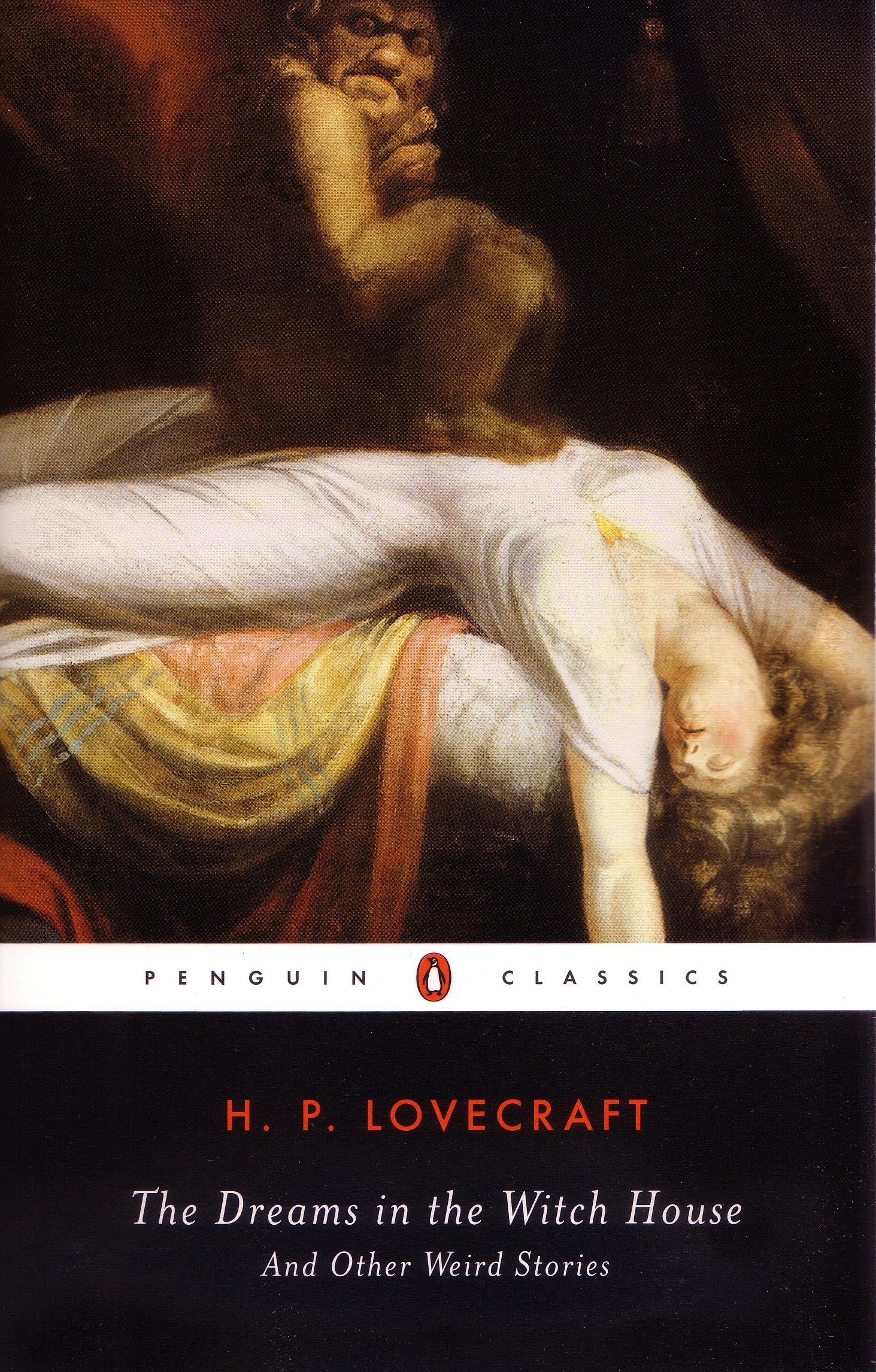
Year ago, I finally read a story of Lovecraft's online, a submarine adventure that proved actually really good--I was hoping for more with this book. Alas, it was not to be. The stories were strange but rarely carried much weight beyond that.
The first two tales in this collection introduce readers to Lovecraft's world. They are essentially histories, explanations of peoples and places, more than actual tales. It's with "The Terrible Old Man" that we begin to see actual plotlines and characters.
Many of the stories center on men coming face-to-face with what I might call "the eternal"--be it death or some spiritual force beyond the ability of our physical minds to fathom. This encounter generally results in a man's disappearance--and for those left behind a token of some sort of transformation that has occurred. For Lovecraft, then, this is what horror is: an encounter with the awesome that we should not behold. This doesn't necessarily equate to fear on the part of the reader (in fact, it rarely does) but rather fascination. Such is the case in a story such as "Hypnos," which recounts two men facing their own nightmares. The survivor of the tale finds that his friend is turned into some kind of statuette, one that others think the narrator himself has carved. If one is pulled along by the story it is by the descriptions not so much by suspense of what will happen.
The collection begins to draw to a close with a set of stories about one Randolph Carter, who descends into the land of dreams to search for, once again, "the eternal"--in this case the old ones/gods and the sunset city. The longest of these tales is more of a novella than a short story, "The Dream-Quest of Unknown Kadath." Here, as in many of the stories, familiar scenes and characters from other stories materialize. We visit, multiple times, Ulthar, which has become a land peopled by cats. All of this is in pursuit of the aforesaid sunset city. While a quest might make for good reading--I was reminded quite a bit of Tolkien's Lord of the Rings--here, the work plays out more like a medieval romance. The character undergoes various trials and performs various exploits among ghouls and other grotesque creatures, but the work seems more episodic than one with a culminating plot. In the end, the character finds that what he seeks is actually the landscape of his childhood.
And that's where the next story takes us--to Carter's childhood. Or rather, it is the story of Carter's disappearance as an older man, with a flashback to a time when he discovered "The Silver Key" that allows him to venture into this dream world. The next story, "Through the Gates of the Silver Key," focuses in part on the search for Carter and in part on Carter's adventures once he walks into the land of the silver key, reminiscent of the Kadath story explained above.
The title story of the collection involves a haunted house of sorts--a place wherein the lead character has bad dreams each night, dreams that he slowly comes to realize are in fact a reality of sorts. Too late, however, for he eventually succumbs to the evil. The house is later torn down. The last story in the collection, "The Shadow out of Time," focuses on a man who has amnesia for a few years, taking on the life of another, but who discovers that his body was actually taken over by another for a time, as their is an ancient race that lives on in and through others as it travels across space/time.
The macabre and strange, fanciful elements mixed with seeming historical detail place Lovecraft's New England work in the realm of Nathaniel Hawthorne, while his tone often makes him seem reminiscent of Poe. Both earlier writers have much to recommend them, but both also tend to be less than satisfying on some levels for modern readers, or at least this modern reader. I could say the same of Lovecraft's work.
Wednesday, July 6, 2011
On "The Temple" by H. P. Lovecraft (5388 words) *****
This is the first time I've every read Lovecraft. Now I know why Paul Bowles and other fans find him so appealing. This story at least is a mix of fantasy and madness, which makes it all the more entertaining and hard to pin down.
On a long cruise in the Atlantic, a seaman finds refuge on the deck of a submarine--only to be drowned. Or so that's the theory. In his possession is a magnificent piece of ivory that one of the crewmen takes possession of. Over the coming weeks, the crew goes mad, claiming it's a curse of the ivory piece. Our narrator, however, always a cool and rational one dismisses all warnings, recognizing these cautions as just what they are--mutterings of a crew too long at sea, too long alone, separated from others. Or are they? With such an ultrarational narrator, Lovecraft plays on this border with madness for full effect. Read the story here at Innsmouth Free Press.
On a long cruise in the Atlantic, a seaman finds refuge on the deck of a submarine--only to be drowned. Or so that's the theory. In his possession is a magnificent piece of ivory that one of the crewmen takes possession of. Over the coming weeks, the crew goes mad, claiming it's a curse of the ivory piece. Our narrator, however, always a cool and rational one dismisses all warnings, recognizing these cautions as just what they are--mutterings of a crew too long at sea, too long alone, separated from others. Or are they? With such an ultrarational narrator, Lovecraft plays on this border with madness for full effect. Read the story here at Innsmouth Free Press.
Subscribe to:
Posts (Atom)

 Posts
Posts


