Showing posts with label Robert Coover. Show all posts
Showing posts with label Robert Coover. Show all posts
Sunday, May 8, 2016
On "Going for a Beer" by Robert Coover (1093 words) ***
Here is life as a trip to the bar. I'm reminded a bit of Fitzgerald's Benjamin Button, not because Coover tells the life backward but because the speed with which the life is recounted seems similar. Here, the man meets his future wife at a bar, the man who steals his wife (or is it he who stole his own wife), the man who congratulates him on being a father, the woman with whom he has an affair, the son, and so on. Read the story here at the New Yorker.


Wednesday, February 17, 2016
On "The Reader" by Robert Coover (1473 words) ****
Here is a fairly standard piece of metafiction for Robert Coover. It is about a writer who creates a reader but who keeps finding his story interrupted by other readers and writers and events. Here the "real" and the imagined keep colliding, as if fantasy cannot ever be fully consummated, just like in life--only this isn't life--this is a story. I'm reminded a bit of the popularity of erotic fiction. Could it be that writers of such material are living fantasies in their imagination that they in turn pass along to readers? And yet, plots of fiction demand conflict--disappointment and trouble keeping us from the ultimate denoument, until the very end. And the readers, like the writers, are often lonely people whose real-life personas would never match those of the stories they are reading/writing. Read the story here at Conjunctions.
Wednesday, January 27, 2016
"The Gingerbread House" by Robert Coover (3171 words) ***
Many of Coover's stories in Pricksongs and Descants revolve around fairy tales--or their retelling. Often details change or Coover offers several varying versions or he opts to make a vaguely sexual component obvious. Such is the case with this refashioning of Hansel and Gretel, which can be read here.
Tuesday, December 22, 2015
On "The Brother" by Robert Coover (13:36 minutes) *****
My favorite section from Coover's "Seven Exemplary Fictions" involves a retelling of the story of Noah's flood. In this case, a brother has been hired to help Noah build the boat. He works on it until it is done, thinking Noah mostly just a crazy man. Noah gives no real explanation for his actions, so when the brother finds that it is beginning to rain and that everything is disappearing under water, there's a rather grim pity we feel for him.
I could not help but think of the biblical story itself. Noah is regarded as a prophet in the scriptures, so my understanding is that his boat building was accompanied by warnings to those around and by preaching. The real tragedy in Coover's tale is that the brother is clueless--that there is no warning about what is about to happen. But then I think of how we are today surrounded by "prophets" who name an end date for the world that comes and goes. I have to think that one some level, people in Noah's day would have had a similar issue. Was Noah merely one of many predicting the world's end? Which person do we listen to, or should we just ignor them all? Is a proliferation of warnings, many of them false, any better than no warning at all? We live in a sad and pitiable world.
You can listen to Coover himself read the story here.
I could not help but think of the biblical story itself. Noah is regarded as a prophet in the scriptures, so my understanding is that his boat building was accompanied by warnings to those around and by preaching. The real tragedy in Coover's tale is that the brother is clueless--that there is no warning about what is about to happen. But then I think of how we are today surrounded by "prophets" who name an end date for the world that comes and goes. I have to think that one some level, people in Noah's day would have had a similar issue. Was Noah merely one of many predicting the world's end? Which person do we listen to, or should we just ignor them all? Is a proliferation of warnings, many of them false, any better than no warning at all? We live in a sad and pitiable world.
You can listen to Coover himself read the story here.
Thursday, October 22, 2015
On "The Babysitter" by Robert Coover *****
This story, which I read my freshman year of college, blew me away then and still does to this day. I didn't read it for a class. I read it because it was in my textbook for a class, and I read the first line and couldn't stop. I've read other Robert Coover, and none of it compares. This is his climax.
Just a short time after that first read, the story would be adapted into a movie, which I eventually watched and was a shade disappointed in. It's not really a story that lends itself to being adapted. It has no straight through-line in terms of plot, and at the time I first read it, my goal was to try to fit all the disparate pieces together. But of course, Coover isn't intending this. This story is everyone's idea of a babysitter--and so she is sexy, mean, a threat, a nice girl, and much more all at the same time. As we read, plots come into being, some disappearing, others merging into others. It's a world of alternate worlds. If you haven't read this masterpiece, you can find it online here.
Just a short time after that first read, the story would be adapted into a movie, which I eventually watched and was a shade disappointed in. It's not really a story that lends itself to being adapted. It has no straight through-line in terms of plot, and at the time I first read it, my goal was to try to fit all the disparate pieces together. But of course, Coover isn't intending this. This story is everyone's idea of a babysitter--and so she is sexy, mean, a threat, a nice girl, and much more all at the same time. As we read, plots come into being, some disappearing, others merging into others. It's a world of alternate worlds. If you haven't read this masterpiece, you can find it online here.
On "Pricksongs and Descants" by Robert Coover ***
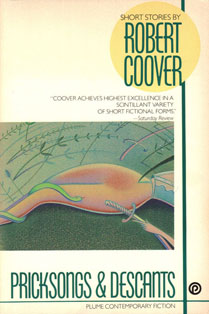
Unfortunately that novel got lost in its strangeness, becoming so inordinately weird that I lost interest about two-thirds of the way through (though I did finish it). I didn't return to Coover again.
Until now. And I wish I could say that I was mistaken in failing to read Coover for all these years. I can see how his work might have appealed slightly more in my early twenties, but I could also see myself not being that much more moved. That isn't to say I was not interested in his techniques--and in fact I still find those fascinating. Long before I had a computer or before the Internet was a widely used public utility, Coover was talking about the use of hypertext in fiction. I thought the ideas intriguing, but I didn't quite know how they would work or what they meant, not having the technology to refer to. The article, for those interested, is available here at the New York Times.
However, this Coover book is, as it is probably meant to be, deliberately alienating in many places, and I was left as if I were watching a showman, but in doing so, the showman fails to be a showman because I continue to see him as such throughout.
The stories in this collection are very much self-conscious. They are, many of them, a rerendering of fairy tales. They consider the process of storytelling itself, how we come to create narratives and what that means. They are also very male-centric stories, focusing often on sex and the female form. But the book is called Pricksongs, so what should be expected? Perhaps, Coover is intimating the sexual desire and story go hand in hand. Given how much best-selling fiction is romance or erotica, that's probably true.
The book opens with a prologue that makes the tie-in to fairy tales explicit. From there, the collection moves to a story called "The Magic Poker," which might qualify as my second-most favorite of the book (perhaps, "The Elevator" could also take the position). Coover is explicit here in saying the story is a story, telling us that he is the author and that he is about to introduce a character or that he regrets introducing a character because he seems to have little to do with the story, and so on. Vaguely, it involves two sisters who find a magic poker--one attracted to it, one repulsed; one who turns it into a prince and one who does not. The poker stands in for the frog the way you might expect the male anatomy to stand in for the prince here.
"Seven Exemplary Tales" features a prologue of its own and seven very short stories--some of them again, retellings of famous other stories. "The Elevator" discusses a man who plots revenge for constantly being accused of flatulence, when in fact another man is the one responsible. As with "The Babysitter" it ends up including several plotlines of possibility--sex with the woman who runs the elevator, revenge, the elevator dropping everyone to their deaths, being let off on the wrong floor or at a floor from which there is no return, and so on. "Quenby and Ola, Swede and Carl" recounts the tale of a family who lives in a touristy fishing area and the man who comes to fish with them, told as per usual with Coover, out of order and with seeming conflicts in terms of what actually happens. "A Pedestrian Accident" focuses on a man who is hit by a truck but is told as a kind of farce.
Another theme of this Coover book is performance. "Romance of the Thin Man and Fat Lady" recounts circus performers, for instance. And the final story in the collection involves a magician, acting as a kind of epilogue for the collection, one in which the magician can perform some great feats but in which he will inevitably disappoint, as indeed, the collection as a whole seems to do.
Subscribe to:
Posts (Atom)

 Posts
Posts


