skip to main |
skip to sidebar
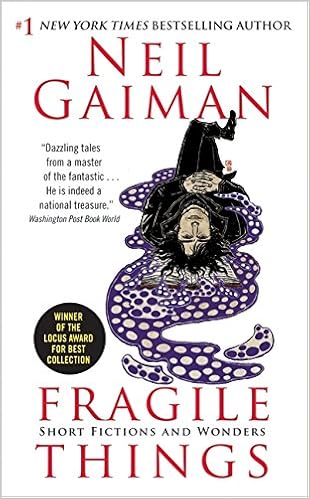
Neil Gaiman has been haunting me for years. A reading copy of one of his books was given to me years ago when I worked at a bookstore (a coworker read the thing and bragged about how good it was--the subject matter didn't appeal to me, however). Another coworker was a huge fan of the Sandman series. Still other friends through time have told me how good that series is--not being a graphic novel aficionado, I've avoided it. But now his writing is winning awards too--most recently one of the kids' book awards given out each year. He was calling me. I was determined, thus, to have his name on my list of fantasy reading. At least then I could say I knew what the hoopla was about.
That I placed him on the list was a good thing. Gaiman is a very good writer. His talent is evident throughout Fragile Things. But as I've suspected all along, his particular choice of subjects isn't what naturally appeals to me. I take, as a case in point, a story called "Forbidden Brides of the Faceless Slaves in the Secret House of the Night of Dread Desire." Great title. The story is one in which a writer wishing to be successful keeps being told that he should give up literature and write fantasy. In this case, though, the "fantasy" world is one very much like our own, with people eating breakfast and arguing over mundanities like who gets which part of the newspaper or who makes breakfast. The "real" world is one with knights and sword fights and strange creatures. I found myself pulled toward the "fantasy" world (i.e., the real/literary world)--more of this, I wanted to say, but Gaiman gives us mostly a world of the fantastic, a world that most of the time is less interesting to me. Beyond that, the collection as a whole seems like a hodge-podge of things that didn't fit elsewhere. In a sense, it's a great way, probably, to get a feel for Gaiman's whole arsenal, but it also feels like a bit of a jumble.
My favorite piece in the collection is one called "Bitter Grounds," the story of a man who is "dead," metaphorically at least (he's been dumped by a woman he loves), who runs into a stranger in New Orleans and eventually finds the stranger missing--and also the stranger's academic paper on zombies (zombie coffee girls, to be more specific) to be presented at an anthropology conference later that week. The man takes it upon himself to assume the stranger's identity and to present the paper himself. The momentary change of personality does him well, but only for a time, only until the conference draws to its end and he's back to being love starved. Nice story, notably with only a little fantasy.
Other favorites include "The Facts of the Case of the Departure of Miss Finch," a story about a crazy circus that comes to town and that somehow Miss Finch ends up a part of, never to return. "Instructions" and "Fifteen Painted Cards from a Vampire Tarot" offer interesting pieces of writing, though I'm not sure how much they qualify as stories. "The Monarch of the Glen" is the final novella and works pretty well, especially in its set up: an American comes to a remote part of Scotland and is offered a job too good to be true--over one thousand dollars for a single weekend of work as a security guard. Lots appears to be ominous, and those fears build for forty pages, and then somewhat disappointingly, the ominous elements come true--I say disappointingly because again there is a turn toward fantasy that doesn't seem in keeping with the rest of the tale. Were this more my genre, I'm sure I'd have been wholly satisfied. "Goliath," a Matrix-like of alternate worlds, is also a good one.
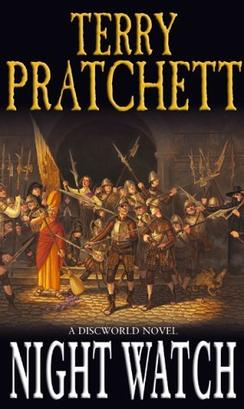
This book poses the question of what would happen if you were transported back in time so that your old self could teach your young self a few things about the world. Or at least, it starts off asking that question, and then it focuses more on space-time continuum and how to fix things in terms of the plot. But I like the question. And while I wasn't too keen on Pratchett's style early on, it grew on me, and then the plot kicked in, and about half way through he had me hooked. In the end, the book should leave readers with a lot of questions about fate, as time traveling books usually do, but Pratchett doesn't get into that too much--it seems more about government and politics than about questions of physics and metaphysics.
I've been wondering why science fiction and fantasy are usually housed together as genres. The answer should have been obvious, but it only dawned on me while reading this book. LeGuin's Left Hand is, I suppose, technically science fiction. It involves spacecraft and alien beings. But its setting is a fantastic world, no less real than Tolkien's Middle Earth. If anything involving fantastic worlds is fantasy, then half of science fiction is also fantasy. (Where I find the combination strange is when one is dealing with a world based on Arthurian-type legend, as Tolkien's world is. There is nothing sci fi about it.)
Of the books on this fantasy and legend list, Le Guin's so far ranks as my favorite. It didn't start out that way. The many strange place names, the inhospitable prose, the emphasis on treaties and other dull government tasks were all quite off putting. But somewhere about the time that Mr. Ai, our alien envoy, is dismissed from the government representatives of Karhide, the book gets very interesting. Mr. Ai ends up taking his desire for open trade to a rival country, Orgoreyn, and eventually finds himself in a bit of trouble--and having to depend on Estraven, a Karhider for whom there is little trust. In the process, one learns of this strange world, where it is always winter and where sex occurs only once a month when the otherwise neutered people go into heat. And one gets a captivating adventure story with a good deal of heart, as Mr. Ai flees for his life.
What of mankind? What of dualism? What of friendship? What of courage? Of gender? Of history and how it's written? Of legend and of how it comes to be? All such issues get played out amid what is actually a rather simple story.
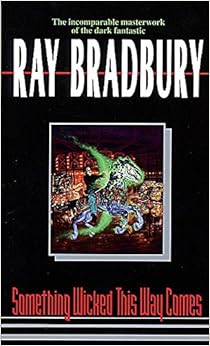
It has been probably close to two decades since I last read Ray Bradbury--and since I first read him. That work was Farenheit 451, which I recall thinking was fine, but not enough to inspire me to rush out and read the rest of his work. "Something Wicked" provided a slightly more complex reaction--but one that in the end is essentially the same. Bradbury's obsession with books is evident early on, with a major character working as a janitor in a library and two boys who enjoy scouring the stacks.
But the book turns mean quick, with the arrival of a fair of freaks. Watch out for the weirdos--they might just be trying to get your soul. Seems kind of fifties--you know, "strange people means strange things." Watch out for folks who are different. And the people who do the best watching--why, of course, twelve-year-old boys. I found the whole thing rather unbelievable, and given that this is a fantasy novel, some level of belief needs to be obtained if I'm to enjoy the thing. Beyond that, parts of these early passages seemed deliberately preaching as well as deliberately lyrical (lyricism is great; forced lyricism not so much).
But then what happened? Somewhere in here the janitor (one of the boy's father) gets involved, and I started to actually feel like this world perhaps made sense. And the action picked up, and there were moments of suspense. And then? And then came the crazy ending, the solution, the means of chasing the demons away. I won't bother telling folks who haven't read it what it is, but my feelings were jolted back to my initial ones. In the end, I didn't really much care.
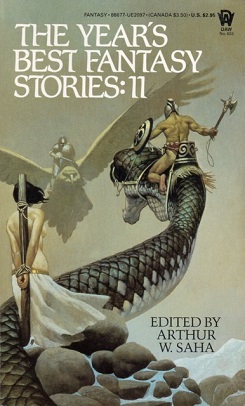
I don't read too many online fantasy or science fiction stories. Genre fiction isn't generally a big love of mine, and on the whole, I've not found online genre writing to be that good (as opposed to literary writing, of which there is a fine good lot of good stuff). This may be due to the fact that I'm not a fan of the genre of fantasy to begin with--or so I'm learning. If all stories were as good as the "best," however, I'd probably give them more of my attention. Every story in this collection was competent, and some were excellent.
What makes the stories typically more generic, however, and what in some ways is what I find disappointing about most genre fiction is that each story wrapped up fairly well and succinctly. There were a lot of loose ends. One need only look at one of my favorite stories in the collection, "The Storm," by David Morrell. Ostensibly, a story about a storm that literally follows on man around, this was a piece about as fascinating as T. C. Boyle's story "Blood Rain." Watching the character discover what was happening and and all the trouble that this situation brought to those around him was fascinating. Then the story gave us an explanation--a curse placed on the man. I was with the story until the curse, but the latter seemed such a letdown--an easy out for an intolerable but intriguing situation. (The very end, a bit of a twist, at least makes up for some of my disappointment.)
Other favorites included "Unmistakably the Finest," by Scott Bradfield, the story of a woman who discovers success in the form of a preacher she follows--and the resulting trouble that eventually ensues. If one notices a trend here, with me, it's that, for me, the best fantasy is that which seems to be part of our world and twists it around a bit, rather than something that is set in a world of dragons and knights. Realism--and fantastic realism--has always been more to my taste.
An exception to this would be Jane Yolen's "The Foxwife," the tale of a man who discovers he is married to a literal fox. The way in which this story is told reminded me of many of the strange tales I read on the Japanese reading list that I undertook last year. Bizarre enough that I wasn't sure what I was to make of it.

The third book in a row for me involving Arthurian legend, this one is the most recent and the most unified, and in that modern sense it's the best. Malory obviously left behind a lot of source material, because it gets mined time and again by people like White. Here, Malory's story is boiled down essentially to that of Arthur, Lancelot, Guinevere, and Merlin, in that order of importance. It works much better than Malory's kitchen sink--no long accounts of jousts and tournament (White explicitly mentions that he is avoiding those because they'd be of little interest to contemporary readers). And the entire section on Tristam is gone, relegated to mere mentions here and there (unfortunately, in White's version, Tristam is not so noble as he is in Malory). Also, unfortunate, is the way that the courtly love of the various knights becomes full-on sexual intrigue. There was something grand about Tristam's story when he was a knight who was wronged by King Mark, rather than the other way around.
What's interesting also is how White uses Arthur to comment on contemporary times--his contemporary times, namely, with the rise of Hitler. The Great War is discussed in terms of Arthur's war to end all wars--and yet which fails to do just that. There is discussion of how borders seem to make the world the sad place it is (we know they aren't real, but we fight over them anyway). Part of how White does this is to have Merlin live backwards, and thus, he knows even what is happening in our day, given his long life (how Merlin knows these things when confined to a cave--not the underside of a stone, as in Malory--I'm uncertain, but I suppose he must get out at some point). And part of how he does this is by having Arthur train with Merlin by becoming various animals. This first section of the book, largely not featured in Malory, features Arthur and Merlin front and center. I found it also perhaps the most boring section, which is a shame really, because it was the one section whose plot wasn't mostly borrowed. So it goes. White's book is good mostly because of how it is able to update Malory and give him the unity of form modern readers expect.
I wish I could say I remember more of this than I do. This old Welsh work is in many ways quite similar to Thomas Malory's Le Morte D'Arthur, which I just finished. I can say I enjoyed this one much more, in part because the style of the writing of this time befits the short tales that make up this collection much better than a 700-page tome. Malory's text, in its middle, came off as episodic and began to feel quite repetitive. Here, split into separate little chunks, the episodes are separate pieces, and it works better.
But what The Mabinogion lacks that Morte D'Arthur has is an arc and a series of continual characters (yes, Arthur, Guenivere, and some of Arthur's knights show up in several tales, but not in every one). As a result, one doesn't recall as much when the tale is completed. A woman's son is stolen away (but is set up so that she looks as if she killed him), and she is forced to tell all visitors to the castle how she apparently killed her son. The son grows up. Someone discovers his true identity, and mom and son are reunited. A fine story, but one I recall probably because it was the very first. In the next to last story, a young man is told to marry a particular woman. He goes to Arthur's court to request the help of the king, his cousin. The knights then venture off to a new kingdom, meet with a man who requires of them some impossible tasks (lest they die) in order to win the lady, they do them, and the young man gets a wife (this piece reminded me how, in Christian lore, God does all these things for his people, who in turn reap the reward, even though they've done very little). In between are similar tales, full of quests and knights. But I'd be hard pressed to recount their plots.
There is a lot of defending women's honor in this book. There are also a large number of unvirtuous, even devious ladies. Men fall trapped to women's wiles--here sex appeal is turned to literal necromancy (Merlin, in love with a woman, gets pushed under a magical rock, a trap from which he cannot escape, so that said woman can pursue another man). Men fight to defend women's reputations, even when the reputation has no base in fact (curiously, many of those same men remain supposedly virgins for the one they love, given that the woman is inevitably already married). Near the end, Lancelot finally makes his love for the queen physical, and then, when accused of wrongdoing, fights tens of knights to prove that she (and he) are innocent. Might makes right, for God is always on the mighty's side, the author seems to suggest. And we wonder why there are bar fights today?
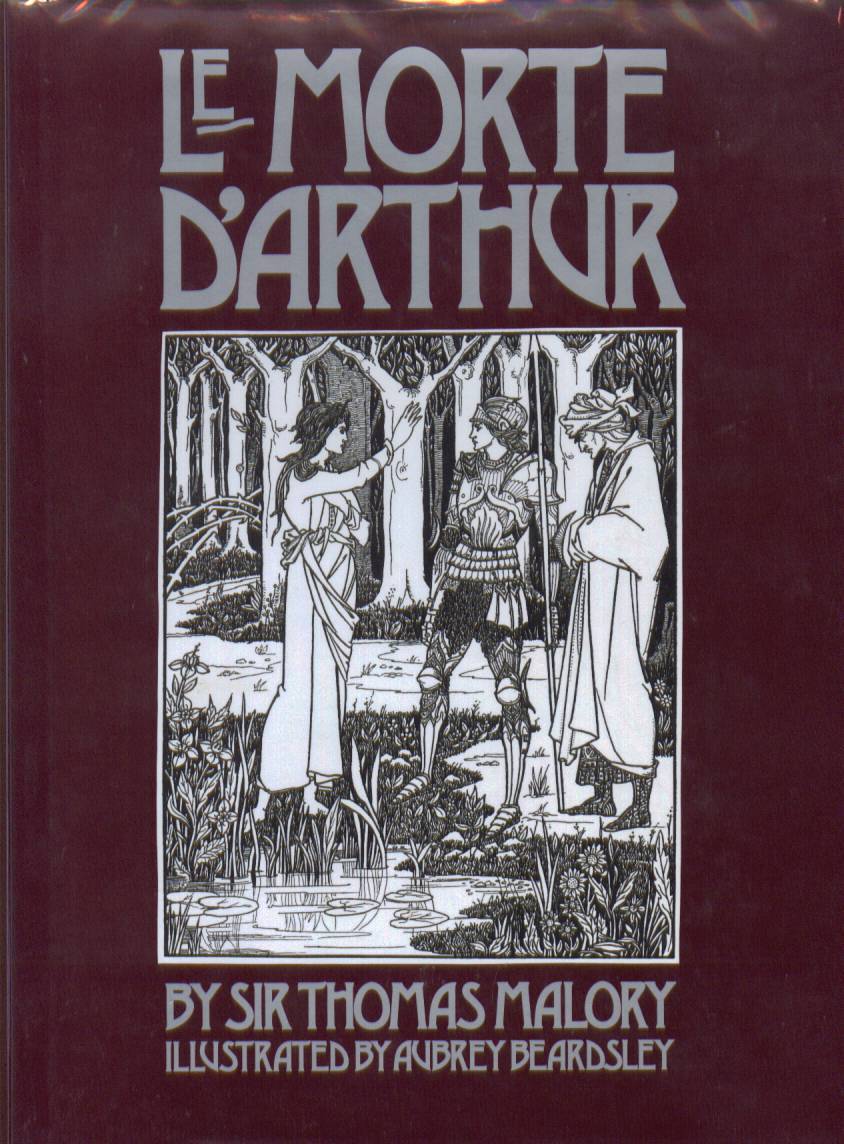
On the whole, this 750-page tome was at its most interesting at the beginning and end, for its first 100 pages and last 100. In the early chapters comes the setup, all the prophecies about what is to unfold in the faraway future, as well as a history of King Arthur's ascent to the throne. In the later chapters comes the fulfillment of those prophecies and the story's tragic end. In between are accounts of numerous battles and quests and tournaments with little or no real climactic buildup. This is a romance in the medieval sense, so the text is episodic, and while some episodes occasionally make for compelling short stories, the whole does not amount to much. I found myself terribly bored during most of the accounts of the battles. But the overall trajectory of the story is mythic, and it's easy to understand why Arthur's legend has inspired so many derivative works.
If you're one of the three (or forty or two) people who's been following this blog for a year, you've seen a sudden dearth of book discussions. That's because the tome I was reading was The Lord of the Rings. I opted not to talk about each volume separately since Tolkien himself thought of it as a single novel. Spare judgment to the end, I thought. The Lord of the Rings is the first of ten books on a reading list of fantasy and legend, a genre I haven't read much of. Unfortunately, this wasn't the best start. I didn't care much for the movie version of Fellowship of the Ring and never bothered with the rest. The books were better--less violent--but still not something I can say I've fallen in love with.
About four years ago, I read Tolkien's The Hobbit. Although it wasn't my "type" of book, I admired his skill and craft. He had a way with telling a story, ending those chapters in the perfect spot to make you want to read on and speed through it. Not so much here, where chapters often ended in dead space. Dialogue was often atrocious, and the descriptions often seemed simply like filler. The plot was fairly predictable.
So why three stars? Because despite all that Tolkien does manage to do something very unique. He creates a complete world, full of its own history and legend, its own calendars and peoples. Few worlds have been so richly imagined and so wrought in such fine detail. Moments in this book shine--like when the hobbits return to their homes or when Sam and Frodo get stuck in a spider's lair. Had the entire work spoken to me as much, I'd have likely been able to rank it up there with The Hobbit as one of those works that entertains through and through, even if it doesn't speak to me personally.






 Posts


