Showing posts with label Jim Thompson. Show all posts

Sunday, October 14, 2018

On “The Getaway” by Jim Thompson ****

One of the more classic Thompson titles is almost entirely about an attempt to escape, or run away from, a crime that has been committed. The couple at the center of the narrative rob a bank. Then bodies start piling up as they flee, with the intent of retiring to a criminal paradise. Much has been made of the surreal ending, as the crooks go from hiding in a cave that barely fits their bodies, where they take sleeping pills to avoid pain, to hiding in a pile of manure, to crossing waters to get to El Rey, to finally landing in their supposed paradise, a place that proves to be less than ideal.

Unlike The Kill-Off, the characters here seem better drawn. But I think that after reading as much Thompson as I have, I've rather soured on the body count and the murders and the violence. Or maybe I just prefer stories about conmen. I loved The Grifters, and some of my favorite scenes in this book involved a similar con situation, wherein our couple loses their bag of riches to a guy swindling people out of keys to lockers at a train station. It's a gripping middle section that involves no so much violence as mental acrobatics between the characters involved.

Monday, October 8, 2018

On “The Kill-Off” by Jim Thompson ***

As the back of this book denotes, this is not so much a who done it as a who will do it. The victim of the murder is alive for two-thirds of the book, though fearful of her impending murder. Through various points of view, Thompson shows that multiple people have reasons to kill the woman, a gossiper who has ruined many a reputation and life among those living in the town. Her younger husband might kill her to get her money (and also the money owed to him that she has confiscated from his work for herself), in part to run off with a new love interest. That love interest might kill her because she's not a very innocent gal and obviously wants to be able to marry her lover. The son of another local might kill her in order to steal money from her to be able to run away with a gal he has an interest in. And so on.

The conceit is an original one, but alas, the characters seem here prisoners to it and to the plot that Thompson has set out. As such, the book doesn't quite live up to its full potential.

Saturday, October 6, 2018

On "The Criminal" by Jim Thompson ***

This multiperspective narrative is not a mystery or thriller in any conventional sense. It's actually rather predictable. It's more of a character study and an indictment of the criminal justice system.

The tale revolves around the rape and murder of a young woman. Each character has his or her own view as to whether the young man charged deserves to be. His parents recount how the son grew apart from the father and how he has been skipping school and how they had conflicts with the parents of the woman killed. The son describes how the event occurred, but the tale leaves off at a crucial moment, such that we as readers don't know whether the man did or did not do the killing; what we do learn, though, is that the man was seduced and the woman was not so innocent as one might think. Enter the legal system and the newspapermen. The latter want a good story to tell and thus promote a rape and murder scenario with the young man at the center. This means that though the DA may well have thought the man innocent, the legal system feels obligated to charge the teen. Nothing is about justice so much as about money and individuals' jobs and careers.

Wednesday, December 6, 2017

On "The Killer inside Me" by Jim Thompson *****

This was the first work I read by Jim Thompson, around a decade ago now. I read it in conjunction with a number of other crime novels. I was impressed in part because, well, I'd known of Thompson for some time, but in the midst of other classic crime novels, it did not stick out perhaps as much as it would have in another type of list, such as this one. I still rated it my second-favorite on that list. Now, having reread my two favorites from that list, I can say that this one was actually better on a second read--and rightfully stands as perhaps Thompson's masterpiece.

It has much in common with Pop. 1280, which I'd recently read--both are about killer sheriffs. But where that one plays things much more for laughs, this one is a bit more serious. That sheriff is over-the-top in acting dumb, and he doesn't let readers in on it: we have to discover such for ourselves. But in this book, the sheriff, Lou Ford, pretty clearly to us readers reveals his cards early on: that he's putting on an act. In a way, I think that works better.

Ford suffers from, he says, "the sickness." There are, I suppose, some psychological dimensions going back to his childhood, not wholly interesting or convincing. What's more interesting is to watch how one action spirals into the set that follows, one murder becomes many more to cover it up.

The work proves suspenseful as one watches Ford attempt to cover each crime. Finally, as the murders mount up, one's feelings for the victims begin to come to the fore. It's not so much that one hates Ford--he becomes more and more pitiful--but one hates what he does to others.

Wednesday, November 29, 2017

On "Hell of a Woman" by Jim Thompson ****

If one can get past the absurd premise near the beginning of this novel, the rest of it is a great read, especially as one nears the end. It's a tale like The Grifters, full of one upmanships and odd twists.

Dolly Dillon is a traveling salesman for the Pay-E-Zee stores, one who borrows from his accounts and is about to get caught. His wife and he fight constantly. Life, essentially, stinks.

One day he goes to visit a client who owes him money and finds, instead, an old lady willing to buy from him, but she won't pay in cash: she'll pay, instead, with her niece--prostitution. Dolly goes for it, and here's the part that's a bit unbelievable: the niece falls for him (in part because he promises to help her rather than sleeping with her--not that he actually intends to go through on his promise).

But Dolly's luck turns when his boss Staples discovers how much he's been shorting accounts. He's fired. His wife runs off. But Mona, the girl he promised to help, bails him out and lets him in on a little secret: her aunt is loaded.

Scheming to get the money and keep it takes up the rest of the book, as we watch Dillon slowly crack apart.

Tuesday, November 21, 2017

On "Savage Art" by Robert Pulito *****

This definitive biography of the writer Jim Thompson starts with a short assessment of his work, of what makes it so powerful, so different from other crime fiction--namely, that Thompson subverted the normal means of telling crime stories by taking their cliches to the extreme. He found an audience later probably because his rather nihilistic portraits worked better for readers of the late twentieth century than for the early. We get crooks with no saving graces--and cops who are crooks. And yet, disturbing as the portraits are, we do sometimes feel with them.

Next Pulito delves into Thompson's familial background--some Native American and the rest going back to the early days of the United States, migrating over the generations from east to west. Thompson himself was the son of a sheriff, born atop the city jail. He grew up for much of his youth in Oklahoma, but his father had good times and bad times financially. A big spender, unable to save, he provided a home that was feast or famine. During the famine times, as he traipsed off to find a better life, his wife would often go to live with relatives in Nebraska, and hence, that too became a home for the young Jim.

Finally, Thompson's dad hit it big for a while in the oil trade, and the family moved to Fort Worth. There, however, fortunes eventually sank, and Thompson went to work as a bellhop, where many of his experiences led to events recounted in his novels. Here, he learned the grift; he served as the getter and giver of drugs, hookers, alcohol, and other things bellhops were often looked to for. Meanwhile, he went to high school, all the while working eight hours a night, doping and especially drinking and smoking to stay alert. Eventually, by age nineteen, still in school, it led to a breakdown.

Thompson's relationship with his dad was not a good one. Dad was a mover, a worker. Thompson was quiet and big on books--writing was not real work in Dad's view. Dad had little respect for Jim. And Jim lacked respect for the dad who left the family by turns and spent out the family fortune whenever it come to be. During his time as bellhop, Thompson saved $1100, which he'd planned to use to support the family after he got out of the hospital and was unable to work for a while--his father stole it, investing it in another get rich scheme that went nowhere. The family suffered.

Thompson spent a couple of years after that in the oil fields, working various jobs. These adventures would become part of his writing later. His mom even came down and joined him, helping to set up a restaurant that quickly went nowhere. Eventually, Jim headed to college, in his mid- to late twenties. There, he majored in agricultural journalism, doing well in the writing and English classes and abominably in just about everything else. He met a lot of other writers, however.

During this time, he began to court the sister of his brother-in-law. The father of the girl really liked him, but the mother not so much. Hence, when the father died, the mother did her utmost to break them up. The girl married someone else, and Thomposon went into a spate of depression, broken up eventually by a blind date arranged by that brother-in-law. The woman he eventually married also had a family that didn't much care for him, and in this case, Thompson's family didn't much care for her. The issue seemed to be one of class--these women were from better-off families, and Thompson would not be able to provide the kind of living these women were accustomed to (or, in the case of the first gal, needed, as she was semi-invalid from an accident she'd had as a young girl). Nevertheless, Thompson and his girlfriend eloped, then lived apart thereafter for a few months, eventually being caught, as the wife came to visit Thompson alone at various times. During this time, Thompson worked and went to college, keeping a schedule much like he had in high school (only now his father was in the throes of whatw as probably Alzheimer's and needed lots of care). But as the Depression years came on strong, even the work dried up.

Jim tried his hand at writing--any he could scrounge up. He sold a fair number of pieces to newspapers and crime journals, often under other names. But the work was not consistent. He tried to get jobs editing for newspapers, and finally one of these attempts led to a job with the Oklahoma WPA. After being hired on by a man who would become a good friend, Bill Cunningham, Jim would work on a guide for the state. He'd also become involved with the Communist Party, an involvement that would lead to a schism between different people involved with the WPA. This would eventually oust Cunningham as head of the Oklahoma division, and Thompson would take his place. Among writers Thompson would work with was Louis L'Amour.

Thompson's writing at this time consisted still of various pieces for crime magazines under pseudonyms, folk stories gathered for the WPA, and Depression-era proletarian-type stories. One of the latter would garner enough attention to land Thompson a book deal with Viking, but though he completed the novel (sending it in in installments), it would never be published, in part because it would lack cohesiveness.

Eventually, Thompson's communist leadings (combined with, ironically, a milktoast labor history that others commissioned Thompson's agency to write that Thompson actually didn't want to do) would lead to his dismissal from the WPA. The state guide Thompson has worked so hard on would sit for nine months until another head was appointed and the agency got back to work; that writer would then take the bulk of the credit for editing of the guide. Thompson meanwhile came up with a book idea for which he got sponsorship and off of which he lived for a year. The book was a series of stories/interviews with various laborers; it, too, would lack cohesiveness, straddling a line between nonfiction, which it was supposed to be, and fiction. It would never be published.

After this came a stint in San Diego. The expectation was that Thompson might scrounge up some work in screenwriting, but nothing materialized. After some dead-end jobs and a few Thompson was good at but had little enthusiasm for, Thompson sent his family back to Nebraska and headed off to New York, where many of his labor and writing friends were now residing. The idea was that there was a job there waiting for him, but it was gone by the time he got there. Instead, Thompson tried to sell his work again, visiting various publishers. Eventually, he got a publisher to take him up on his pledge to write a novel in ten days if they'd lend him a typewriter.

The work, completed in about five weeks, was his first published novel, Now and on Earth. It was heavily autobiographical and still focused quite a bit on labor issues. (In fact, in his personal life, Thompson was moving away from the communist leanings he had had, wanting to write something different, something that would both sell and say something, something grittier and less idealized.) Underneath the novel's characterizations were hints of the crime novel protagonists to come. It received decent reviews but didn't sell very well.

Old WPA friends in New York helped Thompson find a home for his next book, Heed the Thunder, which was a kind of epic Okie historical novel, written under a similar deal as the first. Meanwhile, Thompson had written, and rewritten, a masterpiece called The Unholy Grail. Eventually, it (the eighth draft) would be published as Nothing More than Murder, but not before he had to take more newspaper writing gigs in San Diego and Los Angeles. His firing from the latter gig happened as he finally sold said novel--and received, for once, the critical and popular attention he'd needed to become a novelist.

Strangely, the success of the book, however, didn't lead to more opportunities in terms of book publishing. Two subsequent novels, The Recoil and The Golden Gizmo, went unsold. Thompson took day jobs again. And then, his agent came upon Lion Books. It was a magazine publisher looking for paperback originals to sell into newstands. Thompson went to work writing books for them. The relationship would lead to more than half his career output, as he managed to writing something like fourteen books in the next five years. The success also kept him from drinking as prolifically or uncontrollably as he had--what often led to him losing his day jobs.

The first of these books was The Killer Inside Me. Thompson was handed a plot and then told to write it. But the plot was about a New York City cop who kills a woman. Thompson changed the setting to small-town Texas, the cop to a psycho, the woman to women. The publisher didn't care--when the editors saw the first draft of the first half, they knew Thompson knew what he was doing. Other books followed, with such speed that it's impossible really to know what was written when. Some books were still coming out years later. Pulito opts to put the books into categories in summarizing them: first-person psychos, multiple narrators, third-person novels, autobiographies, and cul-de-sacs. The latter are the handful of dead ends, dunces, bad books. Note to self: I need to read Savage Night, Nowhere Man, A Swell-Looking Babe, The Criminal, and The Kill-Off, as well as the later book The Getaway and the earlier Nothing More than Murder.

And then, the editor at Lion Books left and the magazine company was sold, and Lion Books closed. Thompson, essentially, was out of a job. He went back to drinking heavily. Other crime writers got new publishers; somehow, Thompson's agent could not find him a home, despite the fact that Thompson generally got good reviews and sold about 250,000 copies per title. No reason can be determined, but Thompson thought it was because his novels were so violent. He attempted to pull back, writing some clunkers like The Expensive Sky and The Concrete Pasture. But mostly he just drank, sold short pieces, and worked, for short spans, day jobs--one copyediting at a newspaper.

Along came Stanley Kubrick. A fan of Thompson's, Kubrick was a budding filmmaker whose first film lacked a decent script. He hired Thompson to write (the dialogue) for the second screenplay, an adaptation of a crime novel. The film became The Killing and got rave reviews. Thompson was livid, however, about the screenwriting credit, which Kubrick took for himself, dropping Thompson down as merely the dialogue writer.

Thompson insisted, if he was to write for Kubrick again, he be credited fully. And so it was, when he came on to writing Paths of Glory, for five hundred dollars a week. The degree to which the final screenplay reflects anything he wrote, however, is up for debate. The first draft was overhauled twice, and the writer of the rewrites claims nothing was left of Thompson's work, but Pulito's examination of the scripts suggests that maybe half of Thompson's dialogue and many of the scenes stuck. Either way, Thompson's name is on the byline--as the third writer. After this, however, Kubrick moved on--he didn't think Thompson appropriate for adapting Lolita or other non-crime faire.

About this time, Thompson managed to sell another novel--not one of the clunkers written years before but something new: a revisit with Sheriff Ford: Wild Town. Neither a prequel or sequel to The Killer inside Me, the book is sort of an alternate universe with many of the same characters from the previous book. The book sold to NAL. But editors never gave Thompson the kind of freedom he'd had at Lion. They suggested he start up a detective series, with the same characters--for example, Lou Ford. Or they wanted endings that were "moral," wherein the book managed to show that crime didn't pay. With such shackles, Thompson could not flourish.

Thompson took up writing occasionally for television, but there the shackles were even greater. He did not do well writing for committee. In time, screenplay work dried up, since he was not fast and not able, often, to stick to plans. Pulp magazine publishing also dried up, since television largely replaced it.

Meanwhile, he sold a book called The Getaway, which he had to assure the publisher would end in a "moral" way. When it ended not to the publisher's liking, he stuck to his guns, unwilling to change it to something more realistic.

Thompson was also hired to write a novel/screenplay called Cloudburst, but as he often did, he veered way off the plan for the work. The book ended up being another Lou Ford alternate universe (though the protagonist's name would be changed to Tom Lord to avoid rights issues), and there would be no screenplay. In time, he was able to wrest control of the project from the filmmaker and publish the book as The Transgressors.

Also published during this time was The Grifters and Pop. 1280, but these works would be the last to show off Thompson's powers. After this, his work, when he could sell it, would descend into nostalgia and/or needlessly lurid sex and violence, as in Texas by the Tail, South of Heaven, and King Blood, the latter of which would be pulled by the publisher before seeing publication in the United States and would not appear until after his death. His last book, published as Child of Rage would be similarly tainted, as if, as Pulito claims, Thompson was struggling still to shock in a culture that was now more sexually liberated.

Still other work involved writing novelizations of films and televisions shows, which he did a few of for standard fees.

Drinking during this time took its toll also, and Thompson ended up in the hospital and near death several times. Told to stop drinking and smoking, he'd resume both soon after leaving the hospital each time. Poverty, too, was a problem, since hospital bills stacked up and he wasn't selling much work. He resented the fact that he was not better known and that his work was not more fully accepted. Most was out of print, and when he did manage to sell a book, it was for the same sum as he'd made for years, unlike other big pulp writers who seemed to be making more for each publication.

Still, there was interest in his work for film adaptation. Several novels would be optioned at various times. Thompson didn't own copies of most of his books, so he had to scrounge them up from a used book store or send photocopies, when producers asked to see and consider his work. A big break came with the sale of The Getaway. Thompson wrote the first two drafts of the screenplay, but in the end, someone else took over the project and he ended up with no credit--but a nice paycheck (though not as nice as he would have gotten writing the screenplay). The book in the film became merely an action flick with a happy ending--not a tolerably great adaptation, but still well grossing for the year.

Struggling still to write, Thompson would face multiple strokes until he could barely talk. Eventually, tired and knowing he could write no longer, he starved himself to death.

Through it all, his wife Alberta stuck with him and he with her. He complained about her a lot, but when asked why he wouldn't divorce her, he said that he could never do that to her. (Given his drinking, it's a wonder she didn't divorce him.) He was the one to cook each night, but otherwise, it appears she took care of managing their life. When she had a heart attack, he was as devoted at her bedside as she had been with him through his various ailments. It was love.


The ending to this life seems to come quickly when it finally comes--he's a man who should have died years earlier, one gets the feeling. The real joy of the read for me involved Thompson's communist sympathizer days and the ushering in of his midlife success. The dreariness of life thereafter made the book a rather sad slog in its last hundred pages or so, but such, one might say, is life--most especially Thompson's.

Sunday, November 5, 2017

On "Fireworks: The Lost Writings of Jim Thompson" edited by Robert Polito and Mihael McCauley ***

Often, there are good reasons certain works are lost or left unpublished, but fame has a way of making such miscellany valuable to others. Such is the case with this collection of Thompson's uncollected shorter work.

Arranged in a rough chronological order, the first section from his 1930s and 1940s writing, includes quite a bit of nonfiction written in a fictional vein. In "The Strange Death of Eugene King," Thompson takes on the voice of a transient looking to solve the murder of another transient, a technique popular in thriller magazines of the era apparently. "Oil Field Vignettes" and "Thieves of the Field" both provide first-hand insights into the oil industry that I'd likely never have thought much about otherwise. The first is mostly character sketches of oil workers--one who likes complete silence, one who is scared of drilling, and one who is constantly marrying bad women who take advantage of him and leave him. There's something of a folk tale quality to these bits, as in the stories told in "Thieves," where Thompson ruminates on how pipe can be (and is) stolen and sold. "Snake Magee's Rotary Boiler" is a tall tale about a blown-up boiler that sends a man clear back to bed.

The True Detective pieces show how Thompson became the writer he did. There's a quality of the unknown, as is typical of mystery in each of the true crime pieces, a mystery with a twist usually at the end. "Ditch of Doom" explores the life of an insane man who murders his wife--or is it a planned murder for his former wife? "Oklahoma's Conspiring Lovers" follows the unfortunate story of a man beat up by a horse--who in fact is not beat up by said horse. "Illicit Lovers and the Walking Corpse" tries to figure out how a man's wife survives being accidentally killed by the man--and just how many wives the man has.

"A Penny in the Dust" is an unfinished novel from the period. Seemingly autobiographical in its first passages, it lacks for polish, but the ickiness typical of Thompsom becomes apparent in the final scene provided.

"Character at Iraan" recounts life among oil workers between jobs, as they sleep in a cheap hotel, gamble, and drink. Although published in Prairie Schooner, the piece does not seem to fulfill its literary pretensions.

The second section focuses on Thompson's writings during the 1940s and 1950s, which would have included the time of his most productive output. "Death Missed a Beat" is a straight story about a man who in an effort to get to work on time the next day picks up a hitchhiker to drive him and ends up the object of a murder. "Murder Came on the Mayflower" is a short account of an early colonial murder. "Exactly What Happened" plays to a weird twist in a story in which a man attempts to rob his boss by pretending to be a coworker. "The Threesome in Four-C" is an account of a man who has gone insane because of his conscience. "The Dark Stair" is the basis for Thompson's book No More Than Murder; a true story, the mystery hinges on the contents of a movie. "Forever After" revolves around a woman who, tired of her marriage, plots the murder of her husband via her lover but who, as in "Exactly What Happened," finds the situation reversed on her. "John Stink" is about a Native American whose tribe takes him for dead, so much so that when he finds his way out of the shallow grave they take him for a ghost they must ignore so that he'll go away. "Blood from a Turnip" centers on a watch that hustlers attempt to turn for a profit.

"The Cellini Chalice," one of the longest stories in this section, shows Thompson at his top form, as he is in his better novels. The story centers on a hustler named Mitch. He cons a chalice off a woman who thinks him a vagrant in need, a chalice that is worth much more than she knows. Alas, Mitch isn't an antiques expert, so he thinks he fares well getting a thousand dollars for it but is disappointed when he finds out it's worth at least fifteen times that. Mitch learns that there's another chalice like it and aims to get it with the woman's help. What he doesn't know is that the woman is in on the con--of him. Many pages later, Mitch finds himself in some extenuating circumstances that require him to use all the street smarts he has to extricate himself from.

"The Frightening Frammis" picks up where the previous story left off, once again following Mitch on his efforts to con people out of cash. Having been the victim of a recent swindle, Mitch feels down on his luck, but he soon falls into an opportunity to earn fifty thousand dollars. This story doesn't have the same weight as the previous. The circumstances that lead to Mitch's opportunity seem too haphazard: he's hitchhiking, a couple picks him up, the man dies, and Mitch just happens to look like him, and there just happens to be fifty thousand in the car, and so on. Mitch's wife seems too forgiving, after all that he's put her through in both this story and the last. As such, the plot twists overpower the sense of characterization, and the story loses punch, which is a reason I have tended not to care as much for genre fiction in the past.

The same point could be used to denote why "Pay as You Exit" and "The Flaw in the System" are disappointing. The first involves a hitchhiker who aims to rip off the woman he manages to stop by flattening her tire, only to find out that she might well be just as dangerous as he is. The second involves people at a company who are conned.

"An Alcoholic Looks at Himself" seems a bit disorganized, but it is a sad, autobiographical portrait of Thompson as a drinker, a man who has squandered chunks of his life and talent in an effort to get the next bit of the liquid elixir. I say disorganized, but it is in chronological order. It's just that, being "real life," there doesn't seem much in the way of an arc or growth--it's just random discussion of drinking, stopping, then drinking again.

"The Tomcat That Was Treetop Tall" is a crime story about a man who decides to rip off a couple in a bar and the man who decides to stop him. Here, the story's violence seems as if it is on the page for thrills rather than for a purpose inherent to the story.

We then move to the last two decades of Thompson's life and writing. The middle of the book seems the strongest part; by this era, Thompson's work has become something of a parody of itself. "A Horse in the Baby's Bathtub" revolves around an incest story. A young man who is, in his mind, clever and smart, takes an interest in his father's new bride, his stepmom. He kills off dad and takes up with her, but his interest in her is, in part, one of contempt. In the end, he opts to do some violence to the family next door, who has lost a child--and that's where one learns the meaning of the tale's title.

"The Red Kitten" is the start of a longer work--a promising start. A man marries a woman, but with an understanding that the inheritance the two of them will get requires them to stay married. The will is set up in such a way that it essentially forces the two to despise one another but stay married--or find some way to knock the other off. Alas, the piece ends there.

"The Slave Girl in the Cellar" is a summary of a true crime story, a case of modern slavery. The piece is interesting for the case itself.

"Sunrise at Midnight" is a strange piece, a piece that seems in many ways like male wish fulfillment. The first section focuses on a man married to a stripper who is forced into her profession by a crooked cop. But just as the husband begins to build a plan for taking care of matters, the story backtracks to that same man taking an interest in helping out a much-younger woman in a dead-end job. After he buys her new clothes and sets her up rather well, she insists on going to bed with him against his will and then they get married. The man loses his job as a reporter and thus fall the events that force his wife into stripping--and the man into seeking revenge. Like so many of the pieces in this last section, this one seems unfinished.

I didn't much care for "Hell" from Ironside, the one published piece in the last section, a lyrical exploration of killing and crime.

"This World, Then the Fireworks" closes off the collection and might be the most finished of those works falling in the last section. Full of familiar Thompson tropes, the piece seems a bit over the top. It involves a set of twins who witness their father killing a cop who discovers said father cheating with the cop's wife. The wife commits suicide, the dad goes to jail, and the kids grow up to be troubled. They get into the grift, but their main desire is somehow to avenge or to understand their father's deed. And so goes the tale as the male twin opts to get involved with a female cop.

The book made me feel like Jim Thompson's best material was long form and mostly during the period for which he is most famous, when he wrote so many books in such short order. I wouldn't have bothered with the text were it not one of the few available to me to read on my Jim Thompson list. This is a collection, I'd say, largely for Thompson scholars, who can used it to see how his writing developed.

Wednesday, October 18, 2017

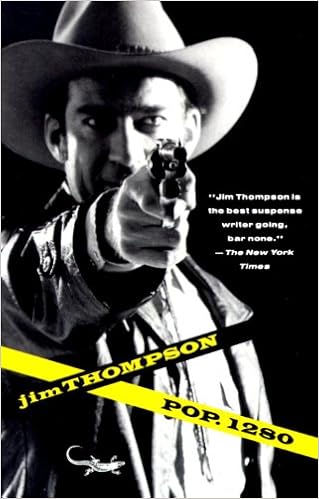
On "Pop. 1280" by Jim Thompson ****

What works so well in this novel is Thompson's corn-pone southern folksy voice. One would think that Thompson came from the South, was born there, but he's a Los Angelino, though he bumped around a bit, I'm sure. And he probably got good at mimicking ideas about the South, cliches and such. And this novel plays into that well.

The text revolves around the small-county sheriff of Potts, population 1,280. He's a goof, an idiot, or so it seems at the start of the book. One wonders, How is it that this guy is carrying on not one but two affairs? But then, something becomes clear: He's no goof. He's very clever, and he plays the goof for full benefits. And he's also incredibly sinister and evil and corrupt.

But so is just about everyone in town. In fact, in some scenes, Nick, the sheriff, comes out looking like an advocate for civil rights compared with those around him--but mostly when it benefits himself. Meanwhile, he manipulates those in town by playing to their worst instincts. If someone catches you in a lie, accuse the person of adultery or arson. If that doesn't work, just denote that you won't accuse ever the person, which is sure to get the rumor mill spiraling with questions and innuendos.

One has to wonder how happy the sheriff can be. He's in a constant fix, playing one crime against another to stay ahead of his pursuers. It seems like a stressful life.

Tuesday, October 17, 2017

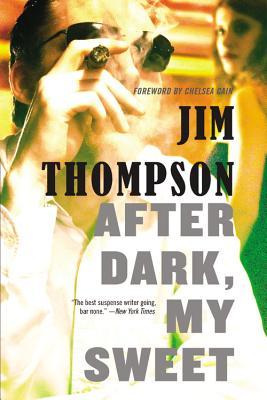
On "After Dark, My Sweet" by Jim Thompson ****

This is the novel that started my interest in Thompson--but mostly because of the movie, or rather, the movie review. Siskel and Ebert loved it; I have yet to see it, some two decades later. But I've wanted to read the book and/or see the movie ever since, and now I have.

Alas, with most things built up so much in one's head for so long, I was a bit disappointed. The characters in this novel seemed half-drawn, and while we might forgive that because the main character is supposedly insane, I still didn't quite understand how the lead was so drawn to the woman who is his potential undoing.

She's sort of pretty, I guess, after the main character thinks on her a while, but she's a drunkard and mostly cruel. She in turn introduces the lead to Bud, a friend, who wants him to take part in a kidnapping and ransom. As in other novels, there is a chance at redemption, in this case via a doctor who tries to help the main character. But he is drawn too much to the woman.

But what exactly is the woman's game? Is she with Bud or against him, with the lead or against him? The main character's paranoia leaves us uncertain until the end whether she is taking advantage of him or truly in love. But then, much isn't as it seems in this book, as the last chapters demonstrate.

Monday, October 16, 2017

On "The Grifters" by Jim Thompson *****

I've wanted to read more of Thompson for quite some time, but our local libraries have only one book of his. Going on vacation recently, I figured I needed some light reading that I could take with me, so I purchased a selection of Thompson's work, this one among them.

I was familiar with this book because of the movie, and admittedly, it was a bit hard for me not to see John Cusack, Annette Benning, and Angelica Huston in the characters of this work. But I'd forgotten much of the plot of the movie luckily, so the book remained largely fresh to me--and it was the kind of read I was hoping it would be.

The story follows Roy Dillon, raised by a young mom who doesn't really want to be a mom and who is a small-time hood. Dillon grows up to be a con artist in his own right, and saves up a good deal of money in the process, clearing his way for an early retirement.

An accident brings him back in contact with his estranged mom, who hires a nurse to care for him (or spy on him). He falls for the nurse, but he's also carrying on with another woman, another con artist as it turns out. These two loves, in essence, represent two sides of Dillon--one that wants to go straight (and has the opportunity to do so) and one that remains tied to the underworld. The novel hinges on which path he will choose. Or should--there seems something of an element of fate in the events that befall him.