Showing posts with label Greg Jackson. Show all posts
Showing posts with label Greg Jackson. Show all posts
Tuesday, November 21, 2017
On "Summer 1984" by Greg Jackson (5744 words) ***
"Summer 1984" is a story about creating a story, but it's really the story inside it. The story as a whole is typical of the later stories in the Jackson's collection, which in some sense are about the creation process. The story here is about Michaela, a woman whose name may have been changed, and about a set of event that may have been changed as well. Autobiography mixes with fiction to the extent that we have no clue as to what is real and what imagined. Read the story here at Vice.


Saturday, September 16, 2017
On "Serve-and-Volley, Near Vichy" by Greg Jackson (8244 words) ****
"Serve-and-Volley, Near Vichy" does an odd trick of showing how one-time fame can corrupt a person's life. The narrator heads with his girlfriend to visit one of her old friends, who happens to be married to a former tennis star. The star, however, appears to be going mad. He no longer plays tennis and forbids the family from it. And yet, one day, he takes the narrator out to film a tennis match--the star player's most-famous tennis match--an act that will transform the narrator's life in ways sad and harrowing. Read the story here at VQR.
Saturday, August 12, 2017
On "Wagner in the Desert" by Greg Jackson (7940 words) ****
In "Wagner in the Desert" a man recounts his activities among a set of friends in California. He's writing a novel and chasing a woman who is happy enough to let him play with her. His friends are trying to make a movie and a baby. Together, they try out various things on their baby bucket list--things to do before one has a baby to tie one down. They seek sponsors for a movie (i.e., one is a guy named Wagner). They have sex. They do drugs. Lots of them. And that is what gives their world so much character. In a sense, there's a kind of sadness percolating beneath this story's heroics, for while there's much going on, there's really little of consequence. Read the story here at the New Yorker.
Monday, August 8, 2016
On "Dynamics in the Storm" by Greg Jackson (8244 words) *****
"Dynamics in the Storm" pulls off a very difficult trick that had me scratching my head and rereading the piece. It's about a man who takes an old woman acquaintance on a drive to escape from a hurricane hitting the East Coast, but it's also about two people who are estranged from their spouses wondering whether they'd have been better off with someone else. It's a rare story that essentially recounts a single conversation over a brief period of time, paying attention to every nuance and detail, and it's brilliant, one of my favorite stories in a long while. In it use of POV, it reminds me of Rick Moody's novel The Ice Storm, but whereas I found that book's POV, in the end to be clunky and gimmicky (in what is otherwise a fairly good novel), Jackson pulls the POV off perfectly and of necessity. Read the story here at Granta.
On "Prodigals" by Greg Jackson *****
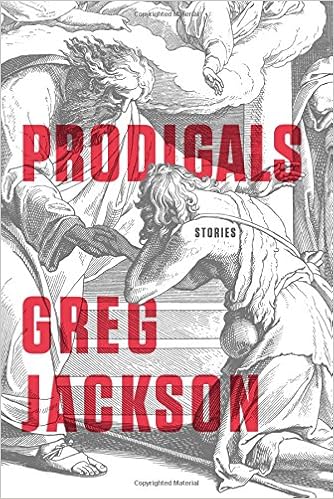
Such is certainly the case with the first tale, "Wagner in the Desert," which recounts events among friends and involves much in the way of drugs, a theme that will be returned to at the end of the collection. "Serve-and-Volley, Near Vichy" also involves friends, but this time the focus is clearer--on a couple and a tennis star family.
"Epithalamium" rehearses the story of a soon-to-be-divorced woman who shows up at her vacation cabin to find another woman, much younger, already there. The soon-to-be ex has rented out the cabin for charity. Angry at first, the woman continues to live with the charity winner, finding herself more and more drawn to the companionship the younger woman offers. In the process, the divorcee begins to reveal--perhaps, see--parts of herself that are perhaps not so healthy.
"Dynamics in the Storm" is one of the best stories I've read all year, pulling off a very difficult trick that had me scratching my head and rereading the piece.
One of the weaker stories, "Amy's Conversations" recounts the tale of a close friend's encounters with Amy, as she moves from conventional faith to activism to the seemingly banal existence that we all desire to lead.
"Tanner's Sisters" manages to be as mesmerizing as the conversation it recounts--namely that of a man who has been through a relationship that has changed his view of the world. The story's conclusions, unfortunately, are not nearly as bold or transcendent as the tale itself, one in which a man falls first for one sister and then for another, one beautiful and amusing, the other sad and profound.
"Summer 1984" and "Metanarrative Breakdown" move into the subject of storytelling itself. The latter tale returns to some of the drug themes of the opening story--and also to the seeming lack of plot. The narrator is at a wedding when he gets word that his grandfather is dying. After catching a plane to the grandpop's residence, he has a conversation with his cousin Misty, a woman who takes up new pursuits every year or so and drops them before much is accomplished. This conversation involves him recounting another conversation with a woman named Gaby, a conversation that involves them taking mushrooms and other drugs and that in turn brings them into contact with a car impounder, who then tells them a story. Hence, we have stories within stories within stories, which are all brought back to the frame story by the end. This story dives deep into theory, and if it weren't for the interesting characters and their interesting manner of talking, I'd have lost interest. Instead, I found myself pulled forward despite myself. And it is this, this ability to make me want to read more that makes Greg Jackson's book such a pleasurable read.
Subscribe to:
Posts (Atom)

 Posts
Posts


