I didn't know what I was getting into when I started this book and was a bit surprised once I started reading it. What I'd long thought was a novel is more a collection of linked stories. Some characters reappear, and there is a general historical timeline that is stuck to chronologically, but this is not a novel in the sense of having the development of a character (unless Mars itself is the character) over the course of the work.
While Asimov's I, Robot seemed more interested in philosophical ideas about intelligence and ethics, Bradbury's work is more concerned with history. The latter is also more of a stylist, with writing that is memorable for its own sake. The history that Bradbury focuses on seems to me to be one of Earth, and most especially of the New World. The extended metaphor between the settlement of the New World and the settlement of Mars is made explicit more than once.
Bradbury's book begins with a story written from the point of view of a race of Martians. In that story, a woman has visions of men from Earth visiting the planet. And indeed, the next several stories revolve around attempts to explore and colonize the planet, with each little group of Earth men killed off in some way before they can bring back news of a successful landing to the people back on the home planet. But in time, Earthlings eventually establish a foothold, this made possible largely through a disease that wipes out Mars's original inhabitants (ala the American Indians).
Eventually, more and more people come to Mars, and it is increasingly seen as a place for young men to go off to make their fortune. And that is where Bradbury's work takes a dark turn, for as Mars begins to be settled, Earth finds itself enveloped in a world war, and new settlements drop accordingly--indeed, as the Martians disappeared, so it seems that humanity itself also will.
Showing posts with label Ray Bradbury. Show all posts
Showing posts with label Ray Bradbury. Show all posts
Wednesday, January 29, 2014


Thursday, July 16, 2009
On "Something Wicked This Way Comes" by Ray Bradbury ***
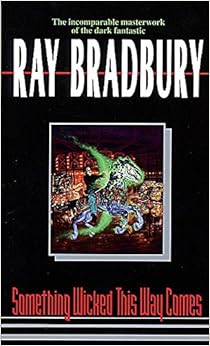
But the book turns mean quick, with the arrival of a fair of freaks. Watch out for the weirdos--they might just be trying to get your soul. Seems kind of fifties--you know, "strange people means strange things." Watch out for folks who are different. And the people who do the best watching--why, of course, twelve-year-old boys. I found the whole thing rather unbelievable, and given that this is a fantasy novel, some level of belief needs to be obtained if I'm to enjoy the thing. Beyond that, parts of these early passages seemed deliberately preaching as well as deliberately lyrical (lyricism is great; forced lyricism not so much).
But then what happened? Somewhere in here the janitor (one of the boy's father) gets involved, and I started to actually feel like this world perhaps made sense. And the action picked up, and there were moments of suspense. And then? And then came the crazy ending, the solution, the means of chasing the demons away. I won't bother telling folks who haven't read it what it is, but my feelings were jolted back to my initial ones. In the end, I didn't really much care.
Subscribe to:
Posts (Atom)

 Posts


