skip to main |
skip to sidebar
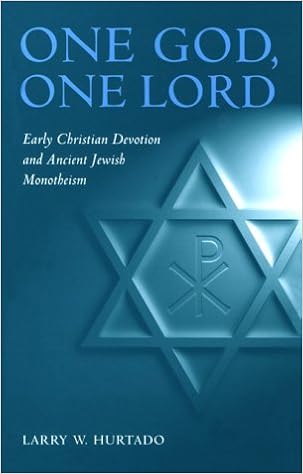
This relatively short book attempts to figure out how Jewish people would have thought about Jesus as a divine figure when he first burst on to the scene. How, in other words, would a monotheist religion manage to explain a second unit in the Godhead? Why would Jewish people accept that and so quickly?
Hurtado rejects the idea that such acceptance stemmed from the Gentile side of the church and that Jewish Christians did not see Jesus as divine. Rather, he says that the idea of divinity was routed in certain concepts having to do with a kind of second in charge or command, behind God--a divine agent who works for and on behalf of and in place of God.
This agent can be found in various forms: as a personified attribute, such as wisdom or the word; as an angel; or as an important human figure/prophet. Of particular note, however, is the angel, for a principal angel figures prominently in many Old Testament and inter-Testamental passages. In this sense, then, Hurtado says, we can see the risen Jesus as fitting into the Jewish concept of a chief angel, a divine agent.
However, that would not mean that Jesus was one who early Christians worshipped, and Hurtado notes that unlike the divine agent's treatment in most earlier texts, it's clear that the worship practice of early Christians included Jesus with God. How that came about is not quite clear, but, Hurtado implies, it was likely related to Jesus's resurrection--an event that changed the view of certain peoples.
Hurtado's ideas are intriguing, especially as one tries to figure out how a Jewish person would have felt about Jesus at the time. The divine agent certainly seems like one avenue by which people could have seen him. But if the Gospel accounts are accurate, it's clear that Jesus claimed divinity of himself while alive, which still is rather mind-boggling insofar as having people accept that. Miracles must have played a large role, with the resurrection being the final step to such acceptance.
This short study of how Christians were distinctive in the ancient world is extremely readable. I've completed a handful of other books about paganism in the Roman Empire in the first century, but none of them were written as accessibly as this one. Here, Hurtado gives readers a real feel for how the pagan world functioned and just how Christianity would have been a disruption to such a society.
Whereas the Jews did not accept other gods, theirs was at least an ethnic religion. In fact, most religions were ethnic at this time. You were born into a faith, but few faiths were exclusivist. Your family god might also be shared by the nation, but the land where you live might have its own god, and you might go to the celebrations of other gods worshipped by friends and family. Rome was accepting of local gods, as such provided for political stability. This was the danger of Christianity, because it did not accept those gods as real. As such, it endangered, in many people's views, the political stability of nations and of the empire. It also meant you broke up the unity of families. It was also a different sort of religion in that it knew no ethnic limits, making its spread potentially greater.
Christianity was also a bookish religion. More than most faiths, its ideas were committed to print and passed along that way. Not only, of course, was their an emphasis on the holy book, but there were also letters and such that were shared. Hurtado spends a full chapter discussing this early written religious culture.
Finally, there were differences in morality, a subject discussed elsewhere but that Hurtado gives an adequate summary of here.
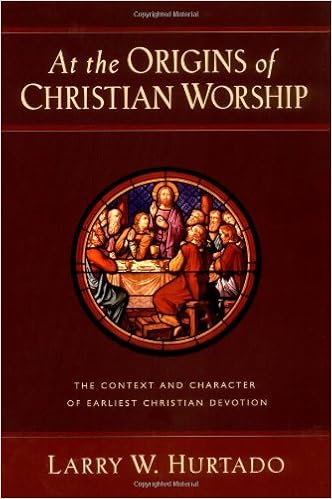
Based on a series of lectures, the short book is a very readable summary of many of the themes that extend throughout Hurtado's work. The main goal of the book is to explore what worship was like near the beginning of the Christian faith.
Hurtado starts his book by looking at paganism as it would have existed in the day and how that would have impacted Christian worship. The gist of it is that a Christian of Gentile extraction would have had a difficult time in society, because its social structure was largely based around pagan cults. Want to share a meal? You'll do that at the temple--or in rarer cases, at rich person's house (though in a crowd of ten at most)--generally in honor of a god. Being Christian involved breaking away from much of this social structure.
Next, Hurtado looks at how Christians actually worshipped, insofar as what they received in exchange for their conversion. Many churches met in homes and featured only a small number of congregants, so the experience was intimate--and it often featured food. Social distinctions were largely removed. There was also the promise of a coming utopian age of which Christians had a foretaste.
Hurtado turns next to the worship pattern insofar as the nature of God is concerned. He denotes that worship was largely binitarian--focused on Jesus and the Father as objects of veneration. The Spirit was certainly something of importance, but it was not an object of worship. Christians still believed themselves monotheists, as the Son was seen as the expression of the Father.
In the final chapter, Hurtado turns to contemporary worship and discusses how the early history/pattern of worship might instruct Christians today in their own practice.



 Posts


