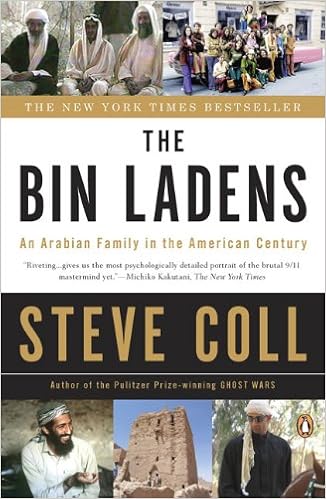
This exploration of the culture and recent (last twenty-five years) history of Exxon did not turn out to be as interesting to me as Coll's book on the Bin Ladens. I think that may be because the book seemed to sprawl so far and wide like a discrete set of articles rather than like a single narrative or a singular argument. Still, I suppose that's in keeping with Coll's point--that Exxon is wide ranging, sprawling, a world power not unlike any nation-state.
And indeed, Exxon's loyalties, as the book makes clear, are chiefly to itself and its shareholders. At one point, the former CEO even states as much, when asked why Exxon doesn't do more to help out with energy costs and jobs in the United States: our responsibilities are to the shareholders not to any particular nation. And yet, ironically, Exxon, when it needs to be, is an American company, happy to take advantage of tax discounts, U.S. military assistance, and U.S. diplomatic assistance. I can't say multinational companies come off looking very nice in Coll's rendering.
The book begins with an account of the Exxon Valdez spill, an event that would shake Exxon badly and that would lead to a heavy focus on safety, in an attempt to never repeat such an incident. It would also lead--as would many other similar events--to a long set of court cases that Exxon would appeal and appeal and appeal until penalties were rejected or reduced to a negligible amount for the damage done. Most galling of all in this regard would be how Exxon, while agreeing to pay for damages to water supply and property values a leak at a gas station caused--but not any kind of penalty beyond the actual physical damage--would eventually even contest what physical damages it agreed to pay. Another lawsuit from people in Indonesia would sit in courts for such a long time that the people who brought the suit would die before seeing any benefit. If you're a regular person, forget ever getting anything from corporate bigwigs.
Other chapters focus on how Exxon works with powerbrokers in Africa, Indonesia, and Russia. They bring out how difficult it is to show a concern for human rights in nations where the rule of law is often that of the local rebel group, where who's in charge might change from day to day, where pirates range freely.
Why bother drilling for gas in such locations given the risks? Wall Street. Exxon and other oil companies continually have to show that they have replaced or surpassed the number of oil reserves they've used up or lost in a given year. This means looking for oil in bad places, merging with other oil companies, playing shady with the numbers (counting certain technologies Wall Street doesn't count as reserves).
Coll starts with Valdez and ends with the BP Gulf spill of 2010. In between, Exxon merges with Mobil; liquified natural gas comes to be a resource of growing importance; and tar sand oil begins to be profitable. There's a lot here to chew on.



 Posts


