Showing posts with label Poetry. Show all posts

Wednesday, May 10, 2023

On "The Collected Works of Billy the Kid" by Michael Ondaatje ****

When I set out to read a group of Westerns, a genre I have had little experience reading, I mostly intended to focus on the pulp fiction, and indeed, most of the books so far that I've ready have fit into that category, but now, for the last few, I'm moving toward reading "high-brow" Westerns, those that intend to be Literature with a capital L. Ondaatje's work certainly fits into that because it's not a Western aiming for a popular audience, with a heavy-handed plot and a likeable character at its center. Rather, it's a book of poetry, with the legendary Western antihero Billy the Kid at its center.

The book, in large part, is a kind of "found poetry," extracts from real-life documents rearranged in a poetic format. Ondaatje aims to describe the final days of Billy from multiple points of view, as his partners are gunned down and he is taken prisoner by and then escapes from his one-time friend and now sherriff Paul Garrett. All this seeps through what narrative is provided, because, this being poetry, we're more focused on the thoughts of the people at any given moment than on what's happening. In that sense, not having read Billy's history, I found the earlygoing parts of the book difficult to follow, but as I read on, I began to understand who was talking when and how events came to be.

As a piece of descriptive and experimental literature (Ondaatje includes various types of prose, rhyming poetry/lyrics, free verse, photographs), the Collected Works works admirably. One gets a pretty good set of views of the young man--from his friend, lovers, enemies, and self--while also coming to see how real-life people enter into myth. It was an enjoyable read, though I can't say that the work made me empathize too much with anyone or made me want to read a ton more about Billy.

Thursday, April 8, 2021

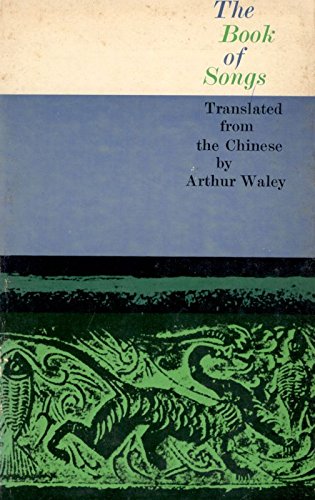
On "The Book of Songs" translated by Arthur Waley ***

This book of ancient Chinese poetry proved less interesting than earlier passages I'd read from the work had led me to believe it would be. The poetry included here definitely are song lyrics insofar as the pieces usually quite repetitive, with minor variations made in each stanza. As such, the work can be interesting. But as well as Waley does in terms of trying to provide context for the poetry through occasional introductions and frequent footnotes, much of it didn't really speak to me in our contemporary times (in fact, the footnotes often proved distracting, as they provided alternative translations or generally ruined the feel of the songs when I paid attention to them). There are poems here about serving the king, about sacrificing to the gods, about dynasties, about hunting, about farming, much of the material seeming quite remote.

The real beautiful pieces of the collection come in the first third of the book. Those are the love and marriage songs. The human heart, it seems, doesn't change, and many of the songs about losing one's loved ones seem to carry the same anguish that folks today would also serve up. I look forward to turning my attention to some more contemplative classical Chinese poets, who may well run down similar paths to these songs.


Friday, May 10, 2013

On "The Kalevala" by Elias Lonnrot ****

Based loosely on ancient epics and folktales, this Finnish epic poem runs from a creation of sorts to a Christ child of sorts, with all its strange tales in between. It is, so I read in the introduction, really the beginning of Finnish literature, insofar as it was the great epic written at a time when Finland was really coming to its own, pressing for its own national identity. One certainly couldn't do much better--it's a marvelous work. The particular translation I read as well, by Keith Bosley, is a lot of fun. Bosley notes that Finnish poetry is heavily alliterative, more even than Old English poetry. Placing rhyme or metric measures onto the work in translation would be to do a disservice to it, as would be trying to mimic completely  the Finnish poetic devices. Instead, he settles on a purely syllabic verse (nine syllables--sometimes five or seven to a line); it seems to work well, especially as lines often repeat, as they would in a rhyming kids' tale (think, for example, of the repetition and refrains in "The Three Little Pigs").

Summing up The Kalevala is difficult, and while I'll try here mostly so that I can one day return to this write-up to refresh my memory, it'll be a sorry recounting. The beauty of the piece is really in the language mixed in with the plot itself, which at times as a bit fuzzy to me.

We start with a kind of creation of sorts, from which springs the old man Vainamoinen. I say "old man," because by the time he gets around to doing anything in the narrative, which is fairly quickly, he is already old in the eyes of others. One of his first acts is to try to find a wife. Unfortunately, in what will become a constant theme for him, the woman, whose father he convinces let him have her, rejects him because he is to old. She chooses, rather, to jump into the sea and kill herself. Vainamoinen builds a boat and goes to sea, and while at sea, finds a mermaid, who turns out to be this woman reincarnated, but he doesn't get the mermaid either.

Enter now the blacksmith Ilmarinen, who goes north to find a woman of his own. After settling in the north country, he goes about his job of forging metal into tools for the people around--and, it seems, of creating the sky. He doesn't get his lady until sometime later, however, when Vainamoinen comes calling. The latter is the better match, the family feels, as Vainamoinen is well off, but the young lady is none to smitten of the idea of being paired with an old man, and so she chooses to marry Ilmarinen.

One more would-be lover yet enters the tale, Lemminkainen. He marries a lady, promising never to go to war if she never runs off to go visiting. The promises, however, are broken on both sides, and Lemminkainen goes off again to find another lady. In the process of trying to woo a lady of the north, he manages to get killed. His mother goes searching for him and, finding him, reconstructs him. He's warned to be more careful, but again he wanders off, this time to Ilmarinen's wedding, where he manages to kill the brother of Ilmarinen's bride. More revenge follows, so Lemminkainen flees his home and wanders a far island for a while, sleeping with various women. When he returns home, finally, after a few years, he finds his home burned.

Ilmarinen, meanwhile, loses his wife to murder. And now the three of them, all sorrowful, Vainamoinen, Ilmarinen, and Lemminkainen wander toward the northlands to seek a certain vengeance of their own. There, they steal something called the Sampo. They do it by use of a pike's comb--the bones of a great fish that Vainamoinen manages to catch. The music puts the people asleep. But Lemminkainen's desire to sing--Vainamoinen, known for his musical abilities, refuses--wakes a bird who wakes the people of the north, who then come chasing after the three thieves. In vengeance, the hag, the northern queen, steals the sun and moon, which the three then go in search of. Ilmarinen tries to forge a new moon and sun, then tools to help Vainamoinen free them, but the hag of the north senses her eventual likely loss and frees them of her own accord.

The story of these men ends there and turns toward the birth of a young child to a virgin, who has eaten a berry that has made her pregnant. Vainamoinen's days are noted as being numbered. The narrator bard exhorts others to join his song and write yet other epics, setting up the Finns for yet more literature.

Alternate translations can be found here, here, here, and here.

Tuesday, April 16, 2013

On "Magpies" by A. G. Synclair

I had planned on featuring three poems today, but the links for all three of them have gone dead--alas, the nature of online journal. Here's one I did manage to refind, republished in a different journal. If poetry is all in the language--and in a way it is--then Synclair's "Magpies" is an examplar of it. I am remembering the blurbs on some of the contemporary poetry books I've read, how single lines will be pulled out, so that's what I'll do here, for it's the final line "you . . . framed October under glass" that just astounds me. Out of context, it's not as incredible as it is in the poem itself. And you can check it here at the Eunoia Review (originally, it appeared in the Legendary).

Monday, June 27, 2011

On "The Scar" by Cathy Barber, "From Don't Leave Me Scarlett Johansson" by Thomas Patrick Levy, and "Half-hearted Apology" by Nicole Koroch

I find Barber's "Scar" to be a powerful poem in part because of what it hints at. Like many a good short story, it leads us down a path of history and drops us off just before things are about to turn, or at least may turn. That we don't know--but that we suspect--the final ending is the scary part. Read the poem here at Marco Polo.

Levy's poems are musings from a lover--or a fan--and they're spectacularly poetical, full of odd turns of phrase and metaphor, unexpected dabblings in linguistic dexterity. Levy asks Johansson not to leave him, but my question is, is she listening? Because if she isn't, she needs to be. Read the prose poem here at Diagram.

Koroch's apology pulled me in just with its title, and the poem is pretty much what the title says. As you can imagine, it's kind of funny--and kind of sad. I hope to avoid building friendships like this one. Read the poem here at Ramshackle Review.

Friday, June 24, 2011

On "If Poems Were Children" by Margaret Sullivan, "Unfinished Letter to Death" by Connie Voisine, and "A Conversation about Momentum" by Cami Park

Sullivan's very short poem is a simple metaphor carried to its logical conclusion, and as such, it is gorgeous. I've sometimes wished for less of a desire to write if only to have more time for other things in life. And yet, the opposite--the inability to write, EVER--is probably a more discouraging prospect. Read the poem here at Failbetter.

Voisine's piece falls into the "unfinished" category of writing, but what makes it so ingenious, coy, original, and darkly funny is that it does not just remain unfinished in one piece. It is a collection of unfinished phrases, begging to to be filled in, just as a life cut short often is. Read the poem here at Pool Poetry.

Park's short poem discusses exactly what the title says--all the ways in which most things move toward another thing, whether we wish it to or not. The interesting part here is in what Park chooses to discuss. Read it here at Ward Six.

Tuesday, June 21, 2011

On "Bedsheets and Typewriter Keys" by Karissa Morton, "New York Postcard Sonnet #85" by Philip Dacey, and "Vocation" by Sandra Beasley ****

Morton's poem is full of metaphor, the main one of which is in the title itself. To think of the body as a typewriter, quite lovely really. Type your words on me. Be nice. Read here at Writers' Bloc.

A sonnet I particularly like is one that gives short TV Guide-like synopses of Shakespeare plays. Dacey's is one that captures overheard parts of conversations, lines that are intriguing passages into possible stories all by themselves. Oh, to find sonnet material as interesting as this. Read it here at Serving House Journal.

Sandra Beasley's "Vocation" explores the subject of what people do for a living, reworking the tired phrases that we have come to associate with work to create something new and exciting and, well, funny. And if Freud is right, we laugh because somehow an uncomfortable truth is revealed. Her other poem, "Story" starts with an interesting quote and takes off from there. Read the poems here at Swink.

Wednesday, December 8, 2010

On "Publish Me" by Eric Blanchard, "Classified #10" by Benjamin C. Krause, and "My Turn" by Erin Murphy ****

"Publish Me" is another poem resting on a single metaphor used quite adroitly--in this case, a sexual being. Nice, funny thoughts, this one puts into play. Read the poem here at Oak Bend Review.

Years ago, a teacher of mine had us write wanted ads. It was an interesting exercise, but few of ours were as interesting as hers. We were, by nature, much closer to beginners. Mine, I'm sure was overwrought, attempting for something big. And yet, simple is often better. Krause's "Classified #10" does just that--keeps to the basics and suggests something profound and wonderful and sad. Read the poem here at Boston Literary Magazine.

Erin Murphy's "My Turn" spins off another poem--her turn at doing Dylan Thomas's "Do Not Go Gently," and a fantastic turn it is. I don't know if I'll ever savor candy without thinking of this poem from here on. Read it here, also at Boston Literary Magazine.

Thursday, October 21, 2010

On "Men, Women and Chainsaws" by Joy Wood, "Traveling East" by Kelly Lenox, and "Captions" by Scott Garson *****

There's something mysteriously disturbing about Joy Wood's poem on the connection between cutting things (fear) and joy, between men and women. But it is those connections that we don't see otherwise that poetry is often put to use to make, to make us rethink. Read the poem here at Elimae.

Given the brevity of many a poem (and generally speaking the poems I like most), a single extended metaphor will often do. And that is certainly the case with Kelly Lenox's "Traveling East," which draws some interesting parallels between the sun and a lover. But how what makes this poem work well comes in what it suggests in the last couple of lines. Read the poem here at Summerset Review.

Garson's "Captions" is a exactly what the title states--a collections of captions from photos we can't see. I never thought a set of captions, sans pictures, could be so evocative and personal, but Garson does it. He makes me want to get out the old yearbooks and cut out the pictures and just read the cutlines. Would they be more interesting? A former yearbook caption writer, somehow I doubt it--we agonized over those things, and they were rarely as good as these. Read the captions here at Elimae.

Sunday, October 3, 2010

On "Theories of Gravity" by Patrick Haas, "Courting in the Music Store" by John Grey, and "Cheekbones" by Wendy Pratt ****

Of late, when reading poetry, I've been returning more and more to imagery. Certainly imagery is the basis for many poems, but for a while it seemed as if my own poetic impulses had been focusing on the rhythm of the language itself--or on some kind of emotional connection. Here Haas's descriptions are so strong, however, that they have a kind of emotional tie of their own. I'll never think of eyes quite the same again--or of a dress in the wind. Read the poem here at Caffeine Destiny.

John Gray's poem doesn't deal as much with imagery as an idea, but many an interesting poem does just that. This one made me stop and think. Were I funny, well, it likely wouldn't matter. Why do we pick the inanimate object over the silly stranger? Read the poem here at Northville Review.

The body of contemporary poetry is full of free verse constituents, many of which use images to beautiful effect. "Cheekbones," however, is more formalist, using repeat lines and rhyme in a kind of villanelle (I didn't take the time to go find out which exact form the poem is mimicking, if any at all), and it uses the form to full effect. After all the poem is itself about mimicking in terms of ancestry. Nice to see someone working in a form so rarely used today--or used with such skill. Read the poem here at Snakeskin.

Saturday, January 30, 2010

On "Be Your Own Boss," by Larry O. Dean, "Saturday Night Fever" by Sherman Alexie, and "We Shoplifted" by Samantha Arlotta ****

Taking a break from the stories today to highlight three poems I really like. The first, I suppose, would strike a chord with those newly laid out of work who have the opportunity to work for themselves (of course, we never really work for ourselves, since even contractors have clients). In a few deft words, Dean sums up the greatness and drawbacks of self-employment. Read the poem here at Keyhole.

Alexie's poem, on a completely different subject, uses its last line to put forth an idea I'd not heard before, but it has a ring of truth, sparks my mind working, looking at other immigrant fiction. Alexie's on to something here, in just a few words, he states what a literary critic might take three hundred pages to prove. Sometimes, just a thought is enough to make a poem. Read it here at Mudlark.

Arlotta's poem makes memory visceral in a most physical sense. It's a narrative poem, with clear characters, who manage to do some irresponsible things together, things at least one of them remembers with fondness. At least sort of. That memory thing is tricky. Read the poem here at Keyhole.

Monday, December 1, 2008

On "Mosey Is As Mosey Goes" by Jeanne Marie Beaumont, "Lover Who Never Was," by Penelope Shuttle, and "Occurrence on Washburn Avenue" by Regan Huff **

I'm taking a break from the online stories to highlight three really great poems, scattered at different locations across the Net. Each one is quite different but speaks to me in some way. The reason I don't feature more poetry is probably that, for me, it seems to come down to such a personal taste. And yet, with these three, I can't help myself.

Beaumont's poem is a work of technical vibrato, working the alliteration and the occasional rhyme to full effect in simply declaring a definition. I love how this poem becomes the definition itself in its very sound, slowly wandering toward its point. Read the poem here at Pool Poetry.

Shuttle's poem is one that works on a more personal level, speaking to that ideal that rests within each of us. In that she is able to capture that, to write about it, I love it. (It reminds me, actually, of a joke that used to go around a former workplace. A few coworkers of mine--or maybe it was just one coworker--used to talk of starting a virtual boyfriend service. He'd leave messages, send flowers, make dates, but he's always fail to show up. I suppose the idea was to give people who wanted to be dating someone--but not someone real, not someone with faults and eccentricities--a chance to have that special someone, and the ability to more easily turn down those unwanted dates.) Read it here at Poetry Bay.

Huff's poem is more of a narrative, but a short one, a very short one. It does what a good narrative poem can do but what a short story technically can't (though that doesn't stop many from calling such things stories, even if they're really just vignettes). That is, it explores a single moment, a moment of wonder. It doesn't present a conflict to resolve--it merely lets us bask in that single instant. I love the repetition in the last line, the way it shows off the glorious repetition in the moment itself. Read the poem here at the Beloit Poetry Journal.

Wednesday, August 6, 2008

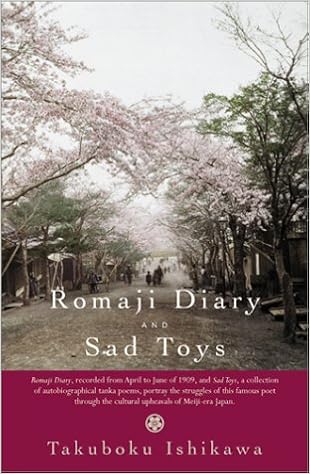
On "Sad Toys" by Takuboku Ishikawa, translated by Sanford Goldstein and Seishi Shinoda ****

Here's the reason I read the Romaji Diary--because Sad Toys was in the same book, and I didn't feel like I could justify just reading the book I was actually curious about, didn't feel like I would be giving Ishikawa full attention if I just read the more appealing work. While the Romaji Diary shows many of Ishikawa's most personal feelings in prose during a time of relative poverty (when was he not poor) but good health, Sad Toys is a collection of poetry put together near the end of his life while he was wasting away in a hospital bed. And Sad Toys is quite amazing.

Start just with the title. Toys--that is poems. For poems really are in many ways a poet's toys. For some who write poetry, poems are word puzzles. You take them apart, put them back to better, try to find the best way for all the words to fit, and there's no end to the process. Now, take a poet like Ishikawa, put him in a hospital at a time when he's becoming increasingly aware of his mortality, and clearly, such toys become sad--sad because that's all there is of his life, sad because he's dwelling on sadness. Many of the poems talk about his hospital stay. Many about his coming death, his desire for death (to relieve himself of pain) and his desire to keep on living. And some poems talk about the change in perspective that comes with such events. In one of my favorites, number 75, Ishikawa talks of reading old love letters. His observation? (All of the poems are typically Japanese, typically short--they're tanka.) So many spelling errors. And how true, really, years down the road, when we're no longer madly in love with someone we're just getting to know, all those little peccadilloes come to the fore. We don't speed through a letter the same way; rather, we say, You know, that woman/man never did spell very well! Such are the observations throughout this little gem.

Sunday, August 3, 2008

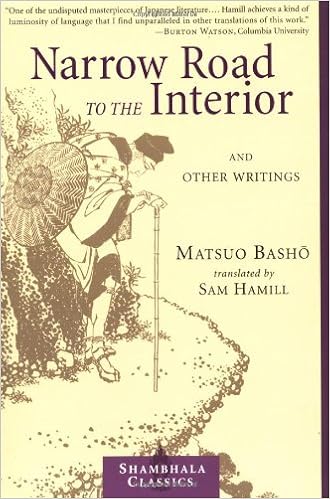
On "Narrow Road to the Interior and Other Writings" by Matsuo Basho, translated by Sam Hamill ***

Japanese poetry, from what I've read, is inevitably short. The forms in such poetry lend themselves only to brevity, moments of keen observation, epiphanies without with long stories leading into them. The best moments in Basho's haiku's are exactly that--statements one must ponder about in wonder before being able to move on.

This book features a selection of Basho's haiku, along with a few of his prose travel writings, many of which contain haiku within them and explanations of how those haiku arose. I'm not much of a fan of the travel writing. With the exception of Parker's The Oregon Trail and the Lewis and Clark journals (albeit in abridged form), I don't know that I've encountered any pre-twentieth-century travel writing I've greatly enjoyed--perhaps the observations of such early travelers rarely transfer to me in my context now. Even in the travel writing, Basho is at his best when he delivers to his readers tiny but profound observations that apply to all throughout time, such as this one from his Sarashina Travelogue: "Then the servant mounted the horse, ignoring the danger. He began to doze off and nearly tumbled over a cliff. With every nod of his head, I was stricken with terror. Thinking it over, I ralized that each of us is like the servant as we wade the shifting tides of this stormy world, blind to real danger."

As for the haiku, Basho is wonderful, though my own lack of knowledge of Japanese tradition is somewhat of a barrier to understanding much of their full depth. I'd read somewhere that Japanese haiku works off of certain tropes (the book's introduction discusses some of this)--that if the poem is about spring, for example, it must include a cherry blossom or one of six or seven other things; if it's about winter, it much include a chrysanthemum or one of six or seven other things. Not fully knowing those tropes, I fear I unfortunately lose out on some of what's really going on. But the fact that even without a full knowledge of the culture I can still enjoy the haiku on some level shows Basho's overwhelming skill.