skip to main |
skip to sidebar

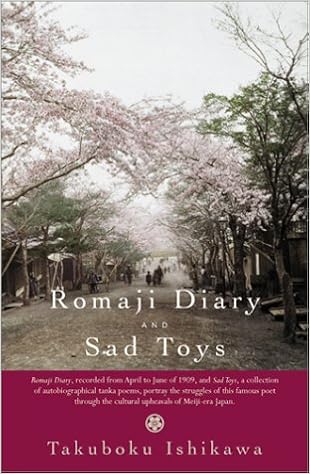
Here's the reason I read the Romaji Diary--because Sad Toys was in the same book, and I didn't feel like I could justify just reading the book I was actually curious about, didn't feel like I would be giving Ishikawa full attention if I just read the more appealing work. While the Romaji Diary shows many of Ishikawa's most personal feelings in prose during a time of relative poverty (when was he not poor) but good health, Sad Toys is a collection of poetry put together near the end of his life while he was wasting away in a hospital bed. And Sad Toys is quite amazing.
Start just with the title. Toys--that is poems. For poems really are in many ways a poet's toys. For some who write poetry, poems are word puzzles. You take them apart, put them back to better, try to find the best way for all the words to fit, and there's no end to the process. Now, take a poet like Ishikawa, put him in a hospital at a time when he's becoming increasingly aware of his mortality, and clearly, such toys become sad--sad because that's all there is of his life, sad because he's dwelling on sadness. Many of the poems talk about his hospital stay. Many about his coming death, his desire for death (to relieve himself of pain) and his desire to keep on living. And some poems talk about the change in perspective that comes with such events. In one of my favorites, number 75, Ishikawa talks of reading old love letters. His observation? (All of the poems are typically Japanese, typically short--they're tanka.) So many spelling errors. And how true, really, years down the road, when we're no longer madly in love with someone we're just getting to know, all those little peccadilloes come to the fore. We don't speed through a letter the same way; rather, we say, You know, that woman/man never did spell very well! Such are the observations throughout this little gem.
Diaries, for me, are generally a tough sell, ranking probably only above collections of letters and computer manuals. This would seem to be somewhat counterintuitive. After all, a glimpse into someone's private life should be fascinating--we all like to snoop. But snooping into the life of someone we don't know who knows a bunch of people we don't know? Ishikawa's diary is apparently renowned for its forthrightness, its willingness to tell all, no matter how bad it makes the narrator look. In that sense, it has much in common with From a Darkened Room, the abridged-abridged diary of Arthur Inman. What it doesn't have in common are two other things. For a Western reader, there are not really any insights into current events of the time (in fact, I'd say the diary on the whole is more personal save a few catty comments about other literary people, all of them Japanese). Rather than a lifetime of journaling, Ishikawa's diary takes place all within two months. Perhaps the more interesting thing about Ishikawa's book is the manner of writing it--in Romaji, the Roman alphabet, rather than the Hiragana symbols more typically used, and for the time even more radical because Romaji was not even common as a tool. As the translator notes, this was like an English speaker writing in Esperanto (or I might say more like writing English using the Arabic alphabet). Why? To keep others from reading it, I suppose. I guess someone must like such things enough to publish them, however.


 Posts
Posts


