Wednesday, September 24, 2008
On "Should" by Tao Lin (1824 words) ****
What I like about this piece isn't perhaps that it offers any sort of clarity. In fact, it works way from clarity as much as possible, jumbling moments together, returning to them, redefining them, trying to figure out what they mean. Did this guy just get broken up with? Or is he seeing this girl? Are they compatible or not? The story works with the same sort of obsessiveness with which we work through such thoughts. And like most such thoughts, they lead us nowhere, at least until babies are involved. Read the story here at Bear Parade.


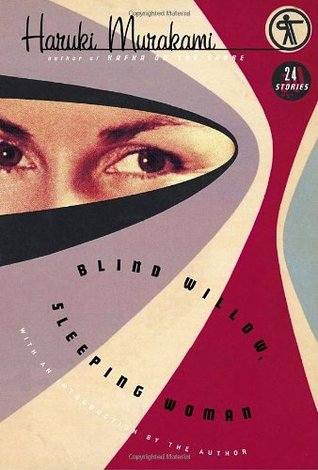
On "Blind Willow, Sleeping Woman" by Haruki Murakami *****
Monday, September 22, 2008
On "Taking You Fast" by Ann K. Ryles (4716 words) ***
I have yet to find a bad story in Stirring. But then again, Stirring so rarely publishes fiction that I get the feeling it's extremely selective. Here's a piece that is very finely written, full of the things one so often sees in fiction--adultery and child abuse. In Ryles's hands, however, they don't come off as pat. They come off as engaging. Part of this has to do with the second person. I have friends who simply reject any story written in the second person. I think this a big mistake. Granted, perhaps I'm a bit too prone to like stories in the second person. Blame that on all the Choose Your Own Adventure novels I read as a kid. But take this story and put it in the first person. It would seem to work fine (I'd say no worse or better than it does in the second person)--until the ending. Part of what's going on here is that "you" are in the present, remembering all these moments leading to this moment at the end. The first person, at the end, in the present tense, I would argue, would seem entirely contrived. You couldn't tell this story this way--you couldn't use the present tense. You couldn't leave us at the start of a trip into the unknown. You'd already be there, telling this story. You'd know. Read the story here.
Thursday, September 18, 2008
On "Dirt" by Kyla Carter (5180 words) ****
What is a life you carry in a trailer? What of a life you carry in a plastic Kroger's bag? I think poor. I think homeless. But try something else instead. Think also lonely. But here, the lonely, the poor, the homeless, aren't who they seem. And there's a whole lot more hurt to go around. Read the story here at Mid-American Review.
Sunday, September 14, 2008
On "Instead of What We Could Have Said" by Vincent Reusch (1185 words) ****
Tragedy lurks behind this piece by Vincent Reusch. I like it when there's a bit of mystery, a certain unknown, to a story--enough that you can sort of figure out what's going on, what happened, but not so much that you know all. I suppose, back when I had to write papers for classes, such stories could drive me crazy unless I knew I "knew" what was going on, but for casual reading, such pieces are grand. They make me read them again, and again. You can read the story--again and again--here at Contrary.
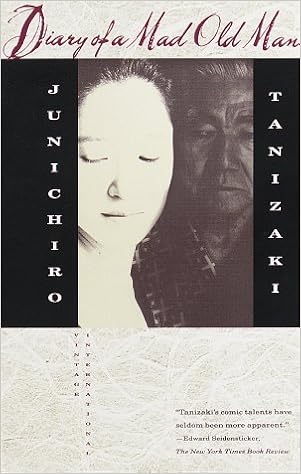
On "Diary of a Mad Old Man" by Junichiro Tanizaki ****
Thursday, September 11, 2008
On "An Ugly Man" by Ana Marcela Fuentes (427 words) ****
Dump one guy and take up with another. That's what Fuentes says she's going to do at the start of this little gem--and all in under five hundred words. I didn't know if she could pull it off and was dubious about the prospects, especially as I neared the story's end, but does it she does, and with aplomb. Read the story here at Vestal Review.
On "The Key" by Junichiro Tanizaki *****

Where it gets strange, however, is in the husband's goding his wife into an affair and his wife's reaction. One could say, be careful what you wish for. I'm thinking of the Inman diaries in particular, where Arthur Inman encouraged a close friendship between his wife and his doctor and was then enraged when he found out years later that the two were carrying on an affair--this despite the fact that Inman himself had had numerous affairs and at least in part encouraged his wife to go out with the doctor in an effort to further his untoward relationships. In Tanizaki's book, however, whatever jealousy exists merely seems to be more fodder for lust. But the consequences are still dire, just not in the manner that they turned out for Inman.
Monday, September 8, 2008
On "Family Five and Dime" by P. J. Woodside (2407 words) ****
Some of the best parts of the movie The Good Girl occur in the five and dime that Jennifer Aniston's character works in. Unfortunately, I can't remember the name of the horrid and desperately depressing store, but those scenes remind me a bit of the location of this story. I think of some cheap ripoff of Pic N'Save, some place where only the poorest people in the community go, on the wrong side of town, where shopping ceased in 1962. Put a couple of employees in the mix, and you have the makings for a story of lives that have petered out. Like Aniston's character, one of them seems bound to try something different--if only she can, if only she is allowed. Unlike The Good Girl, however, this story is set down South, where community standards come into play. It isn't just the hopelessness of the character's surroundings but the will of the community that characters don't try to do anything to change their situation, don't do anything that might upset anyone. Will the narrator conform? Read the story here at StorySouth.
On "Lizard" by Banana Yoshimoto, translated by Ann Sherif ***

Friday, September 5, 2008
On "Border-Line Nostalgic" by Kelsey Rakes (205 words) ****
Perhaps one of the best and worst things about flash fiction is the way that it often ignores the conventional rules of short story form--that is, of plot, the whole idea of rising tension, climax, and resolution. Often, flash fiction is simply a reminiscence, a memory, stated in some nice words. In other words, it's a prose poem--not technically, a story, though many might call it such. At the same time, being shackled to story plots can be rather dreadful too. One can write a perfectly crafted story and have it be infinitely less interesting than a long piece of writing that technically hasn't followed the "rules" about what a short story is supposed to do. With regard to flash fiction, however, I think too often that writers just write--I'm more interested, generally, in those short short fiction pieces that manage to convey a plot trajectory in such a short space (and be well written) than in those that manage to be merely well written. And then there are pieces that make me not even care. After all, isn't part of what a great piece of writing does, be it story or poem or essay, make us feel?
Rakes's piece is such a work. I haven't spent any time examining whether it's technically a story or just a great piece of writing, and I don't care. It's magical, and that's what matters more. It evokes a sense of the past (and the present) and is sad, sad, sad. Read the story here at Right Hand Pointing.
Rakes's piece is such a work. I haven't spent any time examining whether it's technically a story or just a great piece of writing, and I don't care. It's magical, and that's what matters more. It evokes a sense of the past (and the present) and is sad, sad, sad. Read the story here at Right Hand Pointing.
On "New Japanese Voices" edited by Helen Mitsios ***
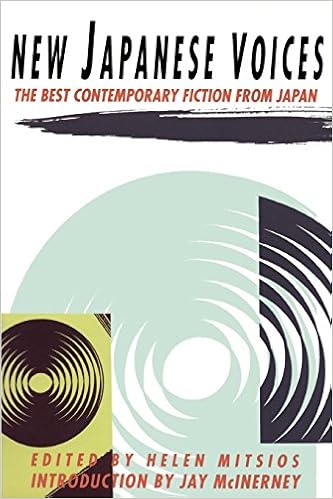
"A Callow Fellow of Jewish Descent" by Masahiko Shimada
"On Meeting My 100 Percent Women One Fine April Morning" by Haruki Murakami
"Swallowtails" by Shiina Makoto
"God Is Nowhere; God Is Now Here" by Itoh Seikoh
"X-Rated Blanket" by Eimi Yamada
"Yu-Hee" by Yang Ji Lee
"On a Moonless Night" by Sei Takekawa
"Living in a Maze" by Kyoji Kobayashi
"The Imitation of Leibniz" by Genichiro Takahashi
"The Unsinkable Molly Brown" by Tamio Kageyama
"Wine" by Mariko Hayashi
"Kitchen" by Banana Yoshimoto
On the whole, the book presents an interesting smorgasbord of fiction writers in Japan in the late eighties and early nineties. But I can't say that the stories on the whole really hooked me. Standing out the most was probably Murakami's, but that story, which has never seemed that impressive to me before, perhaps stood out here because I've read it two or three times before. Other stories I can remember, now, days after reading them, include Shimada's piece, about a Japanese man who befriends a Jewish man in France (only in the end, we're told the man isn't what he seems, which in turns causes us to rethink the whole story).
I really enjoyed Kobayashi's "Living in a Maze," which recounted the story of a man whose nightmares become his everyday life. Such is an old story form, but the dream here was interesting enough that I was drawn in. The man's date becomes a cow, and then so too do the rest of the people, just as in the movie Jacob's Ladder, all the people become lizards. Cows don't seem nearly as creepy or interesting as giant lizards, and yet the manner in which Kobayshi describes all these events--so realistically--makes the ludicrous and silly seem both horrifying and funny.
Kageyama's "Unsinkable Molly Brown" is about a woman who is so fat that when she takes scuba lessons the instructor's have to take various measures to stop her from floating. Hayashi's "Wine" is about a woman who accidentally buys a very expensive bottle of wine and then can't figure out what to do with it (after all, it's too expensive to drink, and it's too expensive to give as a gift for any but the most special person or special occasion). Takekawa's "On a Moonless Night" is about a woman being eaten by insects--told in a "shocking" manner but, for me, makes it seem over the top. Yamada's "X-Rated Blanket" is more like a prose poem--about a woman's lover (i.e., he is her blanket). "Swallowtails" was about a kid with problems at school who grows butterflies as a hobby at home and probably comes closest to the kind of quieter stories one might expect from an American MFA student or from the master Kawabata.
Monday, September 1, 2008
On "Superhero" by Reese Kwon (3909 words) ****
Why is it that college so often means breaking with all the traditions and rules that one lived by while growing up? Perhaps, the answer is rather obvious. Students, out on their own for the first time, feel free finally to experiment, to be themselves, to take on a new systems of belief that don't simply fit into that which their parents have. And yet, there are complications in that. A student may become Cassandra, as the protagonist of this story becomes, but can she truly get away from her parents' authority? Or rather, does the new self continue to hide in one's old self? Perhaps, the true step in becoming an adult is learning how to be one's self even when with one's parents. Or perhaps it's learning to negotiate between selves. Or perhaps there never is any growing up, never is any becoming an adult. The fact is I'm nearing forty, and I still have difficulty negotiating that space between them and me. But while the world, I think, in some ways becomes no more easier to figure out as one ages, the anxiousness one feels at the start of that journey on one's own is perhaps at its most in the late teens and early twenties, in this college-going time. Kwon's story captures the hope and dispiritedness of those years very well. Read it here at Narrative. (Log-in required--but it's free!)
On "The Woman in the Dunes" by Kobo Abe ****

Wednesday, August 27, 2008
On "The Object of Desire" by Gary Pedler (10676 words) ****
Here's a story without a lot of pretensions, well executed, and complex. It has what, unfortunately, is missing from so many stories on the Web, mostly because of the medium's incessant demand that authors be concise. However, with such brevity, it's impossible to flesh out stories as nuanced as this one. Take Alan, a homosexual adolescent who is wrestling with his feelings--and who is also, in so many ways, a typical adolescent in his smart-aleck remarks to others, for example. Or his parents, who just want to help but don't exactly know how--and then fear that what help they've forced Alan into taking isn't quick enough or effective. Or Dr. Kirst, who assesses Alan's problems for us at the end of the story--or does he? Are these Alan's problems or the projections of others onto Alan or a combination of both? This is a story that looks at some tough personal issues and doesn't flinch, doesn't simplify, doesn't politicize, and doesn't preach. This is a story that just shows the way things are, that offers, to what extent it can, a little understanding. Read the story here at Prick of the Spindle.
On "Palm-of-the-Hand Stories" by Yasunari Kawabata ***

I think of another short story craftsman--and especially of his collection of really sharpened bits, What We Talk about When We Talk about Love--Raymond Carver. Even in Carver's oeuvre there are many stories that, while good alone, don't stand out within a whole collection. But there are also ones that do. I think the difference is that Carver's commonplace is often strange. I can say, that's the one about the couple pouring Teachers over one in the motel room. That's the one about the couple buying a living room set in the front yard.
I don't feel like I can do that so easily with Kawabata, given that the commonplace really is commonplace. Right now, because these stories are fresh in my head (having read them today as opposed to yesterday), I can say, That's the one about the blue jay that fell from the tree and the girl saves it. Or that's the one about the kid making paper boats and wanting them to fight, and a crippled woman who had a fiancé who appears to have backed out of the wedding. That's the one about the man who drew pictures of flying horses with a girl when he was young--she never went on to marry, but he did--and now, in his old age, suddenly knowing loneliness, he's having visions of flying horses and a girl on them, a girl in black, an old woman. That last story, I remember, I think, because it managed to be chilling by its end. The first two I remember in part because this is the second time I've read them.
And that leads me to another point. Perhaps, in reading the collection through only once I have missed something. The fact is that those stories I had read before stuck out more. It's possible that were I to read this book again, I might just feel quite differently about it, might find it not just pleasant but incredible.
Saturday, August 23, 2008
On "For the Dogs" by Katie Flynn (3084 words) ****
Maybe it was the pool party, but this one hooked me in and didn't let go. I say this with some surprise because I didn't find the story to be heavily plotted, and it wasn't the kind of story where I was reading as fast as I could to get to the end. Perhaps, the hook was in the characters--or perhaps in the situation as it involved these characters. Tricia returns to her childhood home to find things are not as they used to be--not that they have been that way for a long time. Her father has remarried, and a houseguest has moved into Tricia's old room. Amid all this, Tricia tries to find something to hang on to, tries desperately to see if there might still be a place for her in her father's life. Maybe there always has been--or maybe there never was. This story is poignant and sad. Read it here at the Big Ugly Review.
On "My Beatles" by Makoto Satoh ***
This is the second of two plays I read tonight. Written in the 1960s, it maintains much of the absurdity that contemporary drama is often known for. I think of playwrights like Sam Shepard and Samuel Becket. I like the former, and the latter has his moments. Satoh's play has its moments too and on the whole seems quite entertaining. I think I'd enjoy seeing this staged. It's a play within a play, and sometimes a play within a play within a play. It involves actors practicing a play; it involves an audience breaking in and insisting on watching the practice. And it involves an audience actually taking part in the play, forcing it to its conclusion. And did I mention that that audience is the Beatles? Yes, that's right, the Fab Four. You couldn't have a better audience than that.
On "Don't Call It Christmas" by Ryan Harty (11398 words) *****
Simply put, this is one of the best contemporary stories I have read. I came across Harty's work in a review. I was curious enough that I did a search for him online and found this. This in turn caused me to go buy his collection. There are some other very fine stories in that collection (Bring Me Your Saddest Arizona)--most especially "What Can I Tell You about My Brother"--but none of them, for me, match up to this first encounter I had with Harty's work. Sad, like so many of the stories in this collection, and full of heart. And better yet, they're all set out West, in Arizona--reminding me of the open spaces and the desert of my childhood that I sometimes miss. In this piece, a man takes in a homeless girl and slowly falls for her. Only bad things can happen, right? Read the story here at the Missouri Review.
On "Chushingura: The Forty-Seven Samurai" adapted by Nakamura Matagoro II and James R. Brandon **
I finally, this weekend, after several weekends of either heavy freelance work or heavy socializing (out-of-town visitors; great concerts), have a chance to read a couple of Japanese plays I've had my eye on but which appear in a book much too large for me to simply take with me, in my backpack, to work so that I could read them on the bus or during lunch. Alas, I did take a walk this evening and have a girl in a car who I made eye contact with or who made eye contact with me gesture for me to come over and talk. Shy self that I am, I merely waved. Maybe I could have had a date. Instead, I rushed home to finish what I'd planned--to read these two Japanese plays. My date, this evening was with Chushingura and with Makoto Satoh. One could do worse, I suppose.
The version of Chushingura that I read was adapted for the stage in 1979. The play itself is a traditional one that has been adapted for stage over the course of the last two and a half centuries. Modern versions shorten it for modern audiences (the full play can take fourteen hours). The story is that of a famous series of incidents that occurred in Japan between 1701 and 1703. One nobleman slightly injures another (in the play, it is because the other is making passes at the first nobleman's wife); as a result, the first nobleman is ordered to kill himself by the shogun. The nobleman's samurai/retainers feel obliged to revenge their master's death and so plot to kill the other nobleman. The samurai, in avenging their master's death, do something noble but also break the law. The result is that they too are ordered to kill themselves. In Japan, at this time, ritual suicide is an honorable death--as compared to simply being killed by one's enemies. This adaptation covers only up to the point where the forty-seven samurai get their revenge. Chushingura is a kabuki play, and I can see why none of the other anthologies of Japanese literature contained kabuki within them. It is does not translate very well to our traditions. I credit the adaptors with bringing something to the stage that would allow people to watch the play more easily. But for me, sword fighting and martial arts theater is a hard sell, and Chushingura, unfortunately, never made it past that for me (unlike, say, a film like Hero, which ends up seeming like so much more).
The version of Chushingura that I read was adapted for the stage in 1979. The play itself is a traditional one that has been adapted for stage over the course of the last two and a half centuries. Modern versions shorten it for modern audiences (the full play can take fourteen hours). The story is that of a famous series of incidents that occurred in Japan between 1701 and 1703. One nobleman slightly injures another (in the play, it is because the other is making passes at the first nobleman's wife); as a result, the first nobleman is ordered to kill himself by the shogun. The nobleman's samurai/retainers feel obliged to revenge their master's death and so plot to kill the other nobleman. The samurai, in avenging their master's death, do something noble but also break the law. The result is that they too are ordered to kill themselves. In Japan, at this time, ritual suicide is an honorable death--as compared to simply being killed by one's enemies. This adaptation covers only up to the point where the forty-seven samurai get their revenge. Chushingura is a kabuki play, and I can see why none of the other anthologies of Japanese literature contained kabuki within them. It is does not translate very well to our traditions. I credit the adaptors with bringing something to the stage that would allow people to watch the play more easily. But for me, sword fighting and martial arts theater is a hard sell, and Chushingura, unfortunately, never made it past that for me (unlike, say, a film like Hero, which ends up seeming like so much more).
Subscribe to:
Posts (Atom)

 Posts
Posts


