skip to main |
skip to sidebar

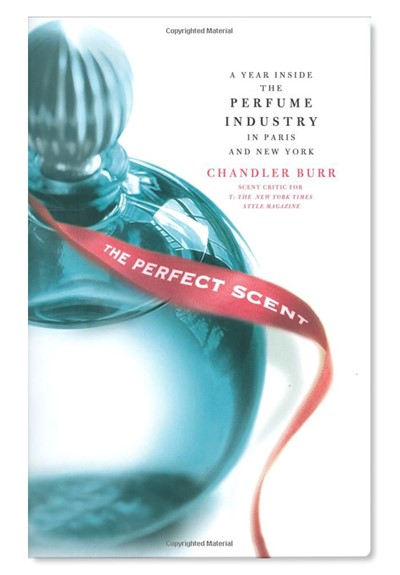
I have probably worn cologne less than a handful of times in my life. I have no real interest in perfume. And yet, I was drawn to this book precisely because of my lack of interest in the subject. Perfume is something I so rarely think about that the idea that whole lives revolve around this intrigued me (just as say, a book about hair care products probably would, or laundry detergent). Burr, who covers the perfume industry for the New York Times (again, another surprise--that someone on a newspaper staff actually has as his sole job to cover scents), goes into a single year in the industry, and really into the making of two particular perfumes. One is a high-end fashion perfume, Un Jardin sur le Nil, and the other is a celebrity endorsed commercial perfume, Sarah Jessica Parker's Lovely. What emerges is a story of an industry whose production components bear similarities to the industry I'm more familiar with, books--that same banter back and forth between marketing and the people who do the production of the product, that same time versus cost concern, that same set of people behind a product that one never hears about or knows about, those same kinds of fads that persist for a half a decade and then seem hopelessly in bad taste (in the sixties, dirty/sweaty/animal smells were in, smells one would, as Burr notes, get kicked out of restaurants for today; by the eighties, clean became hip), those same consistent best-sellers that never seem to die (Chanel No. 5). And then there are the people the book portrays, with two central figures in particular: Parker, who comes across as a very likable person; and Ellena, the perfumer at the high-end Hermès, who seems the consummately conscientious artist.
But most fascinating of all is Burr's--and every character in the book's--attention to smell. Despite the fact that smell is supposedly the strongest sense in terms of spurring memories, I have never spent so much time thinking about it. I can't say I even notice most smells, unless they're the stench of something rotting on the bus, something that makes me want to move away. Here, Burr introduces a bevy of them, describing them in ways that often aren't smells at all, at least, not in the manner that I'd think of them--smells with colors, with weights, with stories. And then there are the perfumes themselves, modeled after animals or detergent or sweat or car exhaust or fruit or flowers or cement after rain. I was so inspired at one point, I went to my medicine cabinet and pulled out the four bottles of cologne I've collected over the years--gifts I never wear--and stuck each one to my nose. Indeed, some of them do have characteristics that vaguely resemble something else. One of my scents is definitely citrus; another is vaguely like motor oil. The other two, however, as one not versed in the signification of smell, I could not really discern as anything other than simply perfume--a particular kind of alcohol. But I'm tempted, now, to walk into the mall and play among the spray bottles, testing what it is the perfumer has attempted to do. I feel like a whole other world has opened to me.
What sticks in my head about this piece that I'd come back to write about it sometime later? It's probably the typically ludicrous world that Tao Lin sticks us in. Here, a family is taken hostage by some particularly inept kidnappers, who also happen to be studying for exams. Do you know how much you're worth? Do you know how much you're worth for one week? one day? one hour? a minute? Read the story here at Bear Parade.
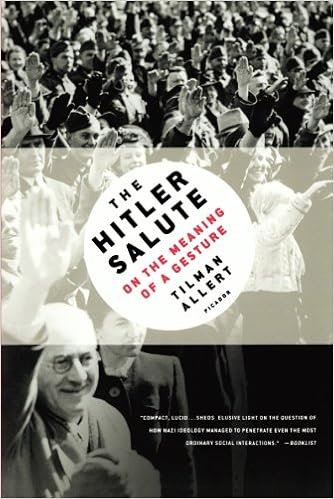
The subtitle of this book is On the Meaning of a Gesture, and indeed, that's what this is--a rending, a tearing apart, an analysis of a single gesture--the greeting of Germans during Hitler's Nazi regime. I can't say I was terribly into the discussion of psychology that the author put me through, but what was fascinating was reading about the gesture itself--how it came to be and how Germans were forced to use it. Imagine a political party taking office, creating a way of saying hello (in Hitler's case, it was "Heil Hitler"), and then enforcing it. Worse, imagine that you don't approve of the gesture, but not going along with it could result in losing a job, in losing one's friends, in even losing one's life. This was life for many Germans during the regime.
The book's most interesting section discussed the heil gesture in relationship to religion, the military, and the family. In the latter case, it's a bit hard to know how exactly the gesture was used in informal family life. In the case of the military, officers managed to avoid using it among military men until 1944, when they finally gave in as a show of loyalty after men in the military had attempted to assassinate Hitler. Until then, it was understood that the gesture was simply too much for the military. Among church people, the gesture was mostly given into--though a few resisted, in one case losing his life, in one case fleeing the country. Or try this for size--ways to get out of the gesture. One way, used by a particular professor, was to carry so many books that he couldn't "heil" when entering the classroom.
In the closing section, the book discusses how some embraced it, while others embraced it only in practice (keeping a kind of ironic distance even while doing it to please others). Both, the author says, lead to moral problems. But most Germans did give in, whether superficially, half-heartedly, or wholly. Being the kind of person who doesn't like to create trouble, I suspect that I would fall into one of the first two camps. And in that sense, according to the author, I would still be complicit in the people's sins. Alas, I am glad I do not live in such a society, where I can show off my general cowardliness with such aplomb.
One's future in a deck of cards, one's luck, one's destiny. Fauth does a good job here of making the old idea fresh by making it literal. I won't say too much more, lest this blog entry grow longer than the story itself. Read the story here at Vestal Review.
.jpg)
The start of a great nonfiction book, it seems, is often simply a hook. It might not be all that original once you get into the book, or it might not present any new information, but as long it has the hook, there's a good chance people will pick it up to examine. Weisman's text has the hook. But it also has loads of information that I wasn't familiar with, even if much of the general thrust of the book is familiar (e.g., how our species has ruined the earth). What I like so much about this text is how Weisman shows both what won't last and what will. It's the latter that he starts off with, running down just how quickly a common house becomes dirt again or even the NYC subway, which sits underneath the city's sewers and is maintained by constant pumping; were we not there anymore, NYC's sewers would become tunnels of water within days. And then it's on to the story of degradation, all the things we'll leave behind that are not going to go away for thousands--even millions of years. It makes me feel guilty for using plastic, though its ubiquity makes me wonder how I could avoid it. Plastic, Weisman brings out, actually can biodegrade--into smaller pieces of plastic. In other words, it just sticks around to much things up, getting smaller and smaller until even little organisms can eat it and force it out as, well, plastic. Hope we aren't poisoning anything--but we probably are. The book ends on a familiar note, discussing the supposed problem with overpopulation. This last item seems a bit timeworn, given Ehrlich's The Population Bomb and many other books have have been through the same territory with fewer people. I don't think getting rid of people is the answer (nor would it mean a better world, as I think nations where population is shrinking would demonstrate). Learning to live within our means and in harmony with nature might help. But even here, I've often wondered if there is a way we wouldn't muck things up. We're like an invasive species--we kill off what's around us, affect whatever is there, and there's no getting around that. Hopefully, we can preserve enough of what's around that the kids will have something to grow up into.
Imagine repeating sixth grade as an adult. All right, I guess Adam Sandler has already imagined that for you. So has Brock Clarke. I didn't see the Sandler film, but Clarke's story has its own hysterical antics, especially once love strikes and complications ensue. Read the story here.
Short, concise, and practical, this little treatise proved much more interesting than I thought it might actually be. I've wanted to take a closer look at it for a long time, and being stuck in a car for hours for several days allowed me to take a listen. Tzu is a master of the metaphor, and much of his advice on war seems, well, like common sense. While listening, I often thought about how Tzu's principles might apply to other things and about which of his principles might not apply today. Interestingly, Tzu argues that a good general doesn't always follow the ruler--he does what is best for the nation. I could see this leading to some problems (coups) but also saving from others (bad decisions based on politics rather than what makes sense on the ground). You can read the text here, or listen to the book here.
A great way to write something interesting, but also a very difficult way in terms of making the piece ultimately work, is to turn some saying into something literal. I say one is bound to create something interesting because such stories make us rethink our use of the term, how it arose, what we do with it. But such a story is difficult because so often it fails to become anything more than a curiosity. The characters become submerged to the idea, and the all-important ending simply drops off--"Yo, I'm done with this, where to now? Guess I'll go eat me some spaghetti." Adams's story isn't one to drop off. It gets more interesting as the literal becomes even more literal, and even more unexpected. And then, just when you think it might end up trying to reach too far, it pulls back with a zinger. Read the story here at Café Irreal.
This was perhaps the most engaging book I listened to while I was on the road, which is good, since it is also the only one I paid for. I much enjoyed how the producers of The Daily Show translated their hilarious "textbook" into an audio format. The presentation--the little dings and audio clues--made the parody seem ultrarealistic. So useful, and yet so highly useless in terms of actual content, which skews toward the highly inaccurate, as one might imagine. While I was away, in a hotel, with a television, I actually caught several episodes of The Daily Show for the first time and loved it. Something, unfortunately, seemed lacking in the audio book that seems present on the show, for the book only made me chuckle a few times--I rarely laughed out loud the way I do at the show. Perhaps it is that the show is more timely. Perhaps it has to do with the live audience. But whatever it was, in that sense, America was not quite as entertaining.
Demolition Magazine does pulp fiction. Most of the writing is good, in that pulp sort of way--short and chipped. My problem with pulp literature, however, is that so often such stories leave me cold (I never get a sense of the characters themselves beyond a sketchy outline, punchy words, and a tough-guy/gal plot). This piece didn't stand out to me at first--the writing suggests a typical obsessive weirdo--but as it moves toward its conclusion, my discomfort grew and exploded big time at the end. I'm glad I kept reading to that final paragraph. Maybe you will be too. Read the story here.

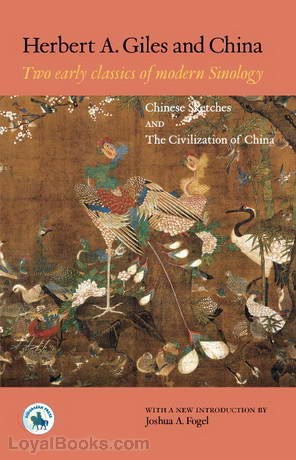
I was expecting--hoping for--a history of China up to 1902, when this book was published. In that, I was disappointed. This is not a history in the least but rather an exploration of Chinese culture, at least as it existed up to 1902, in the form of six lectures on distinct topics. Some of the lectures themselves are very good and very interesting. I particularly enjoyed Giles's first lecture, on the subject of the Chinese language. In that one, Giles discusses how Chinese is monosyllabic and how one manages to convey complex ideas with only a single syllable. I tend to like these theoretical discussions of other languages--more than I like actually learning to speak another language. Another interesting lecture compares the Chinese to the Greeks and hypothesizes on where these similarities arose. (I find it interesting that some Bible scholars assign the Greeks to being descendants of Japheth, while others assign the Asian people. Could it in fact be both?) You can read the text here, or listen to the audio here.
If the Hollars story featured earlier on this blog (here) was fantastic realism, this one falls more precisely into the realism camp. That earlier story, with its odd subject matter, caught my attention much more quickly, but this story still managed to keep me reading."Extinction" is, in part, a story about stereotypes. They aren't the stereotypes we usually think of, when looking at a national or human level--racial, gender, or otherwise. These stereotypes are more personal than that. These are stereotypes that two characters have built up about each other--a dad who fails to acknowledge that his son has grown up, and a son who can't see his father for the new man he is. This is also a story about change, two men dealing with grief, one the loss of a mother, the other the loss of a wife. And most important, this a story about desperation, about a dad trying to hang on--to life, to people, to anyone really, but most especially to his son. Stirring doesn't publish fiction very often, it seems, so the stories are rather special when they do. Read the piece here at Stirring.
So I just returned from a road trip, which means that most of the reading I've been doing in the last couple of weeks is via good old books on tape or CD. Most of what I "read" (or, rather, listened to) in the car was via the public domain archive Project Gutenberg. Wilde's book, one I've been intending to get around to for over a decade, was the first. What can I say? I was disappointed. Is it fair for me to be disappointed by it? I'm not sure.
I'm recalling seeing The Godfather for the first time, another slight disappointment, and I'm wondering if this might not be a similar case. What happened with The Godfather was that I'd seen so many interesting bits and pieces and heard so many things about it that I expected much. But The Godfather is such a iconic movie that films thereafter have often copied its various techniques and plot points. Seeing it for the first time, I felt like it was full of cliches. Such was also the case with The Picture of Dorian Gray. I'd never read it, but I'd heard the whole story before, many, many times, and now, finally reading the original, it lacked much oomph. Beyond that, Victorian dialogue, with its paragraphs of discussion, seems so unrealistic, even bad, to my modern ear that at times it was hard to put up with Mr. Wilde, even if the reader himself did a rather remarkable job of making his voice seem lively and clear. You can download the text here, and the audio book here.
Previously, I wrote about "Shot Girls" by Kim Chinquee (here). Here's another story with a variation on the same theme. Although I typically end up enjoying one story much more than another, I like it when authors write two versions of a story and share them both. It's simply interesting to watch the way in which a mind can go in different directions with the same idea--the meaning a given piece will take on and the emotions that piece will elicit. It's also interesting insofar as usually one piece is much longer than the other, more full bodied, less stream lined. Some authors, of course, only write a very few stories, over and over and over--Poe was one of those. Perhaps, all authors do that to an extent, but most are more subtle than presenting the same "buried alive" theme/plot device (one of Poe's favorites) again and again. Another author I enjoy who has written stories that closely parallel one another is Brock Clarke. Unfortunately, the two pairs of stories of his that I see as parallel are no longer available online. You can read Chinquee's "Shots" here at Willow Springs.(Note: In an e-mail exchange with Kim herself, sometime after I read the story, I discovered that "Shots" and "Shot Girls" were written four years apart. So this was indeed a case of an author returning to fertile ground to explore the same setting and some of the same themes again, rather than a story taking two directions and both being written and published.)
I like the modernists, usually, but sometimes they can be a bit much. Proust's book is French modernism at its height, and it reminds me much of Virginia Woolf in its focus on thought. Add to that an interest in memory and love, and one has the essence of the first volume of Proust's In Search of Lost Time. The first two hundred pages recount a child's life and his interest in his own mother (hello, Freud), culminating with the beginning of his interest in Gilberte, Swann's daughter. The second section I thought the strongest and the most interesting--"Swann's Love." Here, we get the story of Swann, falling for one Odette. At first, lady's man that he is, he has little strong interest. She's not his type. She makes a play for him, and he spends time with her accordingly, but without much intensity. During the course of the section, however, Swann's interest grows, even as Odette's seeming interest falls. This interest finds form in jealousy (Odette, Swann learns only later, has been something of a gentleman's woman herself). Watching the transformation take place is interesting, if a bit mind-numbing in a Woolf sort of way.
A common subject in Brock Clarke's stories is men who have failed to live up to life's potential. Often, this revolves around marriages gone bad, in part because of these failures. In this story, from Clarke's second collection, Carrying the Torch, we see the theme carried across a family. Here, the setting of a lake house is used to full effect, presenting us with eras of the family and its gradual deterioration. Read the story here at Virginia Quarterly Reivew. Or listen to Clarke read it here at Lit-Cast.
"Mr. Inspirational" is what I'll call here a "talking story." What I mean is that it's a story you'd hear someone tell rather than write. Such stories are first-person narratives by and large, and they sound real, and personal--and genuine. One of the difficulties, sometimes, with fiction is that, well, it reads like fiction. We write in ways we would never tell a story. When was the last time, after all, in a conversation, that your friend Francis said something like, "Joe sat down at the bar; Sam, the bartender, was a surly sort who'd just lost two hundred dollars on a horse, and he wasn't in the mood for guff; 'What'll it be?" he asked Joe, swaddling a stack of newly washed glasses in a towel like a baby"? There's a certain faux quality to fiction. When written like "Mr. Inspirational," however, that faux quality is pushed down and what emerges is something you might hear around the water cooler at work or at a bar or at church--or at a funeral. Thus, the piece seems more immediate. I never did varsity sports, but this guy seems to have. Read the story here at A Cautionary Tale.
Cunningham's "Junkyard Dog" falls into that genre of stories about diary writing--or stories that are a diary. I think of Evan S. Connell's novel The Diary of a Rapist and of Rick Moody's short story "The Preliminary Notes" (this latter not exactly a diary, but something akin to it). Both are about who in writing about themselves and their relationships discover something unsavory about themselves--as do the readers. Cunningham takes a similar track, but what makes this story an interesting variation on the genre is that our main character to an extent knows that he's a jerk. And his change at the end--indeed, the change wrought in every single character--suggests that perhaps nothing has changed at all. It seems, unfortunately, so much like many a life. Read the story here at the Summerset Review.
There seems to me to be a trend in short stories these days where narrators use short declarative sentences and talk mostly about banal day-to-day things. One would think such stories would be incredibly boring, but somehow they're often very interesting--and quite sad. The stripped-down language speaks for characters who lack much to live for, whose words are as stripped as their lives. Examples of this include the earlier reviewed "Eat When You Feel Sad" by Zachary German on Bear Parade and much of Tao Lin's often hilarious and absurd work. Here is yet another example of the form. I love how Malone repeats one key phrase regarding her friends, how that in turn reflects on the narrator's relationships in general with other people. And the title--the second favorite girl. Always second. Of course, I'd take second over third or fourth or fifth--but when it comes to romance, whether it's second or third or fourth doesn't really matter--it's still not the "one," still not special enough. Oh boy. I'm going to go cry now and try not to think about all those rejections. Why don't you read the story while I'm gone? You'll find it here at Bearcreekfeed.
This story is made of simple, declarative sentences. It is choppy. Early writing instructors would be horrified. You need sentence variety, they would say. I would comply. Zachary German does not. In that is part of this story's strength. Young adults struggle with tedium. Life moves forward. Life stays the same. People party. People stop partying. People ride bikes. People stop riding bikes. They go to another party. They eat some grapes. They go to sleep. They type on the computer. Somehow, if you're like me, you'll be sucked into the tedium and read the thing all the way to the end, fascinated. Read the story here at Bear Parade.





 Posts
Posts


