I'm taking a break from the online stories to highlight three really great poems, scattered at different locations across the Net. Each one is quite different but speaks to me in some way. The reason I don't feature more poetry is probably that, for me, it seems to come down to such a personal taste. And yet, with these three, I can't help myself.
Beaumont's poem is a work of technical vibrato, working the alliteration and the occasional rhyme to full effect in simply declaring a definition. I love how this poem becomes the definition itself in its very sound, slowly wandering toward its point. Read the poem here at Pool Poetry.
Shuttle's poem is one that works on a more personal level, speaking to that ideal that rests within each of us. In that she is able to capture that, to write about it, I love it. (It reminds me, actually, of a joke that used to go around a former workplace. A few coworkers of mine--or maybe it was just one coworker--used to talk of starting a virtual boyfriend service. He'd leave messages, send flowers, make dates, but he's always fail to show up. I suppose the idea was to give people who wanted to be dating someone--but not someone real, not someone with faults and eccentricities--a chance to have that special someone, and the ability to more easily turn down those unwanted dates.) Read it here at Poetry Bay.
Huff's poem is more of a narrative, but a short one, a very short one. It does what a good narrative poem can do but what a short story technically can't (though that doesn't stop many from calling such things stories, even if they're really just vignettes). That is, it explores a single moment, a moment of wonder. It doesn't present a conflict to resolve--it merely lets us bask in that single instant. I love the repetition in the last line, the way it shows off the glorious repetition in the moment itself. Read the poem here at the Beloit Poetry Journal.
Monday, December 1, 2008


On "The Bin Ladens" by Steve Coll *****
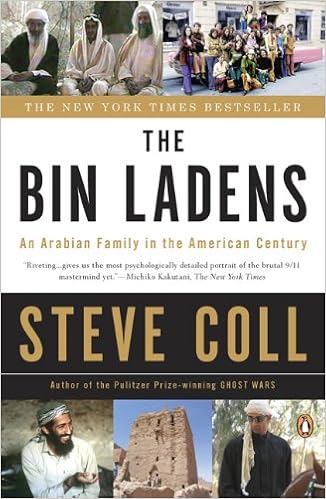
He would also have fifty-four children. As a fairly devout Muslim, who would help to refurbish the holy cities of Mecca and Medina, he could and would take four wives, as allowed in Islamic tradition. (What strikes me as interesting in this is that the men often take not just four wives in a lifetime but four wives at a time. Divorce seems fairly common, so that, where in the United States, we have serial monogamy because of rampant divorce, among some circles in the Islamic world you have essentially serial polygamy.)
Those children would be bequeathed a huge fortune when Mohammed died in a place crash. Mohammed's oldest son Salem would then take the reigns of the family and the family businesses. Salem, as the book shows, was a natural salesman--and, as many salesmen are, a kind of party animal with a tremendous sense of humor. Salem's own recklessness would lead to another tragedy in a plane twenty years later.
Under Bakr, Salem's half-brother, the family businesses would move toward being more professional, more corporate--or so, that was my impression from the book. At this point, the book becomes a bit drier as a result, though still quite fascinating. For this is also the time when Osama begins to create problems for the Saudis and for his own family. And perhaps one of the most interesting themes throughout the whole book is the way in which this one family straddles the Muslim and Western worlds, how some are very devout, conservative Muslims, some Muslims in seeming name only, and most Muslims somewhere in the middle, each of them donning different personalities as necessary in and out of Saudi Arabia.
And finally there are the Bin Ladens themselves, the awkwardness that one black sheep family member can create for all the others, the loyalty to one another, the devotion to the royal family and to Islam itself. This is as full and textured a portrait one could expect in six hundred pages, and so far the best of the four historical books I've read that have come out of our obsession with September 11, save perhaps the 9/11 Commission Report, itself an amazing work.
Sunday, November 30, 2008
On "Doors Closing" by Amy Anderson (2751 words) ****
Snoopers. How many have you been the victim of? How many have you victimized? Why do we have such curiosity about others who we know or live with? Is it a secret crush? A desire to be like someone else? Or is it a wish to be with a given person? Do you wonder where you fit in someone else's life? Do you imagine yourself in his or her thoughts? What are those thoughts? Maybe it's best you don't know. Maybe it's best you just keep imagining. Maybe it's best you don't even meet. These are all the things Anderson's story delves into, with its lump of inevitable sorrow in the end, a sadness I feel like I've shared a few times myself. Read the story here at Failbetter.
Sunday, November 23, 2008
On "At the Core" by Evan Lavender-Smith (2056 words) ***
Despite my love of John Steinbeck in my younger years, I am not a fan of allegory. Still, it's a valid form of structuring a story and giving it depth, and when I see it done well, I have to respect that. Lavender-Smith's piece is such an allegory. What's interesting about the piece, however, isn't just the obvious set of metaphors that go along with the stories events but the way in which the narrator focuses on one subject--what he buries in the backyard over the course of his childhood. Read the story here at Memorious.
Sunday, November 16, 2008
On "The Rattle" by Al Dixon (465 words) ****
A writing teacher of mine once noted that it is often the absence of knowing something that gives a story its power. Tell us what is in that bag everyone wants--or wants to get rid--and a story might just lose some of its bang, its malice, its sense of impending dread. Movies, especially thrillers and horror movies, are often built around this. I think of The Blair Witch Trial, for instance, which gained most of its thrills by failing to show viewers much of anything. Sometimes a few screams in the dark are worth more than all the blood and gore a director can throw at someone. And sometimes, a rattle that makes a man cry years later hints at something we probably are happier not knowing about. Read the story here at Failbetter.
On "The Perfect Scent" by Chandler Burr ****
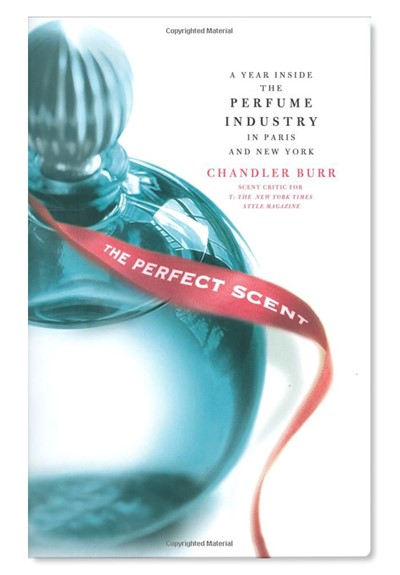
But most fascinating of all is Burr's--and every character in the book's--attention to smell. Despite the fact that smell is supposedly the strongest sense in terms of spurring memories, I have never spent so much time thinking about it. I can't say I even notice most smells, unless they're the stench of something rotting on the bus, something that makes me want to move away. Here, Burr introduces a bevy of them, describing them in ways that often aren't smells at all, at least, not in the manner that I'd think of them--smells with colors, with weights, with stories. And then there are the perfumes themselves, modeled after animals or detergent or sweat or car exhaust or fruit or flowers or cement after rain. I was so inspired at one point, I went to my medicine cabinet and pulled out the four bottles of cologne I've collected over the years--gifts I never wear--and stuck each one to my nose. Indeed, some of them do have characteristics that vaguely resemble something else. One of my scents is definitely citrus; another is vaguely like motor oil. The other two, however, as one not versed in the signification of smell, I could not really discern as anything other than simply perfume--a particular kind of alcohol. But I'm tempted, now, to walk into the mall and play among the spray bottles, testing what it is the perfumer has attempted to do. I feel like a whole other world has opened to me.
Sunday, November 9, 2008
On "Richie" by Tao Lin (1717 words) ***
What sticks in my head about this piece that I'd come back to write about it sometime later? It's probably the typically ludicrous world that Tao Lin sticks us in. Here, a family is taken hostage by some particularly inept kidnappers, who also happen to be studying for exams. Do you know how much you're worth? Do you know how much you're worth for one week? one day? one hour? a minute? Read the story here at Bear Parade.
On "The Hitler Salute" by Tilman Allert ***
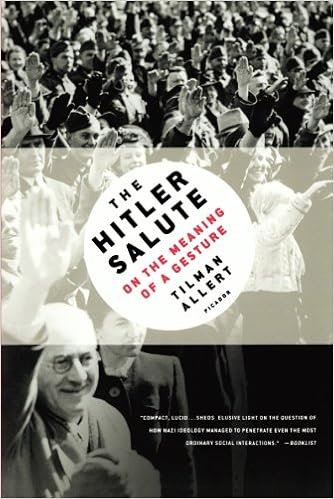
The book's most interesting section discussed the heil gesture in relationship to religion, the military, and the family. In the latter case, it's a bit hard to know how exactly the gesture was used in informal family life. In the case of the military, officers managed to avoid using it among military men until 1944, when they finally gave in as a show of loyalty after men in the military had attempted to assassinate Hitler. Until then, it was understood that the gesture was simply too much for the military. Among church people, the gesture was mostly given into--though a few resisted, in one case losing his life, in one case fleeing the country. Or try this for size--ways to get out of the gesture. One way, used by a particular professor, was to carry so many books that he couldn't "heil" when entering the classroom.
In the closing section, the book discusses how some embraced it, while others embraced it only in practice (keeping a kind of ironic distance even while doing it to please others). Both, the author says, lead to moral problems. But most Germans did give in, whether superficially, half-heartedly, or wholly. Being the kind of person who doesn't like to create trouble, I suspect that I would fall into one of the first two camps. And in that sense, according to the author, I would still be complicit in the people's sins. Alas, I am glad I do not live in such a society, where I can show off my general cowardliness with such aplomb.
Friday, November 7, 2008
On "Dizzy" by Jurgen Fauth (394 words) ***
One's future in a deck of cards, one's luck, one's destiny. Fauth does a good job here of making the old idea fresh by making it literal. I won't say too much more, lest this blog entry grow longer than the story itself. Read the story here at Vestal Review.
On "The World without Us" by Alan Weisman ****
.jpg)
Wednesday, November 5, 2008
On "Specify the Learners" by Brock Clarke (about 5200 words) *****
Imagine repeating sixth grade as an adult. All right, I guess Adam Sandler has already imagined that for you. So has Brock Clarke. I didn't see the Sandler film, but Clarke's story has its own hysterical antics, especially once love strikes and complications ensue. Read the story here.
On "The Art of War" by Sun Tzu ***

Monday, November 3, 2008
On "Blue Morning Dark" by Brock Adams (1255 words) ****
A great way to write something interesting, but also a very difficult way in terms of making the piece ultimately work, is to turn some saying into something literal. I say one is bound to create something interesting because such stories make us rethink our use of the term, how it arose, what we do with it. But such a story is difficult because so often it fails to become anything more than a curiosity. The characters become submerged to the idea, and the all-important ending simply drops off--"Yo, I'm done with this, where to now? Guess I'll go eat me some spaghetti." Adams's story isn't one to drop off. It gets more interesting as the literal becomes even more literal, and even more unexpected. And then, just when you think it might end up trying to reach too far, it pulls back with a zinger. Read the story here at Café Irreal.
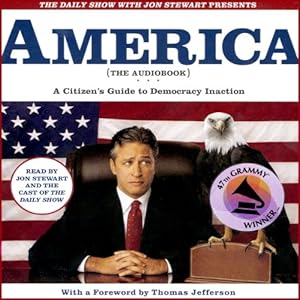
On "America: A Guide to Democracy Inaction" (audio) ***
Saturday, November 1, 2008
On "X" by J. T. Ellison (1360 words) ***
Demolition Magazine does pulp fiction. Most of the writing is good, in that pulp sort of way--short and chipped. My problem with pulp literature, however, is that so often such stories leave me cold (I never get a sense of the characters themselves beyond a sketchy outline, punchy words, and a tough-guy/gal plot). This piece didn't stand out to me at first--the writing suggests a typical obsessive weirdo--but as it moves toward its conclusion, my discomfort grew and exploded big time at the end. I'm glad I kept reading to that final paragraph. Maybe you will be too. Read the story here.
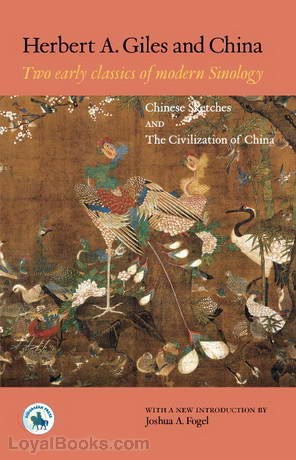
On "China and the Chinese" by Herbert Allen Giles ***
Thursday, October 30, 2008
On "Extinction" by B. J. Hollars (2385 words) ***
If the Hollars story featured earlier on this blog (here) was fantastic realism, this one falls more precisely into the realism camp. That earlier story, with its odd subject matter, caught my attention much more quickly, but this story still managed to keep me reading.
"Extinction" is, in part, a story about stereotypes. They aren't the stereotypes we usually think of, when looking at a national or human level--racial, gender, or otherwise. These stereotypes are more personal than that. These are stereotypes that two characters have built up about each other--a dad who fails to acknowledge that his son has grown up, and a son who can't see his father for the new man he is. This is also a story about change, two men dealing with grief, one the loss of a mother, the other the loss of a wife. And most important, this a story about desperation, about a dad trying to hang on--to life, to people, to anyone really, but most especially to his son. Stirring doesn't publish fiction very often, it seems, so the stories are rather special when they do. Read the piece here at Stirring.
"Extinction" is, in part, a story about stereotypes. They aren't the stereotypes we usually think of, when looking at a national or human level--racial, gender, or otherwise. These stereotypes are more personal than that. These are stereotypes that two characters have built up about each other--a dad who fails to acknowledge that his son has grown up, and a son who can't see his father for the new man he is. This is also a story about change, two men dealing with grief, one the loss of a mother, the other the loss of a wife. And most important, this a story about desperation, about a dad trying to hang on--to life, to people, to anyone really, but most especially to his son. Stirring doesn't publish fiction very often, it seems, so the stories are rather special when they do. Read the piece here at Stirring.
On "The Picture of Dorian Gray" by Oscar Wilde **

I'm recalling seeing The Godfather for the first time, another slight disappointment, and I'm wondering if this might not be a similar case. What happened with The Godfather was that I'd seen so many interesting bits and pieces and heard so many things about it that I expected much. But The Godfather is such a iconic movie that films thereafter have often copied its various techniques and plot points. Seeing it for the first time, I felt like it was full of cliches. Such was also the case with The Picture of Dorian Gray. I'd never read it, but I'd heard the whole story before, many, many times, and now, finally reading the original, it lacked much oomph. Beyond that, Victorian dialogue, with its paragraphs of discussion, seems so unrealistic, even bad, to my modern ear that at times it was hard to put up with Mr. Wilde, even if the reader himself did a rather remarkable job of making his voice seem lively and clear. You can download the text here, and the audio book here.
Tuesday, October 28, 2008
On "Shots" by Kim Chinquee (761 words) ***
Previously, I wrote about "Shot Girls" by Kim Chinquee (here). Here's another story with a variation on the same theme. Although I typically end up enjoying one story much more than another, I like it when authors write two versions of a story and share them both. It's simply interesting to watch the way in which a mind can go in different directions with the same idea--the meaning a given piece will take on and the emotions that piece will elicit. It's also interesting insofar as usually one piece is much longer than the other, more full bodied, less stream lined. Some authors, of course, only write a very few stories, over and over and over--Poe was one of those. Perhaps, all authors do that to an extent, but most are more subtle than presenting the same "buried alive" theme/plot device (one of Poe's favorites) again and again. Another author I enjoy who has written stories that closely parallel one another is Brock Clarke. Unfortunately, the two pairs of stories of his that I see as parallel are no longer available online. You can read Chinquee's "Shots" here at Willow Springs.
(Note: In an e-mail exchange with Kim herself, sometime after I read the story, I discovered that "Shots" and "Shot Girls" were written four years apart. So this was indeed a case of an author returning to fertile ground to explore the same setting and some of the same themes again, rather than a story taking two directions and both being written and published.)
(Note: In an e-mail exchange with Kim herself, sometime after I read the story, I discovered that "Shots" and "Shot Girls" were written four years apart. So this was indeed a case of an author returning to fertile ground to explore the same setting and some of the same themes again, rather than a story taking two directions and both being written and published.)
On "Swann's Way" by Marcel Proust ***

Subscribe to:
Posts (Atom)

 Posts
Posts


