Thursday, August 27, 2009
On "Show and Tell" by David Crouse (5740 words) *****
One of my favorites, though not my actual favorite, from stories from Crouse's second collection is this gem about a cleptomaniac kid. Okay, maybe he's not a clepto full time, but he's a clepto at least when it comes to this one friend, this friend who isn't going to be cool enough to be a friend come the school year. But in these long and dull summer days, when all you have is a brother who likes to beat you up for a companion, better to go to that misfit's house and steal his stuff. Read the story here.


On "The Nine" by Jeffrey Toobin *****
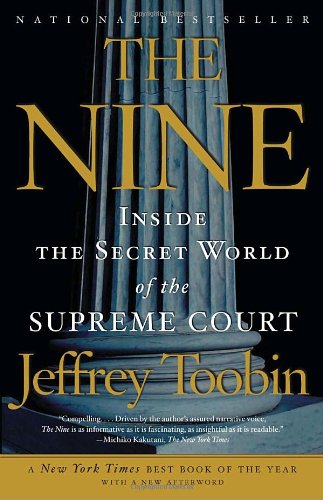
What makes Toobin's account of the Supreme Court so fascinating? That, on reflection, is somewhat hard to say. After all, I was familiar with many of the events that the book recounts. I think it was that Toobin brought to the story some insight that perhaps one doesn't get from the basic news. He brings us into contact with the people themselves, with what makes them tick, and with who they are. Each justice comes off, in some manner, pretty well, though some come off much better than others, particularly those on the left.
That Toobin sympathizes with those on the left seems evident from the book's early pages, when he talks about the Court being separated by a single vote, about the Federalist movement, and about Roe v. Wade. But the "single vote" discussion is also his way to frame the narrative. A single vote changes the court from liberal to conservative, and in Toobin's estimation the court has changed to be exactly that.
What strikes me, however, as the bigger tragedy in all of this is the final conclusion that Toobin reaches--that in the end, all court decisions are about ideology, that they are--in the end--political (something seen quite well in the 2000 election). And it's true. But the sad part about the 5-4 votes that now seem to dominate the judiciary isn't so much that those 5-4 votes are now favoring the conservative side rather than the liberal (with Anthony Kennedy's vote the only one that occasionally swings to the other side). It's that those are 5-4 votes at all and that those so much reflect our own political culture these days. There isn't much space for people in the middle anymore. In a television news commentary culture dominated by Keith Obermans and Glen Becks, politics has become the domain of ideological purists, and so too has the Court. We don't talk to one another anymore to come to a reasoned middle ground. We yell over one another and hope that our yell is the strongest. For the moment, the conservatives, when it comes to the Court, at least according to Toobin, have the upper hand.
Monday, August 24, 2009
On "Where Our Wives Are" by Greg Oaks (3177) ***
Here's a deceptively interesting story. I say deceptive because it's not one that at first hooked me in, but by about a third of the way through it, the story took hold. For me, what was working was the theme, this way that Oaks keeps circling back to crime. If stories are obsessions, crime is this story's obsession--all the horrible things this one man has had to endure. And then comes the end, all those crimes take on a whole other meaning. What are our lives when our loved ones are gone? Who do we trust? How can we? Read the story here at Switchback.
Friday, August 21, 2009
On "I Met Loss the Other Day" by Cara Blue Adams (916 words) ****
Personification is a poetic technique that goes back at least to the days of scripture. I don't think it's a very easy technique to pull off in our ironic age. I'm more prone to laugh at the specter of a balding man in a black cape with a scythe than I am to feel terror. Death, in its real form, seems so much scarier than this cartoon character. But some artists are able to pull the technique off. In the case of Death, I think of the Coen Brothers recent film No Country for Old Men, the way that that guy with a bad haircut becomes a walking embodiment of our dread. Adams uses the technique to masterful effect in this story in response to loss. Perhaps the most magical section of all is the end, where a shift in point of view stabs us for maximum emotional dis-ease. But I won't go deeper than that in my discussion yet I ruin it. Read the piece here at the Kenyon Review.
On "First Love and Other Sorrows" by Harold Brodkey *****

And now I have. What a pleasure it was to return to. I recognize many of the things he does in the second collection, but here--perhaps because the collection is shorter--they don't grow so irritating, so redundant. The first half of First Love revolves around narrators who are adolescent (teen and young adult) boys. Here, I'm probably the most entertained. We get the story of a boy seducing a girl, while his older sister works on seducing a husband. We get a boy babysitter who, as he looks back on that time as an adult, recognizes that he isn't living up to what he could be living up to during those youthful moments. We get a boy in college who falls for a young woman and watch as the two characters, in all their clumsy youthfulness, move from love sickness to simply being sick of one another (and back again). The second half of the collection, while less entertaining on the whole, revolves around a girl named Laura, as she moves through the early stages of marriage--dating, marrying, having a child, becoming an adult (sort of).
What makes Brodkey's stories so grand to me, besides his command of the English language, is that they seem have such keen psychological insights into their characters. We watch these people, in all their confidence and lack of it, swagger from moment to moment, between varying emotions and thoughts not very dissimilar to our own. And yet, Brodkey does this so well that the emotions and thoughts seem fresh, seem singular. Only this character would think this at this particular moment. Such heavy attention to thought, taken to extremes, as it is in some of the stories in his second collection and in Runaway Soul, where he's got eight-year-old kids thinking such complex things about the world around them one wonders how they ever managed to grow up, it can seem ridiculous, but here, in this lovely first collection, every bit of writing seems to work just fine.
Tuesday, August 18, 2009
"Goliath" by Neil Gaiman (3901 words) ****
Written as a kind promotional piece for the movie The Matrix, Gaiman's "Goliath" stands well on its own--and it's one of the better stories in his collection Fragile Things. So, say, you were stuck in a time loop--déjà vu--only it wasn't a time loop. Turns out, your brain is connected to a machine, and it's malfunctioning a bit, and in the "real" world, there's a war going on, and you're just in training for that. Or at least, I think that's what's going on. Otherwise, I'm not really sure why the computer-generated world is needed, except it sure is a lot more interesting, which is kind of the twist here. We start off thinking the fantasy world the more spectacular and end up wanting to be back in that other place--you know, taking care of wife and kids, selling computer parts. Read the story here.
On "Fragile Things" by Neil Gaiman ***
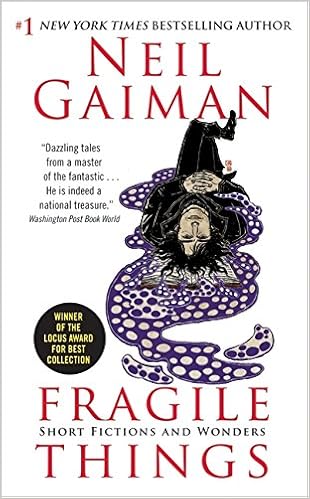
That I placed him on the list was a good thing. Gaiman is a very good writer. His talent is evident throughout Fragile Things. But as I've suspected all along, his particular choice of subjects isn't what naturally appeals to me. I take, as a case in point, a story called "Forbidden Brides of the Faceless Slaves in the Secret House of the Night of Dread Desire." Great title. The story is one in which a writer wishing to be successful keeps being told that he should give up literature and write fantasy. In this case, though, the "fantasy" world is one very much like our own, with people eating breakfast and arguing over mundanities like who gets which part of the newspaper or who makes breakfast. The "real" world is one with knights and sword fights and strange creatures. I found myself pulled toward the "fantasy" world (i.e., the real/literary world)--more of this, I wanted to say, but Gaiman gives us mostly a world of the fantastic, a world that most of the time is less interesting to me. Beyond that, the collection as a whole seems like a hodge-podge of things that didn't fit elsewhere. In a sense, it's a great way, probably, to get a feel for Gaiman's whole arsenal, but it also feels like a bit of a jumble.
My favorite piece in the collection is one called "Bitter Grounds," the story of a man who is "dead," metaphorically at least (he's been dumped by a woman he loves), who runs into a stranger in New Orleans and eventually finds the stranger missing--and also the stranger's academic paper on zombies (zombie coffee girls, to be more specific) to be presented at an anthropology conference later that week. The man takes it upon himself to assume the stranger's identity and to present the paper himself. The momentary change of personality does him well, but only for a time, only until the conference draws to its end and he's back to being love starved. Nice story, notably with only a little fantasy.
Other favorites include "The Facts of the Case of the Departure of Miss Finch," a story about a crazy circus that comes to town and that somehow Miss Finch ends up a part of, never to return. "Instructions" and "Fifteen Painted Cards from a Vampire Tarot" offer interesting pieces of writing, though I'm not sure how much they qualify as stories. "The Monarch of the Glen" is the final novella and works pretty well, especially in its set up: an American comes to a remote part of Scotland and is offered a job too good to be true--over one thousand dollars for a single weekend of work as a security guard. Lots appears to be ominous, and those fears build for forty pages, and then somewhat disappointingly, the ominous elements come true--I say disappointingly because again there is a turn toward fantasy that doesn't seem in keeping with the rest of the tale. Were this more my genre, I'm sure I'd have been wholly satisfied. "Goliath," a Matrix-like of alternate worlds, is also a good one.
Saturday, August 15, 2009
On "Hook" by Claudia Smith (2307 words) ***
Mention the word "Hook," and I think of that poem by Margaret Atwood, the way she twists that word from something sexy to something dreadful and harrowing. This story does a similar thing. You start out thinking you're reading about some girl picking up a guy, then maybe a girl picking up a guy for someone else, then . . . It just gets worse--it just gets creepy. But it hooks you, makes you read on, until you come to the dreadful, unexpectedly quiet end. Read it here at Storyglossia.
Wednesday, August 12, 2009
"Every Earth Is Fit for Burial" by Cyn Kitchen (7659 words) *****
This one caught my attention straight out with its clear voice, its southern Evangelistic feel. What's nice about this piece, however, is that it doesn't--to me--belittle its subject matter. Religious folks are easy to make fun of, and while I'm one of them, I'm often uncomfortable talking about my own faith because of the kind of ludicrous behavior that some spiritual folks engage in. But that's part of faith, isn't it? For some--and certainly for these folks.
But where I really see faith is in our narrator, a faith in her mother and her mother's religion, and in her father, her faulty crippled dad, who despite all his shortcomings proves to be as kind a soul as most all the others in this story. Kudos to the Million Writers Award judges for picking this one out of the pack to include in its top-ten short list (it got my vote for best of the year). Read it here at Menda City Review.
But where I really see faith is in our narrator, a faith in her mother and her mother's religion, and in her father, her faulty crippled dad, who despite all his shortcomings proves to be as kind a soul as most all the others in this story. Kudos to the Million Writers Award judges for picking this one out of the pack to include in its top-ten short list (it got my vote for best of the year). Read it here at Menda City Review.
On "Into the Wild" by Jon Krakauer *****
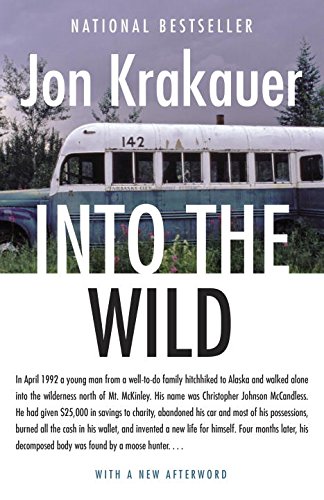
When younger, I too had a desire to take off on wild trips. I too had a desire to prove that I could "make it on my own." I too wanted just to bum around the country, taking odd jobs as I could. Perhaps this passion is in all young people--or all young men. But few of us dare do such things--I never did. And then, I think, many of us outgrow them. What do I mean by that? McCandless's desire to go it alone struck me as a kind of immaturity one goes through in the twenties. By the time one hits thirty, one knows there is no such thing--we are social creatures. We exist in culture and by culture. Even when "independent," we are dependent--on each other, if not at least on God. But I admire McCandless for doing what I couldn't and wouldn't have done.
The story itself that Krakauer reads is very engaging. The guy is a craftsman in terms of setting up a good plot. Start somewhere toward the end, and then begin again, somewhere near the start. Tell us only what we need to know when we need to know it. Keep us reading. That he did, for me--and I guess for many others given his robust sales.
Sunday, August 9, 2009
On "Oh Girl" by Corey Zeller (940 words) ***
Remember when you last told your friend about this time that the two of you did something? Yeah, you remember. Happens all the time, right? That wistfulness for bygone days. I remember when I got out of high school and started beginning every sentence with "I remember . . ." and every question with "You remember . . . ?" I loved high school, this despite all the stress that high school inevitably bears down on a kid, and for the first several years afterward, really, until I left California, I missed it. Now, now, I don't remember it. Or if I do, it doesn't seem nearly so grand as it did then, in those few years right after, when the life that follows seems so utterly disappointing, utterly lacking in the fulfillment of all those hopes one has when younger.
Corey Zeller's "Oh Girl" is a story about remembering, a story about telling your friend about what you remember--or asking your friend about it. Only there's a sadness here, because, as with all such sentimental memories, something is missing, something that means that remembrance will never be something you'll have again. Though my life has never been as risky as this story's narrator's, I, too, am one of the lucky ones who has gone on to be able to ask, "Remember?" and to know that for some, the answer is no because they're no longer there to answer. Read the story here at Word Riot.
Corey Zeller's "Oh Girl" is a story about remembering, a story about telling your friend about what you remember--or asking your friend about it. Only there's a sadness here, because, as with all such sentimental memories, something is missing, something that means that remembrance will never be something you'll have again. Though my life has never been as risky as this story's narrator's, I, too, am one of the lucky ones who has gone on to be able to ask, "Remember?" and to know that for some, the answer is no because they're no longer there to answer. Read the story here at Word Riot.
Thursday, August 6, 2009
On "Chowbang" by Pete Pazmino (2855 words) *****
This story made me laugh--out loud. That doesn't happen so much when I'm reading, not as much as I think it should. But that's not the only reason this story is such a keeper. It also channels a voice, a character, in ways that few stories do. I came away feeling like I knew this girl--this sort of female machismo hiding a little bit of vulnerability that she won't show us for a second. Read the story here at JMWW. (A warning to those who might want to stay clear of such things: this story contains adult themes and language, more so than most of the stories I've profiled.)
Monday, August 3, 2009
On "Modeling" by Sarah Scoles (3506 words) ***
If stories are often built out of motifs, this one is built out of mathematics. There's something nice about applying something as seemingly nonliterary as math to fiction. Not that it's not done or that one couldn't, for example, try to apply mathematics to a given Chekhov story, but math in fiction, frankly, is not usually on the surface, not something folks in the humanities put front and center. Perhaps it's our own discomfort with the subject, the way that some English majors do all they can to avoid math. Myself, I often wonder if maybe that's what I should have done instead--I was usually better at math than vocabulary. But the upper echelons of the subject might have scared me off eventually, even though it's there that the more interesting elements of math come into practice, the philosophy and theory. And it is this theoretical component that the author, an astrophysics major, begins to explore in this story, along with psychology and the whole world of fate. Read the story here at Diagram.
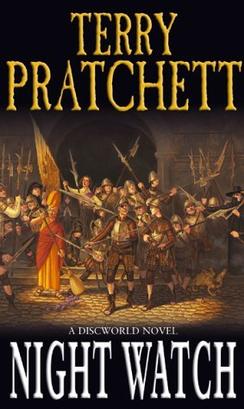
On "Night Watch" by Terry Pratchett ****
Friday, July 31, 2009
"Tasting the Fruit" by Kate Blakinger (413 words) *****
Try this one on for size. In less than five hundred words, a friend's jealousy will drive him to commit acts of utmost cruelty. I'm floored by how quick it happens and how well it's recounted. Suffice to say, with friends like these . . . Yeah, you know. Read the story here at Flashquake.
Tuesday, July 28, 2009
On "What Happens When The Mipods Leave Their Milieu" by Elizabeth Crane (4644 words) ***
I've been a fan of Elizabeth Crane's fiction since soon after her first book came out. Her first two books carried a very distinctive style consisting in long sentences in which she raved or complained or maybe just listed things but really just processed her--or rather her narrator's--thoughts so that you had the feeling you were listening in not just to thoughts but to some person's mildly insane musings, perhaps told to you over coffee, or read on the Web somewhere, like this, only not this particular site specifically because I'm not insane--I promise--even if someone says otherwise, someone who obviously doesn't know me. . . . Anyway, this story doesn't do that. It's a departure, in that sense, from what I'm used to from her. But it's also a pleasure. Crane has rarely been as funny. And what makes the humor even better here is that her observations seem, in some ways, quite trenchant. Meet the Mipods, a couple whose simplicity is taken for--surely--something much more than that. Read the story here at Five Chapters.
Saturday, July 25, 2009
On "Pussies" by Paula Bomer (4126 words) *****
One of the things I enjoyed most about teaching freshman composition, for the few years that I did it, as a graduate student, was that I got work with eighteen-year-olds, folks just beginning life as an adult, life on their own. There was so much hope, so much vibrancy there, so much expectation. Even by twenty-four I had become a bit jaded, and other students, the upper-division students in literature classes, were also. They've been at this a few years, know what it is to live away from mom and dad.
I remember my own days, that summer after graduating from high school, the way that I thought maybe, given all the great work I'd done in school, the world would open up for me. Just give it a little time--a month or two--and people would see how much I could do for them. Good jobs were likely to walk right into me. Now, I know that I don't much matter to people who don't know me, that I'm one of seven billion people--and seven billion people is a lot of people. At eighteen, seven billion--that doesn't seem to register. I don't know why. Somehow, we think we're different. Not one of the billions who go through life anonymously, vanishing with only a handful of people caring.
Bomer captures those kind of young moments in this piece, that awkwardness of youth, that worshipping of cooler friends, that thinking, conversely, that somehow people will eventually come to know us and will love us, given time--you know, a month or two. Read the story here at Night Train.
I remember my own days, that summer after graduating from high school, the way that I thought maybe, given all the great work I'd done in school, the world would open up for me. Just give it a little time--a month or two--and people would see how much I could do for them. Good jobs were likely to walk right into me. Now, I know that I don't much matter to people who don't know me, that I'm one of seven billion people--and seven billion people is a lot of people. At eighteen, seven billion--that doesn't seem to register. I don't know why. Somehow, we think we're different. Not one of the billions who go through life anonymously, vanishing with only a handful of people caring.
Bomer captures those kind of young moments in this piece, that awkwardness of youth, that worshipping of cooler friends, that thinking, conversely, that somehow people will eventually come to know us and will love us, given time--you know, a month or two. Read the story here at Night Train.
On "The Left Hand of Darkness" by Ursula LeGuin ****

Of the books on this fantasy and legend list, Le Guin's so far ranks as my favorite. It didn't start out that way. The many strange place names, the inhospitable prose, the emphasis on treaties and other dull government tasks were all quite off putting. But somewhere about the time that Mr. Ai, our alien envoy, is dismissed from the government representatives of Karhide, the book gets very interesting. Mr. Ai ends up taking his desire for open trade to a rival country, Orgoreyn, and eventually finds himself in a bit of trouble--and having to depend on Estraven, a Karhider for whom there is little trust. In the process, one learns of this strange world, where it is always winter and where sex occurs only once a month when the otherwise neutered people go into heat. And one gets a captivating adventure story with a good deal of heart, as Mr. Ai flees for his life.
What of mankind? What of dualism? What of friendship? What of courage? Of gender? Of history and how it's written? Of legend and of how it comes to be? All such issues get played out amid what is actually a rather simple story.
Wednesday, July 22, 2009
On "Are You Somebody?" by Andrew Roe (1238 words) ***
I don't know that I've read a story about a gold digger before, though the notion is one I have seen many times in film--and in the tabloids. This is gold digging with a twist, however, gold digging in the sad confines of the former celebrity. These kind of lives do fascinate, perhaps more, in some ways, than the lives of current celebrities. I love those whatever happened to stories. I don't know exactly why. Maybe it's that such a person is like someone dropping out of the sky and becoming again just like one of us nobodies. Do I see new money-making schemes afoot? Get your own former celebrity--just buy this pamphlet that shows you how. Or just read the story here at Juked.
Sunday, July 19, 2009
On "Coyote" by Werner A. Low (3172 words) ***
Okay, so the main thing I kept thinking while I read this (save, the part about how scarecrows generally don't work, so this must be something pretty special)--the main thing I kept thinking was this: This guy must be pretty desperate for some sort of life. I mean, imagine obsessing over winning some ridiculous office prize and then obsessing over how the reason for that prize is put into effect. The absurdity makes the story pretty funny--but it also makes the main character into someone rather pitiful, which in the end, I suppose, is the point. If only a prize could solve all our problems. Read the story here at Terrain.
Subscribe to:
Posts (Atom)

 Posts
Posts


