Monday, December 7, 2009
On "Endless Cup" by Emily Ross (3850 words) ***
Ever been in love with love, with the idea of person? So much romantic love starts out this way, in this ideal, this crush, we have on someone we create in our own head. We have a handful of interactions with the person, and each one betokens some kind of meaningful zeitgeist that is going to transform our life--if only we can get that person into our life. Meanwhile, Ricky or Bonnie or Pat stand by, right there, before us, waiting for us to get over this silly thing. But we'll never see Ricky or Bonnie or Pat as worth our time--not when Mr. or Ms. Ideal is around. Ross's piece focuses on exactly this kind of ordinary conundrum but in a way that we can't help but feel a bit for its protagonist, whose visions are belittled by her coworker and friend, a person who perhaps sees love in more practical (read, financially beneficial) ways but also in ways much less romantic. Read the story here at Menda City Review.


On "American Green" by Stephen Germac ***
I had wanted to read American Green by Ted Steinberg, but the library didn't have it. That book apparently does for lawn care what Fast Food Nation did for fast food. Instead, I found this American Green, by Stephen Germac, which turned out to be an interesting subject all its own--enough that I opted to check it out.
Germac's book is no light reading. This is academic writing as its dense and difficult best. By that I mean that, while not easy reading, it is by no means impenetrable, and the rewards of wading through the prose are worth it.
Germac's text is essentially a Marxist critique of public and national parks. His basic thesis is that capitalism creates inevitably excess production. This is the cause of our economic downturns every nine years or so. In the 1870s, there was a railroad bubble, just as in the 1990s there was a tech bubble and in the 2000s a real estate bubble. To use up this excess capital, the state turns to financing public parks. Parks produce nothing, yet they use a tremendous amount of the surplus production. In turn, they also put the unemployed laboring class to work and, thus, help to offset labor unrest and keep the peace, as well as keep the social strata in its familiar order of rich, middle class, and poor.
The irony of the creation of said parks is that while they are "public"--accessible to all, thus appearing to elide class difference--and put the laboring classes to work, Germac notes, such parks actually reinforce class structures. They do this because they are generally built at the expense of the lower classes for the primary benefit of the upper classes. How so? Germac uses New York's Central Park, Yosemite, and Yellowstone as his key examples.
In Central Park, Germac notes, how the park itself required the resettling of a predominantly black neighborhood. This neighborhood, in a passage from the New York Times that Germac quotes, was, in the eyes of the contemporary higher classes, mostly a shanty town in need of destruction. Germac notes that the neighborhood was actually one of the most stable of the black neighborhoods in New York. Here, what little the poor have is taken for the sake of handing over property to the "public." This "public" is essentially one consisting of the higher classes, because those who are able to enjoy the park are those who have one of the following: (1) money to transport to the park; (2) money to afford the higher-cost real estate next to the park; and/or (3) jobs that are flexible enough to allow for trips to the park during daylight hours. Such benefits preclude those who are removed to districts much farther away in order to make the public park possible.
A similar thing happens in Yellowstone, where native people are booted off their land in order to create a public park available for all American citizens. Here, land surveyors note both that the land is inhabited only by a few barbarians and also that the land is uninhabited. Barbarians--Natives who lack political power--in other words, equals no one. The public that can afford to visit the park are those able to afford the railway ticket costs, which again precludes most of those in the lower class.
It's an unsettling reading of the American park system. And it's engaging theoretically. On a practical level, I'm left a bit startled, however. The author alludes to environmentalists' dislike of his work and gives a little rational for why they should not be troubled by it (after all, few environmentalists would accede to booting Native peoples off land in order to "preserve" the land for a blessed "public," if they knew in fact that was at the heart of what was happening). But this, for me, doesn't resolve the question as to how one preserves natural spaces--it would, in fact, seem to suggest such preservation is inherently ill-conceived.
I'm reminded of a Supreme Court case from a few years ago wherein a town declared eminent domain over some private property in order to hand that property over to another private owner for redevelopment. Many among my friends were dismayed and shocked. And yet the case, while troubling, is not so easily black and white. If a state has the right to condemn private property in order to build a road or a stadium or an airport--something that is supposedly in the public interest--how is one to determine what is public interest and what is private? Often the two work with each other to achieve something that neither on its own would be able to do. Many "public" roads become private toll roads. A dilapidated downtown might best be condemned, in the public interest, so that it can be put to use again, for private interest. But what is dilapidated? And what is to happen to those who own land, and make a livelihood, in this supposedly bad part of town? Is the creation of capital inherently bad? Is it, by contrast, inherently good? I would propose neither, and it seems to me that when it comes to public interest there is a vast gray area.
In this sense, I wonder if the economic system set up on the biblical Old Testament might not be on to something. There, every seven years, all debts are forgiven and agricultural production ceases for the course of twelve months. If we extended that to industrial production, would that not give opportunity to use up the excess production that capitalism inevitably creates and thus avoid economic bubbles? In that system also, land is redistributed every fifty years, meaning that no one is left without property in perpetuity in the name of a public or private interest. Perhaps, in that system, equitable distribution of wealth would actually to a degree be possible.
Germac's book is no light reading. This is academic writing as its dense and difficult best. By that I mean that, while not easy reading, it is by no means impenetrable, and the rewards of wading through the prose are worth it.
Germac's text is essentially a Marxist critique of public and national parks. His basic thesis is that capitalism creates inevitably excess production. This is the cause of our economic downturns every nine years or so. In the 1870s, there was a railroad bubble, just as in the 1990s there was a tech bubble and in the 2000s a real estate bubble. To use up this excess capital, the state turns to financing public parks. Parks produce nothing, yet they use a tremendous amount of the surplus production. In turn, they also put the unemployed laboring class to work and, thus, help to offset labor unrest and keep the peace, as well as keep the social strata in its familiar order of rich, middle class, and poor.
The irony of the creation of said parks is that while they are "public"--accessible to all, thus appearing to elide class difference--and put the laboring classes to work, Germac notes, such parks actually reinforce class structures. They do this because they are generally built at the expense of the lower classes for the primary benefit of the upper classes. How so? Germac uses New York's Central Park, Yosemite, and Yellowstone as his key examples.
In Central Park, Germac notes, how the park itself required the resettling of a predominantly black neighborhood. This neighborhood, in a passage from the New York Times that Germac quotes, was, in the eyes of the contemporary higher classes, mostly a shanty town in need of destruction. Germac notes that the neighborhood was actually one of the most stable of the black neighborhoods in New York. Here, what little the poor have is taken for the sake of handing over property to the "public." This "public" is essentially one consisting of the higher classes, because those who are able to enjoy the park are those who have one of the following: (1) money to transport to the park; (2) money to afford the higher-cost real estate next to the park; and/or (3) jobs that are flexible enough to allow for trips to the park during daylight hours. Such benefits preclude those who are removed to districts much farther away in order to make the public park possible.
A similar thing happens in Yellowstone, where native people are booted off their land in order to create a public park available for all American citizens. Here, land surveyors note both that the land is inhabited only by a few barbarians and also that the land is uninhabited. Barbarians--Natives who lack political power--in other words, equals no one. The public that can afford to visit the park are those able to afford the railway ticket costs, which again precludes most of those in the lower class.
It's an unsettling reading of the American park system. And it's engaging theoretically. On a practical level, I'm left a bit startled, however. The author alludes to environmentalists' dislike of his work and gives a little rational for why they should not be troubled by it (after all, few environmentalists would accede to booting Native peoples off land in order to "preserve" the land for a blessed "public," if they knew in fact that was at the heart of what was happening). But this, for me, doesn't resolve the question as to how one preserves natural spaces--it would, in fact, seem to suggest such preservation is inherently ill-conceived.
I'm reminded of a Supreme Court case from a few years ago wherein a town declared eminent domain over some private property in order to hand that property over to another private owner for redevelopment. Many among my friends were dismayed and shocked. And yet the case, while troubling, is not so easily black and white. If a state has the right to condemn private property in order to build a road or a stadium or an airport--something that is supposedly in the public interest--how is one to determine what is public interest and what is private? Often the two work with each other to achieve something that neither on its own would be able to do. Many "public" roads become private toll roads. A dilapidated downtown might best be condemned, in the public interest, so that it can be put to use again, for private interest. But what is dilapidated? And what is to happen to those who own land, and make a livelihood, in this supposedly bad part of town? Is the creation of capital inherently bad? Is it, by contrast, inherently good? I would propose neither, and it seems to me that when it comes to public interest there is a vast gray area.
In this sense, I wonder if the economic system set up on the biblical Old Testament might not be on to something. There, every seven years, all debts are forgiven and agricultural production ceases for the course of twelve months. If we extended that to industrial production, would that not give opportunity to use up the excess production that capitalism inevitably creates and thus avoid economic bubbles? In that system also, land is redistributed every fifty years, meaning that no one is left without property in perpetuity in the name of a public or private interest. Perhaps, in that system, equitable distribution of wealth would actually to a degree be possible.
Friday, December 4, 2009
On "The New Thieves" by Thaisa Frank (384 words) ****
Looking to make your marriage a little more than it was? Are you tired of the mundane and everyday, of plain-vanilla sex? Frank has some advice for you, what works and doesn't work, the experiments that go into reinvigorating one's love life with the one you've chosen. It's all about fantasy, of course, but the right one. Read the story here at Oxford Magazine.
On "The Crisis of American Foreign Policy" by G. John Ikenberry, Thomas J. Knock, Anne-Marie Slaughter, and Tony Smith ****
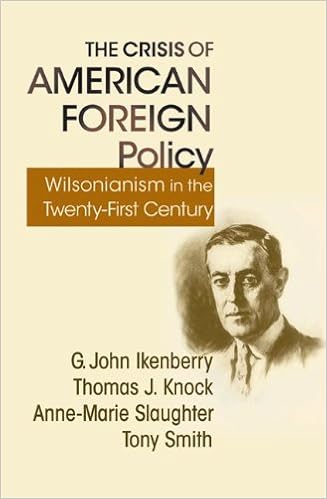
Enter Thomas J. Knock's essay, wherein he ties two traditions together--Woodrow Wilson's conceptions of foreign policy (founding what Knock calls neoliberalism) and neoconservatism. Knock argues that they are more or less two sides of the same coin, with a goal of democratizing the world and thus providing for world peace (since mature democracies supposedly don't go to war against one another). The key difference is in focus--multilateralism versus unilateralism. In one, the United States does this in consort with other countries; in the other, the United States goes it alone. Yet, Knock argues, these aren't as different as they appear. Both have at heart protecting American interests abroad. In one America acts for the good of the world, which in turn helps America; in the other, America gets the world to act the way America wants for the good of America.
Anne-Marie Slaughter goes on, in the last essay, to rebut each of Knock's arguments, reconfiguring Wilsonianism as a set of policies that respects self-determination of peoples and that would never act unilaterally to achieve desired ends. At her essay's end, she looks to Europe as the exemplar of Wilson's dream, a set of nations who have voluntarily ceded some sovereignty in order to set united goals and thus to sustain peace. It is to this, she says, the United States should aim in its own actions with the world, integrating more with such a system.
It is a persuasive argument, insofar as Knock's own essay ends with a lament, one that seemed wholly appropriate given the first two essays in the book and the foundation for much of the neoconservative argument (and the neoliberal for that matter). That argument rests in the assumption that the United States is the most powerful nation on the planet--militarily and economically. In the face of two wars, a financial crisis largely brought upon the world by the nation's profligate personal spending, and further profligate national spending necessary to recover from--or postpone--the looming disaster caused by the first two, however, claims of American power as supreme in the world seem hollow. How the nation continues in light of these problems would seem to demand the country no longer look to itself as the savior--or ruler--of the world but as one of the company of nations.
Tuesday, December 1, 2009
On "My Gift to Her" by Lauren Becker (196 words) ***
This short, short piece starts with a curse and ends with a curse. In between, we get a glimpse into the life of a bitter woman. She's bitter for a good reason. But she'll do what she is supposed to do for the family--for a while. Read the story here at Dogzplot.
On "Darkness at Noon" by Arthur Koestler ****
Koestler's book is a novel of ideas, which is not something I've read much of lately. By that, I mean that it is a book more concerned with its themes and ideas than with its story; it is more philosophical treatise than plot-driven narrative (though there is a plot); the thoughts themselves remain interesting enough to drive the book forward. The book is broken into a series of three confessions, each one of which explores concepts of right and wrong, power and progress, ethics on a political stage. The story is a veiled description of life in Stalinist Russia, of men who led the Bolshevik Revolution yet died years later accused of being traitors to the party--in fact, not only being accused by confessing to such.
Koestler explores why men who would put their lives on the line for a cause would confess (rather absurdly) to betraying it? The answer is essentially that the ends justifies the means and that loyalty to the party and its purposes comes before even one's own life. If the party needs you to confess to crimes you haven't committed in order to further the revolutionary cause and concede power to it, then you do it.
It's a rather scary totalitarianism, one that affects not only one's actions but one's very thoughts and one's very conceptions of history. And it seems, unfortunately, not all that far apart from realities even today. I'm reminded of the troubles in Iran, where old guard revolutionaries are now being rounded up by the current leaders and made to confess their crimes against the regime, even as the regime seems to be betraying some of the principles on which it was founded. I'm reminded of certain experiences growing up, wherein even suggesting that X or Y may not be the proper way to accomplish something would have been seen as rebellion (akin to questioning the Party, in Koestler's book and thus breaking apart unity), leading one to remain silent in the face of wrongdoing by superiors. I'm reminded, sadly, even in some ways of the U.S. fight against terrorism, especially in the former administration, where citizens have been told, in a sense, that the ends justifies the means, as the government ignores certain rules set out in the nation's constitution. Koestler's book serves as a warning against such thinking. Those who live by it are likely to end up its victim. Rather, we should, as Koestler writes, quoting the Bible, let our Yea be Yea, our No, No--aim to be decent (righteous in all acts), rather than clever (duplicitous to serve a moral end).
Saturday, November 28, 2009
On "The Unreliable Memoirist" by Keith Lord (4705 words) ****
A few years ago, there was quite a rage over A Million Little Pieces, the James Frey memoir that proved to be in part made-up. But what memoir isn't? I remember reading a guide to memoir writing in a class that I took in autobiographical writing of early America. That book explicitly told writers to embellish, to add details that they couldn't possibly remember. But perhaps there are levels of embellishment that are allowed and levels that are not. Perhaps you can add what clothes you were wearing on the day you saw the Space Shuttle explode but cannot decide that you were a heroin addict instead of only an occasional heroin user. Where does one draw the line? And what are the consequences of drawing the line in the wrong place?
This is what Keith Lord's story is in part about. It's also about a not entirely sympathetic protagonist who becomes less sympathetic the more that we learn about his memoir and its inaccuracies. But it's art, isn't it? Just like a movie is an adaptation that changes facts, a book changes facts as well. How do you tell a good story if you don't at least set it up well? Lord does quite a job setting it up here, at Our Stories.
This is what Keith Lord's story is in part about. It's also about a not entirely sympathetic protagonist who becomes less sympathetic the more that we learn about his memoir and its inaccuracies. But it's art, isn't it? Just like a movie is an adaptation that changes facts, a book changes facts as well. How do you tell a good story if you don't at least set it up well? Lord does quite a job setting it up here, at Our Stories.
Wednesday, November 25, 2009
On "The Day You Were Sad" by Jennifer Levin (771 words) ***
I remember walking into a Japanese bookstore in New York once. Everything was in Japanese. I don't know the language, don't even know the symbols that are used in the written tongue. I knew then what it is like to be illiterate--completely illiterate. I mean, if go to a European country, I can at least parse out the alphabet, recognize a few cognates. But here, I was clueless. The writing around me might as well have been abstract art.
A few years ago, I was having drinks with a friend when the sister of his wife (now ex-wife) came by and started talking. After she left, he said something to the effect of, "Couldn't you tell that she was crying?" No, I couldn't. Something horrible had happened to her and I was as blank about it as I'd been about the language in that bookstore.
I've never been one to read signs very well--that is, body signals, heart signals, people signals. I'm an illiterate when it comes to that, though I think I have gotten a little better with age. But only a little. Here's a story about just that sort of thing. All the signals are there, so many signals one says, Um, how could you have missed that? But miss it the narrator did. And thinking about its meaning for her life and for the life of the person who she missed is what this piece is all about. Read it here at Twelve Stories.
A few years ago, I was having drinks with a friend when the sister of his wife (now ex-wife) came by and started talking. After she left, he said something to the effect of, "Couldn't you tell that she was crying?" No, I couldn't. Something horrible had happened to her and I was as blank about it as I'd been about the language in that bookstore.
I've never been one to read signs very well--that is, body signals, heart signals, people signals. I'm an illiterate when it comes to that, though I think I have gotten a little better with age. But only a little. Here's a story about just that sort of thing. All the signals are there, so many signals one says, Um, how could you have missed that? But miss it the narrator did. And thinking about its meaning for her life and for the life of the person who she missed is what this piece is all about. Read it here at Twelve Stories.
Sunday, November 22, 2009
On "Goldenboy" by Sarah Black" (625 words) ****
Here's a coming-of-age story that's surprisingly as innocent as the narrator's age. I think coming of age, and I think some kind of traumatic experience (as in John Updike's "A&P") or some kind of "big" experience, like losing one's virginity. Here, Black chooses to focus, however, on simply a walk through a city with a friend. The new experiences aren't terribly "big," but they're big in the eyes of our little narrator. The descriptions are beautiful, full, and part of what makes this short short so utterly beyond its minimalist number of words. Read the story here at Flashquake.
On "Last Last Chance" by Fiona Maazel **

By chance, I happened to be reading a book about the possible end of the world at the same time as that movie arrived. And bleak this book is. This is no Oprah pick of the month. People die. People do not get better--or they get better, but why bother, since they're going to die anyway?
About fifteen years ago, I read a book by Dave Bowman called Let the Dog Drive. I was attracted to it by the book's beginning and its snappy copy. I finished it, feeling I'd read a bit too much (weirdness). I had the same feeling with Maazel's debut novel. We get a story about a superplague that panics the nation. We get it from the point of view of the family of the unassuming creator of the superplague, which by the way is a family made up of drug addicts. A family of drug addicts? A nation dealing with a plague? A family dealing with a patriarch blamed for releasing the plague into the public? Any one of these could have been the subject of a book. Put them together, and for me, it seemed a bit over the top. Most of the time. And almost unrelentingly bleak, despite the narrator's apparent recovery from addiction.
Maazel, however, is a talented writer. Line upon line, sentence upon sentence, shines. Those first several pages will hook you. And there are other places where this novel becomes hard to put down as well. I found particularly interesting the first portion of part 2, wherein our narrator Lucy, a lifelong drug addict, goes to rehab with her mother, another long-term drug addict. While there, the feared superplague finally begins a full-force charge across the United States, and it's coming right for the areas surrounding this desert rehab oasis. The rehab center goes into lockdown. Now it's the folks in rehab versus the world. Keep all at bay, not just so that we can recover but so that we can avoid the plague. It's the most engaging section of the novel, one that could be a book of its own. Or a movie. 2013 anyone?
Thursday, November 19, 2009
On "Distractus Refractus Ontologicus: The Dissemination of Michael Martone" by Josh Maday (2138 words) ***
If you like heady experiments--especially with a bit of verve in the writing--this piece is just the sort for you. Can I say I know exactly what's going on at all points, no? Clearly, the author has read his share of philosophy (and Michael Martone) and is relishing putting some of it to use, what with the numbers and all. I, by contrast, tend to push aside things that are too theoretical. But Maday here isn't just doing theory--he's having fun, and forcing you to have a little bit of it. Who is this "thing" we call Michael Martone? Who are you? What's your name? When you dress in the morning, do you think, this is me--I am putting on me? And what of the other six thousand versions of you, the other six thousand people who are signified by the same exact nomenclature? Think deeply on these subjects as you read the story here at Lamination Colony.
Monday, November 16, 2009
On “Punch-Drunk Love” by William Walsh (867 words) ****
Titular is a really interesting journal in that it asks writers to take another’s title (from a book, movie, or TV show) and write something brand new with the same title. The results are always fun, though the concept, while leading to some interesting pieces, haven’t really spoken to me as short stories. (And in trying to do one myself, I can see why. I don’t start off with titles--that’s the last thing I assign--so switching it up is difficult and, for me, has yet to bear any fruit with which I’m satisfied.) This piece here, however, by William Walsh is one of the most successful of the items up at Titular that I’ve seen. Essentially a dialogue between two brothers, according to Walsh, one a hermit and one vagrant, it manages to get inside the head of these people and create something heartfelt, sincere, and singular. (In fact, I think one could read the story as that of a single man--the brothers have some commonality.) Each line is a piece of poetry. Each line is could be the start of its own story. These are interesting men, though not necessarily men I’d want to know. Read the story here at Titular.
Friday, November 13, 2009
On "Suspension" by B. J. Hollars (3921 words) ***
Hollars can tell some whoppers, but sometimes he tells quiet stories also. This is the second story I've read of his that features a father-son relationship at its center. This one is particularly charming in that the difficulties, the problems, are so subtle. We watch parents having marriage problems through the eyes of an admiring kid. We don't see lots of battles, lots of big fights. What we see instead are two parents who still, in some way, love each other but whose priorities are different. And we see a kid get along with them both, love them both, remember them both fondly. We also learn a lot of about monster trucks (rallies for which I've never actually been to). Read the story here at Memorious. Then go buy some monster truck tickets for your loved ones.
On "Scar Vegas" by Tom Paine ****
In fact, the selling point for Paine's collection of stories is perhaps also a drawback. This collection is all over the place. It's hard to know how Paine does it. We're with Caribbeans in one piece, Arabs another, and Romanians in yet another. His work reminds me a bit of the all the energy and craziness that sometimes goes into the work of some of the postmodernists like Barth and Coover--and much of the same the excess. Paine adopts the slangy voice of drugged-up anarchists in "The Spoon Children," a story worth reading for that voice alone; becomes a hipster in "Scar Vegas"; and takes on the absurdist drama of totalitarianism ala Kundera in Ceausescu's Cat. He tells war stories ("The Battle of Khafji") and work/spiritual (spirit) stories ("The Hotel on Monkey Forest"). Each of these is interesting in its own right.
But my favorite in the collection is at this point the opening story, "Will You Say Something, Monsier Eliot?" It starts slow, but like many a slow-going story, it builds to a grand crescendo. The story of a shipwrecked boater picked up by Haitian refugees, the work becomes something terrifying and sad in one ungraceful swoop. Never trust an American.
Tuesday, November 10, 2009
On "The Basketball Captain's Wife" by B. J. Hollars (1261 words) ****
This is a tough story, a disturbing story (and a very tight one as well, coming in at just over 1000 words but with back story only hinted at that demands rereading). I remember writing at some point about a story involving a man with Asperger's syndrome published at Summerset Review, and I wonder here if the narrator of this story suffers from the same complex but without being aware of it. Or maybe not. Because it's also a strange story in which the cruel behavior of the narrator becomes not just something tied in to an inability to catch others' emotions but rather an ability to catch others' emotions precisely and exploit them for cruel ends. Or maybe not even cruel ends--just self-justifying ends. Maybe even ends to help assuage grief in some twisted sense. In the end, that is part of what makes this story mysterious. Anyway, the one thing I do know, after reading the story, is Wheeler is a place I'd rather not visit. Find out why by reading the story here at Diagram. (Warning: This story involves adult language and situations.)
On "Paul, the Jewish Theologian" by Brad H. Young ****

Young's points are well taken. My one quibble with the book would be that at times I think Young makes his point too stridently. Yes, Paul was a Pharisee, and there were other Pharisees who were followers of Christ. But Young seems to make it appear as if all persecution of early Christians arose from other sects like Sadducees or from proselytes to the Jewish religion, when scripture is clear that Pharisees were numbered among those who persecuted the new sect. After all, Paul the Pharisee was one of the greatest persecutors of the church before he became one of its strongest proponents. But this is a minor quibble, one perhaps caused more by my impression of the overall thrust of the book than by Young's actual words, when taken in the context of Young's overall thesis.
Saturday, November 7, 2009
On "Mud Love" and "The Singing Fish: Revisited" by Peter Markus (399 words; 312 words) ***
Double Room publishes prose poems and flash fiction. I'm not sure that there's a clear, well-accepted difference between the two. For me, I think of prose poetry as being simply interesting writing--interesting prose. It's poetry, however, in that it captures a moment or an idea, rather than following the rules of the short story. There is no rising action, no climax, no resolution. I don't focus much on prose poems, and that's one reason I don't check Double Room that often, since the works there tend toward that rather than what I think of as flash fiction. As a result, I've probably missed some interesting experiments in prose such as Peter Markus's work. In this case, Markus has present the story of--or poem about--brothers living next to a muddy river. There are three parts, though I like the last two parts best and thus feature them here. The brothers, to me, seem an analogy to something bigger--the mud too--the brotherhood of humanity, the dust to which we return; all this strung together in some elegant words. Read Markus's work here and here at Double Room.
Wednesday, November 4, 2009
On "You Wake Up And The Virgin Mary Statue On Your Dresser Is Crying Blood" by J. R. Angelella (934 words) ****
Here's a writing exercise gone amuck, which is of course what makes this short piece so interesting. Rather than taking the exercise and running with it--once--Angelella takes it and runs with it once, twice, thrice, four times . . . And each time, it's fascinating and crazy interesting. Somehow, each little piece manages to have a certain feel of completion on its own. Would I like it had he developed one story, made into one long whole? Quite possibly. It's an interesting first line. And certainly, that might have led to a deeper emotional connection, but I don't know if the longer story would have been as much fun. This is like a video game you haven't yet discovered all the clues in yet. New things pop up with each new beginning. Read the story here at Word Riot.
Sunday, November 1, 2009
On "Cab Ride" by David Moss (3007 words) ***
Sometimes, a premise is so good it's hard not to write a decent story based on it. I remember once, in a creative writing class, being given just such an assignment. That is, the teacher supplied the premise, and we wrote the story. But virtually anyone writing a story based on that premise, I'd venture to guess, wrote a decent one.
What is a good premise? That's a great question, I'm realizing. I mean, there are plenty of stories that are told over and over again--the story of the washed-up sports player trying to recover his past glory; the story of a relationship breaking up; the story of someone's relative dying. But these don't necessarily make great stories. For one, the story ideas are so common that it's hard to recreate them as something new. For two, the ending is too predictable. The washed-up sports player either will or won't succeed. The relationship will break up--and the person will feel bad about it or maybe will come to feel better about it. A good premise doesn't offer just one or two endings. A good premise promises to take us in any number of directions, promises unpredictability.
"Cab Ride" is a story that works basically on this principle--the great premise. I could see this premise used in something much longer, a novel, a movie. In fact, in a way, it has--I'm thinking of North by Northwest. A man is kidnapped in a case of mistaken identity. What happens? Will he discover who he's supposed to be? Who is that person? Will he get away? Will he get killed? Will he get turned over to the authorities for a ransom even though he isn't who he's supposed to be? Lots of possibilities here. Read the direction in which Moss takes the premise here at Thug Lit.
What is a good premise? That's a great question, I'm realizing. I mean, there are plenty of stories that are told over and over again--the story of the washed-up sports player trying to recover his past glory; the story of a relationship breaking up; the story of someone's relative dying. But these don't necessarily make great stories. For one, the story ideas are so common that it's hard to recreate them as something new. For two, the ending is too predictable. The washed-up sports player either will or won't succeed. The relationship will break up--and the person will feel bad about it or maybe will come to feel better about it. A good premise doesn't offer just one or two endings. A good premise promises to take us in any number of directions, promises unpredictability.
"Cab Ride" is a story that works basically on this principle--the great premise. I could see this premise used in something much longer, a novel, a movie. In fact, in a way, it has--I'm thinking of North by Northwest. A man is kidnapped in a case of mistaken identity. What happens? Will he discover who he's supposed to be? Who is that person? Will he get away? Will he get killed? Will he get turned over to the authorities for a ransom even though he isn't who he's supposed to be? Lots of possibilities here. Read the direction in which Moss takes the premise here at Thug Lit.
On "Cadillac Desert" by Marc Reisner ****
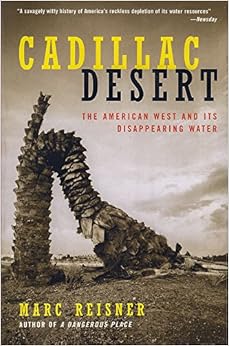
Reisner's book has been on my reading list for decades. It came highly recommended from a coworker of mine back in my retail bookstore working days. A California native, he was not a fan of Los Angeles and did his best to stir up antipathy toward its water practices. But Reisner's book isn't just about Los Angeles or California--it's about the whole of the West. It's a warning about how the prosperity of the American West is built on sand--or rather on water imported to sit over that sand. In the short run, a great civilization is built; in the long run, the sand, Reisner notes, will prevail. Civilizations built on irrigation have a limited lifespan. Eventually, dams silt up, salt deposits overcome the fields where water is deposited, reservoirs fill, fields become useless, and all returns to the desert from which it came.
Reisner's book is about more than that, however. It's also about bureaucracy, about the way government programs become self-perpetuating even after they've served out their primary useful purpose, the way that individual powerbrokers in Congress serve their constituents first before ideology. A liberal Democrat might support environmental causes in word, but if a multimillion dollar water project looks like it will help his or her district, environmental concerns become a secondary issue. A conservative Republican might hate big spending government in word, but if a multimillion dollar water project looks like it will help his or her district, suddenly big spending doesn't look so bad. A "if you vote for my project, I'll vote for yours" keeps big (and often bad) projects passing through the legislature. As a result, farmland that is too dry to be productive naturally gets close to free water and becomes superprofitable, while farmland that is naturally better suited to a given crop goes fallow because it doesn't get the same water subsidies.
The whole history of American water rights is enough to sadden anyone about the prospects of the United States ever again achieving a balanced budget, let alone passing health care legislation that makes sense or financial oversight regulation that will do what it's intended to do. Reisner exits on a positive note, explaining how attitudes toward dam building (a major focus of his book) changed in the early 1990s and offering hope that this bodes well for the country taking a more reasonable approach to water rights. Somehow, pessimist that I am, I think that reason likely won but a short respite. While cities out West may be taking a more responsible approach to water usage (though Reisner notes that it's agriculture that uses the most water), down here in Georgia, during the most recent drought, I heard word of the need for more dams--rather than the need for more restrained water usage or the creation of landscapes more befitting the natural terrain.
Subscribe to:
Posts (Atom)

 Posts
Posts


