Thursday, February 11, 2010

On "Rabbi Paul" by Bruce Chilton *

This "intellectual biography" attempts to place Paul in the context of the thinking of his day and of the education that Paul would have received. Unlike Paul between Damascus and Antioch, this one is written squarely for a mass audience. The writing is clear and easy, quite beautiful really. The author relies heavily on Pauline scholarship and on dominant Protestant views of the theology, and in that is, for me, the book's downfall. Where Chilton sees Paul as at virtual war with Peter and James over preaching to Gentiles, I see no such thing. Where Chilton sees Paul as a virtual antinomionist, ridding the world of the law, putting faith in Jesus alone at Christianity's core, I see Paul as very much a lawkeeper and one who admonishes others to keep the law (Paul's claim was not that Christ replaced the law but that he replaced the punishment one earns for disobedience to the law).

What's more, in taking the typical scholarly line of dismissing large chunks of Paul's writing as being by others and Acts as being an often inaccurate listing of the events that occurred in the early church, the author has little to draw on in terms of creating a narrative beyond his own conjecture. Giving reasons why such primary writings aren't realiable and providing reasonable conjecture as to what really occurred, however, might be acceptable if the author actually posed his writing as conjecture--that is, used the conditional mood (Paul may have done). Instead, his own conjecture is stated as fact. A particularly interesting passage, in this regard, involves Acts' claim that Paul returned after a missionary journey through Asia Minor to go through Asia Minor again. The author dismisses this as impossible and says that Paul was really in Tarsus at this time and that only Barnabus went on the return journey. Neither Paul nor Acts speaks of this trip to Tarsus, the author states, which leaves me wondering how--if no primary source recounts this trip--the author can proclaim so assuredly what Paul was actually doing. Ferreting out what is the author's own conjecture is enough if one knows the primary materials, but it makes one question what is really fact and what is conjecture where one doesn't know the primary materials. Thus the book becomes a dangerously untrustworthy text. Fine reading, but much of it may be fiction--it's just hard to tell where.

Monday, February 8, 2010

On " Another Story About Me and Some Guy" by Kathy Fish (276 words) *****

There aren't too many writers who do flash fiction well as well as Kathy Fish when she's on her game. This story has a kind of desperation to it that's put forth in a haphazard, go-with-the-flow kind of way. And that's what makes it work so well. A woman takes off with a total stranger, but only after he runs some errands. Where are they going? Um, well, read the story here, at Night Train.

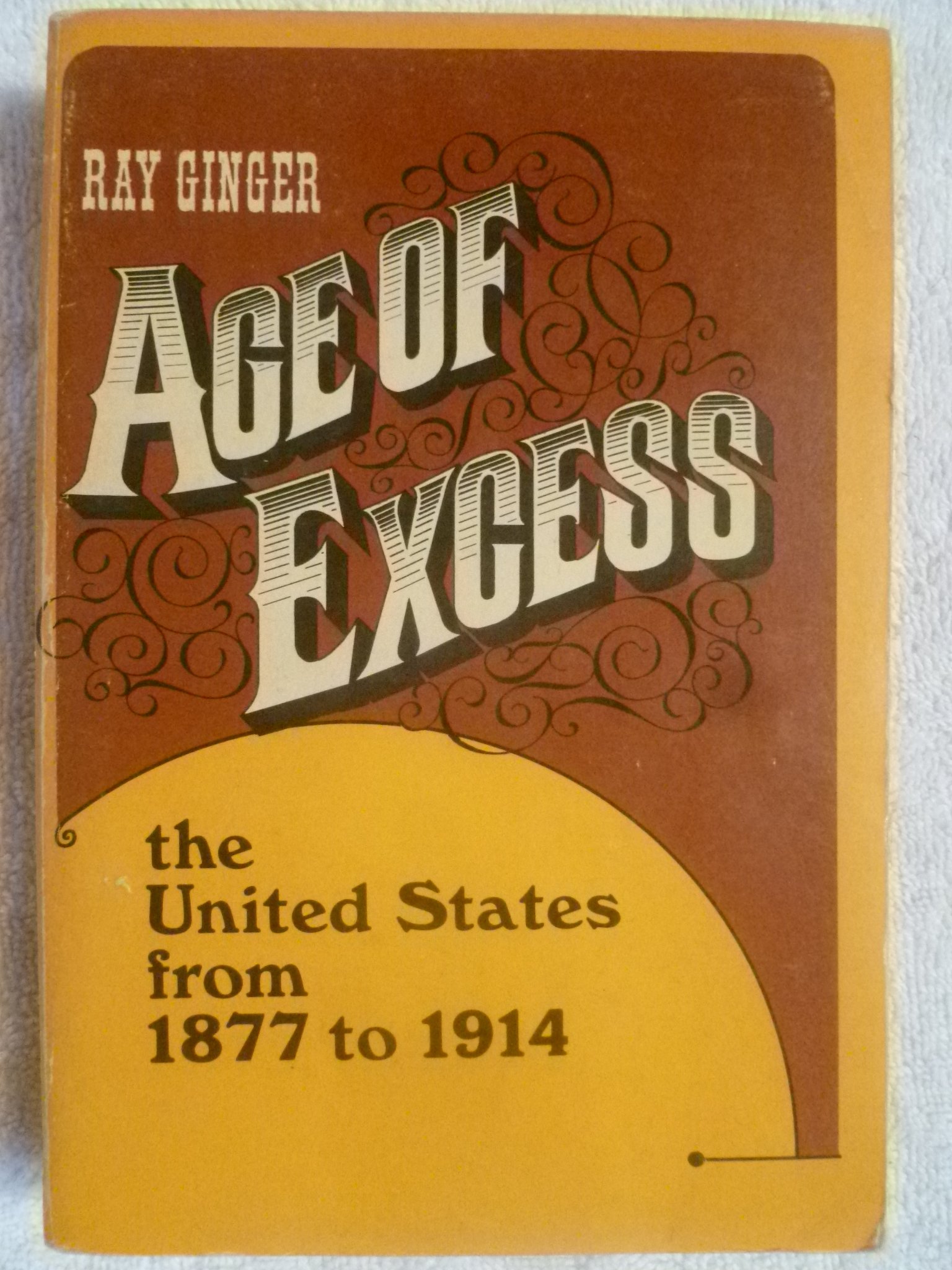
On "The Age of Excess" by Ray Ginger ***

This history of the United States from 1877 to 1914 provides a good background to the period and seemed a good start to my reading on the Gilded Age. The author presents material related to business, politics, and culture. That said, the writing itself seems a bit textbookish--that is to say, it doesn't quite leap off the page that the writing in a comparative book about the 1920s that I read a couple of years ago did. Why that's the case I'm not sure. I remember that other tome as being full of really great anecdotes, but Ginger isn't exactly sparing in anecdotes either. The end of each chapter is given over to short two-page biographies of people of the era, some minor some major. But perhaps that's just it: two pages summarizing a person's life, rather than a short explanation of some oddity in one day of that person's life.

In fact, I found myself most interested in the passages where Ginger provides short synopses of major books of the era and relates those to the historical and cultural milieu. It seems he does that very well. Passages on the politics sometimes became mind numbing in detail. Analysis of the culture in general, while interesting, sometimes seemed contradictory. In some places, he contends--or perhaps more accurately quotes people who contend--that the era was one of the hardest for the poor and laboring classes, or even for people in general. With eighty-four-hour work weeks and frequent economic collapses that would certainly seem to be the case. And as Americans moved into cities, life also grew harder because they moved around more and no longer had as many ties to community.

Or was it harder? Elsewhere, Ginger seems to contend the opposite. A move to the cities, for example, allowed people to accrue more wealth then they ever could have before. Standards of living rose. Because the population was expanding at such a rapid clip, an immigrant could easily walk into a new town and, through hard labor, leave a decade later a rich man. (As Ginger also brings out, however, something like 40 percent of immigrants found life in the United States too tough and actually returned home.)

What's plain is that history is complex, and one can read both narratives into any given period. But as a result of this kind of shoring of bets, in some ways, I feel like I didn't get the best handle on the era. Part of me would have enjoyed a simple thesis and set of evidence.

One thing that Ginger does convey quite effectively, however, is just how much corporations and big money began, during this era, to have their effect on our economy and our political system. I started this book around the time that the Supreme Court issued its ruling on the unconstitutionality of campaign finance limits, essentially turning the country's elections over to the highest bidder (not that, in a way, it really matters--moneyed interests find a way to get around any laws made anyway, so perhaps letting them spend as much as they like directly, with their name on any candidate or cause they sponsor, is ironically better). Especially in the early portion of the book, I was struck by the parallelisms to the nation's political system more than one hundred years ago, wherein the government generally took the side of big business, wherein antitrust laws meant to curb the abuses of big businesses were often turned around to fight unions and working people and to aid in the very abuses they were meant to curb, and wherein common people--many of whom felt powerless anyway--often sold their votes for a few useful dollars. Some things don't change.

Friday, February 5, 2010

On "The Trials" by Jedediah Berry (897 words) ****

Here's a story that working on all cylinders. Berry takes an obsessiveness with the Salem witch trials, two twins, model airplanes, and bullying and puts them all together, stacking them one on top of the other, circling back to each until the job is complete. Trials become a kind of motif working throughout the piece, until that final line when . . . I'm not saying. Go read it here at Fictionaut.

On "The Manual of Detection" by Jedediah Berry *****

Having read a story of Berry's online, I was drawn to read more about him and found that he had this novel. The description sounded like something I'd enjoy--and indeed, it was. Berry's Manual of Detection is unlike any mystery I've read, and also like so many other books and stories that I have read. The novel has been compared with the works of Jorge Luis Borges and Ray Bradbury, as well as Terry Gilliam. One can see the influence of all here--the interest in dreams, the strange and sinister carnival come to town, the obsession with bureacracy gone silly.

But Berry's book was, for me, fun in ways that Bradbury's carnival was not. It evokes that same sort of gothic feel that Bradbury's fantasy does, but by turning the readers to the world of dreams and adding a mind-numbing focus on red tape, the story becomes fantastically absurd and a bit funny.

Essentially Berry's book is about a clerk in a detective agency, one larger than perhaps any such agency on this planet unless it's government affiliated. As such, there are regulations guarding what the clerk can and can't do, what information he has access to, and whom he can speak with. One day, Unwin, the clerk, is promoted to detective, much to both his surprise and horror. He loves his job, and he has no desire to move on. And thus begins the mystery. He's off to find out how he got promoted and by whome, but that's no so easy in the dimly lit halls of an agency so large that no one department seems to know what another does nor have any interest in it.

Dreams become a big part of this book, for in the course of Unwin's work, he discovers a larger mystery that in many ways part of the world of dreams and that can only be solved and fixed there. Hence, we find the connection to Borges, though without quite so much of Borges's philosophically learned tone acting as an erudite barrier between the reader and the author--and the very possibility of reading the truth (or do we reach the truth?). Like much of Borges's work, however, Berry's book does lack a certain passion that at times one longs for. Unwin is a curiously devoted clerk, with no seeming life outside of the office (though perhaps that changes by the end, but not in a way wholly convincing or wholly transforming). Still, by novel's end, I did find myself sad to leave its world and its various characters, and that is always a good sign when it comes to a novel.

Tuesday, February 2, 2010

On "Rapture" by Gayle Brandeis (500 words) ***

A lot of people are going to die forever if we believe many of any one of the world's religions. Brandeis takes this terrifying idea, puts it into the mind of a kid, and makes us laugh--or at least she made me laugh. And this isn't necessarily something that's humorous. My own childhood was full of angst about just such things--the end of the world, and somehow I'm in the wrong place. I remember, in fact, as a kid being told that the world would end in ten years--that put me at about nineteen. That was absolutely terrifying to me. Why? Because the timing was the absolute worst. The church in which I was raised taught that children were under the protection of the parents; adults by contrast were on their own. Age nineteen meant that I was just outside that "parental protection" window--but also so young that I likely wouldn't have gotten baptized yet (our church didn't baptize children either). Just my luck, for the world to end while I'm in limbo land. Now, I recognize how much that kind of thinking was nonsense--I still keep the faith, but I know that self-concern is the least important thing of all and also that God is merciful. But I don't feel like I heard a lot of that as a kid. Or thought about it. Ponder Brandeis's narrator's experience here at Vestal Review.

Saturday, January 30, 2010

On "Be Your Own Boss," by Larry O. Dean, "Saturday Night Fever" by Sherman Alexie, and "We Shoplifted" by Samantha Arlotta ****

Taking a break from the stories today to highlight three poems I really like. The first, I suppose, would strike a chord with those newly laid out of work who have the opportunity to work for themselves (of course, we never really work for ourselves, since even contractors have clients). In a few deft words, Dean sums up the greatness and drawbacks of self-employment. Read the poem here at Keyhole.

Alexie's poem, on a completely different subject, uses its last line to put forth an idea I'd not heard before, but it has a ring of truth, sparks my mind working, looking at other immigrant fiction. Alexie's on to something here, in just a few words, he states what a literary critic might take three hundred pages to prove. Sometimes, just a thought is enough to make a poem. Read it here at Mudlark.

Arlotta's poem makes memory visceral in a most physical sense. It's a narrative poem, with clear characters, who manage to do some irresponsible things together, things at least one of them remembers with fondness. At least sort of. That memory thing is tricky. Read the poem here at Keyhole.

Wednesday, January 27, 2010

On "The Formula" by John Olson (1828 words) ***

Another story of a cat, a boy, and a life from the blog of the same name, this one on the longer side. I think the length, in this case, helps. While there are a lot of great things about the wide variety of publications available on the Web--the fact that people are reading during their lunch breaks again, the fact that new writers have a way to be easily and widely accessible--one of the unfortunate effects has been, from what I can tell, more and more of an emphasis on short Web-centered reading. Folks no longer have the patience for more than a paragraph or two. I find myself, when reading online, to often feel the same, wanting to rush through a long piece in a way I wouldn't feel rushed were I reading it in print. So when authors finally get a chance to take a deep breath and dig in, it's often rewarding to those readers willing to hang on.

Olson makes of the three items a mantra and sticks them into the thoughts of a what I take to be a middle-aged man struggling to get some kind of comfort out of life. To that extent, the mantra is his calming influence, even as it hints at the anxiousness within his soul. Read the story here at A Boy, a Cat, A Lifeboat.

Sunday, January 24, 2010

On "Pretend I Am There" by Blake Butler (35 pages) ****

I don't know exactly who Butler is drawing from, but similarities to disparate sources seem numerous, all put here in one single work that is totally newfangled. There's dreamlike oddity. There's sadness. There's absurdity. I'm reminded of Tao Lin. I'm reminded of the movie About Schmidt. Our narrator adopts a dog, a sick one, and tries to get rid of it. Our narrator keeps up a one-sided dialogue with a random person on e-mail. Our narrator sits, terrified of the plane he's riding in. Each section is short and to the point. Each section is beautiful in its own way. Did you know that today you are the oldest you have ever been? Of course, but I'd never really thought of it that way--until Butler's narrator brought it to my attention. Learn more obvious facts here at Publishing Genius.

Thursday, January 21, 2010

On "What Love Is Really About" by Sonya Friedman (3440 words) ***

This is a love story that relishes in love. This isn't something one sees a lot of. I'm reminded of a movie with Richard Dreyfus where he is at a racetrack, and he wins on his bet--and wins and wins. Where's the conflict one might ask? If this person lives on easy street, gets things right. But in the Dreyfus film, I'm guessing the reason folks stayed enthralled was because they were certain that at some point Dreyfus would lose, and they wanted to see what happened when he did.

The love in this story isn't so simple. Sure, the man and woman love and continue to love, but what one also sees is the cost. This isn't a case where circumstances make love seem easy, but they keep on regardless. Why read on? Perhaps because, as in the film A Beautiful Mind (not true, apparently, to the real-life story), we are fascinated by how people can stick together in such trials. Read the story here at TPQ Online.

Monday, January 18, 2010

On "Send Me Work" by Katherine Karlin (5636 words) ****

A good story puts all the elements together--character, language, setting, plot. But plots--new ones at least--are hard to come by. Sometimes, a story might be an old one, but it becomes fresh because of its singularity in regard to the first three. And that's the case here. Harriet and Izzy, the subjects of this story, come across as people we know quite a bit about by the end--and as people we sort of like. We also get to hang around New York, and we get to listen in on great lines like "The sky was a slate-colored ribbon over the avenue" and "I am big. The pictures got small." There are more, I promise. Read the story here at In Posse Review.

On "In Cold Blood" by Truman Capote *****

What's there to say of a book that one first read nearly fifteen years ago and just completed a second pass through and found pretty much just as compelling? That I haven't seen any of the recent movies--though my interest in those is now at a fever point--was probably a help insofar as I'd forgotten many of the plot details. Still, the narrative itself is one so full of feeling that it gets beyond mere plot and becomes quite a sorrowful tale. Capote has the knack of making one feel for both the victims and the perpetrators (or at least one of the perpetrators), as well as for all the families connected with either one, so that in the end one is moved not so much to call for justice or to espouse righteous indignation against the evildoers but a rather a sadness for what bad doings like these do to all of the people involved on every side. A scene at the book's very end is particularly demonstrative of this point, where we meet up again with one of the victims' best friends visiting the grave of the family killed many years later. She recounts something she and her friend were planning to do after high school, and the recounting can't help but make one tear up.

Friday, January 15, 2010

On "Chemistry" by Lauren Becker (1859 words) ***

Here's a familiar story about a woman who masks her loneliness in a multitude of ways: anonymous sex, an obsession with studying, an imaginary friend. What makes this story a little different, though, is the degree of honesty with which the narrator tells this story. It's not terribly pleasant. Read the story here at Word Riot.

Tuesday, January 12, 2010

On " Of Love: A Testimony" by John Cheever (7109 words) *****

About the same time that I first read The Stories of John Cheever, I read also his uncollected stories, a collection that came out about that time. Most of the stories were gathered from Cheever's early years, when he was trying to write in the manner of social realists. The stories weren't very good or interesting--passable, sure, but not marked by the kind of humor and pathos that his later work, set amid the suburbs of the Northeast, would achieve. Why this story didn't make it into that collection--or if it did, why I don't remember--I can't make sense of. I also don't know what Cheever left it out of his own selection. It's magnificent.

It's an old motif--the love triangle. Morgan is a young man newly arrived in the city (Boston, I believe), and through his friend Sears he meets a woman named Julia. Julia was once Sears's girlfriend, but now she is Morgan's, except Sears keeps hanging around. Someone's heart is going to get broken--and it might be yours. Read the story here at Five Chapters.

On "The Stories of John Cheever" by John Cheever *****

I first read this book about ten years ago. In those days, I'd often go to the Hulen Mall in Fort Worth, Texas, to read. Recently, sans computer, I realize why. There's an unbearable loneliness as a single person that a computer--or a television (which is one reason I've refused to have one)--fills in. Back in the Texas days, without a computer, I had no ability to correspond online and certainly very little ability to meet anyone in real life (I've always been relatively shy), so reading in public was my attempt to do something I love while perhaps opening myself up to the possibility of social interaction.
The only people I ever seemed to meet, however, were vagrants who wanted money. And such is the one memory I have attached to the first reading of Cheever's stories. A man from Germany who had come to Texas to visit Kenneth Copeland and now was sans money or place to stay sat down next to me. He needed a place to sleep. Could he pray for me? Yada, yada. I was in the middle of, I believe, "The Day the Pig Fell into the Well." And I was a bit annoyed, but being the kind of person I am, I agreed to help the man. In the end, I took him to a Motel 6; a few months later, the same guy asked me for money again--and I figured I'd likely been duped, as is so often the case with such beggars.

The unfortunate thing, however, was not being able to read "The Day the Pig Fell into the Well" in one sitting, as the story demands. It's one of Cheever's best--a story told from multiple points of view about a single incident years ago, full of sadness in the form of sentimentality, but in the best possible way.
Another story that stuck out on this read was "The Hartleys," the story of an unhappy couple everyone likes who at the end of the piece brutally loses their daughter. Favorite stories from the previous reading included "The Enormous Radio," "Torch Song," and "The Wrysons." The first still stood out on this reading; the latter two not as much. At the same time, "The Swimmer," a favorite of so many other people I know, read much better to me this time around than the first time. All of this shows in part why the collection remains one of my favorites. Thick and full of Cheever's wit, the book is sure to surprise and fascinate in new ways on each read.

Saturday, January 9, 2010

On "How to Leave" by Kerri Quinn (2810 words) ****

Good fiction is supposed to be about the details, the specifics. What's nice about this piece is that it does just the opposite--it remains vague. It's the vagueness here that makes the story so effective. Sure, there are details--don't get me wrong. But the story is vague insofar as we don't really get a keen sense of why the narrator feels the way that she does, just as we often don't have a keen sense of why we feel the way we do. We open cans of dog food for the pet. We walk in snow without a jacket. We circle random ads for things we might like to buy in the classifieds and then never follow up. We do these little things. But what do they all mean or add up to? Who knows? Read the story here at the Apple Valley Review.

On "The Stranger" by Albert Camus *****

I first read Camus' The Stranger on a Sunday evening in one sitting during my second year of collection. It's a short book--and such a thing is thus easily done. But at that time, a single sitting for a whole book struck me as rather incredible. This was likely because it was only a short while before that I had given up television, and always before, reading had had to fit in between television shows, among other things--and thus could only be an hour at most.

I've intended to reread The Stranger for years in the same manner. My computer recently malfunctioned, and sans Internet, I have had time to spare. I sat, as I did that last time, and read Camus.

It's a great reading, at least in Matthew Ward's translation, with a simple prose as dead sounding as the narrator himself. Meursault goes through life sans emotion because he has come to understand that "nothing matters" in the face of the death that we all face, especially if, as he believes, there is no God. A trial for murder, however, slowly brings Meursault back to life and to an understanding of his own recently deceased mother. In the end, The Stranger is a kind of seize-the-day novel for the modern age. Whether I saw that at age twenty, I don't know.

Wednesday, January 6, 2010

On "Kalispell" by Aaron Hellem (1160 words) ***

The nicest moments in this story comes after the first section, when the narrator goes over to a friend's house for a meal. The recount of the visit reminds me much of times when I've gone over to similar places, where families reside in seeming contentment. I, too, can't help but think, this is something I could never have, something that I'm glad just to be playing a part in as a guest for a few hours on a single day. Read the story here at Menda City Review.

On "Paul between Damascus and Antioch" by Martin Hengel and Anna Maria Schwemer **

This book attempts to identify the Apostle Paul's actions during a period largely undicussed in scripture--from his conversion to his first missionary trip. As such, it provides some key insights into places where Paul was--Arabia, Tarsus, Antioch--through its discussion of historical and geographical context. I'd have wished for more of such. Unfortunately, the authors spend much of the book conjecturing on what exactly what Paul was doing. Some conjecture is, I suppose, unavoidable, given the scant records, but the text seems full of it. I also think the authors read too much into Galatians 2, claiming a clear break between Paul and Peter for something that could also be seen as merely a corrective (if a break were the case, I highly doubt Peter would have even considered Paul's letters worthy reading and thus would have warned against them rather than state that they contained things hard to understand). The book is also quite clearly not for general readers like me but for a scholarly audience. Almost half of it is notes, and phrases in Greek without translation are common. The general thrust of the argument, that it was during the unknown period that Paul came to the understanding he shares in his letter that follow, however, is one that the authors do a good job of proving.

Sunday, January 3, 2010

On "Remember Guernica" by Kate Gale (2495 words) ****

I was lamenting the other day the lack of a real rule book when it comes to relationships, the fact that you can't really tell what's going on until it's too late, till everything has fallen apart or somehow you're involved with this person you never intended to be involved with and it's no good. If only life were a book--or a play or a movie--if you knew where the drama was, where it was going to end, or end up. These are essentially the obsessions of the kid at the heart of "Remember Guernica." But perhaps not all experiences are worth the art that comes out of them. Read the story here at Pif.