Wednesday, October 10, 2018
On "The Horror at Red Hook" by H. P. Lovecraft (8,323 words) ****
Here, detective takes to never again wanting to set foot in a certain kind of home. The story sets out to explain why, for the cause is more than the collapse and resulting psychological illness that is given as a reason. And thus we descend into a piece about a man named Robert Suydam who seems to get younger as the story proceeds, eventually marrying a young bride. How he finds this fountain of youth is the clincher on this one. Read the story here.


On “Black Klansman” by Ron Stallworth ****
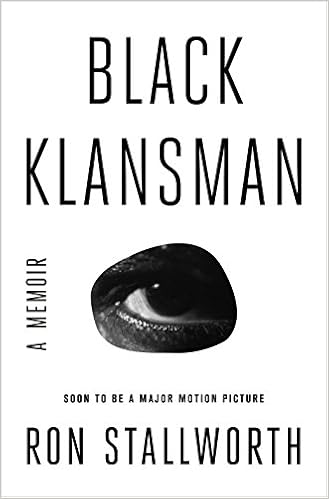
One day, reading the classifieds, he finds an ad inviting people to join the Klan. He sends in a letter denoting his interest, not expecting anything back. Surely, this is a joke. But a few weeks later, he receives a response. From that comes a telephone conversation and a meeting. For the meeting, he has to have another cop pose as himself.
From there, several cops from the Colorado Springs Police Department become involved with the Klan in an effort to keep it from taking hold in their community. The black police officer also becomes involved in investigating anti-Klan groups who have violent tendencies (similar to today's Antifa). He also forges an interesting relationship (mostly on the phone) with David Duke, the Klan's grand wizard.
The tale is one that resonates with the current state of our country in terms of the viciousness of people at both far-out ends of the political spectrum—and how that can filter down to the mainstream, as racist and violent views are “cleaned up” for regular folks. It's also a very funny book, which is a good thing, because the investigation itself seems, by the end, something much less important than the fact that a book is devoted to it might make it seem to be. The investigation prevented some local disturbances, which is important, but one doesn't get the feeling that it reveals anything astounding about these groups that we don't already know or changes anything in our country.
Monday, October 8, 2018
On "Emergency" by Denis Johnson (3569 words) *****
Georgie, the narrator's friends in this piece, is one of those characters that sticks in one's head. He's a drughead who seems only semiconscious of things going on around him but who somehow manages to make good repeatedly--not necessarily out of some sense of love or goodness, just out of sheer luck. He stands in contrast to the narrator, who tends to think of his life as falling apart, of himself as one who constantly messes things up for others. I was curious to know how Georgie would be portrayed in the film version, and I wasn't disappointed, though in some ways, that portrait now sticks in my head more than the one that was in my mind before. Georgie was a bit more subdued in my mind, whereas now he is always over the top. The story can be read here at Narrative Magazine.
On “The Kill-Off” by Jim Thompson ***
The conceit is an original one, but alas, the characters seem here prisoners to it and to the plot that Thompson has set out. As such, the book doesn't quite live up to its full potential.
Saturday, October 6, 2018
On "In the Vault" by H. P. Lovecraft (3416 words) ****
A shorter but well-done piece by Lovecraft, this one revolves around a gravedigger/mortician who builds cheap coffins and pays the price one night when he accidentally gets locked in the vault where coffins are kept as they await burial. Read the story here.
On "The Criminal" by Jim Thompson ***
The tale revolves around the rape and murder of a young woman. Each character has his or her own view as to whether the young man charged deserves to be. His parents recount how the son grew apart from the father and how he has been skipping school and how they had conflicts with the parents of the woman killed. The son describes how the event occurred, but the tale leaves off at a crucial moment, such that we as readers don't know whether the man did or did not do the killing; what we do learn, though, is that the man was seduced and the woman was not so innocent as one might think. Enter the legal system and the newspapermen. The latter want a good story to tell and thus promote a rape and murder scenario with the young man at the center. This means that though the DA may well have thought the man innocent, the legal system feels obligated to charge the teen. Nothing is about justice so much as about money and individuals' jobs and careers.
Thursday, September 20, 2018
On "And the World Was Crowded with Things That Meant Love" by Amber Sparks (604 words) ***
This tale is about long-distance lovers who exchange gifts. The lyric formulation of words is what saves this listing of presents. Read it here at Matter Press.
On "Cities of Tomorrow" by Peter Hall ***
Hall starts his account with the urban poor in Victorian England and in similar locations around the globe at the time. For him, modern urban planning essentially originates in this milieu, the idea being, How can we reform society such that the urban poor will no longer live in such squalor?
One of these early plans was the Garden City, but like most such plans, the original theory rarely made it into actual practice, and the idea got twisted out of its original intent. Also, like so many of the ideas, in part because it was never put into practice as written, the planning theory did not end up helping the poor. Rather, its benefits went mostly to the middle class and the rich. The Garden City, in theory, was to be a city--or series of cities--interspersed in gardens. Each would be of limited size, with a green belt around it. In the city, there would be moderate space for homes, and there would be businesses and work within the city itself. It's this latter portion of the idea that rarely made it into reality. Instead, such cities became suburbs, with people commuting into the big city for work. This meant such cities only helped those with enough means to afford such a commute. The urban poor remained urban.
Another idea was one much maligned by Jane Jacobs--that of Corbusier. He had the concept of towers in parks. Again, his idea was thrown a bit out of context. When applied to the urban poor, such towers did not create wonderful communities. But, Hall notes, such towers could and did work for those of higher class.
Then there were the nonplanners, the anarchists, who essentially denoted that cities should grow on their own and that planners should work around that. Had I taken notes during my reading I could have likely explained this section better, as well as the sections previously. I will probably need to read the entire book over at some point.
Hall eventually turns his attention to the split between academic planners and those who practice, a split that made its way more felt in the second half of the twentieth century and that showed how academics had become uninvolved in how cities really work. In this same timeframe, there were more private-public partnerships, and some cities actually saw renewal, but again, the solutions led mostly to gentrification rather than actually helping the urban poor. In other words, the poor, rather than being raised up, were simply pushed out.
A final chapter focuses on poverty and racism. As Hall rightly notes, the middle class did grow from the time of the Victorians to the present such that some issues are less troublesome than they were one hundred years ago. He is also an advocate, it seems, based on the research he cites, for the death of family being a large cause for the fall into or continuing life in poverty, more so than race (though the history of racism certainly plays a role in where people fall in terms of class). Urban planning, it seems, while intended to aid in resolving these issues has ultimately not been able to solve the problem.
Sunday, August 26, 2018
On "Macadam" by Lucia Berlin (148 words) ***
This is Berlin doing poetry essentially. The focus of this story is the sound of words--or rather, one word. Read the story here at Biblioklept.
On "Walden" by Henry David Thoreau ***
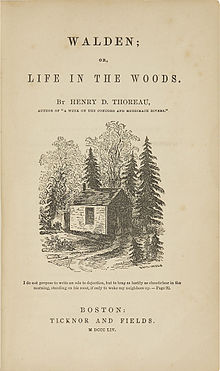
Also, there was an amazing NPR piece on Walden. That was really what made me take note--the radio piece made this book sound amazing. I figured, Why not? So I checked it out.
Some things the radio piece did: It quoted from the book--and those quotes were amazing (remember, short bursts). Also, it talked about how there's a subtext about the underground railroad, which Thoreau's family was involved in--indeed, there were a couple of mentions I spotted.
There's also the idea, according to the radio show, that this book is not about isolation and solitude, as most people assume, but about going into civilization. The radio person made this claim because Thoreau doesn't leave permanently--this is just one stop on life's journey. Of course, he's not really isolated at Walden either; it wasn't that far from town, and he talks about his neighbors and others who come to the pond.
For me, the book was more about simplifying one's life. The first chapter and the conclusion are the pieces that really drive that point home, and those were, for me, the most interesting parts of the book. Once Thoreau gets involved with describing the nature around him, it was a snooze fest for me. But his material on economy gave me much to consider. In a way, that was my life really up until marriage, although I probably did get myself too caught up in doing too many things rather than just enjoying the present. Still, in many ways, I was one to say, I don't need that or this, and I often didn't go out and purchase gizmos everyone else wants. Even furniture was minimal. Now, married, I don't have as much choice in regard to what to keep and what to get rid of; there's others whose desires and needs have to be accounted for, and their idea of simplifying (if indeed they even want to--kids tend to want more toys not fewer) is something different from my own.
Thursday, August 16, 2018
On "Holy Ground" by Jamie Quatro (about 6400 words) ***
In “Holy Ground” a woman decides to literally run away. She's been having an affair of sorts (on the phone) and feels a need somehow to make good. Her husband and kids stay home. She runs to a poorer area down the hill, in another town, where she hopes to live for a week, getting a sense of how others live and helping them. Instead, she finds herself helped of a sort. Read the story here.
On "Brushing Back Jim Crow" by Bruce Adelson ***
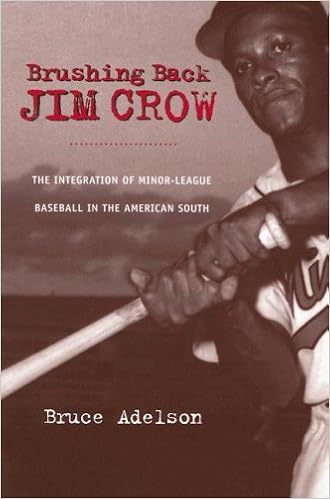
The book begins with an anecdote about a young man whose intention was to continue on to college but who was drafted by a baseball team. He didn't really want to play, but his dad urged him to, because that had been the father's dream. For most African Americans, until the 1950s, playing baseball professionally was just that--a dream--unless of course one played for the Negro Leagues. This was an opportunity, the dad brought out, to do something great for a people. The son chose baseball. The anecdote, as written, held for me an emotional wallop.
Alas, in one of the major issues for this book, the anecdote is repeated in the very next chapter, word for word (though in slightly greater detail insofar as it is enlongated at its start and end). Other anecdotes and quotes are repeated elsewhere in the book. And there is no index, so tracking down a minor character's identity is difficult; described first in some early chapter, the character is not reintroduced in a late chapter where he shows up again, and so one is left with a gnawing wish to remember who this guy is or was.
But the tales themselves are incredibly interesting. Adelson spends time in different leagues during the course of the 1950s, covering events year by year, and connecting them to large events in the civil rights movement. Often, rather than writing about the events, he lets quotes from newspapers or from interviews with baseball stars stand in for narrative, giving one a sense of the times.
In brief, some of the rather amazing things that happened included the following: A given minor league team might integrate by adding one or two black players. That team then reaped the benefits of larger attendance from black patrons, at a time when attendance numbers were otherwise sagging. But other teams in a league often disagreed with such actions, and so various things might happen to stop the integration from fully occurring. State and local governments might ban interracial game and sporting events, or the league leadership itself might step in to enforce segregation. As a result, black players from another team had to be left behind or the team might have to forfeit (ironically to the team that refused to play because of the inclusion of a black player). Just as segregated buses were boycotted in some cities during the civil rights movement, so too African Americans often ended up boycotting games by those teams that refused to integrate, which increased the attendance problem and the declining revenue. In some cases, leagues or teams ended up going out of business because of their stubborness. Some northern teams simply stopped coming South to play sports (most notably, in college football, but also exhibition baseball games with major league teams).
But even if a black player was allowed to take the field, there were other issues. There wasn't just the name calling, which often spurred such athletes on. There was the fact that seating was often segregated so that African Americans were relegated to lousy outfield seats and often not enough--this last factor sometimes led to expanded black and eventually integrated seating. There was the fact that black players might take the field with their white counterparts, but after the game, they'd have to go stay at someone's house. They couldn't go to the hotel with the team, couldn't eat at the same restaurants as the team, couldn't essentially do anything with the team itself out in public. It was a lonely and tough life, a mirror of what Robinson endured but sometimes in spades insofar as this was the South, where jim crow reigned.
I never thought much, when I was younger, about what some players had endured just a decade or so before my birth, men like Billy Williams or Hank Aaron, who played minor league ball in the South and who were old and about-to-retire stars or new coaches when I was a kid. I thought of them as great ballplayers, but their early careers were in fact civil rights-type actions, given the prejudice they had to endure. As Adelson shows, baseball was in some ways the first line of integration. As segregation fell here, it would fall elsewhere in entertainment, at schools, and in public transportation.
Saturday, August 4, 2018
On "La Vie en Rose" by Lucia Berlin (12 minutes) ***
"La Vie en Rose" revolves around two girls on a visit in Europe who are swept up by two young dashing soldiers and are summarily dealt with by their strict father. It's a story about youth--youthful daring and folly--more than about anything sinister or hateful, rebellious or oppressive. Listen to the story here at Soundcloud.
On "The Monkey Wrench Gang" by Edward Abbey ****

And so finally, I've read Abbey's classic, and I can see the appeal to young idealistic Alex. Oh, to be young again.
As I read the book now, the four central characters, conspirers to prevent the destruction of the West through nearly any means necessary (save killing people), come across as essentially terrorists. They do not, for most of the book, seem like heros very much. And they are hypocrites, littering their way across the same landscape they profess to be saving by destroying bridges and wreaking havoc on new construction. For most of the book, I did not have much sympathy for them.
But credit Abbey with somehow making the characters get into you enough that by the end you are cheering for them, hoping they get away with all their bad deeds, even if you don't agree with them. You come to like them in some odd and twisted way. Perhaps, that's because most of the squares come across as unsympathetic foes. (I also credit Abbey with making much of the writing itself absolutely beautiful.)
Still, I do end up wondering where Abbey's real feelings lie. In creating characters who are not entirely good and in naming one of the "squares" after himself, one gets the feeling that while Abbey might sympathize with the views of his four main characters, he does not entirely approve of their means. The character named after himself is a ranger who comes across them and lets them go--the first time--and then who catches one of them the second. Maybe there's hope in a more conservative approach to conservation.
Friday, July 20, 2018
On "Things You Should Know about Cassandra Dee" by Amber Sparks (1801 words) ****
This story starts promisingly. It's about a girl who is ugly, really ugly. She dreams of other people's deaths--the future. And she dreams her own. But what she really dreams of is being pretty, if only for a moment. Read the story here at Atticus Review.
On "What Is Gnosticism?" by Karen L. King ****
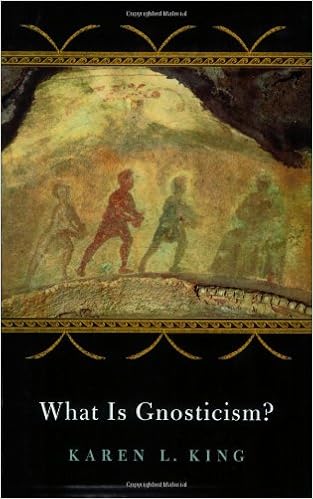
Gnosticism, in its earliest variety, was simply heresy. If something did not fit into what became Christian orthodoxy, early writers termed it gnostic--or more often heretical (because the gnostic term itself didn't really come to be until the Middle Ages, and even then, regular usage only really comes into being much later).
Attempts to define and determine the origins of gnosticism begin to make some real headway under Adolf von Harnack, who tied it to the hellenization of Judaism and Christianity. The History of Religions school said, not quite, finding ways to tie it to ancient Eastern philosophies (in, for example, Iran). Still other scholars tied it into pre-Christian Jewish ideas. In general, it would be easiest just to say that gnosticism is syncretic.
But this still begs the question of what gnosticism is. King spends the rest of the book looking at various definitions and then also at primary documents from the gnostics themselves. One trick with regard to discussing gnosticism has been that has largely been defined by its enemies. But when we look at so-called gnostic documents, suddenly there is not as much unity of belief, and "heresies" are not the same across the board. One could easily point to various origins or create various definitions depending on the document examined. For this reason, the term gnosticism may better be simply jettisoned. As King notes, early Christian teachings were in flux, and one can't really say that there was a uniform alternative.
Thursday, June 21, 2018
On "Teenage Punk" by Lucia Berlin (611 words) ***
This short piece centers on one of Berlin's recurring characters--Carlotta, a woman who drinks and drugs her way through much of life and whose several marriages are a testimony to her care-free life style. One of her great loves is this, Jesse, the drugged-out friend of one of her sons. Read the story here.
On "Paganism in the Roman Empire" by Ramsay MacMullen ***
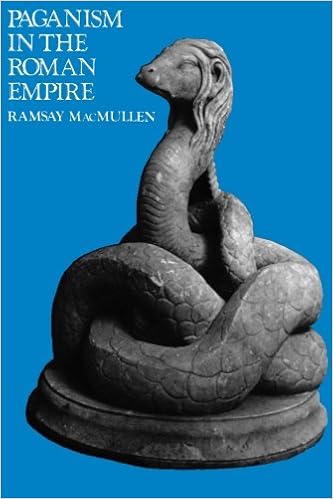
Pagan religions were part of daily life. They were the means by which social functions happened. The poor, without recourse to large homes in which to host parties, hosted them in temple dining rooms. Festivals, put on by supporters of a particular god, invited people to come celebrate with them--there were parades and other fun activities.
Particular gods became popular, it appears, largely through sponsorship of rich patrons or government officials. They could change with the change of the local legate. People's personal gods--the local gods, the ones of each conquered nation--had more sticking power in the local area. And it, was more than trade or military service, largely slavery that accounted for the spread of a god in new locales, as slave families adhered to the ancient customs.
The rich and educated may have paid for and advocated a particular god. Philosophy may have leaned more and more on the idea of one god--or more properly, the superiority of one god, of which all the gods were manifestations. But the common people remained largely unmoved by such ideas.
As such, there wasn't a lot of missionizing in the sense that we would account for in religious conversion today. The most dominant argument for a deity was generally based around miracles--healings and the like. This was likely the appeal of Christianity, along with the martyrdoms to Christians endured, which were a kind of wonder in themselves.
Gods gained and lost popularity. At the time that Constantine came to power, the Sun was in the ascendant. But had he not converted to Christianity, the process of various other pagan gods gaining popularity for a time would have continued.
If this summary seems somewhat disjointed, that is probably partly because MacMullen's text at times seems this way. There is a clear organization underneath that flows along easily as one reads, but when one goes back to outline the thoughts included, it is a bit difficult, so fluid is the discussion.
Monday, June 11, 2018
On "Personal Foundations of Self-Forming through Auto-Identifications with Otherness" by Nelly Reifler (3041 words) ***
This story discusses philosophical ideas about identity in the form a squirrel who thinks she's a rat, which made me wonder whether I've ever enjoyed a work before written from the point of view of an animal. Read the story here at Barcelona Review.
On "Cynics, Paul, and the Pauline Churches" by F. Gerald Downing ***
Methinks Downing overplays his hand here a bit, often repeating the same few facts about Paul that he says show he would have been taking for a Cynic: his state of dress, his public preaching, his scars. Downing says he is not claiming that Paul was a Cynic, but he comes very near to saying so, though he also denotes the Paul pulls back from such ideas in his later letters, as his readers claim too much freedom in misinterpreting his Cynical points. Hence, in Galatians Paul can deny the law. The Thessalonians take Cynic freedom to mean they can give up working; the Corinthians take it to mean they can engage in wanton sexual practices. Paul corrects them, and then by the time he writes Romans and Philippians, he focuses more on Stoic ideas.
Downing does draw out some differences between Cynics and Stoics that are useful. The former tend to act on their "virtue," while the latter tend to internalize it. It's okay to be poor or wealthy, the Stoics would believe, so long as one is happy in the former as well as in the latter; the Cynics, by contrast, would actually do something like make themselves poor.
He also shows that there were different types of Cynics. Not all of them were, or looked like, beggars; not all of them lacked for tact--some were gentle. This ability to metamorphose gives Downing the space to lay claim to the existence of Christian Cynicism. So what if they don't appear the stereotypical Cynic? Cynicism came in many varieties.
The basic outline of Downing's argument is this: Paul would have been taken as a Cynic by the Greco-Roman Gentiles, based on his actions and sayings. Paul likely would have known that he was being taken as such. Paul likely did so deliberately. Gentiles likely responded to him as a Cynic. Because Paul did these things with the blessing of Jesus's apostles, the rest of the Christian movement was likely Cynic in some form also.
While I can't bring myself to think of Christianity as a Jewish Cynicism movement, Downing does make a good argument for how some aspects of the Christian movement may have been perceived, at least superficially, as Cynicism in the early going among some people.
Subscribe to:
Posts (Atom)

 Posts
Posts


