Friday, February 27, 2009
On "The Tourists" by Rebecca Epstein (1220 words) ****
Take a moment of wonder, or of celebration, or maybe of horror. Throw some things down on the patio, on the sidewalk, on the places where you step. Epstein's "Tourists" does just that, leaving us to ponder what exactly is happening. Are we in the midst of a parade or the midst of a shakedown, buildings tumbling? There aren't many places to go with this piece once what happens begins to descend into the hell we feared, but Epstein manages to take us exactly where we need to go--into our surprising selves. Read the story here at Convergence.


On "Then We Came to the End" by Joshua Ferris *****

Sunday, February 22, 2009
On "Pretty Parts" by Hannah Pittard (1464 words) ***
My sister has this one weird thumb. It's normal length, but it looks like a dwarf thumb in some way. I'm not sure exactly why. Perhaps the last segment, following the knuckle, is shorter than usual. That would be my bet. But I haven't seen my sister's thumbs in years. I don't even know whether the odd thumb is on the right or left hand. Still, this is what you do when you are growing up together. You compare thumbs.
Or maybe, when you're a teenager, you compare a whole lot more than that. Suddenly, your body going all wonky on you, you look at yourself amid others and think, am I normal? Am I developing as the guys or girls around me are? Others heighten your concern. They make fun of your ears or your hair. (I remember, years later, someone seeing a picture of me from when high school saying I was really cute. I didn't think of myself as that in high school--and still wouldn't. But I wonder if it was all those others, talking me down, that in part affected the image I had of me back then. Or maybe I just look good in pictures, as some have noted.)
Take any given moment, and our own perception of our looks can vary. I can be quite nice looking one day and a too-quickly-aging man the next. Thin or fat but on the scale still the same weight. Perhaps we like to have someone there to tell us, give us perspective, on who we really are--or rather, what our bodies really are. And that's the essence of Hannah Pittard's story.
Start not with a sister but with a man and a woman of dubious relation--strangers perhaps, or girl/boyfriend playing strangers? Take off their clothes. Expose them to each other. Evaluate. Read about the two of them here at Narrative Magazine. (Log-in required--but it's free!)
Or maybe, when you're a teenager, you compare a whole lot more than that. Suddenly, your body going all wonky on you, you look at yourself amid others and think, am I normal? Am I developing as the guys or girls around me are? Others heighten your concern. They make fun of your ears or your hair. (I remember, years later, someone seeing a picture of me from when high school saying I was really cute. I didn't think of myself as that in high school--and still wouldn't. But I wonder if it was all those others, talking me down, that in part affected the image I had of me back then. Or maybe I just look good in pictures, as some have noted.)
Take any given moment, and our own perception of our looks can vary. I can be quite nice looking one day and a too-quickly-aging man the next. Thin or fat but on the scale still the same weight. Perhaps we like to have someone there to tell us, give us perspective, on who we really are--or rather, what our bodies really are. And that's the essence of Hannah Pittard's story.
Start not with a sister but with a man and a woman of dubious relation--strangers perhaps, or girl/boyfriend playing strangers? Take off their clothes. Expose them to each other. Evaluate. Read about the two of them here at Narrative Magazine. (Log-in required--but it's free!)
Wednesday, February 18, 2009
On "Rocky Point" by Rita Kasperek (2668 words) ***
There's something about estranged sibling stories that often appeals to me. Perhaps it's the idea of closeness and intimacy that has been turned off. It's like a love affair gone bad--it is a love affair gone bad--but without the romance the idea of one-time romance. There's just love, just family. It's nice to see stories where doomed romance, so often the heart of fiction, is not the theme. In this story and sister and her brother go on his first ever vacation, across the border, and discover, well, nothing--except that they will never rekindle the closeness they once had as a family. Read the story here at Big Ugly Review.
On "The Man Back There and Other Stories" by David Crouse ****
Crouse writes dark stories. These particular stories are set around the lives of lonely men. My favorites--there are quite a few--would be "Show & Tell" (the tale of a toy thief), "What We Own" (about a young man who tries to commit suicide), and "Torture Me" (about a man whose porn tape his wife finds). But the piece I like most is "The Forgotten Kingdom." This story, about man working in an office at the tail end of a set of going-out-of business layoffs, captures so much so well--the surreal, sad environment in such an office building; the longing one sometimes feels for one's past, even though one doesn't really want to return to the past; and the desire just to talk--to anyone. "The Forgotten Kingdom" is a forgotten video game, one through which the narrator bonds with another lonely soul. This story, more than any other in the collection, struck me with its presentation of men alone and wanting. (If only a David Crouse story were online, I'd feature it--he's a wonderful writer, and I look forward to his next collection.)
Saturday, February 14, 2009
On "The Accident" by Allan Reeder (4371 words) *****
Perhaps because of its name, I've always thought of Memorious as a literary journal devoted to memory, and since so many stories revolve around memory, that leaves quite a bit of room in which to negotiate. Allan Reeder's story within that journal, however, seems one of the pieces most tied in thematically to the journal's name. What I like about the story, in particular, is the narrative voice. I'm not exactly clear who the "you" is or what "stories" he refers to when referencing previous events that of course "you" would know, but this easy familiarity lends a certain personal connection that would otherwise be missing. The story also makes reference to various newspaper articles, as if this were some kind of research project. And it makes reference to various character's thoughts. Rarely has the omniscient point of view been so well done. Read the story here at Memorious.
On "Legacy of Ashes" by Tim Weiner ****
What I mean by myopic is that the author puts the CIA's problems are front and center here and interprets all of the CIA's history through that lens. Certainly, the CIA has had its problems, but even its "successes" here are reinterpreted as failures or simply skimmed over. Certainly, some of the "successes," such as removing the democratically elected ruler of Iran (who the U.S. government thought too closely tied to communists) to reinstall the shah, have come back to bite the United States in some very inconvenient ways. And certainly the CIA has missed some very key events. But where it has managed to do things "right," such as helping to dismantle weapons programs in Pakistan and Libya or feeding disinformation for years to the Soviet Union, the author brushes past with simply a mention. The author points to other nations being much better at covert action, but his claims are never substantiated (indeed, such substantiation would be beyond the scope of this book, lest it grow to twice its size). But just how easy is it to spy, to tell the future, to subvert another nation's government? I don't think these are things any nation seems particularly good at, let alone the CIA.
Because of this singular focus on the CIA's failings, I'm left with a lot of questions--for example, about the CIA's role in the run-up to the latest war in Iraq. The author notes how the CIA fed very misleading information to the Bush administration about Iraq's weapons capabilities. If the reports were as alarming as the author makes them sound, no wonder President Bush took the nation to war. But mention of how the administration itself insisted on including certain information in media press releases and the like that the CIA had in fact debunked (or debunked soon after such things were made public) isn't included. The author mostly takes the Bush administration line and blames the fiasco of the war almost completely on CIA misinformation, ignoring that much of that blame was assigned after George Tenet was removed. My impression at the time--subsequently reinforced by Ron Suskind's The One Percent Doctrine--was that Tenet and the agency were made to take the fall for things it had never done. The fact that none of the information in Suskind's book, some of which Weiner would have had access to, even made it into this book makes me question how much I have been mislead--either by Suskind or by Weiner or by both. With hatchets to bury, as each of these authors had, it's hard to get a straight story.
But these things aside, Weiner has written a really compelling book, one that makes me cringe. I cringe because of the things the U.S. government has done in the name of national security, democracy, freedom, or whatever. I cringe because here is an agency built on lies, built on deceit, built on doing things in the shadows--illegal things, including (how typically hypocritical of our nation) terrorism. How does a president visit a foreign leader and then order an agency to assassinate him? How can a country that supposedly values freedom do all in its power to remove governments elected by their own people that it doesn't like and replace them with repressive regimes? How can humans be so cold to one another? Perhaps, the answer is in a statement by as one person interviewed in the book: once one pushes a button to detonate a bomb in a war, how different is it to assassinate someone in a covert war? After all, it's all just killing. And I suppose that's why this whole world is in the kind of state that it is in. God help us all before we destroy everything that lives on this planet.
Friday, February 13, 2009
On "An Odd-Looking Catfish" by B. J. Hollars (2083 words) ***
Another odd and fantastic (in more ways than one) story by B. J. Hollars. This one involves a man who finds his daughter after ten years, finds her while fishing one day, inside a boot. Like the best stories of fantastic realism, the weird tale is told as if totally plausible and the weird situation itself becomes a kind of analogy for a lot of what's going on in the story--the loss that the father feels and the inability to understand someone who has changed, who is no longer that person, that friend or kid, you used to know (a loss of a different sort but loss nonetheless). Read the story here at the Summerset Review.
Monday, February 9, 2009
On "Toggling the Switch" by Alicia Gifford (3080 words) ***
So many stories depend on a horrible incident. So many others depend on some sort of infidelity. Gifford does a grand job here of merging the two. I love how the incident comes out of nowhere. We think we're getting one story and end up with another. And then the first story comes back, in what now seems rather unimportant. Nothing like something else to put things in perspective. Read the story here at Narrative Magazine (log-in required--but it's free!).
Thursday, February 5, 2009
On "The View from Union Square" by Mika Taylor (2122 words) *****
Here's a story I love, in part because it does something different, something I've not seen before. That seems rare these days. Taylor set out to write a story from one hundred points of view, and came close. The setting seems mostly appropriate--a park, a man discovered dead. Such could, theoretically, gather a crowd (these days, though, I think most people would simply go on about their business--and in fact, many of those nearly one hundred people do). As the story started, I was left wondering if Taylor could pull this off, if there could be a story here, and if there could be any sort of ending that would manage to tie all things together. The answer, as I found out, is yes. Read the story here at Diagram.
Sunday, February 1, 2009
On "Sketch of a Relationship" by Yuvi Zalkow (2637 words) ***
Here's a nice one about about a relationship, an all too familiar one--the doubts early on, the doubts in the middle, the doubts that will never stop for as long as the relationship lasts. Why do we ever even bother loving or falling in love when all that results seems to be a lot of questioning of the other person's motives, of our own value as a human being? Zalkow shows us "scenes" from this relationship, little glimpses into it, by pulling out random days over the course of a year. The form works well for its subject matter. And the "sketch" part, it ends up working on more than one level. If I were discussing this story, that's probably where I'd begin, what I'd think about most, the meaning of a sketch and how this piece fills that meaning. Read the story here at Storyglossia.
On "I Dream of Microwaves" by Imad Rahman ****
Because I was coming to Rahman's work blind, I didn't know what I was in for. I knew he was Pakistani American, and I knew that these were short stories. I didn't know that all eight stories were linked, building on one another in a way that didn't seem repetitive, that seemed more of a whole than some other linked collections I've read, yet not trying to foist itself off as a badly paced novel either (i.e., each story really does read as a story on its own).
Rahman's central protagonist is a largely unsuccessful Pakistani American actor, whose most famous work involves roles as criminals in reenactments on America's Most Wanted. Don't look for prose that's somber and dredgelike here, though. Rahman's writing is vibrant, full of life, crazy, absurd. I see the influence of Padgett Powell (with whom I believe he studied, based on his acknowledgments) and by extension of Joseph Heller. Rahman is part of that absurdist school. Such writing at times can grate on me, for I generally prefer more realistic work, dialogue that isn't so clever (in one story, all of a particular character's lines are taken from movies), but when it's done well, as it often is here, and as Heller does best in Catch-22, such writing can make one want to step out into the day and join the birds in song.
The absurdity works well for Rahman in part because of what he seems to be aiming to present, which is a breakdown of what identity is, of who we are really. The actor, the man who perennielly poses as someone else for a living, is what underneath? And what, by extension, is this thing we call an American citizen? Kareem Abdul Jabbar, the narrator of Rahman's stories, is mistaken at various times for a Mexican or for the criminals he plays--and is typically rejected as "inauthentic" when he's asked to play transcendentalist-type Asians (and indeed, he may be Asian, but by no means is he transcendental). I do question Abdul's continuing ability to gain women--and lose them--with such ease; the constant focus on sex (or lack thereof) comes to seem a bit like machismo one sees in some less elegant Hispanic American writing (one story, where the sex is turned on its head, that works fairly successfully involves Abdul's renting out his ex-girlfriend's house to local porn artists).
Although I really enjoyed "Here Come the Dog People," a story about Abdul's in-between-gigs job as a dog walker, the story I liked most is "Call Me Manny" It comes near the end of the book and also seems to me the least gimmicky. It's a post-9/11 story in which Abdul, on the outs with a girl, ends up tag-teamed with a couple of down-and-outs, bored with their life, who are intent on finding Arab terrorists in Florida. Abdul poses as a Mexican actor who poses as an Arab in order to expose criminal elements in his new place of employment. Every stereotype is played up in this story and turned around in such a way that you can't help but feel a little sorry for all these people who have nothing better to do than stare at each other through the lens of popular television.
Saturday, January 31, 2009
On "Going Away Shoes" by Jill McCorkle (7103 words) ***
I've known of Jill McCorkle for years, but this is the first time I've ever managed to get around to reading something of hers. Here is a polished and professional writer if there ever is one. I love how McCorkle weaves this story around a few key phrases ("pull it"), around soap operas, around family and race. But most of all what I like about this story is how we get a portrait of a woman trapped by duty and obligation. The pacing of this story is sometimes slow, like those summer days when I was a kid at home, watching my own mom clean or wash clothes, while my sister and I sat around watching television game shows, or worse, soap operas, just waiting for the day to end, for something more interesting to come along--I imagine Debby Tyson, this story's main character, would understand. Read the story here at Blackbird.
On "Life on the Hyphen" by Gustavo Perez Firmat ****
At its strongest, the book gives readers a view of some prominent people in the Cuban American world. The chapters on Desi Arnez, Gloria Estefan, and Oscar Hijuelos are the most interesting to me, perhaps because these are the people with whom I'm the most familiar. Getting more background about their lives and art, in addition to a thorough analysis of what that art says about the one-and-a-half generation that is much of Perez Firmat's focus--those born in Cuba but who grow up in the United States. This is literary criticism and this is, at times, written university professor speak, so it's not quick reading, but it's enjoyable nonetheless.
Thursday, January 29, 2009
On "Accidents" by Brock Clarke (4270 words) ****
Here's a story from Brock Clarke's first collection What We Won't Do. It's a story very similar to "The Fat," which is also featured in that collection. While I like that story more, it is no longer available online. However, that's just a reason to go out and buy the book, if you haven't already, especially if you like "Accidents." Both stories involve a journalist in a small town and his editor and a marriage gone bad. What's interesting to me, about "Accidents," is to see how Clarke takes essentially the same situation and writes something distinctly different from that other piece. Read the story here at the Mississippi Review.
Sunday, January 25, 2009
On "Blueberries" by Scott Bowen (4694 words) ***
Luckily I've never had the experience of vomiting while on a date. That alone seems worthy of a story. And the story of such an experience is yet to be written, because this story ends up being so much more than the simple awkwardness that would result from such an occasion. Early on, I found myself at times frustrated at the seemingly inhuman actions of the story's characters, and then--and then it begins to make sense. This is a story about insanity, about memory, about slowly losing one's mind, written from the point of view of the one losing it. Interesting reading here at Prick of the Spindle.
On "Panama Fever" by Matthew Parker ***
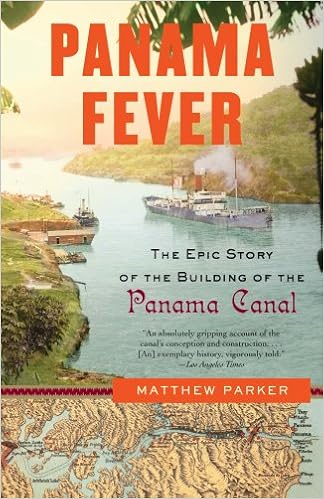
Enter the Americans. Sure, the French man who pushed the project ended up in jail and got nothing out of the canal, but some other French cronies would work up a deal whereby they would sell the canal to the American nation and thus recoup their losses (meanwhile, most of the original small-time investors were shut out). Never mind that the Americans for years had favored a canal through Nicaragua--these French executives would lobby hard and eventually win.
One major problem would be the nation of Colombia, which Roosevelt would take care of by helping the Panamanians, who never had been totally happy as part of Colombia, to rebel and set up their own nation, and then, who he would subsequently betray by hastily signing--with a French man representing Panama during its transition to its new government--a treaty that essentially divested Panama of control of the canal and the zone around it. After Roosevelt defended his actions to Congress, one congressman said congently, "You have shown that you were accused of seduction and you have conclusively proved that you were guilty of rape." Ten years of building the canal would subsequently consist of employing black Caribbeans at next-to-nothing wages to dig the huge trench while white American overseers worked higher-wage supervisory jobs, no matter the degree of experience of either. The canal, on this level, simply leaves me disgusted. A great and useful feat, to be sure--but can ends ever justify means?
As a book, Parker's portrait is a great summary of the events and a well-told story, though it left me a bit cold. I'm not sure why. Perhaps, it is my disgust with much of what happened. Perhaps also, even given its great attention to the little guys doing the work, I didn't feel like I got a deep sense of the personal psychology behind some of the big actors or of the regular folks themselves. Hard to say why I felt this way; still, I would definitely recommend it to someone looking for a basic history of the canal's building.
Thursday, January 22, 2009
On "The Cut-Glass Bowl" by F. Scott Fitzgerald (7400 words) *****
Here's my favorite story from Fitzgerald's Flappers and Philosophers. I've always been curious why a story like "The Offshore Pirate," which I consider pretty ridiculous (i.e., silly, in a bad way), get anthologized so often while this one is ignored. It may not have the easily identifiable characters, types, time, and plot that a classic like "Bernice Bobs Her Hair" has, but what it has is something beyond that. I love how the bowl in this story, a wedding gift, becomes an character in and of itself, taking on an almost malevolent will of its own. And I love how, through the bowl, we get a summary of this couple's entire life together. Read the story here.
On "Present at a Hanging and Other Ghost Stories" by Ambrose Bierce (17,528 words) ****

One of my two favorites in this book is "A Man with Two Lives," the story of a man who is killed and returns to the dumbfoundment of those around him. The story has a surreal quality about it insofar as it's not really a ghost story but a story of a person who somehow manages to return to life. The other is "At Old Man Eckert’s," the story of three friends who agree to visit a haunted house--one of them doesn't make it. It's ending words are particularly creepy. All of the stories are short, easily read in five-minute bathroom sittings. You can grab a copy here at Project Gutenberg or even download the audio version here--it's quite well read.
Sunday, January 18, 2009
On "Love So Divine" by R. G. McCartney (1262 words) ***
Benumbed prose. A story told in a rather sterile voice. An odd technique, one might think, for a love story. But that's exactly what this is--and the tone is wholly suited to what unfolds. I love how McCartney has taken an easily oversentimentalized event and, through the choice of exotic location juxtaposed with the matter-of-fact prose, made it into something readers can wholly understand and without any of that sentimentality. Read the story here at Big Ugly Review.
Subscribe to:
Posts (Atom)

 Posts
Posts


