Sunday, March 29, 2009
On "The Geometry of Closets" by Marko Fong (2014 words) ***
This story doesn't quite break my heart, but it does provide an interesting glimpse into lives of three supposed misfits. It's a love triangle of a different sort, where the best friend is left to figure out--or simply let be--what appears to be happening, where the best friend is slowly being pushed away by an emerging couple. Or is that just my reading? I've never been to brilliant at figuring out the obvious either, though like the narrator, I often suspect. (I take as an example a time when the sister-in-law of a friend of mine joined a few friends and I at a bar. I kept talking on as if things were just like usual, but brother-in-law suddenly had to leave. One of my friends noted, then, couldn't you see she was crying? Alas, no, I hadn't noticed, so caught up in whatever world I was in. An emotional emergency arises, and I just keep blathering on. I don't know exactly what Asperger's is, but sometimes I feel like I have it. Or maybe I'm just a guy.) Read the story here at Summerset Review.


On "Catch-22" by Joseph Heller *****

Wednesday, March 25, 2009
On "Animal Control" by Jon Pineda (3291 words) ***
Here's a piece that does a good job of using its title to full effect. I like how "animal control" reflects not just on the narrator's job but on all the various passions that are running away in this story and all the people trying to catch them and put them back into a box. Pineda's story isn't going to warm your heart--and I don't think it's intended to. Read the story here at Blackbird.
Saturday, March 21, 2009
On "Company" by Claudia Smith (310 words) ****
A good piece of flash fiction packs so much into its words that you're left wondering exactly what happened, exactly how it made you laugh or jump or cry. This piece's wallop occurs in the last line, hinting at something deeper than you might imagine this story is at first directed toward, something that made me tingle a little bit in a bad way--good stuff. Read the story here at the Cortland Review.
Tuesday, March 17, 2009
On "My Father's Fear" by Merle Drown (409 words) ***
Here's a short short that does what good short shorts do. It manages to tell a story, to reveal a change, that happens in a very short moment. And it whallops with the final line. Think about this story as something longer--throw in some extra memories, a few odd characters. It wouldn't work as well, or at least, it wouldn't work as the same story. I think that's when you know an author has managed to pull off the often-difficult short short. Read the story here at JMWW.
Friday, March 13, 2009
On "Still Life with Dog" by Misty Urban (9750 words) ***
Sometimes telling a story is like juggling, although I don't juggle, so maybe I'm completely wrong about this. Maybe I should say a story is like juggling ideas and tasks and themes--but especially ideas, and thing. The trick is to bring them all together, and in a good story, this often happens all at once, some climactic scene near the end in which the dog meets the ice cream meets the concept of loneliness and that black hawk helicopter that keeps showing up in the boy's dream--you know, the whole 12 Monkeys thing. And that's what happens here, only this time it's men--several men, and a single woman. Not the making for a good time. Read the story here at Blackbird.
On "The Dharma Bums" by Jack Kerouac *****

I remember really liking Dharma Bums at first but being somewhat underwhelmed after coming back to it a year or so later, like I had high expectations by then that it couldn't possibly meet. Or maybe it's just not as good in the second half, because that was my feeling this time as well. After Ray Smith leaves Japhy Ryder to go back east the first time, the story loses momentum. The first eighty pages or so have that same kind of enthusiasm that On the Road does, where Kerouac basically says, I'm going to write about five times I met my friend and what we did. There's not a heavy plot, but his enthusiasm for all that's being done carries readers through. Same thing here in Dharma Bums for the first half--Ray is just as excited about Japhy as the narrator of On the Road was about Dean Moriarty.
What happens in the second half? Maybe what happens is that the philosophy--the dharma, all the Buddhist trappings--become more and more pronounced and finally overwhelm. And yet, even as I found myself not as excited about the second half, I did enjoy these ideas being tossed around, this enthusiasm for a way of life, for giving up on all the worldly goods and getting back to simple things. All the parties that Kerouac describes, hanging out talking about philosophy, reminded me of myself at that age and how much fun I had doing similar sorts of things (though the parties I was at were never as wild). I used to dream of picking up odd jobs any old place and living "on the road" too. Now, such a thing sounds simply stressful. Of course, even though it had appeal when I was younger, I always figured it too dangerous and too stressful to really do. But now, it seems that way even more so. Still, in the midst of all our nation's current financial troubles, it's good to remember that we can still hike into the forest, still drink a little water, still get back to basics--that those stocks really don't mean anything (except that it will be a lot harder to pay for food and rent once retired if they stay low).
Wednesday, March 11, 2009
On "Applied Algebra" by Harbeer Sandhu (916 words) ****
To what extent this qualifies as a story, I'm not sure. But certainly, Sandhu conveys a life, a situation--a series of situations--in unique terms that add up to more than just their singular parts (in this case, 1 + 1 does not equal 2). I would have never thought I'd enjoy reading math problems quite so much. And the story has me thinking about the way in which our lives really are in every single decision we make, as those economics professors like to spout, about economic choices. On just what do we put our priorities? How much money could I have earned had I copyedited a page of someone's textbook rather than read this story? Was it worth it. As Sarah Palin would put it, you betcha. Read the story here at Switchback.
Saturday, March 7, 2009
On "Where's the Beauty, Jimmy?" by Holly Wilson (824 words) ***
Think sexy. Think art. Think trying to do both together. Think being obsessed with the latter. Think really not being obsessed with either. Think, Is this really the best way to think about this? Think about being original. Think about food. Think about children. Let your thoughts take you where they will. Act on them--act on each one of them, as they arise. Always act. Think funny story. Think I need to read a funny story while I think these things. Think that. Think I will read this story here and now, while I think these things and be sexy. Read. Here. Narrative. (Log-in required, but it's free!)
On "Proust and the Squid" by Maryanne Wolf ***
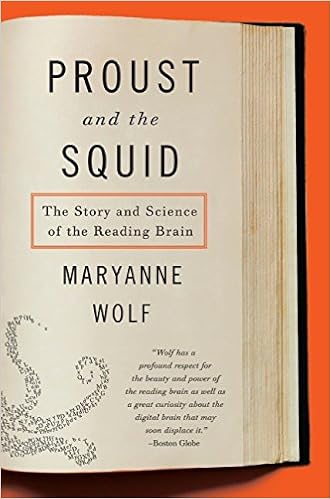
The history section was probably the most fascinating to me. The author discusses how reading is an unnatural (i.e., nongenetic) activity and thus how it changed the actual structure of how minds work. Different language systems, it turns out, use different parts of the brain. An example of how this is evidenced is the case of a man who had a stroke leaving one side of his body was paralyzed. He lost the ability to read Chinese (which uses both sides of the brains), but he retained the ability to read English (which uses only one).
As for reading being unnature, the book goes into how the brain has to adapt--learning to connect visual portions to linguistic portions of the brain. (I suppose it would be akin to learning braille, and having to connect touch to linguistics.) Some folks can't do it, which is how you end up with some learning disabilities. There are many reasons for this, but sometimes parts of the brain simply don't work in some folks. The author goes into some interesting stories about stroke victims, like the one above or another about a man who had a stroke and then had trouble reading afterward even though he could still see and speak (the synapses connecting the two portions of the brain that do each of those had been severed).
My only complaints come with the third section, which I found at times much harder to follow. The author, being an expert on reading disabilities, became a bit technical here. Sometimes, when you're really within your field, it's hard to pull back and write down to people. Still, this book, even in its more difficult passages, was easier reading than the neuroscience textbook I've been reading for RB&D, though both books are fascinating. I should have been a brain surgeon, except I'd have had to have studied all that other biology, which I typically am bored by.
Friday, March 6, 2009
On "Kopy Kats" by David Crouse (5400 words) *****
Thanks to an anonymous reader's tip, I now know that David Crouse has a Web site of his own, where he updates fans on readings he's doing and shares information on his books. He's also posted a few of his stories--some of his very best. My favorite of all of his stories (though "The Forbidden Kingdom" would likely rival this one for that spot) is "Kopy Kats," a story whose ending is one of the most unexplainably chilling finishes to a story that I have ever read. I say "unexplainably" because it isn't an ending that would, on the surface, seem to mean much. This isn't some gory shoot-em-up. It's just a question, but a question that gets under one's skin, especially after reading about a character so easily mistaken for others, about characters who seem so nakedly oblivious to the world around them. Are we all that way? Read the story here at Crouse's site.
Monday, March 2, 2009
On "This Is Your Accident" by Elizabeth Farren (2806 words) ***
"This Is Your Accident" might as well be "This Is Your Mistake." Everything in this story revolves around mistakes--a woman who dates a jerk, a woman who comes to visit her friend (invited mainly to get that friend's mind off the jerk), a jerk who insists on having everything his way, a liar (or perhaps two or three liars), and a night on the town that turns into a mess. This is a pile-up of accidents, of bad vibes, and of trouble. In the end, perhaps, revenge is reaped. What do I like? The unapologizing characters, especially the Italian. These are people you don't want to know. Read the story here at Prick of the Spindle.
Friday, February 27, 2009
On "The Tourists" by Rebecca Epstein (1220 words) ****
Take a moment of wonder, or of celebration, or maybe of horror. Throw some things down on the patio, on the sidewalk, on the places where you step. Epstein's "Tourists" does just that, leaving us to ponder what exactly is happening. Are we in the midst of a parade or the midst of a shakedown, buildings tumbling? There aren't many places to go with this piece once what happens begins to descend into the hell we feared, but Epstein manages to take us exactly where we need to go--into our surprising selves. Read the story here at Convergence.
On "Then We Came to the End" by Joshua Ferris *****

Sunday, February 22, 2009
On "Pretty Parts" by Hannah Pittard (1464 words) ***
My sister has this one weird thumb. It's normal length, but it looks like a dwarf thumb in some way. I'm not sure exactly why. Perhaps the last segment, following the knuckle, is shorter than usual. That would be my bet. But I haven't seen my sister's thumbs in years. I don't even know whether the odd thumb is on the right or left hand. Still, this is what you do when you are growing up together. You compare thumbs.
Or maybe, when you're a teenager, you compare a whole lot more than that. Suddenly, your body going all wonky on you, you look at yourself amid others and think, am I normal? Am I developing as the guys or girls around me are? Others heighten your concern. They make fun of your ears or your hair. (I remember, years later, someone seeing a picture of me from when high school saying I was really cute. I didn't think of myself as that in high school--and still wouldn't. But I wonder if it was all those others, talking me down, that in part affected the image I had of me back then. Or maybe I just look good in pictures, as some have noted.)
Take any given moment, and our own perception of our looks can vary. I can be quite nice looking one day and a too-quickly-aging man the next. Thin or fat but on the scale still the same weight. Perhaps we like to have someone there to tell us, give us perspective, on who we really are--or rather, what our bodies really are. And that's the essence of Hannah Pittard's story.
Start not with a sister but with a man and a woman of dubious relation--strangers perhaps, or girl/boyfriend playing strangers? Take off their clothes. Expose them to each other. Evaluate. Read about the two of them here at Narrative Magazine. (Log-in required--but it's free!)
Or maybe, when you're a teenager, you compare a whole lot more than that. Suddenly, your body going all wonky on you, you look at yourself amid others and think, am I normal? Am I developing as the guys or girls around me are? Others heighten your concern. They make fun of your ears or your hair. (I remember, years later, someone seeing a picture of me from when high school saying I was really cute. I didn't think of myself as that in high school--and still wouldn't. But I wonder if it was all those others, talking me down, that in part affected the image I had of me back then. Or maybe I just look good in pictures, as some have noted.)
Take any given moment, and our own perception of our looks can vary. I can be quite nice looking one day and a too-quickly-aging man the next. Thin or fat but on the scale still the same weight. Perhaps we like to have someone there to tell us, give us perspective, on who we really are--or rather, what our bodies really are. And that's the essence of Hannah Pittard's story.
Start not with a sister but with a man and a woman of dubious relation--strangers perhaps, or girl/boyfriend playing strangers? Take off their clothes. Expose them to each other. Evaluate. Read about the two of them here at Narrative Magazine. (Log-in required--but it's free!)
Wednesday, February 18, 2009
On "Rocky Point" by Rita Kasperek (2668 words) ***
There's something about estranged sibling stories that often appeals to me. Perhaps it's the idea of closeness and intimacy that has been turned off. It's like a love affair gone bad--it is a love affair gone bad--but without the romance the idea of one-time romance. There's just love, just family. It's nice to see stories where doomed romance, so often the heart of fiction, is not the theme. In this story and sister and her brother go on his first ever vacation, across the border, and discover, well, nothing--except that they will never rekindle the closeness they once had as a family. Read the story here at Big Ugly Review.
On "The Man Back There and Other Stories" by David Crouse ****
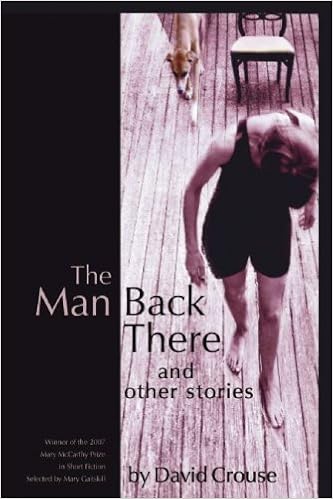
Crouse writes dark stories. These particular stories are set around the lives of lonely men. My favorites--there are quite a few--would be "Show & Tell" (the tale of a toy thief), "What We Own" (about a young man who tries to commit suicide), and "Torture Me" (about a man whose porn tape his wife finds). But the piece I like most is "The Forgotten Kingdom." This story, about man working in an office at the tail end of a set of going-out-of business layoffs, captures so much so well--the surreal, sad environment in such an office building; the longing one sometimes feels for one's past, even though one doesn't really want to return to the past; and the desire just to talk--to anyone. "The Forgotten Kingdom" is a forgotten video game, one through which the narrator bonds with another lonely soul. This story, more than any other in the collection, struck me with its presentation of men alone and wanting. (If only a David Crouse story were online, I'd feature it--he's a wonderful writer, and I look forward to his next collection.)
Saturday, February 14, 2009
On "The Accident" by Allan Reeder (4371 words) *****
Perhaps because of its name, I've always thought of Memorious as a literary journal devoted to memory, and since so many stories revolve around memory, that leaves quite a bit of room in which to negotiate. Allan Reeder's story within that journal, however, seems one of the pieces most tied in thematically to the journal's name. What I like about the story, in particular, is the narrative voice. I'm not exactly clear who the "you" is or what "stories" he refers to when referencing previous events that of course "you" would know, but this easy familiarity lends a certain personal connection that would otherwise be missing. The story also makes reference to various newspaper articles, as if this were some kind of research project. And it makes reference to various character's thoughts. Rarely has the omniscient point of view been so well done. Read the story here at Memorious.
On "Legacy of Ashes" by Tim Weiner ****
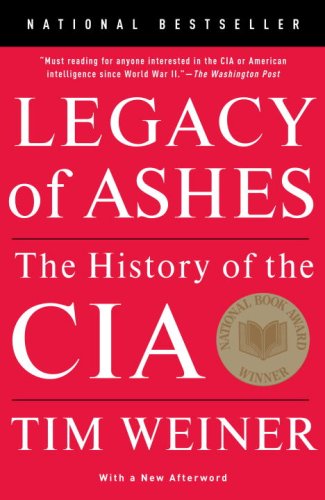
What I mean by myopic is that the author puts the CIA's problems are front and center here and interprets all of the CIA's history through that lens. Certainly, the CIA has had its problems, but even its "successes" here are reinterpreted as failures or simply skimmed over. Certainly, some of the "successes," such as removing the democratically elected ruler of Iran (who the U.S. government thought too closely tied to communists) to reinstall the shah, have come back to bite the United States in some very inconvenient ways. And certainly the CIA has missed some very key events. But where it has managed to do things "right," such as helping to dismantle weapons programs in Pakistan and Libya or feeding disinformation for years to the Soviet Union, the author brushes past with simply a mention. The author points to other nations being much better at covert action, but his claims are never substantiated (indeed, such substantiation would be beyond the scope of this book, lest it grow to twice its size). But just how easy is it to spy, to tell the future, to subvert another nation's government? I don't think these are things any nation seems particularly good at, let alone the CIA.
Because of this singular focus on the CIA's failings, I'm left with a lot of questions--for example, about the CIA's role in the run-up to the latest war in Iraq. The author notes how the CIA fed very misleading information to the Bush administration about Iraq's weapons capabilities. If the reports were as alarming as the author makes them sound, no wonder President Bush took the nation to war. But mention of how the administration itself insisted on including certain information in media press releases and the like that the CIA had in fact debunked (or debunked soon after such things were made public) isn't included. The author mostly takes the Bush administration line and blames the fiasco of the war almost completely on CIA misinformation, ignoring that much of that blame was assigned after George Tenet was removed. My impression at the time--subsequently reinforced by Ron Suskind's The One Percent Doctrine--was that Tenet and the agency were made to take the fall for things it had never done. The fact that none of the information in Suskind's book, some of which Weiner would have had access to, even made it into this book makes me question how much I have been mislead--either by Suskind or by Weiner or by both. With hatchets to bury, as each of these authors had, it's hard to get a straight story.
But these things aside, Weiner has written a really compelling book, one that makes me cringe. I cringe because of the things the U.S. government has done in the name of national security, democracy, freedom, or whatever. I cringe because here is an agency built on lies, built on deceit, built on doing things in the shadows--illegal things, including (how typically hypocritical of our nation) terrorism. How does a president visit a foreign leader and then order an agency to assassinate him? How can a country that supposedly values freedom do all in its power to remove governments elected by their own people that it doesn't like and replace them with repressive regimes? How can humans be so cold to one another? Perhaps, the answer is in a statement by as one person interviewed in the book: once one pushes a button to detonate a bomb in a war, how different is it to assassinate someone in a covert war? After all, it's all just killing. And I suppose that's why this whole world is in the kind of state that it is in. God help us all before we destroy everything that lives on this planet.
Friday, February 13, 2009
On "An Odd-Looking Catfish" by B. J. Hollars (2083 words) ***
Another odd and fantastic (in more ways than one) story by B. J. Hollars. This one involves a man who finds his daughter after ten years, finds her while fishing one day, inside a boot. Like the best stories of fantastic realism, the weird tale is told as if totally plausible and the weird situation itself becomes a kind of analogy for a lot of what's going on in the story--the loss that the father feels and the inability to understand someone who has changed, who is no longer that person, that friend or kid, you used to know (a loss of a different sort but loss nonetheless). Read the story here at the Summerset Review.
Subscribe to:
Posts (Atom)

 Posts
Posts


