I never had a brother--younger or older. I did have a sister, an Irish twin (i.e., about one year younger), but I was never the kind of older brother, that I know of, that seems to be the center of much fiction, never the guy dispensing advice or beating on the sibling. My sister and I had our fights, sure, and but I don't recall beating her. And I don't recall dispensing advice. Maybe it was the difference in gender, maybe the lack of difference in our ages, or maybe it's just the faulty memory of an older sibling who thinks he didn't do the things an older sibling does when he actually did.
The brother thing came to me when I was in Britain visiting a friend. We went to see some British movie--I don't recall the title, though I think it involved the name Beckham. It was about two brothers and a dad living in Wales. The younger brother took ballet lessons. The older brother, much older, worked in the coal mine with dad. In bed at night, the brothers argued, fought. Just like in real life my friend said, my friend who'd had a two-years-older brother.
This story reminds me a bit of that film--though I think I like this story better. Here's why: This story takes the form of brotherly advice, a format that works well for it. And then it takes that advice up a notch, giving the reader a sense of all the older brother hopes for his younger sibling by providing not just advice but alternate futures. This isn't just about the sibling we realize, about forcing someone into one's whim, but about the older brother himself, about all of his failings, all of his wishes and dreams and hopes, and all of the things he'll never have. Read the story here at Verb Sap.
Tuesday, September 29, 2009


Saturday, September 26, 2009
On "Seven Hands Played" by Cora C. Pyles (500 words) ***
I'm reminded of Jayne Anne Phillips's flash fiction or prose poems or whatever they were, the ones published in Sweethearts and then again as vignettes separating the large stories in Black Tickets. What these bursts of prose stand for, one isn't always certain, other than that they are really well-rendered pieces of prose. Cora C. Pyle's "Seven Hands Played" is a piece in such a tradition. The tale of a single night, of girls gone to visit boys in a far-out place, of something about to happen. Read it here at Kaleidowhirl.
On "Everything I Want to Do Is Illegal" by Joel Salatin ***
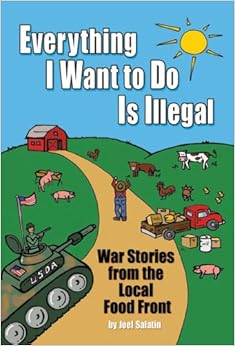
Take, for example, the practice of zoning. To zone land as agriculture often means that (1) one can't process meat on one's own site (beyond that, what can be processed often involves so much government-mandated equipment that a small farmer couldn't possible do it legally); (2) one can't open a store on one's own site to sell the products from one's farm; and (3) one can't charge tourists for the pleasure of visiting one's farm. There are subtleties in each of these sets of laws. Salatin, for example, can process chicken but not beef, but only his own chicken. Salatin can sell food at the farm but only his own farm's food--and nothing that has been "processed" (forget those cookies). But there are good reasons for zoning--most of those stemming to corporate culture. I mean, who really wants to live by a huge chicken processing plant?
Salatin's point is that he's not a corporation and thus shouldn't be subject to the same sets of laws. There's a libretarian streak in Salatin's writings, a desire to do away with government as much as possible. I understand Salatin's points, and too a large extent I would tend to agree. Many regulations are nonsense. However, I'm not one for removing regulations in general. There's a balance here. Regulations that don't work should be rewritten (but often aren't because they advantage certain power players). And regulations in general need to be slated for the kind of farm one is running. Small producers shouldn't have to follow the same rules as large ones. Given the scale of production some of the health issues involved just aren't the same. But removing regulations in general doesn't seem a wise move to me. After all, laws are written to protect people, to offer guidance, and if such things don't exist, you end up with the kind of muddle our financial system is now in. Scale matters. If you have to stare your customer in the eye after selling him or her bad beef, you may not be so likely to do so, as compared to a big company to whom each customer is just a number. But at the same time, many of the banks that have failed in this most recent crisis are small ones. Had there been more guidance--albeit guidance scaled appropriately--perhaps troubles at all levels would have been averted.
Has Salatin changed my eating habits? Many of those had already changed after reading Fast Food Nation. Salatin simply added to my knowledge base. Were only good food more widely available.
Wednesday, September 23, 2009
On "Finders Keepers" by Ravi Mangla (347 words) ****
I've become a fan of Mangla's work largely through a social networking site I read on from time to time. Mangla's been one of those whose work has been consistently interesting--and consistently good. In this little piece Mangla turns the old safecracking story on its head and gives us something, in fact, literary. Read it here at Pindeldyboz.
Sunday, September 20, 2009
On "Heart Mechanics" by Molly Jones (840 words) ***
I'm not sure what this strange little piece is. There's no rising conflict, no climax, no real resolution. But there is an idea, and an odd one at that. The idea was enough to sustain my interest, enough for me to go back and reread this, try to figure out what exactly is going on. Why a mother would do this to her child, I'm not sure. Having a wind-up heart, though, certainly sounds like a recipe for trouble--or maybe salvation. Read the story here at Thieves' Jargon.
Thursday, September 17, 2009
On "Tuning Pegs" by Sterling McKennedy (2708 words) ****
This is a quiet one, one of those slices of life--and here, it is slices, because we're getting more than a single incident. What makes this particular story special, however, is in the details. There are two moments in this story where I had to stop and think, awed by an observation at once very true and very unthought (at least by me) before. One involves an incident at the DMV (or rather a series of thoughts there), the other simply a description of some police drama. I wonder if I'll ever be able to watch police dramas again without thinking about what McKennedy has to say about them. Oh, and the story--about a newly divorced woman with two kids trying to find her way, settling now for a job she thinks will need nowhere (and which probably will)--that's a fine piece of work as well. Read it here at Night Train.
Monday, September 14, 2009
On "If Wishes Were Porsches" by Jay McInerney (5171 words) ***
I first read McInerney on my high school senior trip. I bought Bright Lights, Big City at Crown Books in San Diego. The book had been mentioned by my English teacher in conjunction with the Lost Generation, with Hemingway's The Sun Also Rises (an amazing work I just finished rereading this past winter--twenty-some years after my previous reading, twenty-some years to forget just how amazing). So I wanted to read this new Lost Generation. McInerney was the first; I would read Bret Easton Ellis the next fall. Ellis I did not care for, except in the way he captured a certain milieu; McInerney I cared for a lot. I finished Bright Lights, Big City by the weekend after I returned from the trip and immediately started it again. I must have read it three times that summer. It was good. It was very good.
I went on to read Ransom, a book I also loved. And then Story of My Life (brand new, in hardcover), which proved disappointing. On the anniversary of my first reading of Bright Lights, Big City, I read it again and was again enthused. Other reading interfered then, and I didn't touch Bright Lights again for a long time. I did, however, somewhere in here get around Brightness Falls and was again disappointed. I began to think either McInerney had fallen in form, or I had been young and enthusiastic over writing that age was proving to be less than stellar.
About two years ago, I finally got around to rereading McInerney. I started with Bright Lights, Big City, and you know what? It was still great. I found the last half a bit contrived, but it still had heart and great, great writing. Ransom, unfortunately, proved not to live up to my memories of it--I had loved the portrayal of that strange world of Japan, but now it seemed like a very contrived novel. And then I read Model Behavior. The latter proved that McInerney was not a fluke. He was back in form for that novella, back in the world of Bright Lights.
Here is a story written by a master chronicler of the New York scene. Sure, I don't know how it is that McInerney's male protagonist always seems to have a model or future celebrity fall for him--and then leave him once the woman becomes famous. Sure, I wonder sometimes how people in such financial straits manage to lead such rich social lives (especially among the seemingly well-to-do). Maybe it's all my own lack of social skills that causes me to doubt these things. But for sheer force of New York City, for its moments of craziness one is unlikely to find elsewhere (the old man's story in the bath house here made me laugh out loud), for the energy of language and turns of phrase, McInerney is a wonderful and enjoyable writer to soak in. Read the story here at Five Chapters.
I went on to read Ransom, a book I also loved. And then Story of My Life (brand new, in hardcover), which proved disappointing. On the anniversary of my first reading of Bright Lights, Big City, I read it again and was again enthused. Other reading interfered then, and I didn't touch Bright Lights again for a long time. I did, however, somewhere in here get around Brightness Falls and was again disappointed. I began to think either McInerney had fallen in form, or I had been young and enthusiastic over writing that age was proving to be less than stellar.
About two years ago, I finally got around to rereading McInerney. I started with Bright Lights, Big City, and you know what? It was still great. I found the last half a bit contrived, but it still had heart and great, great writing. Ransom, unfortunately, proved not to live up to my memories of it--I had loved the portrayal of that strange world of Japan, but now it seemed like a very contrived novel. And then I read Model Behavior. The latter proved that McInerney was not a fluke. He was back in form for that novella, back in the world of Bright Lights.
Here is a story written by a master chronicler of the New York scene. Sure, I don't know how it is that McInerney's male protagonist always seems to have a model or future celebrity fall for him--and then leave him once the woman becomes famous. Sure, I wonder sometimes how people in such financial straits manage to lead such rich social lives (especially among the seemingly well-to-do). Maybe it's all my own lack of social skills that causes me to doubt these things. But for sheer force of New York City, for its moments of craziness one is unlikely to find elsewhere (the old man's story in the bath house here made me laugh out loud), for the energy of language and turns of phrase, McInerney is a wonderful and enjoyable writer to soak in. Read the story here at Five Chapters.
On "Ghost Soldiers" by Hampton Sides *****
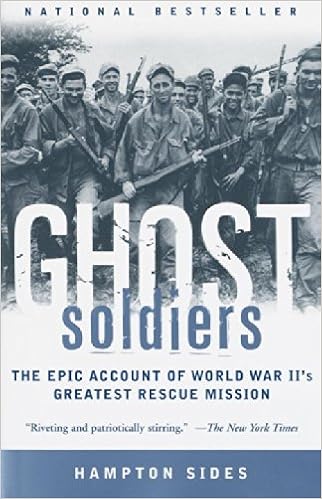
Ostensibly the story of the Bataan Death March, Ghost Soldiers follows two tracks. One is the story of U.S. Rangers' raid on a POW camp where many of those Bataan marchers who survived ended up. The other is the story of the POWs themselves. The one is "heroic." The other is incredibly sad. One would make a great movie. The other could be made into some kind of existential novel of great nihilism. In the end, of course, the stories meet. And one rushes onward to get to that ending, to see whether this impossible mission can be carried off and if so how well. Sides has done his research well, but he's done an even better job of molding all of it into a compelling, emotional book.
Friday, September 11, 2009
On "Virgins" by Claudia Smith (2060 words) ***
"I wasted it"--the words sting. And in a sense, they're the heart of this piece. Two girls who can share everything about each other. It's that portion of life when you're discovering for the first time, as adults. It's that portion of life when a good friend to share it with is the most wonderful thing in the world. Claudia Smith captures it well. Read the story here at Juked.
On "The Salton Sea" by George Kennan ***

Tuesday, September 8, 2009
On "Push or Pull" by Lauren Becker (276 words) ****
It's hard to come up with something that has any power in five hundred words, let alone less than three hundred. Becker manages to pull it off here, the story of a desperate woman, one apparently of many. I don't get guys like this. Sometimes, though, I wish I were one of them. And then again, not. Something in me prefers being rejected to rejecting. Read the story here at the top of the page (among many others) at Dogzplot.
On "Greetings from the Salton Sea" by Kim Stringfellow ***

Stringfellow's introductory essay situates the photographs that she's made of the Salton Sea, which rest in this valley. The largest inland body of water in the state of California, created by an engineering accident and maintained through agricultural runoff, this eco-catastrophe has become the major home for many migrating birds. Or had. In the past decade, as Stringfellow demonstrates, the increasingly salty and toxic sea, has increasingly killed off its fishy inhabitants--and its birds along with them. Perhaps we need to save this accident--but how?
Saturday, September 5, 2009
On "Things You Can Do With a Can of Campbell’s Soup," by Brock Adams (747 words) ***
Perhaps this is more an essay than a short story, or maybe it's just a list. But if it's an essay, it also hints at a kind of plot, a subtext, a life--all the things the a can of soup can be to us, all the meanings it can gather, throughout the course of our days. Recently, during the first week of the significant downturn in the stock market this past fall, one of the few stocks that actually rose that week was Campbell's Soup. Hearkening back to the Depression, one commentator said, Campbell's Soup gives us comfort. And that's what Adams suggests here, if in a perhaps ultimately sad and sordid way. Read the story here at Barrelhouse.
On "Olive Kitteridge" by Elizabeth Strout *****

Ostensibly a cycle of stories about Olive Kitteridge--the crabby old lady noted above--this collection somehow managed to make me care or at least enjoy getting to know this woman. Granted, I would never want to know her in real life. She's overbearing, selfish, mean. She's also, at times, caring--but the bad seems to outweigh the good, much as such does in many of Flannery O'Connor's characters (a writer whose stories, somehow, I've by and large never managed to come to love). Also, in the level of detail with which Strout writes, I'm reminded of Alice Munro, and yet again I am a big fan of these stories about Olive, whereas for all her skill I usually find Munro's work a tad boring.
Two things pull me to this collection. First, the stories are often hilarious--or at least moments in the stories are, just as those moments are so incredibly unpredictable. Second, the stories--the best ones at least--leave me shuddering at the end. To be sure, some stories I merely shrugged at, but probably half of them gave my heart a little pitter pat when I got to the end.
Take the first two stories, "Pharmacy" and "Incoming Tide." The first is a quiet story about Olive's husband Henry's female coworker. This isn't one of those stories that made me say Wo! at the end, but what I liked about it was how through the various subtle details, we got a vision of Olive, on the sidelines, as the jealous wife. Sure, it was Henry's story, but the little nuances that were Olive's made this a piece to admire. Next, we see Olive through the eyes of a man who is readying to commit suicide. Here, Olive comes across simultaneously as a tedious bully and as a wonderfully caring person. It's not that Olive tries to talk the man into living. The man never opens up about what he is on the verge of doing. It's that she is so a part of her own world that she never even seems to notice the emotional stress that the man is in. But she does notice someone else, and it is Olive's concern for this someone else who in the end saves this other man's life.
Strout is at her best, though, when we get into Olive's head. And Olive, when we're in her head, is even less sympathetic in most cases than when we see her from outside. In the hilarious "A Little Burst" we watch Olive because some jealous of her new daughter-in-law's relationship with her son that she commits an act--and commits to acting in a way--that is sure to undermine her son's marriage. One is shocked. In "A Different Road," Olive forces her husband to drop her off at an emergency room so that she can take a pee and ends up somehow in the middle of stickup, during which she and her husband--at gunpoint--get into one of the funniest arguments I've ever heard. The results are, to be sure, disastrous.
Wednesday, September 2, 2009
On "DMV" by Ashley Farmer (416 words) ****
Back to an old theme--the idea of a story as an obsession. This one works with hands. Actually, this one works with a lot of things, a lot of images. It's the story of a woman going through a degree of stress, a canceled relationship of sorts. And it's tight. I love the image of the melted plastic on the dashboard. Love the way this piece comes to its bitter end. It's so calm, I didn't even realize what had happened at first--and when I did, I shivered. Read the story here at Elimae.
Sunday, August 30, 2009
On "A Sigh Is Just a Sigh" by Sean Lovelace (1050 words) ***
Here's an interesting short piece, a musing on film and sleeping and doors and dreams. I'm really not sure what to think of it, but sections of it sing, lines from it shine. Bogart on your futon? Asking him if he wants Pop Tarts? Really interesting. But really, this is just an excuse to mention another Sean Lovelace piece, in the Sonora Review (not online), about nachos, " Someone Emailed Me Last Night and Asked if I Would Write About Nachos"--one of the best pieces of writing I've read this year. Read Lovelace's story about Casablanca here at Wigleaf, then go out and get yourself a copy of the Sonora Review.
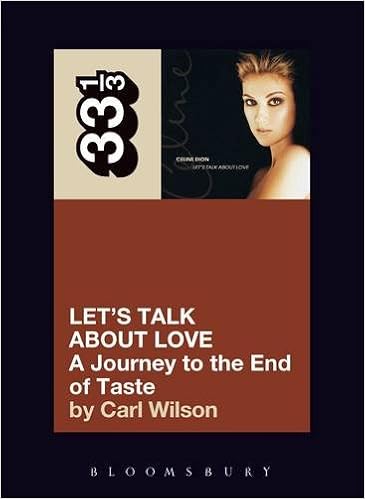
On "Let's Talk about Love" by Carl Wilson ****
Similarly, while in Florida, I was driving a few friends to a pizza place, and I had in my CD player, a mixed CD that for whatever reason at that moment was focused on Phil Collins and Liz Phair. I like both. The former, though, is considered by many to be cheesy eighties music, the latter, after her first album, often considered to be too commercial. There are lots of other songs on that CD, but these were the two artists that ended up on play. I felt a bit shy. Really, I wanted to say, my tastes aren't always so mainstream. I like some out of the way stuff too.
Wilson has a similar moment in his 33 1/3 book, whose subtitle, A Journey to the End of Taste pretty much sums up what the book is about. In it, he tries to figure out what taste is and why some people can like an artist he detests so much, like Celine Dion. In an attempt to come to that understanding, he plays the album over and over in his apartment, an apartment that does not hide very well what sounds emanate from inside. And strangely, he feels incredibly embarrassed, more so than say if people were listening to him have sex. What is this thing that causes us to be embarrassed by certain things we might read or listen to? What is this thing called "taste"?
I like Wilson's book because it's about something I haven't given much thought to since a twenty-something in grad school. There, I had to confront other grad students who were arguing that the sole reason a given book is considered literature (say, The Great Gatsby) and another given book (say, Myers's Twilight) is not is politics. In my twenties, I couldn't abide by such reasoning. The greats were great; the not so greats were not--there were aesthetic reasons. One supposedly can read Gatsby on many more levels than Twilight. And maybe one can--or maybe one can't. But does that make something better aesthetically? (The particular example is drawn from a more-recent conversation with a high school senior who considers Twilight the greatest book of American literature, and Gatsby merely boring. She'll be an English major at college this year--I'm curious to know if her tastes remain the same. Judith Krantz was the actual college example.)
These are the questions Wilson confronts. In that process, he discusses theories of taste by men like Hume and Kant (arbiters, in their judgment, should be those with a great deal of background in a subject, who have in short good discernment). And he discusses a more recent and more interesting (and much more arguable) one by Bourdieu--namely that taste is a class thing. We show our particular class by disparaging the "tastes" of a lower class. Hence, we end up with high and low culture. But Wilson, I think correctly, says that that sort of argument isn't wholly satisfying. There's more to life then class. Still, our tastes are, in part, forged in an attempt to fit in with a particular cultural subset. We judge Gatsby better because we want to be part of the kind of group that would choose Gatsby over Twilight. Or the White Stripes over Celine Dion.
In the end, however, Wilson comes to appreciate Dion. He may still not find her to be "his" music, but he can appreciate her for the kind of music she does. And what he suggests is that critics should not so much "judge" a work as enter into a dialogic conversation about it, about taste--and more explicitly about the personal experiences that would cause us to like one thing or dislike another--as in, "I like this, but you don't. Why for me and why not for you?" In this way, we better understand one another.
To be sure, the book has a large theoretical component, but it is readable. And it's also fun. Wilson doesn't just talk about taste but about Dion's career, where she came from and where she's gone. And he summarizes hilarious studies such as that of Komar and Melamid's study of art, coming up with a "most wanted" painting based on a generic quiz about what type of art people like most and a "most unwanted" painting on the same; the same study is later applied to music. He uses wonderful anecdotes to illustrate points, such as Dion's own statements on Larry King regarding letting the Katrina looters "touch those things." A wonderful read.
Thursday, August 27, 2009
On "Show and Tell" by David Crouse (5740 words) *****
One of my favorites, though not my actual favorite, from stories from Crouse's second collection is this gem about a cleptomaniac kid. Okay, maybe he's not a clepto full time, but he's a clepto at least when it comes to this one friend, this friend who isn't going to be cool enough to be a friend come the school year. But in these long and dull summer days, when all you have is a brother who likes to beat you up for a companion, better to go to that misfit's house and steal his stuff. Read the story here.
On "The Nine" by Jeffrey Toobin *****
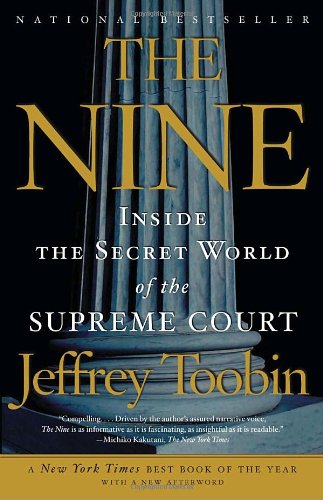
What makes Toobin's account of the Supreme Court so fascinating? That, on reflection, is somewhat hard to say. After all, I was familiar with many of the events that the book recounts. I think it was that Toobin brought to the story some insight that perhaps one doesn't get from the basic news. He brings us into contact with the people themselves, with what makes them tick, and with who they are. Each justice comes off, in some manner, pretty well, though some come off much better than others, particularly those on the left.
That Toobin sympathizes with those on the left seems evident from the book's early pages, when he talks about the Court being separated by a single vote, about the Federalist movement, and about Roe v. Wade. But the "single vote" discussion is also his way to frame the narrative. A single vote changes the court from liberal to conservative, and in Toobin's estimation the court has changed to be exactly that.
What strikes me, however, as the bigger tragedy in all of this is the final conclusion that Toobin reaches--that in the end, all court decisions are about ideology, that they are--in the end--political (something seen quite well in the 2000 election). And it's true. But the sad part about the 5-4 votes that now seem to dominate the judiciary isn't so much that those 5-4 votes are now favoring the conservative side rather than the liberal (with Anthony Kennedy's vote the only one that occasionally swings to the other side). It's that those are 5-4 votes at all and that those so much reflect our own political culture these days. There isn't much space for people in the middle anymore. In a television news commentary culture dominated by Keith Obermans and Glen Becks, politics has become the domain of ideological purists, and so too has the Court. We don't talk to one another anymore to come to a reasoned middle ground. We yell over one another and hope that our yell is the strongest. For the moment, the conservatives, when it comes to the Court, at least according to Toobin, have the upper hand.
Monday, August 24, 2009
On "Where Our Wives Are" by Greg Oaks (3177) ***
Here's a deceptively interesting story. I say deceptive because it's not one that at first hooked me in, but by about a third of the way through it, the story took hold. For me, what was working was the theme, this way that Oaks keeps circling back to crime. If stories are obsessions, crime is this story's obsession--all the horrible things this one man has had to endure. And then comes the end, all those crimes take on a whole other meaning. What are our lives when our loved ones are gone? Who do we trust? How can we? Read the story here at Switchback.
Subscribe to:
Posts (Atom)

 Posts
Posts


