Saturday, August 12, 2017
On "Wagner in the Desert" by Greg Jackson (7940 words) ****
In "Wagner in the Desert" a man recounts his activities among a set of friends in California. He's writing a novel and chasing a woman who is happy enough to let him play with her. His friends are trying to make a movie and a baby. Together, they try out various things on their baby bucket list--things to do before one has a baby to tie one down. They seek sponsors for a movie (i.e., one is a guy named Wagner). They have sex. They do drugs. Lots of them. And that is what gives their world so much character. In a sense, there's a kind of sadness percolating beneath this story's heroics, for while there's much going on, there's really little of consequence. Read the story here at the New Yorker.


On "Unconditional Surrender" by Evelyn Waugh ***

The main character, Guy Crouchback, however, remains the center of attention. Keen on joining the army and being part of the action at the start, he still finds himself interested in such even in this third book. But by the novel's end, his interests and devotion turn elsewhere. Making his life have meaning becomes doing good for others, not in battle but in the realm of the family.
A retelling of Waugh's short story "Compassion" plays a large role in this novel's ending--and this transformation. Guy becomes the main character of that story, helping Jewish refugees find food. That sort of compassion is also what leads to the familial ending.
The ongoing subplot about Guy's ex-wife also finds center stage for much of the book, as she find herself in difficult circumstances that continue to become more difficult, her life of vacuity and immorality finally catching up with her. The subplot regarding Guy's being taken for a spy also gets some play, but it never reaches proportions that make it wholly satisfying--it keeps him from some work but usually also puts him back into the same work, depending on the characters interpreting the data for their own purposes. Satire, I'm guessing, is Waugh's main concern here, but the fact that this subplot rolls through the background without ever really coming to the fore makes it something of a disappointing set of twists.
Other characters who played large roles throughout the trilogy end up writing torrid novels about their experiences, dying in meaningless battles, or dying simply of old age (Guy's father). The various ends are tied up, but I found myself more interested in simply finishing the book to have it done than in caring much about what happens to any one of the characters.
Tuesday, August 1, 2017
On "On Guard" by Evelyn Waugh (about 2800 words) ****
"On Guard" is an enjoyable romp through the vagaries of love. Milly is a woman whose nose is so beautiful that it attracts many suitors, each of whom she fancies for a short time before spurning. One suitor leaves her a little dog to which she becomes devoted. The dog is to guard her from others suitors so that when this suitor returns, he can marry Milly. The tale is mostly the story of how this dog tries to keep other men away. It has a cruel ending, but in other ways, the story seems a kind of exploration on the way that some people waste their youthful years in flirtatiousness to end up alone once beauty wains. Read the story here.
On "Officers and Gentlemen" by Evelyn Waugh **
Near the start, we learn that Crouchback's nephew has become a prisoner of war. His father schemes to keep his two-bedroom residence out of the service of army officers quartering in England. And Guy himself is on a mission to hunt down his dead friend Apthorpe's goods to distribute them according to his will/desire. We run into Guy's old wife and several army friends of his. There's a subplot about Guy maybe being a spy (based solely on misunderstandings) that never gets developed. There's a neat little segment where a man who fails in his mission gets promoted after the army dresses up what happened in its best language. In this absurdist and humorous sense, the book seems much like Catch-22; but unlike that book, this book doesn't for the most part seem to have as much gravitas. I didn't find myself caring that much about the characters or being sideswiped by sudden, shocking violence, until near the end.
I suppose Waugh is aiming for a climax, which is why the plot seems to kick in in the last hundred pages, when Crouchback, after being reassigned from his old unit to a commando unit, now as a communications officer, goes on a mission to Crete, where the troops beat a hasty retreat and Crouchback's own unit is left deserted--to surrender. More happens after that (we learn why they were left, for example), of course, as there is a third book and more war adventures to come.
Thursday, July 20, 2017
On "Out of Depth" by Evelyn Waugh (1699 words) ***
"Out of Depth" is a science fiction story of sorts, one that plays with ideas related to black magic. The main character meets a magician, wishes nothing to do with him, but then somehow ends up being pulled into his orbit. Said magician hurtles him into a future five hundred years hence in which London society has been turned upside down. We get the sense that some kind of devastating war has taken place and society has been propelled backward centuries in technological innovation. Read the story online here.
On "Men at Arms" by Evelyn Waugh ***
Crouchback is divorced without kids. He suffers from a kind of feeling of worthlessness of life. The military, fighting for a cause, will give him something to live for. Alas, it doesn't want him. It is only after a relative tells him of this special brigade that he is able to get in.
What follows are a series of humorous little stories about training. Particularly funny scenes involve one in which Crouchback is about to get back with his former wife but keeps getting interrupted by phone calls from his best army buddy. Another involves the friend's thunder box, which the brigadier takes a liking to and which Crouchback and his friend constantly try to hide.
Overall, one gets the sense that the military is a rather funny place. This is the Bill Bailey type military, one that succeeds, when it does, despite incompetence. There didn't seem to be much in the way of angst here, except a tiny bit toward the very end--and that mostly personal rather the military/war related. As such, the book didn't seem as tied in to most of the other post-1900 war literature I've read.
Thursday, July 6, 2017
On "Cruise: Letters from a Young Lady of Leisure" by Evelyn Waugh (2031 words) ***
"Cruise: Letters from a Young Lady of Leisure" is notable mostly for its voice, that of a young girl who falls in and out of love most ficklely, as people are wont to do on overseas cruises to Egypt. One gets the sense she is about twelve, at an age when understanding the viccisitudes of adult relationships is just beginning to don on her. Read the story here.
On "Scoop" by Evelyn Waugh ****
Alas, the person in charge of hiring Boot mistakes the directive for a different Boot--William Boot--who writes a column for the paper on country living. And thus begins a novel of mistaken identity, a theme that is nearly dropped until the novel's end. William, thus, is presented with no choice but to go the Ishmaelia if he is to keep his job. Ishmaelia is an African country in the heat of civil war. And thus he packs--or buys the many things he is told that he'll need.
It's here, about a third into the novel, that the work loses steam for me. The jokes come furiously in the first third, somewhat less furiously thereafter, but more important, they become more and more easy jibes at the profession and at the characters involved. William Boot is something of a dolt who manages through incompetence and intransigence and even a little common sense (that other reporters seem to lack) to become a great foreign correspondent. Along the way he meets Katchen, a married woman whose husband has disappeared and with whom he falls in love. She promises to feed him news stories in exchange for various favors--mostly money. It becomes clear that she is primarily a gold digger (literally and metaphorically), but William, to all disadvantage, continues to support her in his grand love.
Waugh writes of one legendary journalist who tells great stories. This journalist, he notes, was sent to a country where nothing was going on and through the strength of his reports managed to get every nation to send troops to it to stop a civil war that until then had not even existed. For Waugh, news is in many ways not something that is reported but something that is created.
In this sense, this novel remains relevant in our day of "fake" news. What a media outlet chooses to report shapes what happens as much as it reflects what is really happening. Hence, one network's focus on the Trump campaign's Russian ties brings that prospect into a certain reality, while another network's almost complete ignoring of the story in favor of Clinton's botched e-mail server creates an alternate reality. Each in their own way shape and foster who holds power within the nation. Without reporting, Trump's indiscretions could never lead to whatever downfall might await us. The extent that those indiscretions are exaggerated or minimized--real or not--affects whether that downfall ever comes. If and when the downfall does come, it'll largely be at the hands of those reporting.
Thursday, June 22, 2017
On "Excursion in Reality" by Evelyn Waugh (4499 words) *****
One of the better tales Waugh tells is "Excursion in Reality"--or perhaps I'm just a sucker for Hollywood stories. In this one, a novelist is recruited to rewrite Hamlet for the motion pictures--but to update it in terms of language. In the process, of course, with studio committees what they are, the play loses much of its actual being. Meanwhile, the novelist's fickle relationship with his girlfriend is put on hold, as he becomes wrapped up in a completely other affair. Methinks Waugh uses the term reality ironically. Read the story here.
On "Brideshead Revisited" by Evelyn Waugh *****
What do I like about this book? It has a very strong voice, one that beguiles, that ropes one in, as if it were a true-to-life memoir. And secondly, it takes religion seriously--and respectfully--which is not something one sees in a lot of post-1900 fiction.
The story is about one Charles Ryder, an officer in the army who comes upon the Brideshead estate in his work. This is the frame through which the story of the estate--of his relationship with it--is told.
Most of that relationship is with Sebastian, the younger brother of the four children to whom the estate might one day fall. Sebastian and Charles meet at Oxford, where they do as many college students do: they drink and they party. This is the bulk of the first half of this book. It is a story of friendship. And it feels as if it is going nowhere, and yet, as I noted, it beguiles. I was reminded of On the Road, another book about a friendship that has only a loose plot that somehow manages to keep readers hooked. We're not driven to find out "what happens." We just enjoy learning about these young men, sharing in their fun times and enthusiasm for life. And most of all learning about the fun, strange character Sebastian, who carries a teddy bear with him as a friend.
While one can clearly read the story as one of male friendship, there is a subtext of homosexuality going on as well. Some of the friends of the pair are clearly of that persuasion, and at various times we are provided strange asides: the two too naked in a bedroom to come out to see their sister, the two being denoted as not interested in women by other relatives. But Waugh keeps that in the background; his focus is on friendship. This might be a reflection of the time in which Waugh wrote or it might be more that friendship is Waugh's concern here. Or both.
Alas, a plot does kick in. The drunken escapades become more regular, and from here the novel loses some energy as it becomes more and more concerned with Sebastian's alcoholism. Attempts are made to keep him from drinking, and one sees the strain that is put onto a friendship in which one is confronted with wanting to help one's friend in two different ways: giving the friend the freedom he wants but also keeping the friend from destroying himself.
Eventually, Sebastian wanders off into Europe and Africa and drifts apart from Charles, who has become a kind of member of the family. Eventually, Charles is sent to find Sebastian to tell him of his mother's impending death, but such ends up being the climax and end to the friendship. Years later, having moved into a career as a painter and married, Charles meets again Sebastian's sister Julia. The two have an affair, and one has to think that it is in part an unspoken love for Sebastian and for times past that draws them together.
Charles is the lone cynic among the family of Catholic believers. His agnosticism is the point of view from which the novel is written, and thus much of the book is about Charles attempting to understand the family's devotion to Catholicism. It is in this sense that the book takes religion seriously, for rather than dismiss religion, in the end, Charles comes to have an understanding of its meaning.
Waugh, himself a Catholic, thus wrote a Catholic novel. If we take this as being his view of the church, one would see within it a way to stave off or deal with the issues of modernity and death, a way to put order to the world. It's more a feeling than a logic or way of life, insofar as its enacted in the novel, though I'm sure Waugh would see that to be very much logical in itself.
Sunday, June 11, 2017
On "Too Much Tolerance" by Evelyn Waugh (1543 words) ***
Just as "Love in the Slump" seems in part a commentary on Waugh's first marriage, so too on some level does this one, "Too Much Tolerance," which is about a very happy man who lets himself be taken advantage of by his business partner, son, and (ex-)wife. But all is good in his book. Something was odd about this piece to me insofar as I didn't really feel bad for the man--perhaps because even though he had much to complain about, he was so happy despite it all. Maybe there's something to being a Penelope. Read the story here.
On "A Handful of Dust" by Evelyn Waugh ***

The book is forged mostly around the Lasts--Tony and Brenda--who maintain an estate called Hetton and throw regular parties. A man named Beaver comes to visit Tony, a man whom Tony barely knows. Brenda takes a kind of liking to him. He is young and difficult to make love her, and that is precisely why she likes him.
Bored by life in the country and wanting to take up with Beaver, Brenda arranges to rent a flat in London that the family can barely afford. She tells Tony it is so that she can study economics. More and more time is spent away from him--and more and more time with Beaver. Tony never seems to catch on, even as Brenda and Beaver become the talk of high society.
Brenda attempts to set Tony up with another woman. The efforts fails masterfully.
Meanwhile, their son John (whose age is hard to fathom since he too speaks in complete paragraphs) is left without a mom. Reared by nannies and butlers, he has a great liking for horse riding. And it is a tragedy involving him that brings the whole affair to light.
So little sympathy can be thrown Brenda's way by the time that divorce is in the offing, Waugh's description of her next acts make her utterly detestable. She's conned her husband of money for months, ignored her child, and taken up with another man. And now Tony agrees to go through with setting up a divorce for her by faking his own affair. The attempt does not go well, but rather than be happy with the alimony Tony is offering, Brenda opts to sue him for an amount that will force Tony to put the family estate on the auction block, this so that she can be supported in the manner in which she is used to and so that her lover, Beaver, can be supported as well (since he has no means of support for himself). It is this that pushes Tony to run away to the jungles of Brazil, where the story's final tragic ending comes into being.
What readers get then is a sense of the utter desolation that divorce works on a man, one that is put into metaphor by Tony's experiences in the jungle. But because the text seems so one sided, the characters fail ultimately to feel fully forged.
Thursday, May 25, 2017
On "Love in the Slump" by Evelyn Waugh (3291 words) ****
"Love in the Slump" focuses on a marriage between two friends--a couple who decide to try out marriage because they are getting toward the end of their marrying years and haven't found anyone. Alas, one gets the feeling that as companionable as they are, they still act and feel single, which does not bode well for the future. Read the story here.
On "Decline and Fall" by Evelyn Waugh ****
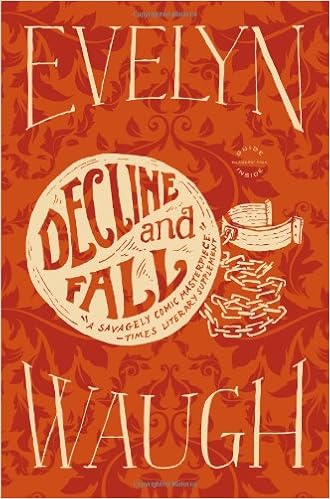
The story revolves around one Paul Pennyfeather. Waugh denotes it himself toward the end of the book: Pennyfeather is a static character. Things happen to him, rather than he doing things to others. And that's right where the book starts. Paul is studying to become a minister when he is mistaken for a person from another college, a person whom revelers see fit to attack by stripping him and forcing him to dance naked in public. This results in Paul losing his place at the divinity school and sets into process the rest of the novel's events.
Where Paul ends up first is at a school for young boys. Waugh, in this first part of the book, pokes easy fun at academia and teaching. Paul has no credentials, but he seems utterly perfect to the man doing the hiring. The main job, it seems, of the teacher is mostly to babysit the students. At the school, Paul meets several other men, including Grimes, a former military man; and a man who tells tall tales about himself. The latter ends up being a crook of sorts and is arrested. The former marries but is already married, and so gets caught for bigamy, fakes his death, and escapes.
Paul opts to marry into a noble family, the mother of one of his students. Unbeknownst to him, the woman is a purveyor of prostitution, procuring young English girls for use overseas. Paul, believing he is helping the girls attain noble standards, agrees to help out with the family business, but on the eve of his wedding, he is arrested. His job finally becomes plain to him.
Now in prison, he meets up with all the people he used to teach with. Like Grimes, who begins anew by faking his death at each ill turn, Paul is given such an option as well.
Do we feel for Paul? He is a rather pitiful character, and I found myself not that concerned about him until, in prison, his fiancee, who is the cause of his imprisonment, announces she is marrying someone else. The odd thing is that by this time, Paul doesn't care: he hurts because he doesn't hurt, as Waugh writes. That's the sad part, that he seems so lost to any good in life.
Tuesday, May 9, 2017
On “Dalyrymple” by J. C. Hallman (2005 words) ****
"Dalyrimple" is an odd tale of a man who offers sleep sessions for a fee. Pay a price for a half hour, hour, day, or ??? What are the ramifications if someone decides to sleep forever? Who is responsible and is this more-or-less death or something else? These are some of the questions the story poses. Read the story here.
On "Brief Lives: Evelyn Waugh" by Michael Barber ***

In Barber's hands, Waugh comes across as something of a bore to me. He had a caustic wit and seemed to treat people generally rudely, though the wit kept him semipopular. He was also obsessed with British tradition and class. These sort of things suggest to me that I would not have much cared for the man.
Waugh's life began rather rough, not in the sense that he grew up underprivileged but rather he grew up the less-liked son of a family. Alec, his brother (a novelist I've also read but did not realize was actually related), was papa's favorite. Thus, Evelyn and his father did not get along very well. Arguably this helped to create Evelyn's personality. One thing his father did do, however, was introduce him to literary culture, for his father was a literary biographer, and often he read aloud Dickens and other nineteenth-century British authors.
Evelyn graduated to the university, where he studied literature and generally drank too much. He took up with other men, since it was an all-male school. But afterward, almost on a seeming whim, he would marry a woman named Evelyn. She-Evelyn was looking to escape her family and was not really in love with Evelyn. This would prove fateful, as a year later, she would run off with someone else. Still, the marriage granted Evelyn access to the noble class, which is something he seemed to want.
Evelyn, the writer, would turn to Catholicism to address issues with regard to the modernizing of society. Like T. S. Eliot, Evelyn seemed to find in long Western tradition the means to address changes brought about by modernism. As such, he seems like a man out of his time. Indeed, his writing, well often greatly satiric, is fairly traditional; early Evelyn experimented a bit, but he came to think that traditional techniques were all that were needed.
Catholicism wouldn't really affect his sexual behavior, however. He would continue pursue and bed women, including married ones. And he would continue to drink.
And he would marry again too, to another aristocrat. He would travel a lot, in part to write about it. He would mingle with the British literary crowd, Anthony Powell, Graham Greene, and others. He would live in an old estate that he'd purchase expressly for the sake that it would look as if it had been around (in the family) for generations.
While he would enjoy quite a bit of success before World War II, his reputation would begin to take a hit later. World War II itself would prove, personally, useful to him in terms of giving him experiences to write about. He set about to become part of it. He would not, however, rise far as an officer, and the three major campaigns he was a part of would each prove not to be very successful. Waugh wasn't really cut out, personality wise, for the military anyway.
Nor does it seem that he was cut out well to be a father. He tended to spend as little time as possible with his children (though that was likely also the British way at the time--he being of a generation not far from my own father, who often denotes how parents at that time did not dote on their kids). The kids themselves, generally, appreciated his humor and were not, according to the biographer, resentful.
The war would provide fodder for his trilogy, in the midst of which he would have a breakdown, which would become material for another book. He would sue and be sued for things he'd say about others and they about him. He'd grow old. And the world would change, and he'd continue on in his conservative aristocratic leanings and seem to be of another time and era.
After his death, the posthumous publication of his diaries and letters and the television production of his novel Brideshead Revisited (a rather atypical book for him) would restore his reputation and bring him back to the literary conversation.
Friday, April 28, 2017
On "Princess of Pop" by Vanessa Blakeslee (3542 words) ***
This is essentially the tale of Brittany Spears retold in lyrical prose. Read the story here.
On "The Loved One" by Evelyn Waugh *****
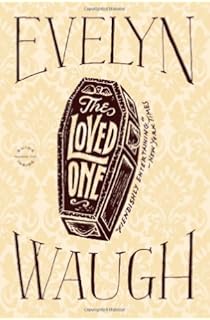
I last read this book toward the end of my senior year of high school. I remember loving it and wishing I'd picked Waugh for my senior paper instead of Thomas Hardy (who I'd chosen as the least of the uninteresting British writers much earlier in the year). Yet strangely, I never went back and read more of Evelyn Waugh.
And now, here is it nearly thirty years later, and I'm finally picking him up again, with the intention of reading much more of this humorous British novelist.
The book, which I remembered was being about a love affair between morticians, one of whom was a plagiarizing poet, was enjoyable again, as it was those decades ago. I can see why I liked it so much in my late teen years: it was funny, and it was dark. The latter probably would have made me like it even more in my early twenties. For it has, under its core, some of the same themes that pop up in many other modernist works. I was reminded quite a bit of the two most famous novels of Nathaniel West, both because of its setting and because of its use of advice column letters.
Also of note--things I didn't remember: The book is about Hollywood, most specifically British writers in Hollywood. There's a good amount of skewering of the movie industry in addition to that of the funerary industry. And the morticians--well, one of them works at a pet cemetery. I laughed out loud at some parts.
I could say something here about how the interest in death is also about the death of the soul, how the main character's interest in becoming a minister merely to make money represents the loss of religion, how he returns to art to replace religion, after losing his artistic abilities to the materialist interests bound within capitalism, which even tries to sell you on burial spots for your pets. Or I could focus on the title and try to ferret out what it is Waugh is saying about our "loved ones." But those sort of philosophical ideas, while perhaps interesting, to me now seem perhaps a bit put on and also lead me to the one fault I have with the novel in these my older years: it doesn't have much heart. It is a vicious book. Funny, but in the end, these characters are cardboard and/or dreadful, and while I enjoyed the book, I didn't find myself caring much about the people themselves. This isn't to say that all books must accomplish this; I like scathingly funny works, dark works, works with characters no one can love too--but I probably prefer most those books that in the end make me feel, and care.
Sunday, April 23, 2017
On “Dendromancy” by Zach Falcon (904 words) ****
"Dendromancy" is about a young man in love with a witch, a real one, into black magic, not "white witchcraft." The story seems innocuous enough, and then it takes a very unsavory turn that shocks, except it's told in such a humdrum manner that one gets the feeling that the narrator does not feel deeply about much, except maybe the beauty of the world. Read the story here at Hawk and Handsaw.
On "The Monopolists" by Mary Pilon *****
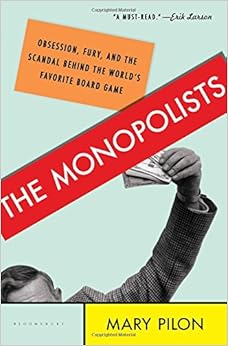
As it turns out, however, the podcast merely skimmed the surface. Another good chunk of this book is about a court case--and about trademark (in addition to copyright and patents) and what it means for inventors and businesses. As such, this book becomes much more than a history. It becomes a kind of polemic, one that will invest you emotionally and will make you a bit angry. You'll cheer the little guy here, which is to say that on one level, this book focuses more on the disadvantages of trademark than the advantages, on the way trademark stifles innovation and small business. My wife, by contrast, pointed out to me that trademark actually protects the little people, and she has a point. There are usually two ways to look at things. No one would want to go into a store and buy a Gucci handbag and then have it fall apart two weeks later (because it wasn't really Gucci); in this sense, trademark protects the consumer. We know when we buy a brand or product that we are actually getting what we have purchased, and if someone tries to get around that trademark, that person will be punished, eventually, so that counterfeiting is discouraged.
But I like a book to rile me up, and this one did. The history part becomes part of the recounting of the lawsuit. The game essentially arose like this: a certain woman named Lizzie Magie created a board game to promote the economic theories of Henry George. That theory essentially promoted a single tax system--a property tax. That way, in theory, excessive landowning would be discouraged, and landlords would not be able to charge exorbitant rents for lousy properties. It was a game intended to show the evils of capitalism; it was called The Landlords Game. One could play it in two ways, one with a single tax system wherein players ended up working harmoniously or one in a monopolistic way wherein people tried to take advantage of each other. The latter, of course, is what won out.
Her game won little notoriety, but people did play it--and copy it--and change it. Games such as Finance and Inflation all played with similar ideas and concepts. A game very much like Monopoly found form among Quakers in Pennsylvania. Enter Charles Darrow. He plays the game at someone's house one night, then asks that person to write up the rules for him. He hires a professional designer to draw up some pictures and make the components pretty. He then begins selling the work as his own, until finally he sells it to Parker Brothers for big dollars, plus residuals. He claims the game as his own creation. Parker Brothers buys up as many patents of similar games as it can in order to better stake a claim to the rights to Monopoly. Magie gets a whopping five hundred dollars.
Parker Brothers does this because it had been burned in the past. Tiddly Winks and Ping-Pong (formally called Table Tennis) being two games that they invested in and marketed heavily only to see those games be considered public domain. So it has good reason to hold its rights to Monopoly closely.
That's the history part. The court case part considers one Robert Anspach, who creates a game for similar reasons as Magie created hers: to show the evils of capitalism--or rather the evils of monopoly. He calls his game Bust the Trust, but no one knows what a trust is, so he changes the name to Anti-Monopoly and sales begin to take off. Enter Parker Brothers, who claim that Anspach has ripped off their trademark. The rest of the story follows the next ten years of Anspach's life as he goes through hell to defend his right to sell and market his creation. There are surprises along the way, so I won't go deeper into the story than that. Suffice it to say that there's a lot of irony in the story: a game about fighting monopolies that becomes, in a sense, the subject of an intense fight over a monopoly. And in the end, the result is the monopolists and trademark advocates get stronger measures in Congress to defend themselves, lest other people like Anspach come along and create problems for big business. This is the part that really makes one feel angry--how much money really seems to matter in terms of the creation of our laws.
Subscribe to:
Posts (Atom)

 Posts
Posts


