Friday, August 22, 2008
On "Crowbar" by Joshua Capps (5809 words) *****
For all the mention of how many 9/11 stories there are, I haven't seen a lot of them, not in fiction, that is. Maybe editors are keeping them away from us. Maybe this is wise. I could see the subject easily being overdone. And I could easily see it being treated with too much sentimentality--today's soap opera classic. Joshua Capps's "Crowbar" definitely isn't sentimental. In fact, I think some people might even find it offensive, though Capps gets away with it because it's not Capps who's potentially offensive but the character at the heart of this story. But it's this character, this no-holds-barred selfish character who makes the story so readable, so interesting, so harsh, so sad. Read the story here at Storyglossia.


On "Contemporary Japanese Literature: An Anthology of Fiction, Film, and Other Writing since 1945" edited by Howard Hibbett ***
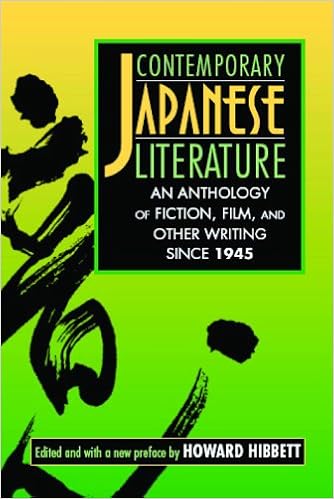
Yoshikichi Furui, "Wedlock" (story)
Taeko Kono, "Bone Meat" (story)
Kobo Abe, Friends (play)
Shotaro Yasuoka, "Prized Possessions" (story)
Nobuo Kojima, "The American School" (story)
Akira Kurosawa, Ikuru (screenplay)
Yasujiro Ozu, Tokyo Story (screenplay)
Taijun Takeda, "To Build a Bridge" (story)
Yumiko Kurahashi, "To Die at the Estuary" (story)
Yukio Mishima, "The Boy Who Wrote Poetry" (story)
Yasunari Kawabata, "The Pomegranate," "The Camellia," "The Plum," "The Jay," "Summer and Winter," "The Bamboo Leaves," and "The Cereus" (stories)
Mitsuhara Kaneko, "Song of Loneliness," "The Sun," and "The Receiver" (poems)
Hiroshi Sekine, "Abe Sada," "The Golden Pavilion," and "Dream Island" (poems)
Ryuichi Tamura, "The Man with a Green Face" and "Human House" (poems)
Minoru Yoshioka, "Still Life" (1), "Still Life" (2), "Paul Klee's Dining Table," and "Nude Woman" (poems)
Mieko Kanai, "The House of Madam Juju" (poem)
Akira Abe, "Peaches" (story)
Junichiro Tanizaki, "The Bridge of Dreams" (story)
Tatsuo Nagai, "Brief Encounter" (story)
Junnosuke Yoshiyuki, "In Akiko's Room" (story)
Kenzaburo Oe, "Aghwee the Sky Monster" (story)
Akiyuki Nosaka, "American Hijiki" (story)
Highlights of the anthology included the first piece, by Furui, which was about a fairly young couple living in an apartment building among young rowdy workers. The couple's male half, who typically spends his days at work, gets sick, so he gets to spend time learning what his wife's life is like during the day.
Another interesting one was Kobo Abe's play Friends. The situation essentially involves a family that decides that its duty is to help out people who live alone, people who must obviously be lonely. The way to do this is to move in with the single person and make him part of your family. (Never mind that in this case, the man had a fiancée.) So this family comes and takes over his apartment, and the man is unable to get rid of them. They live off all that he earns, eat all that he brings home for food. The play is rather absurd, as many plays are, but enjoyable. It reminded me in a way of a Japanese film I did not like called Audition, in which a woman "auditions" to be a man's girlfriend (he poses as a director in order to find a girlfriend, auditioning each one); the situation soon becomes disturbing as she proves to be psychotic. (In the play's rather absurd premise it also reminds me of a great Japanese film that I loved called After Death, but I won't go into that here.) Friends is a pleasant and light play; Audition is not pleasant or light--it is horrifying. But they both share that same dubiousness regarding connection and family and duty, all of which I would guess carry much heavier feelings of obligation than they do in the West. Hence, by the end of the play, when the man is literally caged, like an animal, to teach him a lesson (if only he'd appreciated the family that had moved in with him, he could have just enjoyed the experience rather than being so miserable and having to be punished), one gets a sense the author is drawing some sort of parallel to the idea of family within the culture as a whole.
Akira Kurosawa's screenplay was also really good--and, I think, more concisely written than Abe's play. I've only Kurosawa's Ran. It's these stories of traditional Japan for which he seems most famous here in the States, but the editor of the anthology notes that Kurosawa actually prefers his films about contemporary Japan. For my taste, if most of them are like this screenplay, I can see why. I was not a huge fan of Ran, but I really liked Ikuru. The film is about a man who works for a bureaucratic section of the government. The job of government employees seems to be mainly to avoid letting people get help--each employee just passes customers to the next employee and on it goes down the line. One of these bureaucrats, however, learns he's dying of cancer and doesn't have long to live. So the rest of the film, he's questioning his purpose in life. And by the end, he has found it--fighting the bureaucracy of which he is a member. It was a pretty upbeat movie, with a share of funny moments.
Of the poetry, Mieko Kanai's "The House of Madam Juju" stood out the most to me--an exploration of Japanese beauty, as it has been commercialized for women.
Akira Abe's story "Peaches" is about memory--one memory. The character thinks about a time when his mother and he pushed a stroller of peaches down a hill, and it was a cold winter night, and his mom put her shawl around him. But then he deconstructs the memory, noting that the events could not have happened as he remembered them. There would not be peaches in winter. So which part of the memory is he making up? He circles round and round, trying to sort out all the various events that may have led to this one memory. In the end, he never does figure it out. Sometimes, I think keeping a diary could be of use for precisely this. I know that one time I was recounting something I'd done, and then I went back and checked a diary I had kept of the events and realized I'd merged several days of events into one day. But I don't generally keep a diary. I wonder how many other events have gotten merged and messed up in my head over the years. "Peaches" was an interesting exploration of how our minds trick us.
Perhaps the best short story in the book was by Kenzaburo Oe. I say this with some surprise, having read Nip the Buds, Shoot the Kids a few years ago and not having been that moved by it. It was fine, but nothing that made me want to read more of his stuff. But "Aghwee the Sky Monster" is a piece I think I will remember for a while. It's about a man hired to take care of a musician who has supposedly gone insane--the musician has a baby in the sky who comes to visit him from time to time; conversations ensue, which, of course, embarrass the young caretaker. But there's a big back story that readers slowly discover, which makes the intriguing and ridiculous situation even more interesting. I'll have to give another Oe novel a read.
The last story, "American Hajiki," is a humorous piece that echoes some of the themes of Friends, but puts those themes in a political context. It's about a man who lived during World War II whose wife has invited some Americans to take a Japanese vacation at their home. The wife had previously visited them in America and has been a pen pal for some time. The husband is none too pleased by the wife's offer. The lead-up to the visit and eventual visit are mixed with the man's memories of the early postwar days. The man comes to wonder why it is that, in the end, who always ends up "serving" his American masters--and so wanting to serve them, despite the fact that they killed his father. There's quite a bit of humor amid the various cultural misunderstandings that go on.
Wednesday, August 20, 2008
On "China Mobile" by Summer Block (3381 words) ****
Stories in exotic locales or involving exotic characters have long enchanted, almost always in part because of the exoticism itself. Good stories, however, do more than just show off the exoticness. Sometimes they manage to convey a sense of place and time and character that makes one think for a moment, "Yes, I too was there," even though of course you weren't. This is one of those. "China Mobile" does this in part by running down a description of a list of friends, friends like Chloe, who "was more than just pretty, but . . . was also pretty." A few sentences on each, a few comments on drinking and getting along, and one gets a sense of this narrator's world. It is a small place, just one little microcosm in something so much larger, so much larger that it is beyond words. We can't know China, but we can know this one little piece of it--a piece of it that is at base still American. One of the things I admired so much about Jay McInerney's novel Ransom, on first read many years ago, was the way it was able to conjure up a world similar to this, a world of American exiles at "home" in some strange, weird place. Block manages something similar here, but without the excesses of plot that made Ransom seem far fetched. Read the story here at Stirring.
Wednesday, August 13, 2008
On "Secretary" by Mary Gaitskill (6060 words) *****
Some of you may be familiar with the movie Secretary, which came out about five years ago. That film is an erotic love story involving S&M. The brainchild for the film, however, was Gaitskill's story of the same name, but the direction that the two works take is decidedly different. The movie is a romance. The story is goes in the direction we would more likely expect--a certain disgust with the actions of the boss. What makes it compelling, however, is the main character who, as in the movie, seems turned on by her boss's actions. But here it isn't simplified. Here, the girl's interest is offset by her own uncertain feelings about herself and her life, her own lack of confidence. The ending, as one might expect, is very different from the movie. Gaitskill's work revels in these awkward situations created by our own untoward desires. Not surprisingly, this story is in a collection called Bad Behavior. Read the story here at Nerve.
Wednesday, August 6, 2008
On "Some Things You Should Know about Me before We Meet" by Josh Honn (1037 words) ****
Some stories take what should be a rather mundane subject and put them in a form that makes them, if not fresh, definitely funny. Amy Havel does something similar in her story "Enough Said" that I blogged about earlier--telling us a story of a relationship in a few simple phrases repeated over and over, until the story takes on a tragic tone. Here, Honn tells us the story of a relationship in the form of a letter--an introductory letter. The concept makes the whole story seem preposterous, and yet in that is the humor, because although we know all these things are indeed quite likely, we pretend that they aren't. There is an agreement to be silent. What if, however, we all gave such spiels before dating? Wouldn't it be so much easier? No expectations beyond what we already know . . . Read the story here at Pindeldyboz.
On "Sad Toys" by Takuboku Ishikawa, translated by Sanford Goldstein and Seishi Shinoda ****
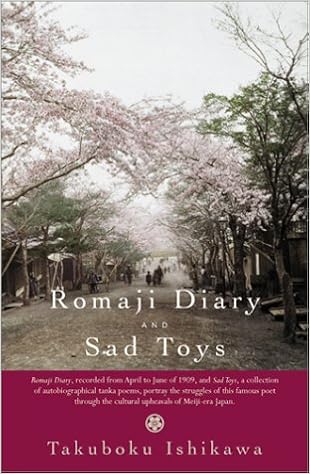
Start just with the title. Toys--that is poems. For poems really are in many ways a poet's toys. For some who write poetry, poems are word puzzles. You take them apart, put them back to better, try to find the best way for all the words to fit, and there's no end to the process. Now, take a poet like Ishikawa, put him in a hospital at a time when he's becoming increasingly aware of his mortality, and clearly, such toys become sad--sad because that's all there is of his life, sad because he's dwelling on sadness. Many of the poems talk about his hospital stay. Many about his coming death, his desire for death (to relieve himself of pain) and his desire to keep on living. And some poems talk about the change in perspective that comes with such events. In one of my favorites, number 75, Ishikawa talks of reading old love letters. His observation? (All of the poems are typically Japanese, typically short--they're tanka.) So many spelling errors. And how true, really, years down the road, when we're no longer madly in love with someone we're just getting to know, all those little peccadilloes come to the fore. We don't speed through a letter the same way; rather, we say, You know, that woman/man never did spell very well! Such are the observations throughout this little gem.
On "Romaji Diary" by Takuboku Ishikawa, translated by Sanford Goldstein and Seishi Shinoda **
Sunday, August 3, 2008
On "This Person" by Miranda July (1049 words) *****
I first came across Miranda July when a friend of mine recommended her movie You and Me and Everyone We Know. It took me about a year to get around to seeing it--as many such suggestions take time to get around to--but once I did, I certainly enjoyed it, as she noted I would. It was quirky in a rather friendly sort of way--and yet it was also kind of disturbing. Disturbing yet reassuring. Those two don't usually go together. I heard about her forthcoming book a short while after that and was quite interested but never got around to buying it. One day, in a fit of sudden Miranda July interest inspiration, I searched for said book on the Net. Somehow, I ended up at the Library of Congress, where one of the stories from her collection No One Belongs Here More Than You is actually posted with the information. I read it, loved it, and quickly--well, within a year--rushed out and bought the book (let's say it quickly went on my list, and then when I had money, I purchased it). I loved the book, much as I loved the story. The collection is uneven, like most--high flying in places, a bit disappointing in others--but great reading all the same.
As for this story, it's one of my favorites in that collection. I love how July is able to capture the incredible weight that a social occasion or party can pose to someone. The use of "someone," "somebody," and "this person" as the protagonist makes the character into an everyman (or -woman--the character has breasts), but it also makes the story seem rather nonsensical and flirty--the way you might hear some parent say something like, "Someone has a birthday today" (as if you--the birthday girl/boy--don't know). And that's what makes the story so funny and powerful. The lengths to which "someone" gets used--someone gets to have a party or someone gets to go blind or . . . Just read the story, and then buy the book.
As for this story, it's one of my favorites in that collection. I love how July is able to capture the incredible weight that a social occasion or party can pose to someone. The use of "someone," "somebody," and "this person" as the protagonist makes the character into an everyman (or -woman--the character has breasts), but it also makes the story seem rather nonsensical and flirty--the way you might hear some parent say something like, "Someone has a birthday today" (as if you--the birthday girl/boy--don't know). And that's what makes the story so funny and powerful. The lengths to which "someone" gets used--someone gets to have a party or someone gets to go blind or . . . Just read the story, and then buy the book.
On "Narrow Road to the Interior and Other Writings" by Matsuo Basho, translated by Sam Hamill ***
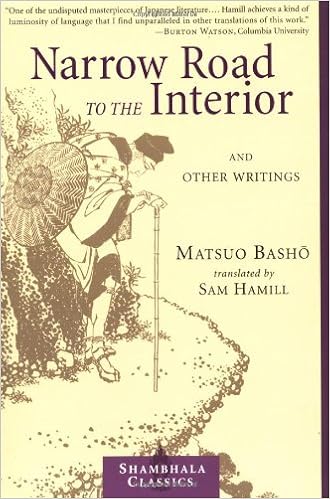
This book features a selection of Basho's haiku, along with a few of his prose travel writings, many of which contain haiku within them and explanations of how those haiku arose. I'm not much of a fan of the travel writing. With the exception of Parker's The Oregon Trail and the Lewis and Clark journals (albeit in abridged form), I don't know that I've encountered any pre-twentieth-century travel writing I've greatly enjoyed--perhaps the observations of such early travelers rarely transfer to me in my context now. Even in the travel writing, Basho is at his best when he delivers to his readers tiny but profound observations that apply to all throughout time, such as this one from his Sarashina Travelogue: "Then the servant mounted the horse, ignoring the danger. He began to doze off and nearly tumbled over a cliff. With every nod of his head, I was stricken with terror. Thinking it over, I ralized that each of us is like the servant as we wade the shifting tides of this stormy world, blind to real danger."
As for the haiku, Basho is wonderful, though my own lack of knowledge of Japanese tradition is somewhat of a barrier to understanding much of their full depth. I'd read somewhere that Japanese haiku works off of certain tropes (the book's introduction discusses some of this)--that if the poem is about spring, for example, it must include a cherry blossom or one of six or seven other things; if it's about winter, it much include a chrysanthemum or one of six or seven other things. Not fully knowing those tropes, I fear I unfortunately lose out on some of what's really going on. But the fact that even without a full knowledge of the culture I can still enjoy the haiku on some level shows Basho's overwhelming skill.
Wednesday, July 30, 2008
On "Cake" by Sarah Rose Etter (1610 words) ****
The connection between food and erotica goes back millennia. Song of Solomon talks of breasts like grape clusters, and Christina Rossetti has a poem about fruits on sale at a market, working the metaphor for something a little more juicy. Etter's "Cake" falls right into that tradition, though for her the metaphor is taken to its literal extreme. I guess all folks have their fetishes. Read the story here.
On "Five Women Who Loved Love" by Ihara Saikaku ****

The first story in the book is typical. It involves a playboy who eventually finds one true love. They attempt to elope but are caught. Money comes up missing, and the former playboy is blamed and sentenced to death. Soon after, the money is found--he wasn't a thief after all. His lover decides to kill herself (only as is to be expected in all of these stories), but after some discussion is convinced instead to become a nun and live a spiritual, monastic life.
It's seventeenth-century fiction, and it's pretty good. It's probably a little sappy, but because I'm reading it in modern translation, it doesn't come across nearly so bad as such melodrama might come off in the original tongue--or maybe the Japanese are simply better at keeping the stories simple than the English are. Whatever the matter is, Ihara Saikaku's point seems to be that love is born in tragedy, and without the possibility of loss, the value of love can't be weighed.
Tuesday, July 29, 2008
On "Salinka Mura and the Typewriter" by Charles Talkoff (910 words) *****
Simply put, I love this story. It's Richard Brautigan silly, but like the best of Richard Brautigan's short stories, it makes some kind of odd sense and even manages to carry a plot. Talkoff turns a typewriter into a literal object. Okay, I guess typewriters are literal objects, so I'm not making a lot of sense. But what I mean is that he turns the whole essence of a typewriter--not just the physical thing itself but also the things it does--into an object. It's beautiful. It makes me want to be a typewriter. Or actually, I think I'd rather be Salinka Mura so I could have beautiful things written on me--or rather, typed. Read the story here.
On "The Tale of Genji" by Murasaki Shikibu, translated and abridged by Edward G. Seidensticker ***

He does have his enemies, namely the emperor's first wife, who wants her own son placed on the throne. Genji is thus demoted to commoner status, though he has court privileges (not being an expert on ancient Japanese affairs, how some things work in the novel are a little lost on me). This is to his own good, as far as love life is concerned. Without responsibilities, he has time to woo five to ten ladies at any given time and even knock up his father's concubine (the son that results from the affair later becomes emperor).
Genji has a wife too. She's pretty cold, but no doubt, as much as Genji may complain about her and blame her for his seeking solace in the company of others, his continued dalliances with other women only add to her coldness. It is only when she dies as a result of childbirth that he finally finds some way to appreciate her and that mostly through excessive grief. Is it guilt that drives him? I don't know. It seems a short repentance, for within a year or so, he's back to his philandering ways, and this brings its share of troubles, which I won't go into here. At some point, we learn that a soothsayer has told him he will have three children (all by different women apparently)--two to become emperors. And the abridgment ends at a convenient spot, with Genji no longer quite as interested in romantic affairs, wishing to leave court life, but now devoted to seeing that his children are well provided for.
This is a novel written a thousand years ago. The mannerisms seem foreign, but the characters and passions involved seem as current as ever--save that much of the seduction takes place by the point of a pen (forget what the women look like--how nice is their handwriting?).
Seidensticker notes that if the abridgment causes one to want to read the full book, he's done his job. I can't say he quite worked his magic on me. I enjoyed his abridged version, and I'm curious to know where the story goes from here, but I'd be just as happy to read a synopsis of the rest of the plot as to read the other thirty-seven chapters.
An online version of another translation of the book is available here.
Monday, July 28, 2008
On "The Floor Champion of Foosball" by Carrie Hall (2859 words) ****
I admit it. I was first taken in by this story because of the title--specifically because of the word foosball. I'd never been much of a fan--I always preferred air hockey growing up. But when I moved to Athens half a decade ago, my friend Al and most of my other acquaintances were big into foosball, and as a result a certain adoration for the game budded within me. Sure, I'd still take air hockey or shuffleboard over the other, but the fact is that when Al and Aaron and Julien and company stopped playing, there was a small hole in my bar world.
So the story . . . Set on a psych ward in some place we don't know, the way pysch wards often are worlds unto themselves, this story manages to convey the essence of four very interesting and disturbed characters, as well as the setting itself. For our narrator, foosball is her way out--or maybe perhaps more accurately just another way for her to lord herself over the others. I can't say this piece makes me hope for the white-suited men to take me away anytime soon, but I suppose that's a good thing--you know, that I want to continue to be normal, rational, stable. . . . Read the story here.
So the story . . . Set on a psych ward in some place we don't know, the way pysch wards often are worlds unto themselves, this story manages to convey the essence of four very interesting and disturbed characters, as well as the setting itself. For our narrator, foosball is her way out--or maybe perhaps more accurately just another way for her to lord herself over the others. I can't say this piece makes me hope for the white-suited men to take me away anytime soon, but I suppose that's a good thing--you know, that I want to continue to be normal, rational, stable. . . . Read the story here.
Monday, July 21, 2008
On "Shot Girls" by Kim Chinquee (5097 words) ****
This is a story about two sisters, each of whom wants to be like the other, about what it means to become the other. Okay, I've made the story sound like Parent Trap 3, but it's not like that at all. The girls in this story go through some messed-up stuff. Okay, maybe it does sound like Parent Trap 3--but this definitely isn't Disney fodder. These girls aren't smiling at the end. These girls grow up, in some rather unpleasant ways. Read the story here.
On "Anthology of Japanese Literature," compiled and edited by Donald Keene ****
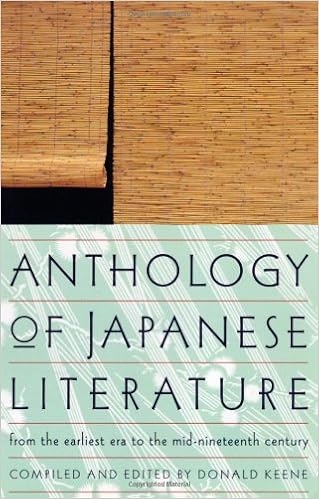
Ancient Period (to 794 A.D.)
Man'yoshu
The Luck of the Sea and the Luck of the Mountains
Kaifuso
Heian Period (794-1185)
Kukai: Kukai and His Master
The Tales of Ise
Kokinshu
Ki No Tsurayuki: TheTosa Diary
Poetry from Six Collections
The Mother of Michitsuna: Kagero Nikki
Murasaki Shikibu: Yugao (from The Tale of Genji, which is available here)
Sei Shonagon: The Pillow Book
Murasaki Shikibu: Diary (available here)
The Daughter of Takasue: The Sarashina Diary (available here or here)
Poetry in Chinese
Ryojin Hisho
The Lady Who Loved Insects
Kamakura Period (1185-1333)
The Tale of Heike
Shinkokinshu
Kamo No Chomei: An Account of My Hut
Tales from the Uji Collection
The Captain of Naruto
Muromachi Period (1333-1600)
Yoshida Kenko: Essays in Idleness
The Exile of Godaigo
Seami Motokiyo: The Art of the No
Kan'ami: Kiyotsugu: Sotoba Komachi
Seami Motokiyo: Birds of Sorrow
Seami Motokiyo: Atsumori
Seami Motokiyo: The Damask Drum
The Bird-Catcher of Hades
Busu
Poems in Chinese by Buddhist Monks
Three Poets at Minase
The Three Priests
Tokugawa Period (1600-1868)
Ihara Saikaku: What the Seasons Brought to the Almanac-Maker
Ihara Saikaku: The Umbrella Oracle
Ihara Saikaku: The Eternal Storehouse of Japan
Matsuo Basho: The Narrow Road of Oku
Matsuo Basho: Prose Poem on the Unreal Dwelling
Mukai Kyorai: Conversations with Kyorai
Haiku by Basho and His School
Chikamatsu on the Art of the Puppet Stage
Chikamatsu Monzaemon: The Loves Suicides of Sonezaki
Ejima Kiseki: A Wayward Wife
Jippensha Ikku: Hizakurige
Takizawa Bakin: Shino and Hamaji
Haiku of the Middle and Late Tokugawa Period
Waka of the Tokugawa Period
Poetry and Prose in Chinese
Of the first four sections, I particularly enjoyed the poems selected from Man'yoshu, the passage from the Sarashina Diary, and Kamo No Chomei's "An Account of My Hut." Man'yoshu is one of the first major works in Japanese literature--it's a collection of poetry put together by an emperor, from various sources. And its quality seems outstanding, at least in the selections Keene has chosen. While British literature starts with a story of Grendel, in the epic poem Beowulf, which sounds much more interesting than I ever found it to actually be, and American literature starts with Puritan sermons, Japanese literature starts with poetry. Okay, there are prose pieces that are like myths--some similar to Native American materials (which are usually unintelligible to me and not very interesting)--but most of the early stuff is poetry, simple lyric poetry, short, as Japanese poetry tends to be. And I enjoy it. I think what I like about the poetry as opposed to the more mythic pieces in our English literature is that it's easy to identify, to understand what the poet is writing and experiencing. And that's also part of what's so interesting, these poets thinking about their mortality, about the weather, about love--they're writing over one thousand years ago, and they could be writing now. I don't know if that's comforting or sad or what, the idea that humans struggle with the same issues through time immemorial. Maybe it's just surreal, when I think about how long ago that was and how much similar it was to today, and how, if time goes on, humans will be worrying and thinking about the same thing a thousand years after I'm gone also.
The Sarashina Diary centered around a woman whose parents sent her to the royal court to live. She was older, around twenty-six, and unmarried. She didn't really want to go, but did in deference to authority. She'd heard that many women found husbands there, though she figured herself a bit too old for that. As the plot fell out, it was hard to believe this was a diary, rather than a short story. It seemed complete and thematic and sad, with a rise and climax and fall as in any good story. The woman, as it turns out, does meet a man one day. But it is only for a brief period. They exchange a few messages via poetry, but for whatever reason circumstances don't allow them to actually begin communicating much in person (there are always others around for one). About six months later, without contact, the man shows up at a social function in hopes of seeing her. She doesn't know and so misses him. He comes to visit her, leaves a note. She misses him again but writes a reply. Alas, he is gone by the time its ready. Such a sad story of near meetings. What also struck me about this piece, and many others, however, was how prevalent poetry seems to have been in the society then. People wrote of their day in poetry, and they courted in poetry as well--exchanging haiku and tanka with potential mates. Wouldn't it be a curious world if we did that nowadays? But maybe e-mail is equivalent. Somehow, it just doesn't seem as romantic as a poem.
As for "An Account of My Hut," it was a piece that reminded me a lot of Ecclesiastes. Kamo No Chomei was a Buddhist who, in this short account, thinks heavily about his life, about the happenings in Japan, and about how little of it is of any lasting consequence. Amid all this there are recountings of several distasters that hit Japan during a relatively short span during his life (an earthquake, a plague), as well as recountings of his homes, which get progressively smaller as he ages. In the end, he realizes he needs little more than a ten-foot hut--and he ponders why he's even bother to write. Lots of deep thinking. It's pretty short. I wish there were a translated version available online to share.
From the Tokugawa Period there was also much to admire. Three works in particular stood out for me, two of which I'd like to return to at some point to read the rest of the work. Ihara Saikaku's "What the Seasons Brought to the Almanac-Maker," one section from his novel Five Women Who Loved Love, seemed intriguing to me in part because of its fairly modern-seeming structure. I tend to go for those kind Gertrude Stein-type Three Lives books. This one covers five lives, specifically the erotic parts of them at that--and in seventeenth-century Japan, there is much to be curious about, given the very different times and culture.
I also liked Jippensha Ikku Hizakurige, a tale of two travelers on the road. Apparently Jippenshu wrote a whole series of these, all of the light and humorous but nevertheless providing an entertaining and interesting insight into the Japanese culture of the early 1800s.
Finally, the poems and prose in Chinese were interesting if not for themselves then for the historical perspective that they offered. Keene chooses to end his anthology with a set of works that discuss, in particular, the coming of Westerners, the opening of the ports, and Japan's seeming weakness in the face of these. There is much criticism in these poems and the one short profile offered of the leaders who fail to fight back, who let the barbarian Westerners in. And there is hate--hate of the Dutch and of the Russians and of all the others from the West; and hate also, for Japanese themselves, who feel as if in this dawning of a new age, Japan has lost its way and its power. In some eras, women act like men, one writer intones sadly (contemporary political correctness aside), while in others men act like women.
Friday, July 18, 2008
On "Lifelines" by B. J. Hollars (1521 words) ****
I love fantastic realism, but so much of the genre that I come across on the Net tries too hard, compromises with the very heart of what fantastic realism does, which is merge the two elements in such a way that the fantastic seems very real. At it's best, though, the genre makes for great reading and interesting commentary on one of humanity's conditions (generally one to two of them at a time--social, ethical, existential, whatever). This story, which appears in Fawlt Magazine--itself an interesting endeavor, themed around various human faults with each issue (and somehow managing still to have enough to select from to be good)--this story is about man who grows up with a broken heart, which somehow requires that he wears mittens full time. I couldn't help but identify with him in his early life, the way everyone wants to protect him, which in turn isolates him, as my rather frail frame as a kid tended to do to me (kids wouldn't let me play football with them, lest I get hurt). I also thought of other cases, a kid I knew who actually had had a heart operation, and who couldn't do any sort of aerobic activity and who was, thus, likely even more isolated than I ever was. Hollars's does such a great job of painting this picture that I was thinking from a point of view I hadn't really considered before, and then the story grows as the character does, leading to its tragic end. Expect to read more about Hollars's stories on this blog; I've been coming across him quite a bit lately and have generally been pleased. Read the story here.
Friday, July 11, 2008
On "The Dead" by James Joyce (15,635 words) *****
There have been enough critical reviews of this classic story that there's no need to wax on about what it all means or how gloriously good this story is. I merely note that a couple of weeks ago, in preparation for a short story reading club I'm a member of, I returned to "The Dead" after more than fifteen years hiatus. I love James Joyce, and I like Dubliners--some of the stories, I love. I don't entirely understand all of the stories, though--Joyce's subtleties sometimes go over my head (though I'm sure any story's point is nothing a good critic couldn't explain). Or mabye I used to not understand some of the stories. That's what struck me on this reading, just how obvious Joyce makes he makes his theme of "The Dead" here. Did I miss all this when I was younger? Or had I simply forgotten it? As for the story itself, on this read, I found it a little slow, but all was forgiven by the time I reached the end and had chills going down my spine from just how moving the story had become. Read it online here.
On "Japanese Literature" by Roger Bersihand ***

Wednesday, July 9, 2008
On "Based on a True Story" by Dave Peters (886 words) *****
This is a story I've always wanted to write but could never get right. It's the story of the end of a life, and the seeming consciousness that goes along with it--the knowledge that you are going to die, in minutes--and what you are you going to do? I have never been able to find the intensity needed to put the story in the right place, that mix of mundane and superimportant, the will to live versus the growing resignation to fate. Peters, here, manages all of that with skill. At 886 words, this story seems so much longer than it really is. Time slows, as one would expect, at this moment, given the full-on lengthy, real-time description of the process of suffocation. But where too many stories would fail in this description, this one succeeds. I think the reason might be that Peters wisely shifts views in the middle, moving from the victim to those around. This has the effect of making things seem to take that much longer, and it increases the harshness and the sadness of the final paragraph as we watch the woman making her last stabs at air. Read the story here.
Subscribe to:
Posts (Atom)

 Posts
Posts


