Showing posts with label Four-Star Anthologies. Show all posts

Monday, May 30, 2022

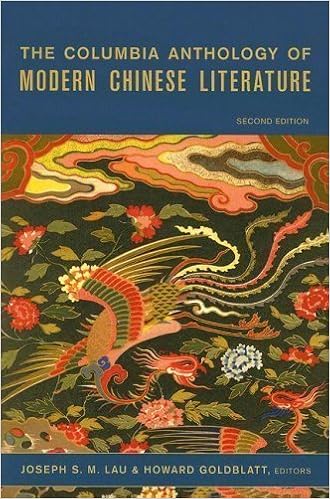
On “The Columbia Anthology of Modern Chinese Literature,” edited by Joseph S. M. Lau and Howard Goldblatt ****

This is the second volume of Chinese literature put out by Columbia University Press that I've read. The first was classic lit; this volume deals chiefly with the literature of the twentieth century. The shame in that is that when the two volumes are put together, the one to two hundred years in between get short shift. Like the previous volume, I was not a fan of the manner in which this volume was put together. As someone who knows little about Chinese literature and who is trying to learn more about it, I would have relished a bit more attention to context. Why these selections? And what do these selections say about the state of Chinese literature at the time? This volume, rather, is set up like a literary anthology in which the editors' voices are relatively muted; the “literature” you're reading is the important stuff, even if you know little about it. There are no headnotes. Instead, there is a set of short biographies placed at the start of the entire book, forcing a reader to go back and forth between the selections and the bios for info. The bios give good life info and sometimes a little info about the selection itself, but it's hard to glean, from the bios and the overall setup, why the editors chose some works or how relatively important the writer or the piece is to the overall body of modern Chinese literature. I found myself no longer checking the bios by about halfway through the volume, as they began to run together.

Intriguingly, the editors chose to provide the volume in three sections, with three subsections each. First, the anthology is split up by genre: Fiction, Poetry, and Nonfiction. Then, it is split up by period: pre-Mao (from 1918), Mao, and post-Mao. Personally, I would have preferred the genres not be split out, so that the work would have been wholly chronological, but I can see the value in the generic splits. The fiction section is the longest, taking up 5/7 of the overall text, with the poetry and nonfiction each taking up about a seventh. Initially, I would have thought the fiction—short stories, not chapters from longer novels—too long, but the editors choice here seems to be wise. It is the stories that are the strongest section of the book. The poetry, I found, though often full of profoundly beautiful imagery did not seem on par, as a whole, to the classic Chinese poetry of years before, the images often not evoking a parallel track of thought about life. The nonfiction was also not so inspiring or interesting to me. As such, the stories proved to be the section that most seemed to reflect the concerns of daily life for modern Chinese.

What is evident in the pre-Mao section stories is the poverty that must have dominated China before the coming of communism. Such helps explain why the revolution came about. One gets the sense in some tales, which present a more communistic view, of the hope some held out for revolutionaries. But mostly, one gets the feeling for the overall povery of the population. The Mao section of stories present only a few of idealism. That's because so much of the literature that the editors have chosen comes out of Taiwan. But there's probably good reason—idealistic stories of Maoist society do not generally make for interesting reading, except maybe the first one or two times. The Post-Mao world is surprisingly open about the failures and horrors of the Cultural Revolution—neighbors turning in/on neighbors to keep from being turned in themselves, no one truly guilty of anything outside a willingness to sell others out for alleged lack of loyalty to save one's own skin; old revolutionaries who have come to see the folly of their hopes; local party leaders who use their authority to perform heinous acts.

My two favorite pieces in the book stemmed from this post-Mao period. The first, “The Tunnel” by Chen Ruoxi, concerns a lonely older man whose adult children are devoted to the party and who are making their way up various government positions. This older man cannot be and is not allowed to have a love interest, since that would interfere with inheritance and potentially with the children's party status. During the course of the story and his service on one of the party committees helping to aid the community, he finds himself falling for a widow, whose husband had been accused of being against the party and had been taken away. The father finds various amusing ways to have small trysts with this woman, sneaking out, for example, to see movies with her. But the family will NOT allow him to remarry—it is simply shameful for an older man and would hurt his children's own economic needs. One day, the couple opts to skip the movie and go for a hike in some lesser known part of the city. They find a tunnel and some alone time. The ending here is heartbreaking, just as the man's experience of being denied love would have been.

The other story, and a very short one at that, that stood out to me was Liu Yichang's “Wrong Number,” not so much for its emotional connection as for its technical trickery. The tale is one told twice, once without the “wrong number” phone call and once with it, showing how a few minutes—a dead butfferfly, if you will, to use the old sci-fi trope—can change the course of one's life.

Thursday, February 18, 2021

On "The Shorter Columbia Anthology of Traditional Chinese Literature" edited by Victor H. Mair ****

This concise volume of Chinese literature mostly dating to pre-1800 seems like a nice introduction to someone like me who is largely unfamiliar with Chinese literature outside of a few fundamental philosophical texts. Mair also aims to present lesser known contemporary translations, most of which seemed accessible and interesting.

That said, while I enjoyed the basic introduction, I found the book's layout and structure to be less than ideal. In terms of layout and design, the introductions to each of the individual pieces are set as footnotes rather than as headnotes, making for confusing reading. Sure, it's easy enough to figure out how the layout works after the first couple of entries, but the fact that the "headnotes" were set as footnotes means that on the few occassions where an introduction to a given reading is really long, the footnote runs across several pages; one then has to turn back several pages to begin the reading. The annotative footnotes can be useful and are appropriately set at the bottom of the page, though I found as I got deeper into the anthology that I read fewer and fewer of them, as many of them weren't essential for the understanding of the work and thus interrupted my enjoyment of the text; that said, as "optional" reading for further, they certainly are nice to have.

Another complaint I had with the general set-up was the choice to split the work up by genre. This, obviously, is the volume editor's choice, and it has some advantages, such as giving one a sense of the differing genres within Chinese literature as a whole. However, the editor doesn't really use the set-up to advantage because there are no general introductions to each genre outside of the extended footnotes at the start of a given reading. I would have preferred to have read the works in wholly chronological order, which would have given me more of a sense of the developing literary output over Chinese history, be it poetry, fiction, letters, drama, philosophy, criticism, prefaces, or whatever. The genre divisions were particularly frustrating when a given author wrote within several genres (some of which were related--lyric vs. poetry; poetry criticism vs. poetry; letter to another poet vs. poetry); thus, the book splits up his (and it generally is men who are the writers) various selections across hundreds of pages, with footnotes/headnotes referencing one back to some much earlier selection for a biography and more info. One doesn't get a feel for how a given author's criticism relates to his creative output or his work in another genre as a result. As such, I felt like I didn't really get as good a sense for Chinese literature as I might have.

Individual selections I found particularly interesting included the following.

I really enjoyed the passages from the Tao te ching that were selected, and I will gladly read this work in whole later in my study (in fact, I've already started).

I also really enjoyed much of the poetry that the editor selected. The poetry, in fact, is probably the only genre of traditional Chinese literature that I can say impressed me, as the rest seemed heavily folk oriented, pat, or too culturally centered to speak to a person thoroughly ensconsed in Western culture (one chapter is devoted to jokes, few of which made much sense to me, outside of the accompanying explanations, which of course made them less than funny). Of the poetry, I enjoyed, of course, the classic poets Li Po and Tu Fu. I also really liked the selections from the Book of Songs and hope to read more of that work down the road. What I came away with in regard to the poetry specifically was an understanding of how human feelings really cross time and space; many of the works seemed quite modern in terms of the issues the poets were dealing with, and yet the poems are often thousands of years old.

Li Shang-yin's Miscellany was a particularly interesting selection. Though not a poem in the anthology (it is in the genre Miscellany, because it is a list), the work is a set of lists on various topics that might as well be poetry, given how interesting most of the lists are--what is shameful, what is not to be despised, what is unlucky, and so on, more than forty lists in all.

In the novels section, I really enjoyed the passage from Ts'ao Hsueh-chin's Dream of Red Towers (more commonly known as Dream of the Red Chamber), which I'll likely given a full read of at a later time.

One nice thing about reading an anthology such as this is that I was able to read in a few genres, such as drama, that I'll likely not otherwise explore as I begin selecting invidual longer works to read. That's, of course, one reason I chose to read an anthology early on in my Chinese reading list and why I'll likely read the companion volume of modern Chinese literature sometime soon as well.

Monday, July 21, 2008

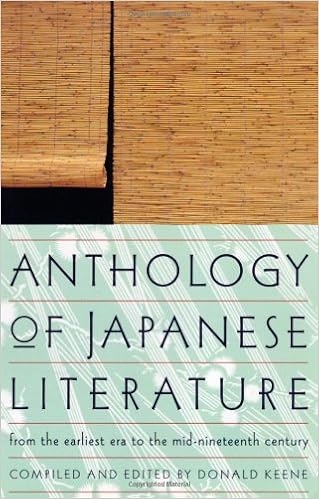
On "Anthology of Japanese Literature," compiled and edited by Donald Keene ****

For an uninitiated person like me, this was a really good quick and dirty rundown on early Japanese literature. And that is partly why I picked it over other anthologies, which seemed too long or too focused. Keene aims rather to give a person a real feel for what the Japanese were writing up until 1870, and with just 450 pages, he appears to do an excellent job. (Another anthology I am planning to read will cover the post-1945 period, and yet another the late 1980s, so I'll have covered pretty much the swoop of Japanese literature, save the realism/naturalism/Meiji eras between 1870 and 1945, which is a bit of shame--I had thought I'd caught that period in one of the anthologies but apparently not, though many of the writers from those periods do show up in one anthology or another via their early or late work.) So here's a short rundown on the works (most of the selections, some of them complete) in Keene's anthology:

Ancient Period (to 794 A.D.)
Man'yoshu
The Luck of the Sea and the Luck of the Mountains
Kaifuso

Heian Period (794-1185)
Kukai: Kukai and His Master
The Tales of Ise
Kokinshu
Ki No Tsurayuki: TheTosa Diary
Poetry from Six Collections
The Mother of Michitsuna: Kagero Nikki
Murasaki Shikibu: Yugao (from The Tale of Genji, which is available here)
Sei Shonagon: The Pillow Book
Murasaki Shikibu: Diary (available here)
The Daughter of Takasue: The Sarashina Diary (available here or here)
Poetry in Chinese
Ryojin Hisho
The Lady Who Loved Insects

Kamakura Period (1185-1333)
The Tale of Heike
Shinkokinshu
Kamo No Chomei: An Account of My Hut
Tales from the Uji Collection
The Captain of Naruto

Muromachi Period (1333-1600)
Yoshida Kenko: Essays in Idleness
The Exile of Godaigo
Seami Motokiyo: The Art of the No
Kan'ami: Kiyotsugu: Sotoba Komachi
Seami Motokiyo: Birds of Sorrow
Seami Motokiyo: Atsumori
Seami Motokiyo: The Damask Drum
The Bird-Catcher of Hades
Busu
Poems in Chinese by Buddhist Monks
Three Poets at Minase
The Three Priests

Tokugawa Period (1600-1868)
Ihara Saikaku: What the Seasons Brought to the Almanac-Maker
Ihara Saikaku: The Umbrella Oracle
Ihara Saikaku: The Eternal Storehouse of Japan
Matsuo Basho: The Narrow Road of Oku
Matsuo Basho: Prose Poem on the Unreal Dwelling
Mukai Kyorai: Conversations with Kyorai
Haiku by Basho and His School
Chikamatsu on the Art of the Puppet Stage
Chikamatsu Monzaemon: The Loves Suicides of Sonezaki
Ejima Kiseki: A Wayward Wife
Jippensha Ikku: Hizakurige
Takizawa Bakin: Shino and Hamaji
Haiku of the Middle and Late Tokugawa Period
Waka of the Tokugawa Period
Poetry and Prose in Chinese

Of the first four sections, I particularly enjoyed the poems selected from Man'yoshu, the passage from the Sarashina Diary, and Kamo No Chomei's "An Account of My Hut." Man'yoshu is one of the first major works in Japanese literature--it's a collection of poetry put together by an emperor, from various sources. And its quality seems outstanding, at least in the selections Keene has chosen. While British literature starts with a story of Grendel, in the epic poem Beowulf, which sounds much more interesting than I ever found it to actually be, and American literature starts with Puritan sermons, Japanese literature starts with poetry. Okay, there are prose pieces that are like myths--some similar to Native American materials (which are usually unintelligible to me and not very interesting)--but most of the early stuff is poetry, simple lyric poetry, short, as Japanese poetry tends to be. And I enjoy it. I think what I like about the poetry as opposed to the more mythic pieces in our English literature is that it's easy to identify, to understand what the poet is writing and experiencing. And that's also part of what's so interesting, these poets thinking about their mortality, about the weather, about love--they're writing over one thousand years ago, and they could be writing now. I don't know if that's comforting or sad or what, the idea that humans struggle with the same issues through time immemorial. Maybe it's just surreal, when I think about how long ago that was and how much similar it was to today, and how, if time goes on, humans will be worrying and thinking about the same thing a thousand years after I'm gone also.

The Sarashina Diary centered around a woman whose parents sent her to the royal court to live. She was older, around twenty-six, and unmarried. She didn't really want to go, but did in deference to authority. She'd heard that many women found husbands there, though she figured herself a bit too old for that. As the plot fell out, it was hard to believe this was a diary, rather than a short story. It seemed complete and thematic and sad, with a rise and climax and fall as in any good story. The woman, as it turns out, does meet a man one day. But it is only for a brief period. They exchange a few messages via poetry, but for whatever reason circumstances don't allow them to actually begin communicating much in person (there are always others around for one). About six months later, without contact, the man shows up at a social function in hopes of seeing her. She doesn't know and so misses him. He comes to visit her, leaves a note. She misses him again but writes a reply. Alas, he is gone by the time its ready. Such a sad story of near meetings. What also struck me about this piece, and many others, however, was how prevalent poetry seems to have been in the society then. People wrote of their day in poetry, and they courted in poetry as well--exchanging haiku and tanka with potential mates. Wouldn't it be a curious world if we did that nowadays? But maybe e-mail is equivalent. Somehow, it just doesn't seem as romantic as a poem.

As for "An Account of My Hut," it was a piece that reminded me a lot of Ecclesiastes. Kamo No Chomei was a Buddhist who, in this short account, thinks heavily about his life, about the happenings in Japan, and about how little of it is of any lasting consequence. Amid all this there are recountings of several distasters that hit Japan during a relatively short span during his life (an earthquake, a plague), as well as recountings of his homes, which get progressively smaller as he ages. In the end, he realizes he needs little more than a ten-foot hut--and he ponders why he's even bother to write. Lots of deep thinking. It's pretty short. I wish there were a translated version available online to share.

From the Tokugawa Period there was also much to admire. Three works in particular stood out for me, two of which I'd like to return to at some point to read the rest of the work. Ihara Saikaku's "What the Seasons Brought to the Almanac-Maker," one section from his novel Five Women Who Loved Love, seemed intriguing to me in part because of its fairly modern-seeming structure. I tend to go for those kind Gertrude Stein-type Three Lives books. This one covers five lives, specifically the erotic parts of them at that--and in seventeenth-century Japan, there is much to be curious about, given the very different times and culture.

I also liked Jippensha Ikku Hizakurige, a tale of two travelers on the road. Apparently Jippenshu wrote a whole series of these, all of the light and humorous but nevertheless providing an entertaining and interesting insight into the Japanese culture of the early 1800s.

Finally, the poems and prose in Chinese were interesting if not for themselves then for the historical perspective that they offered. Keene chooses to end his anthology with a set of works that discuss, in particular, the coming of Westerners, the opening of the ports, and Japan's seeming weakness in the face of these. There is much criticism in these poems and the one short profile offered of the leaders who fail to fight back, who let the barbarian Westerners in. And there is hate--hate of the Dutch and of the Russians and of all the others from the West; and hate also, for Japanese themselves, who feel as if in this dawning of a new age, Japan has lost its way and its power. In some eras, women act like men, one writer intones sadly (contemporary political correctness aside), while in others men act like women.