Friday, April 30, 2010
On "Coyotes" by Ron Burch (2221 words) ****
Something is wrong in this story. A person is missing, and we're going to find out where she's gone. We're going to look. But the more we look, the more we'll wonder why we're looking and what we're looking for. The woman was gone long before then. Who are these other people looking for her? Where is this place we're looking? This story starts with the premise of finding the woman but ends up being a search for its own self. Mystery is rife. Read it here at Freight Stories.


Tuesday, April 27, 2010
On "Jukebox Hero" by Erik Wennermark (2959 words) ***
I found the first several paragraphs of this hard to follow, but about page 2 everything kicked in, and like many a story, you can go back to the early paragraphs and understand more--only in this case, not so much. I had to read it again, identify the cultural references, and then I was in--and I could enjoy that first page. But the first page is a setting for what happens in the rest of the story, which is easier to follow. It's a setting insofar as it establishes tone. This is a character who is trying very hard to be a tough guy, very hard to be cool, to be a lady's man, and it's rather fascinating to follow his thoughts. This isn't the kind of guy I'd particularly want to know, but it's the kind of guy I suspect I am--I suspect all of us are at some level, where our thoughts are ours and where no one else has to know them. Sure, everyone's nice when you get to "know" them--and then again maybe not if we really know them. Read the story here at Fawlt.
On "The Adventures of Huckleberry Finn" by Mark Twain *****
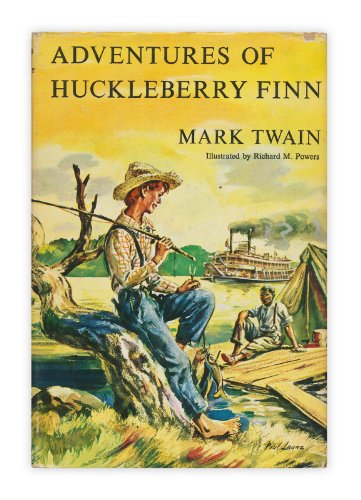
Now here I am reading all these American texts written between 1870 and 1920, mostly books I failed to read while in college but that are iconic nevertheless. Sneaking in a reread of Huck Finn onto this list seemed quite a perfect fit. Twain, writing over one hundred years ago, still seems fresh in the twenty-first century. He plays with dialect. He plays with an unreliable point of view. And he's still funny.
As with most critical assessments, I do find the latter third of the book a little disappointing; once Tom Sawyer shows up, the novel gets rather silly, and the slave Jim, always a bit too childlike so as to be a bit disturbing, becomes downright stupid. And yet, it's possible to read these latter sections as part of Twain's point. Jim, not assessed as a human being by most of the slave society around him, isn't treated any better by the boys; he is infantilized by the racist society, and what for him is a matter of freedom and slavery, life and death, is just fun and games to Tom.
The most humorous passages, though, revolve around the king and the duke, a tiresome duo that take up the middle third of the book. While funny, there's something sad about the dirth of quiet moments in the book once they show up, as the most beautiful passages are those in which Huck and Jim simply float down the river, and we get to listen and look in.
The book may be downloaded here from Project Gutenberg, and the audio here.
Saturday, April 24, 2010
On "Babies" by Amelia Gray (438 words) ****
A relatively new friend of mine is pregnant--again--by the same man who gave her the last child seven years ago, the same man she refuses to marry because of some pretty serious problems in their relationship. For one thing, he isn't "amenable" to babies--not at first. Enter Amelia Gray, whose story parallels my friend's but speeds it up by about a nine months. And then . . . Let's just say this is a story that really doesn't get started until its ending. This story plays well with one's head. Read the story here at Guernica.
Wednesday, April 21, 2010
On "Easy Go" by Mary Beth Caschetta (3403 words) ***
Maybe I'm just dense, but I wasn't really expecting what eventually occurs in this story, and I liked that. It's a tale of a woman whose husband has left her, her psychologist husband. And as expected, she has some problems with that and needs counseling, needs something to get her through. That's really all I want to say, lest I spoil it. But as far as tales of psychologists go, this story seems to have a bit in common with Nabokov's Pnin, another tale of a spouse jilted by a psychologist partner. It's interesting how psychologists in literature and film are often of two extremes--one the hero who saves the day, as in Real People and Good Will Hunting; and one a horrible, self- or politically motivated fraud, as in the aforementioned Pnin or that episode of Cheers where the person in therapy ends up having an affair with the therapist. But I guess I'm not thinking of Alan Thicke in Growing Pains, where psychology seemed to be just a nice job to pay the bills while working from home. Anyway, ponder the portrayal of psychologists in pop culture all you want, but you might want to read the story here at the Del Sol Review first.
Sunday, April 18, 2010
On "The Radiant Car Thy Sparrows Drew" by Catherynne M. Valente (4321 words) ****
The winner of the Million Writers Award a couple of years back (hers was my second favorite story that year and a notably deserving winner), Valente brings her lyrical prose to the subject of film--on a distant planet. Valente reminds me a bit of Nabokov. Her prose is not easy reading, but it's beautiful, and there is something very suggestive about most of what flows out on the page. Here, we get this odd juxtaposition of the old and the future. We watch old films, made sometime a few years back, from a place sometime in the future. We obsess with the narrator about a documentarian. We watch as she watches, examine as she examines. We wonder what is said (the films are silent), and we glory when a deaf person who reads lips tells us something fairly mundane. The story reminds me a bit of an Oscar-nominated short film from a few years back. That animated piece of sci-fi was set in the future as one might have imagined it were one writing sci-fi in the nineteenth century--folks pushing through space in heavy steam engine-like spaceships. Gorgeous. Bizarre. The same might be said for this piece, which you can read here at Clarkesworld.
Thursday, April 15, 2010
On "In Case of Doubt" by Tarl Roger Kudrick (3803 words) ****
Here's a variation on the story about a man with that thing--that disease, you know--where you can't remember anything. Amnesia? Yes, that's it. That's what this story starts off being. But like really good science fiction or fantasy does, this story becomes much more than another simple piece about its supposed topic--it relates to other things in our everyday lives as well. I see elements of Plato's Cave here, people locked into this strange other world that they can't see out of, drugged up and uncertain who they are or where they are except for what they are told. But it's all for a worthy cause, as we learn, somewhat ironically, during the course of that story. I won't bother telling you what that is. Read it for yourself here at ChiZine.
On "Roughing It" by Mark Twain ****
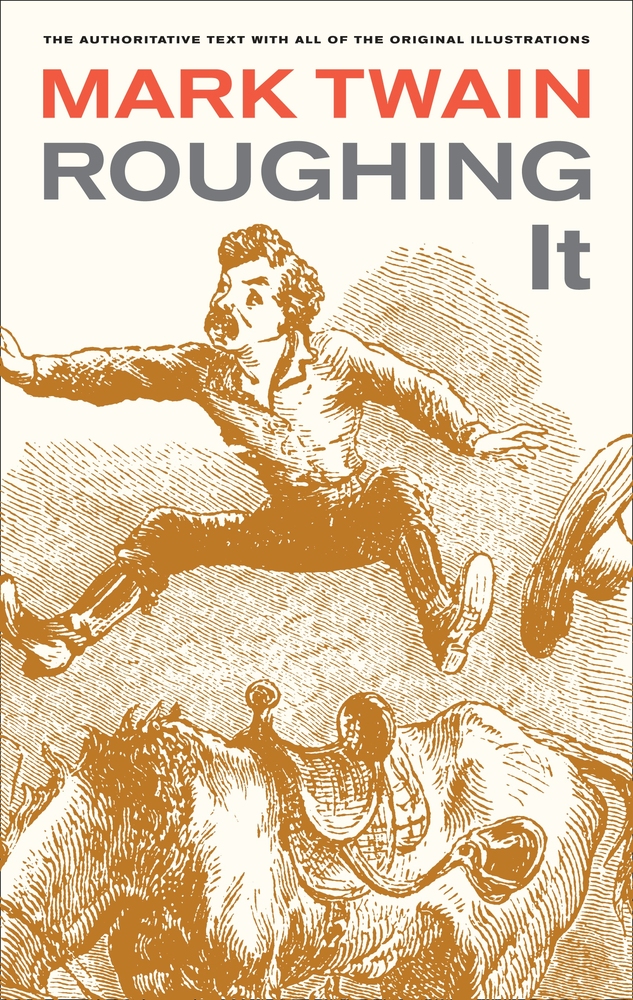
The book is Twain's account of going to work with his brother in Nevada, back when it was still a territory. The two of them got government jobs of some sort, but little time is spent describing those. Instead, one gets accounts of stage travel before the days of railroad (a grueling and long trip it must have been), of silver mining and claiming, and of newspaper writing. Midway through the book, Twain opts to visit California and live there for awhile, and then he moves on to Hawaii. Admittedly, by these later portions of the long text, I was becoming restless. Sans a strong plot, the episodic nature of the writing eventually begins to wear one down, even when well written and at times funny.
Some of the historical information, as well as some of the tall tales and myths, is interesting as well. Twain goes on at length about the relatively recent faith of Mormonism, which was at its polygamous stage with regards to marriage rights. He tells the story of John Slade, a rascally gunshooter who manages to threaten his way into government--and eventual death (I could see those chapters becoming a movie, though a very violent one). He tells tales such as one about a buffalo who chases a man up a tree and then follows him right into it (clearly a "true" story since the man lost his hat and the buffalo staggered off--and neither of those items are present any longer).
The text is in the public domain and can be read or downloaded here.
Monday, April 12, 2010
On "Keep Calm and Carillon" by Genevieve Valentine (2862 words) ***
What if, one day, your sister disappeared for a few hours and when she emerged she was a . . . a . . . choir bell ringer, and weirdly obsessive about it? That's the basic premise of this story, which wins marks for me for simply being strange. Sometimes strange is good. I think of a couple of my favorite John Steinbeck stories, which are unlike most other things he wrote, one about a holy pig and the other about a psychopathic hairpiece (or was it a psychopathic piece of gum?). Both stories take a preposterous situation and run us through an entire plot. The situation itself is enough to get us interested, and the plot propels us forward. Valentine does a similarly admirable job here. I won't say much more about it lest I spoil it. Read it here at Farrago's Wainscot.
Friday, April 9, 2010
On "Wash Me Again" by Mitzi McMahon (498 words) ****
How do you become someone desired? How do you become someone desired again? These are the questions this story confronts--and doesn't answer. We can go to online dating coaches for such answers, to marriage counselors, but that doesn't mean the answers will work. Dress different. Be different. Offer yourself up on a platter. It doesn't matter. This one is a quiet heartbreaker. Read it here at Staccato.
Tuesday, April 6, 2010
On "The Easter Bunny" by Benjamin Dancer (2996 words) ****
I generally avoid novel excerpts when reading online stories, just as many editors avoid them when selecting stories for publication--though I'd say, in general, that too few avoid them. Excerpts usually don't work as independent pieces. They don't measure up as stories. Stuff is missing. Plots go nowhere or leave us dumbfounded at the start or end. Dancer's "The Easter Bunny" is an exception. I've not read a piece with this much tension in a long while. The constant repetition of "I'll have a Budweiser" ups the ante each time it's said. As readers, we wait for things to explode. And then the story goes where we never would have expected. Read the story here at SFWP.
Saturday, April 3, 2010
On "Chase Us" by Sean Ennis (2996 words) ***
Here's a strange one from the mind of Sean Ennis. It has the feel of being a story that starts with an idea--muggers, sort of, more like half-muggers, rascally jerks in a park--and then explores where that idea goes. This lends to a feeling of randomness, though Ennis does keep his focus on these particular youths and their particular predilection. Such makes for something certainly unpredictable. Read the story here at Hot Metal Bridge.
Wednesday, March 31, 2010
On "This Morning" by Eric V. Neagu (400 words) ****
Like James Thurber's film-adapted "The Secret Life of Walter Mitty," Neagu's story focuses on the power of the imagination--specifically with reference to our own daily life. Its very brevity demonstrates the power of the mind, the way that we can achieve in minutes what others cannot in lifetimes, and yet can't even manage to finish our yard work. Read this short, fun piece here at the Pedestal Magazine.
Sunday, March 28, 2010
On "Patience" by Rebecca R. Branden (1735 words) ***
This story is about the salt of the earth, the things abuse can lead to and the way that only one person ever notices or sees the abuse. It's about the cost of a relationship. And in this case, the relationship costs quite a bit--one's voice, both metaphorically and literally. I love it when a writer can turn an idea into something visceral and real. Read the story here at Pank.
On "On Roman Roads with St. Paul" by R. Martin Pope ***
Thursday, March 25, 2010
On "The Outcasts of Poker Flat" by Bret Harte (4049 words) ****
Here's a story about facing death, slowly and meanly. Poker Flat is a mining camp, but some of the local residents don't like the looks of certain others. A few are hanged. But in the end, the kinder thing to do with most is just tell them they've got X hours to get out of town. And so that they do, wandering out into the wilderness toward another. One of these is John Oakhurst, a seemingly honorable man who has just a little too much success at the poker table for the other townspeople. With him is a set of supposedly neer-do-well women and a scoundrel of a man. Near the end of the first day, they meet with a young man Oakhurst knew from a poker game, a man who Oakhurst treated kindly and who now feels like he owes Oakhurst a favor. They also meet with snow--a good lot of it, enough to keep them from moving forward. And that's when things get interesting. Read the story here at Bartleby.com.
On "Selected Stories and Sketches" by Bret Harte ***
Some have accused him of sentimentalism, and the accusation seems accurate. Often, in reading a particular story, I got to its end and felt let down. Some characters are just too good. Some characters are too evil. And endings often just drop off the page, a day done, everything made right, and isn't that character of righteous action oh such a good person? When Harte is at his best, the righteous aren't so nice, and the bad are more self-interested than illogically evil, and the world is a tough place in which to dwell. Watching characters manage in that is much more fascinating than letting them dominate as we would expect or desire.
Monday, March 22, 2010
On "Tales of Carlos" by Paul Vidich (3415 words) ***
Taxis are a great place for stories, yet taxis usually seem to fall within larger stories (I think even of the sitcom Taxi, which only rarely actually involved story lines within the taxi--most occurred in the dispatch office, as I recall). Perhaps it's because taxis are generally the means of a journey from one place to another, and so the story inevitably uses the taxi as a transition. Vidich's story starts in a taxi and almost sticks to it, though in the end, he too takes us someplace else, someplace the taxi ultimately takes us. But it's an interesting ride, that's for sure, and the narrator himself seems to know this. Danger lurks--and a desire for something more, something different, something out of the ordinary. The narrator gets what he wants--almost. Read the story here at Our Stories.
Friday, March 19, 2010
On "The Friends" by B. J. Hollars (1882 words) ****
Here's a heartbreaker. Same old story--one person in love, the other not. Neither of them apparently really talk about it. This one goes on, and on, and on--for years. What makes this one special, I think, is the degree of closeness that the two characters have, in part caused by an unfortunate event near the story's beginning. From there, the dates of the events make the rest of this tale grow sadder and sadder. Read the story here at Necessary Fiction.
Tuesday, March 16, 2010
On "The Movement of Horses" by Adam Cushman (8839 words) ***
This is a sad story made funny, which is what a lot of really good stories are. What makes this story so humorous is the narrator, a troubled teen who hides his insecurities and loneliness behind a facade of bravado--and utter stupidity. The story shines from the moment one starts reading, largely because of that narration, but it really gets going when the narrator and his not-so-legitimate friend Dane steal a car with intentions of fleeing west to start a band (which of course requires a tattoo). These being teenagers--and young ones at that--the scheme goes predictably nowhere, but not before we learn quite a bit about our narrator, enough that he becomes an object of pity rather than just laughs. Read the story here at Fawlt magazine.
Subscribe to:
Posts (Atom)

 Posts
Posts


