Showing posts with label Herbert W. Armstrong. Show all posts

Saturday, March 15, 2025

On “The United States and Britain in Prophecy” by Herbert W. Armstrong ****

I have not read this book since I was a teenager, and I was expecting to be somewhat underwhelmed, as I was with Armstrong's book on the millennium, but this one turned out to have a lot more heft than I anticipated. I remember, at the time I first read it, feeling like the author did an incredible job with the biblical material but that it wasn't too detailed when it came to the historical basis for the theory; that was my impression this time as well. But the book this time left me with a desire to go read up more on the subject historically to see the degree to which the biblical interpretation is accurate—and that's a good thing.

Having grown up being taught the these two countries forge the heart of ancient Israelite migrants, I find that my worldview, even today, to a large degree still falls back on that, even if I've had a few doubts through the years. I would say “it seems to be true,” but it's not a salvation issue. If the understanding is wrong, then in the end, it doesn't take away from the most important truths of scripture. (After all, I've heard other claims, that, for example, Japan is ancient Israel. I haven't looked into such with any seriousness, but I didn't grow up with such a theory either, so it's not where my mind first goes.) Rereading this book, however, made me see, as I noted, that there's a lot more reason to believe such might be the case biblically than perhaps I've recently thought much about.

The issue is, of course, that most modern scholars disagree with the historical thesis and that there are some good reasons for that. The number one reason is that the theory seemed to have found its greatest popularity during the height of British colonialism—that is, it was a way to justify certain racist views. It was, in other words, propaganda for Manifest Destiny and the like. So it is fair to be skeptical. At the same time, it is perhaps unfair to dismiss such ideas out of hand just because of their misuse. What one really has to do is go look at what really happened, insofar as that is possible. Most contemporary scholars are wary to do that in part because of the associated tropes. And so much of the history I've read through the years that ties the lost tribes of Israel to modern nations has been quite sketchy, based on similarities of names and the like—a possible coordinating fact but hardly strong proof around which to base an entire thesis–rather than really tracing the movements of peoples. More reading on the subject would go far in helping me see how such conclusions can be reached. But few serious scholars give the theory much time.

The last chapter of the book, alas, made me uneasy. It's the chapter where the author really lets readers know the troubles that are coming for these nations and pushes readers to join the church the author is associated with in order to escape. I suppose I can't argue with a sincere call to repentance, assuming that's what's going on, and as I see my country literally falling apart now, I can't help but think the author was right in that regard. But the chapter reminded me of many of the nightmares from my childhood, and the appeal to fear and to join one particular group is not something I am completely comfortable with now; it suggests to me these days a kind of insincerity. Repent, yes, but if it's just to save one's own skin and the key is joining one particular organization, something seems a bit off. I don't think a bunch of people just looking to save themselves is what God is after. I'm reminded of what someone said to me shortly after 9/11, namely that they were thinking of returning to church because they were scared of what was going to happen to them. I suppose fear can be a motivating factor for getting one back to doing the right thing, but if that's the whole motive and remains the motive, it's hardly a life of joy and such a choice is not likely to stick. And indeed, that person did not.

Saturday, October 1, 2022

On “The Incredible Human Potential” by Herbert W. Armstrong ****

This is another Armstrong book I hadn't read in decades. I enjoyed its thoroughness. Likely several booklets, that WCG offered, such as Why Were You Born?, essentially were chapters in this text. But put all together, the work has a kind of vibe. In many ways, it sums up the teachings of the Worldwide Church of God in the late 1970s. In that sense, it seemed a bit dated, but it also captures the spirit of many books of the era—that vibe. There's a kind of spiritualist self-help feel to it. This is what you could become, what God intends for you!

The work seems most dated (and disappointing) in its discussion of the church. Armstrong admits that the church is the people, and yet at times, he pretty clearly ties the definition of the church into the legally incorporated organization he served as the legal head of. It seems self-serving and given that that entity has mostly ceased to exist in any recognizable form, it lends a lack of credence and applicability to some of the material.

But in other respects, he lays out the faith as many have understood it, a reading that is distinct among Christian sects: God's purpose for our lives, how human minds work, why there is so much evil, and what happens after death.


Sunday, November 21, 2021

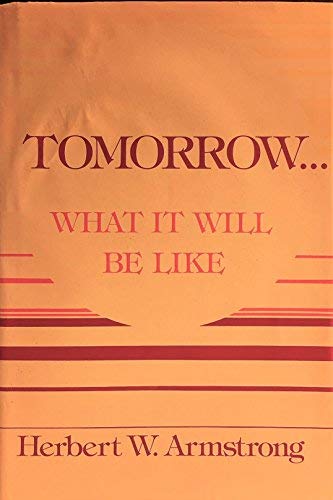
On "Tomorrow . . . What It Will Be Like" by Herbert W. Armstrong ***

I first read this book as a young teen, feeling somewhat obligated to do so and to "like" it, because it is a religious book. Coming to it again as an adult, I find it still difficult to assess critically, since Armstrong forged such an influence on my family's life when I was a kid. What would I think of it if I hadn't grown up around such influence? It's hard to say. Why reread it now? Because after this year's Feast of Tabernacles, I had a desire to study up on what the Bible says about urban planning in the millennium. I was hoping this book might have some ideas. In the end, there wasn't much on the subject, maybe a couple of paragraphs that remotely relate.

What I did find was a book that in some ways is very much of its time (1970s) and in others is rather timeless. That was the way that Armstrong often wrote. I found a lot of his standard catch phrases, the same quotes he liked to trot out constantly. He writes often in generalities that would be true of any time and place (there's lots of pollution in the world, etc.). But it's also interesting to think of this as a work of the 1970s, when concerns about overpopulation were rife, and when books like Futureshock were the rage. (It strikes me that such concerns still make up much of the publishing market, but somehow they don't seem quite as at the forefront as they did to me as a kid. Now, such ideas would be subsumed under works about global warming and climate change.) This book works off a lot of those 1970s fixations. Armstrong opens with two chapters about futurism: pessimistic views of the human future versus optimistic ones. Which will it be? And then, he lowers the scriptural appeal: Neither, because Christ will return (essentially saving humans from the reality of the more pessimistic assessment).

Much of the rest of the book looks at scriptures revolving around what this future world will look like. I found myself wondering, in some cases, what some not familiar with his other teachings would think or understand, because in some cases, the work seems to take that knowledge for granted. In some cases, I found myself thinking that the author goes on far too much about his views on top-down government and, most especially, who will do what in the millennium. One can certainly hypothesize about the role of specific resurrected patriarchs, but outside of David and the apostles, the scriptures don't actually say. Why spend so much time on the subject? There was also one passage espousing segregationist views that were very off-putting.

The book probably hits its stride most as it draws closer to its conclusion, in Armstrong's chapters on education and more especially language. The more scriptures take the central role the more grounded the work seems. But then, why not just read those?

A couple other surprising things about the book? First, its length. At barely over one-hundred large-sized-print pages, the work comes in at just a bit longer than the various pamphlets the church published. When I was young, one hundred pages seemed substantial; now, not so much. Second, its reading level. The work consists of short sentences and is very easy to read. It is set up to appeal to a wide audience, and in that sense, I rather appreciate Armstrong's writing skills and background in marketing. Maybe the writing seems a bit glib, but it certainly better conveys its points than the long-winded, highly qualified assertions I'm prone to.