Tuesday, September 20, 2022

On "Jews and Christians in Antioch in the First Four Centuries of the Common Era" by Wayne A. Meeks and Robert L Wilkes ***

This very short volume provides an introduction and background information about Christianity in Antioch largely as a means to introduce two sets of fourth-century documents written in Antioch: a group of letters by Libanius and a couple of sermons by John Chrysostom. The unifying reason for presenting the two sets of works is the writings are about the Jewish people of Antioch.

Libanius mentions the Jews offhandedly in a kind of historian context; I found myself more drawn to Chrysostom's work, which heavily focuses on them and their interaction with Christians, whom he sees as too easily drawn to the religious practices of. We are presented only with two (the first and last) of his homilies against Jews, but they, especially the first, are incredible in terms of showcasing the degree to which some older Christian--that is, Jewish--traditions persisted, despite the attempts of men like Chrysostom.


Thursday, September 15, 2022

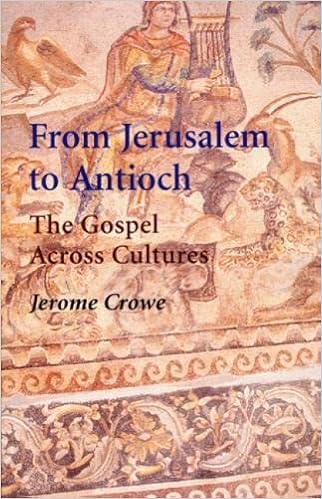
On “From Jerusalem to Antioch” by Jerome Crowe ***

Crowe's work is an accessible good read. If one wants a basic introduction to Jerusalem and Antioch in the first century, this would be a good work to try. Crowe's main task here is to try to explain how the faith changed as it moved from a Jewish mileiu to a Gentile, from a Jerusalem context to an Antioch one. He wishes to show how religion alters across cultures. It's an interesting premise, but on that count, the work seems a bit superficial.

The gist of the book focuses on various ways in which church functions differed in the two locations—preaching, doing missionary work, the mode of worship, the specific message, organization. Most of the text recounts basic details that most people would already be familiar with. In Jerusalem, converts were Jews and met among Jews; they focused on a kingdom to be brought by Jesus, and all fit well within the system already set up. When things came to Antioch, the message had to change, especially as it moved into the pagan realm and out of the Jewish and Jewish curious realm. Now, the focus became philosophical, focused on the “one God” as seen via his son. Meetings moved from synagogue to houses, and so on. Much transformation obviously did occur, but the changes discussed don't seem very deeply analyzed. We get an accounting of how things were different, knowing that the reason was differing cultures, but not so much a discussion of why such changes were made.

Monday, September 5, 2022

“On Theophilus of Antioch” by Rick Rogers ***

We don't know much about Theophilus as it turns out, and Rogers's book doesn't tell readers much more as a result. Although the book's subtitle promises “a life,” we get few details of that. What we know of Theophilus mostly comes from his three-volume work, To Autolycus, and it is that which Rogers spends most of his book recounting—quoting passages from it, and then explaining what those passages mean. I didn't feel like I gained much from the work's first two-thirds. It's been a while since I read Theophilus's work, so the summary was useful, but a rereading of his volumes would have served much the same value. I was hoping for more background, more cultural insight. Most of what we get in that regard is Rogers's breakdown of the volumes into three kinds of works, explaining how to see the work as an apology, as it is usually read, is perhaps not quite as useful as seeing it as also a teaching work.

Where the book grows most useful is in its final third, where Rogers does his true analysis of the subject. Here, he plays off the work of R. M. Grant, whose work he also summarizes. Grant's thesis on Theophilus largely claims that the man was a low-Christology adoptionist (one who believed that Jesus has no prebirth divinity and who was “adopted” as divine at the start of his physical life) of a Jewish stamp (much like the Ebionites). Rogers critiques this view, arguing that although Theophilus claims to be a Christian yet talks very little about Christ in his work, the work was largely intended for a particular purpose that did not require extensive discussion about Christ's role (indeed, such discussion may have turned off his intended pagan audience). As such, it's difficult to assess Theophilus's view of Christ.

That Theophilus was viewed favorably by later early writers such as Eusebius and Jerome, however, suggests to Rogers that he was “orthodox enough” and that his view of Christ may well have been more line with thinkers like Ignatius and Ireneaus. Indeed, Rogers points out, Theophilus's heavy emphasis on law keeping would seem to suggest a closer tie to emphases that the writer James makes in his New Testament letter rather than views outside the pale. (Rogers sees James and Paul not so much as opposites—Paul had his own way of emphasizing the efficacy of the law—but as writers who emphasized different aspects of faith.) Theophilus talks little of the death of Jesus allowing the forgiveness of human sin (indeed, doesn't really mention it), instead emphasizing, like James, that Christian faith (and the salvation that comes with it) demands an adherence to high ethical standards set forth in Scripture. Such emphasis would have played well to Theophilus's purpose of attempting to win interest from a non-Christian, who would have been more drawn to the ethical dimensions of Christianity than to the theological ones.

Sunday, August 28, 2022

On "Ignatius of Antioch" by Allen Brent ***

This study of one of the early "bishops" of Antioch, one who wrote seven letters that are preserved for us and that were written on an extended journey across Asia Minor to the Italian peninsula on his way to be martyred by being fed to wild beasts in the Colosseum in Rome. The story may seem a bit farfetched (Why an overland trip? Would he really be free to talk and write so much?), but Brent discusses in large part what the circumstances were that caused the situation and why just such a thing was possible in the second century. With regard to being able to write and visit on his journey or even being sacrificed in Rome, Brent brings out various accounts that predated or only shortly postdated Ignatius's experience. Cicero, for example, a century earlier, makes note of prisoners being transported to Rome for gladiatorial games. Lucian and Samosota wrote a satire that closely mimics the Ignatian experience of people visiting a traveling prisoner--and some laws make mention of attempts to curtail such free and easy access, showing that a bribe certainly helped to make such visits possible and that laws had to be written to try to prevent just such occurrences.

Why Ignatius would have traveled all the way to Rome is another question that Brent addresses. He sees it as a case where putting Ignatius to death in Antioch would have created too much of a stir. Sending him away, thus, avoids the potential for more violence and fighting. What would Ignatius have done that would have created such stir? Brent makes the case that the strife was all internal to the Christian faith--namely, how to run the church. Ignatius was a proponent of a one-bishop-rule system. By placing himself in the fray and refusing any attempts at pardon, he made a martyr of himself in order to bring unity to the church in the city. Guilt-riddled, men might see what he was willing to do and change their ways accordingly. (I'm not sure I quite believe this, but Brent makes a decent case using cryptic comments from the letters).

Ignatius's main arguments for a bishop, slated next to a council of presbyters and a set of deacons, is drawn, Brent argues, largely from pagan mystery religion and Grecian city-state political systems under Roman oversight. The metaphorical counterpart in Christianity is the Eucharist, in which authority sits in a U-shape. The bishop stands in for God the Father, the presbyters as god's council (a type of the apostolic council), and the deacons as types of Christ, who take the bread and wine into the congregation. Ignatius, in his journey to Rome, takes on a procession like that made within the mystery religions, in which again he stands in for God and his various greeters as stand-ins for the gods, all in an effort to bring unity to the church (as such a procession would bring unity to the state), with the sacrifice to follow at the end. Various quotes from the letters seem to somewhat back up this claim. Indeed, even if Ignatius was not modeling his argument on pagan rites, as Brent seems to be arguing, he likely was at least applying similar terms to make his point, even as the New Testament writers use traditions such as Roman athletic events to make their points.

Ignatius's letters, some thirteen or so in number, are accepted or rejected a spurious by various critics. Six are rejected by almost all, but the other seven are more so accepted. It is these seven that Brent devotes his time examining, and these seven that he argues actually are legitimate. One chapter is given over to countering the arguments of some more-recent scholars who reject some or all of the letters. Another chapter is devoted to how Polycarp's letter fits in with the Ignatian letters. Polycarp's one surviving letter is largely seen as authentic, but some scholars see the mention of Ignatius in it as a forger's interpolation. Brent seems pretty convincing in noting that probably the main reason we even have Ignatius's letters is that Polycarp gathered them, even as his letter makes mention of doing.

Brent also addresses why Polycarp would save such letters if they maintain a position in which pagan ideas are used to justify a version of church government. He sees the link here largely as both Ignatius's and Polycarp's fight against Docetism, the martyrdom of Ignatius being perhaps one of the greatest arguments against the doctrine.

Tuesday, August 23, 2022

On "The Church in Antioch in the First Century CE" by Michelle Slee ***

This work essentially sets out to examine two sets of Christian communities that existed in the church in Antioch during the first century: one open to Christian converts and one that expected converts to become fully Jewish before becoming Christian. Slee bases this reading on the disagreement that is recounted in Acts 15 and more especially in Galatians 2, and then sees the Didache and the book of Matthew as being written by these two separate communities (the Didache by that of the community open to Gentiles and Matthew by that open only to Jews). The argument is very clearly set forth--outlined at the start, summarized as one hits each chapter, and then summarized again at the end of the book. What could have been difficult reading was very clear.

Slee also does a very good job of summarizing the scholarship surrounding her various assertions, both those for and against her positions. The effect is to give readers a full sense of the opinions out there, but it also to an extent takes from the overall convincingness of her case. Her opinion seems, in such context, merely yet another one rather than the distinctive answer. Indeed, I felt as if she were quite straining in her overall thesis by the end, because so many various "facts" have to line up as she sees them for her overall point to be true.

We have to, for example, accept that the Didache was written in the first century (the earlier the better) and that Matthew was written around 80 CE--and both in Antioch. Many scholars agree with these dates and the place, but if one doesn't, nearly the entire argument falls away. Further, one must accept that James and the Jerusalem church, after making an agreement with regard to how to treat Gentiles, went back on that agreement, thus splitting Paul off from the other apostles and most especially James. Slee even tries to make a case that the letter reproduced in Acts was not written in Jerusalem or at the conference at all--rather, it was created in Antioch by a Didachist faction and the writer of Acts introduced it into his account (the real agreement, which was nevertheless rescinded, was noted earlier in James's speech; because the speech and the letter don't line up precisely, one must be from some other source--as if there would be any point in quoting both if they did line up precisely!).

The center of all of this argument was tablefellowship, and more precisely the Eucharist. The Didachist was open to "Law-free" Gentiles; the writer of Matthew expected all Gentiles to become Jews so that they could share meals and was only recently even open to that. But what is a Eucharist? What does "Law-free" mean? What is Judaism (when no such unitary concept actually existed during much of the first century)? Slee didn't, for me, adequately define these terms. She admits that the Eucharist at this time wasn't well defined, which is likely, but it was unclear to me how it differed from tablefellowship in general or a love feast. If it is only the bread and wine portion of a meal, why would that be special at this time? And if the Gentiles are "Law-free," are they free to worship pagan gods or do other things forbidden in the Scriptures as long as they don't bring improper meat to the meal? The whole issue with tablefellowship with Gentiles was the idea that they were impure based on the possibility that they might be involved with pagan worship, even indirectly, in what they ate. The decree in Acts 15 was to mitigate that. So "Law-free" seems an awkward wording to use, since it imposes part of the law. And how exactly is Matthew a defense of a Jewish Christianity open only to fully converted Jews, when so much of the book critiques the Pharisees, even if it does not (as Slee brings out) critique the Scribes in the way the other Gospels do? (Slee sees the critiques as being actually about Christian factions.) Slee makes her arguments, but in the end, I found many of them unconvincing.


Wednesday, August 17, 2022

On “Aphraates and the Jews” by Frank Gavin ***

This short text aims to explain how the fourth-century Eastern Christian writer Aphrahat drew many of this ideas from the Jews. The first half provides basic information about life for Christians and Jews under the Sassanian Empire and the basics of the relationship between the two religious groups. The Jews seemed to have faired somewhat better, but neither group did all that well, as their religious affiliation's tie to the Roman Empire was the window through which the empire's leaders saw them: not so loyal as to be Zorastrian, like real Persians. For Jews, this meant trouble especially during the time of Julian, who promised the Jews a rebuilding of their temple; for Christians, the trouble was more constant once the Romans accepted it as the main faith of their empire. Jews occasionally, apparently, even made trouble for Christians. Christians didn't do themselves much of a favor insofar as they seemed to actually favor the Romans, given the views of the Romans about them.

Despite all that, the Christian faith and Jewish faith were still relatively close, especially having a common origin. In the latter half of the book, Gavin looks in particular at a few of Aphrahat's Demonstrations to show how Aphrahat's words mimic those of the rabbis.

Sunday, August 14, 2022

On “The Formation of Christianity in Antioch” by Magnus Zetterholm ****

A really good intellectual work will often pull one toward a new way of thinking, slowly and then all of a sudden, providing an epiphany similar to what a character might receive at the end of a work of fiction. Zetterholm's book is such a work. Perhaps not quite as much of a history of Christian church in  Antioch as I would have liked, it managed to make me rethink a bit what's going on in Ignatius's letters and why the Gentile church would have an interest in a gospel mostly aimed at Jewish concerns.

Zetterholm's basic thesis is that the parting of the ways of Christians from Jews was not so much that as it was a separating of Jesus-believing Jews from Jesus-believing Gentiles. This may seem obvious, but Zetterholm focuses on what the implications for such a statement really mean.

The book begins by looking at the role of the Jewish community in Antioch. As Zetterholm makes plain, that community was not a unified front. As with any immigrant community, Jewish peoples in Antioch fell into various factions. Here, Zetterholm uses social theory to make his point. (The long summaries of such theory are perhaps what makes the work very much one of scholarly tone and less interesting than it would otherwise be.) That theory essentially posits that such immigrant communities have varying sets of people: some aim to fit in more with the community to which they've moved, some become more inclined to focus even more on preserving the culture from which they have come. And then, there are folks of various stripes in between, who merge some aspects of the old home with that of the new. So some Jewish people gave up practicing “Judaism,” while others became much more devout, and still others continued some practices while abandoning and adopting others. Judaism, at this time, Zetterholm claims, although not the definitive religion we now know it to be still had unique characteristics that all the various sects would have agreed on, even if they didn't agree on all the particulars or the meaning of those characteristics.

Gentiles in Antioch would have been attracted to Jewish synagogues because of the community that such gatherings offered. Antioch as a city would have been a dangerous and lonely place full of crime and disease. The Jewish synagogue would have offered a reprieve from such a world in ways few others legal gatherings could have. The Jesus movement's impact within those synagogues would mean that some of the synagogues more open to Gentiles would have been affiliated with the faith being forged at that time.

Much ink is spilled at this point on the Acts 15 conference and Paul's letter to the Galatians, as it is in any work about Antioch. Zetterholm, like many, if not most, Christian writers posits a split between followers of James and Paul that would be relatively permanent, with Paul demandings Gentiles remain Gentiles and James demanding Gentiles become Jewish. (The disputes in the New Testament, I would counter, don't really show this.) Nevertheless, the implications of the differing factions do play out in an intriguing way as Zetterholm sees it.

The reason is that after the destruction of the temple and the imposition of the tax on all Jewish people, Gentile believers would have been placed in an awkward position. All Jews, whether practicing or not, were subject to the tax. Gentiles, by contrast, would have only been subject to the tax if they became Jews. As such, they'd have had strong reasons not to become Jewish. Within the synagogue, however, in some communities, they could not take part unless they became “Jewish” by taking on Jewish customs. If the opted not to become Jewish, as Paul had told them they should not be, then the couldn't be full-fledged members of the synagogue and, as such, couldn't be part of a legally recognized colegium. So either they had to become fully Jews (and pay the tax) or they couldn't meet with the synagogue and thus were subject to punishment for illegal gatherings—a penalty either way. Efforts to justify Christianity to Roman authorities (as per the second-century apologists), in his reading, thus become efforts to become legally recognized gatherings separate from Jewish gatherings. As such, criticism of the Jewish faith within such writings are part of an effort to help those Roman authorities distinguish the two from one another, but with the Gentiles now claiming to better represent the ancient faith written out in the Jewish scriptures. Thus, they are still a synagogue group of sorts, in the ancientness of their beliefs, but not of the Jewish stamp, in the rebelliousness of their subjects. When Roman authorities finally do recognize the different several centuries later, anti-semitism has become part of parcel of early Christian teaching.
Thursday, July 21, 2022

On “The Day the Sun Died” by Yan Lianke ****

This is the last book on my Chinese literature reading list, a work by a contemporary author that plays mostly as dark fantasy.The work is one that would have likely fascinated me at a slightly younger age, as it heavily involves sleep walking and that line between sleeping and waking.

The text centers around a young man, a child maybe, a simpleton, who grows up the son of people who run a funeral accessories store. At one time, his father worked with his brother-in-law in the crematorium business. His job was to inform on people who bury their dead relatives, as the law no longer allows that due to a shortage of land. There was much money in it, but eventually, the father felt too much shame in informing on his neighbors, so he gave it up. His brother-in-law, by contrast, makes good money, burning up bodies. What's left, often, is a bit of oil, much like grease is left when one cooks ground beef. (I'd never thought of that aspect of crematory work.) This oil, he sells for a nice sum. The father decides to buy that oil at an inflated price, as long as the price always remains the same, in part to make up for his once having been an informer. He does nothing with the oil—simply stores it. You know that oil is going to play a role somewhere later in the story, and it certainly does.

The story itself focuses on one long night, when various atmospheric forces block out the sun and result in people falling very easily to sleep. Pandemonium ensues, as people live out their dreams—often killing themselves or others. Others stay awake and take advantage of the situation. This part makes little sense to me, since we don't all start committing crimes because folks are sleepwalking or asleep. Otherwise, every night would be scary indeed. Nevertheless, looting and riots follow.

With no sign of the night ending and fights become more intense, the boy's family tries to come up with a plan to bring back the sun and wake people up.

Perhaps the strangest element of the plot is the author's own namesake taking part in the novel. The boy is a big fan of the author's novels, and were I more of a reader of Yan Lianke, I would know whether the plots, quotes, and titles cited are real or just made up. Nevertheless, the author is there in the town, sleepwalking among the inhabitants—and eventually gathering notes for the novel.

Thursday, June 30, 2022

On "Playing for Thrills" by Wang Shuo ***

This book starts off with a very interesting premise, arguably even a good one. It's a mystery. A guy finds out he's the major suspect in a murder case, the death of a friend of his ten years ago. He's got to clear his name, find an alibi. The week of the supposed murder, however, he doesn't remember. Where was he? What was he doing? Could he have been the one who murdered his friend?

Imagine The Hangover as a murder mystery, and you've got kind of the gist of this work. The protagonist doesn't have a great memory. Of course, I probably wouldn't know my whereabouts from a given week ten years ago either, except that I live a very humdrum life and so could probably point to being at work, but after work? I would have no idea and little way to track that down if I hadn't taken notes in some way. Or maybe the main character was on a bender. The novel then tracks his attempts to find out what he was doing that week, as he interviews friends he knew and places that he frequented at the time.

The protagonist is something of a ne'er-do-well, a guy who spends most of his time gambling and playing around with friends, and when he can still manage, chasing tail. So are most of the characters in the novel. This makes for some degree of difficulty telling the characters apart. There's a man in a striped shirt whom nobody knows who was at the last dinner at which they saw the murdered man. But later in the book, other friends wear such a shirt, the murdered man does in a dream/memory, and even the protagonist. The characters are in a way interchangeable, which makes them a bit less interesting.

And when one doesn't have characters to root for, it all becomes about the plot. This plot is loose and goofy but substantive enough to sustain two-thirds of the book. But at that point, the novel takes an odd turn, one that plays well with the kind of players all these people are but that blows all the suspense in the book and makes it, well, not terribly interesting anymore. One gets the sense that even the author isn't all that interested anymore, from the way the last few pages of the book go.

There's probably a lot here that is missing in translation. Footnotes explain some of the cultural context, some of which I knew but most of which I didn't. There are jokes that flew right by me, not being Chinese, references to classic works and authors. Such makes me appreciate all the more works that manage to speak to a person in translation, because they speak not just to the culture in which they arose but to the human experience. This book didn't really do that, even though it made a stab at trying to say something about identity and jokes and other human things; there wasn't, in the end, enough heart.

Sunday, June 12, 2022

On "Christianity in the Second Century" by Emily J. Hunt. ****

The subtitle of this book is "The Case of Tatian," which is what this book is really about. I'd have flipped the two titles were it me, since the main title is deceptive and too broad for what the author does here. Certainly, some of what she writes about Tatian establishes ideas about broader trends in second-century Christianity, but the book does not really lay claim to that focus. If I'd wanted a general book about second-century Christianity, I'd have turned elsewhere. Lucky for me, I came to this work because I was looking for a work about Tatian, and it was a ready read.

Tatian was a second-century Christian who grew up a pagan in Assyria. At some point, he went west, became a student of Justin's and then, after Justin's death, apostasized, becoming a gnostic, moving back toward Assyria, and disappearing from history. Or so that is what most histories will tell you, based on the writings of various early church historians. Hunt calls this apostasization into question. The second century was rife with different points of view, and while Tatian's may not have been mainstream, they were hardly gnostic. It seems that the label was assigned him possibly for political reasons by these later church historians.

The two works Tatian is most known for are his Oration to the Greeks, which still survives, and the Diatesseron, one of the first harmonies of the Gospels--and the only version of the Gospels available in much of the church of the East for the first few centuries. Hunt looks closely at the first work to ferret out Tatian's points of view and his likely influences. She comes to believe that Tatian was heavily influenced by his teacher Justin and possibly eastern Christian view but not as much by the Gnostic Valentinus or Greco-Roman philosophy (except insofar as the ideas of philosophy permeated early Christianity generally). There are, of course, some problems with depending so much on the Oration, the main one being that we're not sure when it was written and and therefore what stage of Tatian's point of view it represents. If written early, he could well have changed much of his perspective later on (Hunt doubts not so much the early writing but the idea that he would have actually changed his point of view so greatly as to accept Gnostic ideas, something I find a bit dubious, knowing how some people really do flip in terms of belief systems over the course of their lives); if written later, of course, we're on pretty firm ground to use it to argue that the various early historians had Tatian wrong in many respects.

As per the Oration and what little we have of the Diatesseron, it is evident that Tatian did have ascetic sympathies, much like most other Eastern Christians. It's also clear, however, that he did not believe in more than one God, an evil and a good god, a pleroma of aeons, or the immortality of the soul, as most Gnostics would have. Rather, like Justin, he embraced the resurrection. He thought there to be just one God (curiously, he rarely mentions Jesus in the Oration). He believed demons to be fallen angels. Perhaps one of the most unique aspects of his thought, insofar as what Hunt describes, was his belief that people had been created with the spirit of God but that that spirit was removed when Adam sinned; the Christian process thus is one of having that spirit restored.

As with so much of early Christian history, however, much of Tatian's life and thought is hidden in shadows. We have only the one work and a few early comments about him, each with their own agenda. Hunt's work adds now, many centuries later, to that set of comments; there have been and will be others to do so.

Monday, June 6, 2022

On "Marcion" by Adolf von Harnack ***

This introduction to Marcion is one of the few book-length critical studies on the gnostic teacher of the second century--Marcion, the creator of a New Testament consisting only of seven of Paul's letters and an edited version of the Gospel Luke. That seems to be his main claim to fame, when one reads about him in other works. He posited that the god of the New Testament was a different one than the Old Testament and that all the rest of the Bible was twisted by Jewish thinkers and believers, who had fallen for the doctrines of the old fake god.

As one commentator said Harnack's work, Harnack makes Marcion almost into a Protestant hero. Here is a man who understands the difference between the god of the Old and New Testament, who had the guts to know that grace is by faith alone. Indeed, parts of Harnack's work definitely come across that way, especially in the introduction and conclusion. But Harnack does draw a line at claiming there were actually two gods; he sees that as Marcion's bridge to far for Christians.

In between, however, Harnack does a good job of showing some of the subtle aspects of Marcion's thought. One would get the sense that Marcion was an antinomialist, and yet in reality, he was an ascetic. If the Old Testament is the work of a evil creator god, then one must do what one can to prevent the continuation of the creation. That means no sex, no joy in physical things. They're all fake and keep people bound to that fake god, just as much as the law, so one is to avoid them. Interestingly, while Marcion saw much of the New Testament as corrupted (thus his throwing away of much of it), he saw the Old Testament as an unadulterated complete work. And it is in fact the means by which one comes to know the difference between the good god and the bad one, so even though he dismisses it as scripture, it has a purpose. As Harnack implies, Marcion wouldn't have even had a problem with much of the content of the law (no murder, adultery, etc.); rather, his problem was with the motivation for keeping that law. The good god is all love; he will not judge. Rather, one falls out of contact with that god and thus loses out on the goodness. The evil god, by contrast, punishes for not keeping his law. But the evil god and his law will one day pass away with all that is physical.

Of particular interest to those technically inclined is Harnack's inventory of items that Marcion deleted from or changed in Luke's Gospel and even from Paul's letters (I hadn't realized he'd made changes to Paul's letters before; makes one wonder what exactly Marcion thought he was looking at that he felt like he knew better than the texts handed to him; I mean, if these works are full of errors, why bother trying to rescue them?).

Marcion, according to Harnack (and many who have written about Marcion since), was also the impetus between the canonization of the New Testament and the organization of the larger Christian church. In this view, his New Testament predated that of the orthodox church; it was to refute him that the church came up with its own list of acceptable books. Likewise, his church was earlier organized, in this view, with a hierarchy of structure and government.

Monday, May 30, 2022

On “The Columbia Anthology of Modern Chinese Literature,” edited by Joseph S. M. Lau and Howard Goldblatt ****

This is the second volume of Chinese literature put out by Columbia University Press that I've read. The first was classic lit; this volume deals chiefly with the literature of the twentieth century. The shame in that is that when the two volumes are put together, the one to two hundred years in between get short shift. Like the previous volume, I was not a fan of the manner in which this volume was put together. As someone who knows little about Chinese literature and who is trying to learn more about it, I would have relished a bit more attention to context. Why these selections? And what do these selections say about the state of Chinese literature at the time? This volume, rather, is set up like a literary anthology in which the editors' voices are relatively muted; the “literature” you're reading is the important stuff, even if you know little about it. There are no headnotes. Instead, there is a set of short biographies placed at the start of the entire book, forcing a reader to go back and forth between the selections and the bios for info. The bios give good life info and sometimes a little info about the selection itself, but it's hard to glean, from the bios and the overall setup, why the editors chose some works or how relatively important the writer or the piece is to the overall body of modern Chinese literature. I found myself no longer checking the bios by about halfway through the volume, as they began to run together.

Intriguingly, the editors chose to provide the volume in three sections, with three subsections each. First, the anthology is split up by genre: Fiction, Poetry, and Nonfiction. Then, it is split up by period: pre-Mao (from 1918), Mao, and post-Mao. Personally, I would have preferred the genres not be split out, so that the work would have been wholly chronological, but I can see the value in the generic splits. The fiction section is the longest, taking up 5/7 of the overall text, with the poetry and nonfiction each taking up about a seventh. Initially, I would have thought the fiction—short stories, not chapters from longer novels—too long, but the editors choice here seems to be wise. It is the stories that are the strongest section of the book. The poetry, I found, though often full of profoundly beautiful imagery did not seem on par, as a whole, to the classic Chinese poetry of years before, the images often not evoking a parallel track of thought about life. The nonfiction was also not so inspiring or interesting to me. As such, the stories proved to be the section that most seemed to reflect the concerns of daily life for modern Chinese.

What is evident in the pre-Mao section stories is the poverty that must have dominated China before the coming of communism. Such helps explain why the revolution came about. One gets the sense in some tales, which present a more communistic view, of the hope some held out for revolutionaries. But mostly, one gets the feeling for the overall povery of the population. The Mao section of stories present only a few of idealism. That's because so much of the literature that the editors have chosen comes out of Taiwan. But there's probably good reason—idealistic stories of Maoist society do not generally make for interesting reading, except maybe the first one or two times. The Post-Mao world is surprisingly open about the failures and horrors of the Cultural Revolution—neighbors turning in/on neighbors to keep from being turned in themselves, no one truly guilty of anything outside a willingness to sell others out for alleged lack of loyalty to save one's own skin; old revolutionaries who have come to see the folly of their hopes; local party leaders who use their authority to perform heinous acts.

My two favorite pieces in the book stemmed from this post-Mao period. The first, “The Tunnel” by Chen Ruoxi, concerns a lonely older man whose adult children are devoted to the party and who are making their way up various government positions. This older man cannot be and is not allowed to have a love interest, since that would interfere with inheritance and potentially with the children's party status. During the course of the story and his service on one of the party committees helping to aid the community, he finds himself falling for a widow, whose husband had been accused of being against the party and had been taken away. The father finds various amusing ways to have small trysts with this woman, sneaking out, for example, to see movies with her. But the family will NOT allow him to remarry—it is simply shameful for an older man and would hurt his children's own economic needs. One day, the couple opts to skip the movie and go for a hike in some lesser known part of the city. They find a tunnel and some alone time. The ending here is heartbreaking, just as the man's experience of being denied love would have been.

The other story, and a very short one at that, that stood out to me was Liu Yichang's “Wrong Number,” not so much for its emotional connection as for its technical trickery. The tale is one told twice, once without the “wrong number” phone call and once with it, showing how a few minutes—a dead butfferfly, if you will, to use the old sci-fi trope—can change the course of one's life.

Sunday, May 29, 2022

On “The Common People of Ancient Rome” by Frank Frost Abbott ***

This work had moments of lucid prose focused on the “common” people, but the majority of the early portions of the work focused on language and literature. In a sense, I understand why. We have mostly just what is written to gather information about such people. But in that sense, the work becomes one of linguistics and reflections on literary statements about the lives of such folks, itself not the most pedestrian discussion. I was fairly bored before Abbott got to stuff I was actually interested in—economics. Life, as Abbott notes, was quite hard for most common folks and luxuries few. Indeed, things we would consider staples, such as a well-balanced diet were not to be had. Bread and water might be your livelihood. Much of this I'd read elsewhere by now, for example, regarding housing and trade guilds. Still, it was interesting. Abbott closes with a couple portraits of Romans about whom we know a little from writings that survive. These were not “common” people, however, in my estimation, being friends to Caesar and various political entities. As Abbot''s work makes clear in its selection of things to discuss, finding info on common folk two thousand years ago is no easy task. Histories are written about the “important” people in our world.


Wednesday, May 18, 2022

On "Parthia" by George Rawlinson ****

Of the three books I've read on the Parthian Empire, this is the best. One focused on the political history of the empire and was difficult to parse without more understanding about the general history surrounding the events. One was really interesting and well written but had an agenda that made much of the information in it suspect. Rawlinson's text seems to strike a good balance, providing useful background info for the eventual political history that follows. But it doesn't just focus on events; it also gives information about the geography and culture, which gives one more of a feel for what those events meant to the folks living at the time.

As a work of history written before the 1950s, it does, alas, participate in some of the dated wording and colonialist perspectives that such older histories often do. Rawlinson, in other words, is too often willing to take on the views of Parthia's detractors, calling it a region of barbarians and critiquing its culture as less refined than those of the West. 

The book starts with a discussion of the geography of the area. Following that comes the bulk of the book: a recounting of the various kings and the wars in which they participated. Because so little information was recorded by the Parthians themselves, most of our history about the region comes from outsiders, most especially the Romans. Thus, the history to a large degree is a recounting of Rome's various wars with the empire--and usually over the kingdom of Armenia. My particular focus of interest was the warfare within Mesopotamia, so it was interesting to read about Cassius's disastrous invasion of Parthia--and then the later less disastrous invasions by Titus and another emperor (Severus, if I remember right). Rome never seemed to hold the land for long. Strangely, Parthia would often send royal family to be educated in Rome, which would give Rome the aura of holding "captive" Parthian royals and let it feel superior, even as Parthia often put the actual Roman army to flight.

Parthia was a rather loose empire, with many vassal states within it. The Parthian king was a "king of kings" insofar as many of the vassal states had their own rulers. One gets the feel that it had a more easygoing government than Rome did and that the people had more freedom (though, really, it wasn't likely the "people" who had the freedom but the vassal governments within the Parthia empire that had the freedom to rule over the people as they willed). That leant the kingdom both its strength and its weakness, insofar as the kingdoms ruled over were more often willing to fight for themselves but also, with less cohesion among the subject peoples, less unity between the various factions.


Sunday, April 10, 2022

On “Simon Peter in Scripture and Memory” by Markus Bockmuehl ****

The most intriguing idea contained in this book is that, as Bockmuehl argues, we may not be able to know exactly who Peter was or what he actually did, but we can note his importance and the degree of influence that he held over the early church by the shadow that he casts, the the ripples that he left in his wake. Bockmuehl the examines what those ripples would be, even as he admits that some of the literature about him may not be wholly accurate. It's a good point. Why, after all, would so many early writers fuss over Peter or try to tie their own claims to Peter were it not that Peter had some kind of heavy early influence. He must have been an important apostle.

Bockmuehl does this by examining first writings left behind in the Eastern church and then in the Western. As he notes, few in the Eastern church lay claim to him as one of their own, that is, as one who traveled extensively in the area. Rather, Peter is more often associated with the West, even in the East. And his martydom in Rome is acknowledged by quite a few early writers—hinted at if not outright stated. Bockmuehl also provides a useful website where he summarizes, or gives quotes from, the various early writings about Peter, which should be very useful to anyone else who might want to examine the evidence.

He closes his book by looking at Peter in two particular situations. First, he looks at Peter's conversion—or rather the narrative of it. Much attention is given to Paul's conversion on the road to Damascus, but we have no similar single moment provided for for Peter. Yet in Luke, Jesus tells Peter that he will be handed off to Satan for a while, and when he returns, he should take care to care for others. We never really see that moment. When did it happen? It seems to have occurred between the end of Luke and the start of Acts, wherein Peter is already strong in the faith. Bockmuehl guesses that the turn to Satan happened at Peter's denying of Jesus, which would make sense. The turn back would happen at Jesus's resurrection, when Peter saw Jesus, which would also make sense. John's recounting of Jesus telling Peter to “feed my sheep” three times works off this theme of conversion—insofar as it's the opposite of Peter's three-time denial.

Second, Bockmuehl looks at Peter's upbringing in Bethsaida, which is only mentioned once in Scripture. This was perhaps the most interesting reading Bockmuehl did in the work. We associate Peter with Capernaum, where he lived as an adult. Bethsaida was a far different area—mostly, from what we can tell, Gentile. As such, Peter would have been quite familiar with non-Jewish culture and likely would have spoken Greek (contrary to what many try to argue—namely that he didn't know the language), even though he likely grew up in a devout Jewish household. Such a background, of course, would have made Peter a very useful apostle indeed.

Wednesday, March 23, 2022

On "The Dream of the Red Chamber" by Cao Xaoqin ***

Credit working a second job and general length of the book for making me take so long to get through this one. Or perhaps credit the fact that this book, although a classic of Chinese literature, goes nowhere. It reminded me of the Japanese classic The Tale of Genji, insofar as it is largely about court intrigues and relationships among a well-to-do family. Single chapters are great. Indeed, I read an excerpt from this book in an anthology, which made me look forward to reading this text. But the episodic nature of the book and the fact that the writer often introduces plot points that go nowhere ultimately make this something of a frustrating read.

The early chapters of the book recount the disappearance of a young woman and the family's reaction to it. It's a great set-up (where'd she go? what happened? don't know), but eventually, we end up spending time mostly with the family of one Pao-yu Secundus, a fifteen-year-old with many female cousins and servants who sloughs off at his schooling and displeases his father. As a portrait of this portion of China at this time, it's intriguing. Pao-yu forges a close friendship with one other male at one point, who then traipses off to other places. He forges close relationships with his various maids and cousins. They get together to write poetry and start a poetry club. Families of the maids visit. One lower-class mother of one of the maids visits, gets drunk, and makes a full of herself.  One maid is given the opportunity to be the second wife to a rich older man, which she rejects, much to the shock of others. Pao-yu travels far off to a temple, unbeknownst to his family, indeed, hiding the very fact. Each of these things is told in discrete chapters, which alone are interesting enough. Together, not so much. Court life is tedious.

The book ends--or at least the version of the book I read--ends with Pao-yu meeting a doppelganger, another boy named Pao-yu, this one twelve years old, but otherwise similar in personality and looks and even class situation. He is even, at one point, somewhat mistaken for the other boy. Intriguing. But alas, it was just a dream. Not so intriguing. "And if you'd like to know what happens next, reader, you'll need to turn to the next chapter." That is, the book ends with the same ending that all other chapters carry, as if the author were writing a serial that was cancelled in its midst, with discrete chapters that feature the same characters but not always plot points that go from start to finish.

Monday, March 21, 2022

On "The Shepherd of Hermas" **

I wasn't expecting much from this work, and it delivered just about what I expected. I find it interesting so many early Christian writers thought this almost on the level of scripture. My interest in that stems largely from the fact that were this work actually in the cannon, what sense would I make of it--and why would one think it at such a level that it should be.

The work starts off with a set of visions or tales in which Hermas meets up with various angels--mostly women. He finds himself drawn to them; they give him instructions. He's warned about having lusting thoughts. At one point, he's even told that Christians have the opportunity to repent only once of a sin after baptism; after that, there's no more hope. That seems a strange comment and one that later portions of the work don't seem to confirm.

Although the visions were not particularly interesting to me, the next two sections had a bit more going for them. The second section consists of mandates, twelve of them. Think of them like commandments for New Testament believers. I couple of them seemed so close in meaning that I had a hard time distinguishing between them. Most were a bit long-winded, and so not as easy to ferret out or summarize as the Ten Commandments. Nevertheless, I'll try here:

  1. Believe God is one.
  2. Be guileless.
  3. Love truth.
  4. Remain pure.
  5. Have patience.
  6. Trust righteousness.
  7. Fear the right things.
  8. Remain temperate in right things.
  9. Avoid doubt.
  10. Put away sorrow.
  11. Trust the Spirit.
  12. Remove evil desire.

The last section consists of a set of parables, comparing the church and believers to this and that--trees, plants, cities, towers. These, on the whole, seemed much more approachable than the visions at the book's start.

Sunday, November 21, 2021

On "Tomorrow . . . What It Will Be Like" by Herbert W. Armstrong ***

I first read this book as a young teen, feeling somewhat obligated to do so and to "like" it, because it is a religious book. Coming to it again as an adult, I find it still difficult to assess critically, since Armstrong forged such an influence on my family's life when I was a kid. What would I think of it if I hadn't grown up around such influence? It's hard to say. Why reread it now? Because after this year's Feast of Tabernacles, I had a desire to study up on what the Bible says about urban planning in the millennium. I was hoping this book might have some ideas. In the end, there wasn't much on the subject, maybe a couple of paragraphs that remotely relate.

What I did find was a book that in some ways is very much of its time (1970s) and in others is rather timeless. That was the way that Armstrong often wrote. I found a lot of his standard catch phrases, the same quotes he liked to trot out constantly. He writes often in generalities that would be true of any time and place (there's lots of pollution in the world, etc.). But it's also interesting to think of this as a work of the 1970s, when concerns about overpopulation were rife, and when books like Futureshock were the rage. (It strikes me that such concerns still make up much of the publishing market, but somehow they don't seem quite as at the forefront as they did to me as a kid. Now, such ideas would be subsumed under works about global warming and climate change.) This book works off a lot of those 1970s fixations. Armstrong opens with two chapters about futurism: pessimistic views of the human future versus optimistic ones. Which will it be? And then, he lowers the scriptural appeal: Neither, because Christ will return (essentially saving humans from the reality of the more pessimistic assessment).

Much of the rest of the book looks at scriptures revolving around what this future world will look like. I found myself wondering, in some cases, what some not familiar with his other teachings would think or understand, because in some cases, the work seems to take that knowledge for granted. In some cases, I found myself thinking that the author goes on far too much about his views on top-down government and, most especially, who will do what in the millennium. One can certainly hypothesize about the role of specific resurrected patriarchs, but outside of David and the apostles, the scriptures don't actually say. Why spend so much time on the subject? There was also one passage espousing segregationist views that were very off-putting.

The book probably hits its stride most as it draws closer to its conclusion, in Armstrong's chapters on education and more especially language. The more scriptures take the central role the more grounded the work seems. But then, why not just read those?

A couple other surprising things about the book? First, its length. At barely over one-hundred large-sized-print pages, the work comes in at just a bit longer than the various pamphlets the church published. When I was young, one hundred pages seemed substantial; now, not so much. Second, its reading level. The work consists of short sentences and is very easy to read. It is set up to appeal to a wide audience, and in that sense, I rather appreciate Armstrong's writing skills and background in marketing. Maybe the writing seems a bit glib, but it certainly better conveys its points than the long-winded, highly qualified assertions I'm prone to.

Monday, October 4, 2021

On "The Sibylline Oracles" translated by Milton S. Terry ***

This ancient work consisting of fourteen books poses itself as a set of prophecies about world history and the fate of mankind. Parts were very interesting to me; others not so much, especially as the work gets to be rather repetitive and at times obscure. Not all the books survive and not all that do survive do so in complete form. The books, most scholars believe, were written over centuries by different writers with different agendas. Thus, some sections seem to be Christian in orientation, some pagan, and some Jewish--many merge aspects and views from these various traditions. It's interesting to read the differing views on the end of time as they develop within the books, though the varying writers makes for many inconsistencies in such views; because we don't know for certain who wrote what and when, unfortunately, tracing the development of thought within the collection is to some extent necessarily and unfortunately speculative. The translation itself that I read, available online here, was well done--with useful notes and the materials placed into polished blank verse.


Sunday, October 3, 2021

On "The Christians as the Romans Saw Them" by Robert L. Wilken *****

This book came up on a list of best Christian history books, and having found a good copy at a cheap price, I decided to try my hand at reading it. I was glad that I did. It is one of the most interesting takes on early Christianity I have read, one that seems like a very obvious study to undertake but that Wilken actually did.

Wilken focuses on the work of five individual Roman writers over the course of the first four centuries of Christianity--Pliny the Younger, Galen, Celsus, Porphyry, and Julian the Apostate. In the course of doing so, he shows how the reaction of Christianity changed especially as it increased in popularity.

One issue with early writing about Christianity from those outside of the communion of believers is that so little of it survives. Pliny and Galen both mention it only briefly, as during their lifetimes, the religion was hardly widespread. Pliny's letter to Titus regarding what to do about Christians was well familiar to me. In it, he calls Christianity a superstition, which was one of two main ways that it could be perceived by those outside its associates. Galen, by contrast, in his brief offhand mentions of the faith seems to equate it with philosophy.

Celsus and Porphyry both take the religion much more seriously as a threat to social order. Alas, neither of their writings survive in whole. However, we are lucky to have large chunks of their works preserved in the writings of others who wrote responses to their work. Although both writers see issues with the faith mostly in relation to societal order, the latter is more familiar with Christian teachings. Such would be even more the case with Julian, who was raised Christian. As such, each writer posed a greater challenge to Christian orthodoxy, even as Christian orthodoxy took on a stronger and stronger role within the empire. This intermix of arguments for and against Christianity, Wilkin argues, in the end, opened up new avenues in intellectual thinking throughout the Western world, avenues that continue to reverberate today.