Saturday, November 1, 2008
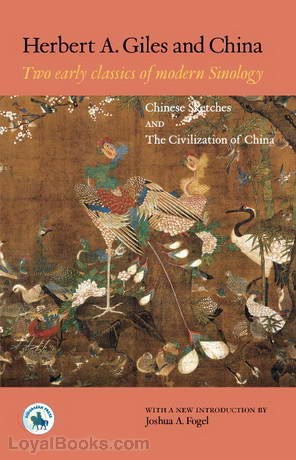
On "China and the Chinese" by Herbert Allen Giles ***


Thursday, October 30, 2008
On "Extinction" by B. J. Hollars (2385 words) ***
If the Hollars story featured earlier on this blog (here) was fantastic realism, this one falls more precisely into the realism camp. That earlier story, with its odd subject matter, caught my attention much more quickly, but this story still managed to keep me reading.
"Extinction" is, in part, a story about stereotypes. They aren't the stereotypes we usually think of, when looking at a national or human level--racial, gender, or otherwise. These stereotypes are more personal than that. These are stereotypes that two characters have built up about each other--a dad who fails to acknowledge that his son has grown up, and a son who can't see his father for the new man he is. This is also a story about change, two men dealing with grief, one the loss of a mother, the other the loss of a wife. And most important, this a story about desperation, about a dad trying to hang on--to life, to people, to anyone really, but most especially to his son. Stirring doesn't publish fiction very often, it seems, so the stories are rather special when they do. Read the piece here at Stirring.
"Extinction" is, in part, a story about stereotypes. They aren't the stereotypes we usually think of, when looking at a national or human level--racial, gender, or otherwise. These stereotypes are more personal than that. These are stereotypes that two characters have built up about each other--a dad who fails to acknowledge that his son has grown up, and a son who can't see his father for the new man he is. This is also a story about change, two men dealing with grief, one the loss of a mother, the other the loss of a wife. And most important, this a story about desperation, about a dad trying to hang on--to life, to people, to anyone really, but most especially to his son. Stirring doesn't publish fiction very often, it seems, so the stories are rather special when they do. Read the piece here at Stirring.
On "The Picture of Dorian Gray" by Oscar Wilde **
I'm recalling seeing The Godfather for the first time, another slight disappointment, and I'm wondering if this might not be a similar case. What happened with The Godfather was that I'd seen so many interesting bits and pieces and heard so many things about it that I expected much. But The Godfather is such a iconic movie that films thereafter have often copied its various techniques and plot points. Seeing it for the first time, I felt like it was full of cliches. Such was also the case with The Picture of Dorian Gray. I'd never read it, but I'd heard the whole story before, many, many times, and now, finally reading the original, it lacked much oomph. Beyond that, Victorian dialogue, with its paragraphs of discussion, seems so unrealistic, even bad, to my modern ear that at times it was hard to put up with Mr. Wilde, even if the reader himself did a rather remarkable job of making his voice seem lively and clear. You can download the text here, and the audio book here.
Tuesday, October 28, 2008
On "Shots" by Kim Chinquee (761 words) ***
Previously, I wrote about "Shot Girls" by Kim Chinquee (here). Here's another story with a variation on the same theme. Although I typically end up enjoying one story much more than another, I like it when authors write two versions of a story and share them both. It's simply interesting to watch the way in which a mind can go in different directions with the same idea--the meaning a given piece will take on and the emotions that piece will elicit. It's also interesting insofar as usually one piece is much longer than the other, more full bodied, less stream lined. Some authors, of course, only write a very few stories, over and over and over--Poe was one of those. Perhaps, all authors do that to an extent, but most are more subtle than presenting the same "buried alive" theme/plot device (one of Poe's favorites) again and again. Another author I enjoy who has written stories that closely parallel one another is Brock Clarke. Unfortunately, the two pairs of stories of his that I see as parallel are no longer available online. You can read Chinquee's "Shots" here at Willow Springs.
(Note: In an e-mail exchange with Kim herself, sometime after I read the story, I discovered that "Shots" and "Shot Girls" were written four years apart. So this was indeed a case of an author returning to fertile ground to explore the same setting and some of the same themes again, rather than a story taking two directions and both being written and published.)
(Note: In an e-mail exchange with Kim herself, sometime after I read the story, I discovered that "Shots" and "Shot Girls" were written four years apart. So this was indeed a case of an author returning to fertile ground to explore the same setting and some of the same themes again, rather than a story taking two directions and both being written and published.)
On "Swann's Way" by Marcel Proust ***

Friday, October 24, 2008
On "The Ghosts We Love" by Brock Clarke (9318 words) *****
A common subject in Brock Clarke's stories is men who have failed to live up to life's potential. Often, this revolves around marriages gone bad, in part because of these failures. In this story, from Clarke's second collection, Carrying the Torch, we see the theme carried across a family. Here, the setting of a lake house is used to full effect, presenting us with eras of the family and its gradual deterioration. Read the story here at Virginia Quarterly Reivew. Or listen to Clarke read it here at Lit-Cast.
Friday, October 17, 2008
On "Mr. Inspirational" by Kirk Pynchon (920 words) ***
"Mr. Inspirational" is what I'll call here a "talking story." What I mean is that it's a story you'd hear someone tell rather than write. Such stories are first-person narratives by and large, and they sound real, and personal--and genuine. One of the difficulties, sometimes, with fiction is that, well, it reads like fiction. We write in ways we would never tell a story. When was the last time, after all, in a conversation, that your friend Francis said something like, "Joe sat down at the bar; Sam, the bartender, was a surly sort who'd just lost two hundred dollars on a horse, and he wasn't in the mood for guff; 'What'll it be?" he asked Joe, swaddling a stack of newly washed glasses in a towel like a baby"? There's a certain faux quality to fiction. When written like "Mr. Inspirational," however, that faux quality is pushed down and what emerges is something you might hear around the water cooler at work or at a bar or at church--or at a funeral. Thus, the piece seems more immediate. I never did varsity sports, but this guy seems to have. Read the story here at A Cautionary Tale.
Friday, October 10, 2008
On "Junkyard Dog" by Michael J. Cunningham (8818 words) ****
Cunningham's "Junkyard Dog" falls into that genre of stories about diary writing--or stories that are a diary. I think of Evan S. Connell's novel The Diary of a Rapist and of Rick Moody's short story "The Preliminary Notes" (this latter not exactly a diary, but something akin to it). Both are about who in writing about themselves and their relationships discover something unsavory about themselves--as do the readers. Cunningham takes a similar track, but what makes this story an interesting variation on the genre is that our main character to an extent knows that he's a jerk. And his change at the end--indeed, the change wrought in every single character--suggests that perhaps nothing has changed at all. It seems, unfortunately, so much like many a life. Read the story here at the Summerset Review.
Monday, October 6, 2008
On "Second Favorite Girl in Brooklyn" by Kendra Grant Malone (5708 words) ***
There seems to me to be a trend in short stories these days where narrators use short declarative sentences and talk mostly about banal day-to-day things. One would think such stories would be incredibly boring, but somehow they're often very interesting--and quite sad. The stripped-down language speaks for characters who lack much to live for, whose words are as stripped as their lives. Examples of this include the earlier reviewed "Eat When You Feel Sad" by Zachary German on Bear Parade and much of Tao Lin's often hilarious and absurd work. Here is yet another example of the form. I love how Malone repeats one key phrase regarding her friends, how that in turn reflects on the narrator's relationships in general with other people. And the title--the second favorite girl. Always second. Of course, I'd take second over third or fourth or fifth--but when it comes to romance, whether it's second or third or fourth doesn't really matter--it's still not the "one," still not special enough. Oh boy. I'm going to go cry now and try not to think about all those rejections. Why don't you read the story while I'm gone? You'll find it here at Bearcreekfeed.
Thursday, October 2, 2008
On "Eat When You Feel Sad" by Zachary German (5688 words) ***
This story is made of simple, declarative sentences. It is choppy. Early writing instructors would be horrified. You need sentence variety, they would say. I would comply. Zachary German does not. In that is part of this story's strength. Young adults struggle with tedium. Life moves forward. Life stays the same. People party. People stop partying. People ride bikes. People stop riding bikes. They go to another party. They eat some grapes. They go to sleep. They type on the computer. Somehow, if you're like me, you'll be sucked into the tedium and read the thing all the way to the end, fascinated. Read the story here at Bear Parade.
Sunday, September 28, 2008
On "All Roads Are One" by Deena Fisher (1088 words) ***
Is this is a story? Of that I'm not quite certain, if we're going to talk about the formalities of form--conflict, rising action, climax, resolution. I'm not sure what the conflict or the resolution would be, although I suppose if I gave it some deep thought, I could come up with one. But I've never been one to insist that a story must follow the conventions so long as it is interesting. Perhaps, such pieces are not stories but just extended pieces of poetic prose. Into that category, "All Roads Are One" certainly fits. And therein is how a good piece of writing can, without necessarily presenting a rising action or conflict in the plot, still supply a rise and a climax in voice, in the words used, in the energy a piece sends out. When the author begins to simply list experiences near the end, the quick sentences and short paragraphs make me want to shout, make me want say, Go on, go on. And then, we move back into something longer, restful, and it's like we've come through something as readers, a storm of words, and now we're just looking at the damage left. Read the piece here at Farrago's Wainscot.
Wednesday, September 24, 2008
On "Should" by Tao Lin (1824 words) ****
What I like about this piece isn't perhaps that it offers any sort of clarity. In fact, it works way from clarity as much as possible, jumbling moments together, returning to them, redefining them, trying to figure out what they mean. Did this guy just get broken up with? Or is he seeing this girl? Are they compatible or not? The story works with the same sort of obsessiveness with which we work through such thoughts. And like most such thoughts, they lead us nowhere, at least until babies are involved. Read the story here at Bear Parade.
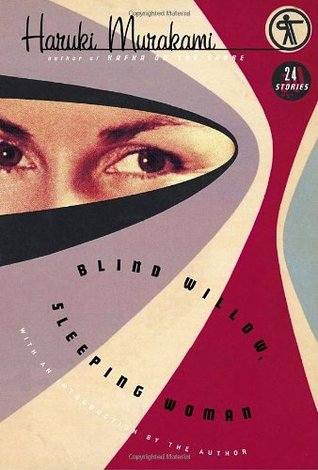
On "Blind Willow, Sleeping Woman" by Haruki Murakami *****
Monday, September 22, 2008
On "Taking You Fast" by Ann K. Ryles (4716 words) ***
I have yet to find a bad story in Stirring. But then again, Stirring so rarely publishes fiction that I get the feeling it's extremely selective. Here's a piece that is very finely written, full of the things one so often sees in fiction--adultery and child abuse. In Ryles's hands, however, they don't come off as pat. They come off as engaging. Part of this has to do with the second person. I have friends who simply reject any story written in the second person. I think this a big mistake. Granted, perhaps I'm a bit too prone to like stories in the second person. Blame that on all the Choose Your Own Adventure novels I read as a kid. But take this story and put it in the first person. It would seem to work fine (I'd say no worse or better than it does in the second person)--until the ending. Part of what's going on here is that "you" are in the present, remembering all these moments leading to this moment at the end. The first person, at the end, in the present tense, I would argue, would seem entirely contrived. You couldn't tell this story this way--you couldn't use the present tense. You couldn't leave us at the start of a trip into the unknown. You'd already be there, telling this story. You'd know. Read the story here.
Thursday, September 18, 2008
On "Dirt" by Kyla Carter (5180 words) ****
What is a life you carry in a trailer? What of a life you carry in a plastic Kroger's bag? I think poor. I think homeless. But try something else instead. Think also lonely. But here, the lonely, the poor, the homeless, aren't who they seem. And there's a whole lot more hurt to go around. Read the story here at Mid-American Review.
Sunday, September 14, 2008
On "Instead of What We Could Have Said" by Vincent Reusch (1185 words) ****
Tragedy lurks behind this piece by Vincent Reusch. I like it when there's a bit of mystery, a certain unknown, to a story--enough that you can sort of figure out what's going on, what happened, but not so much that you know all. I suppose, back when I had to write papers for classes, such stories could drive me crazy unless I knew I "knew" what was going on, but for casual reading, such pieces are grand. They make me read them again, and again. You can read the story--again and again--here at Contrary.
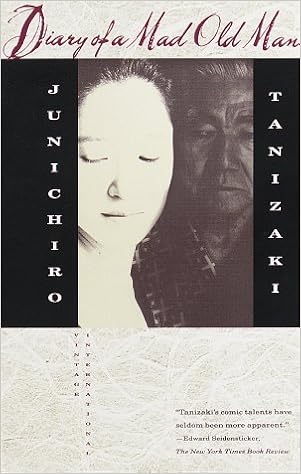
On "Diary of a Mad Old Man" by Junichiro Tanizaki ****
Thursday, September 11, 2008
On "An Ugly Man" by Ana Marcela Fuentes (427 words) ****
Dump one guy and take up with another. That's what Fuentes says she's going to do at the start of this little gem--and all in under five hundred words. I didn't know if she could pull it off and was dubious about the prospects, especially as I neared the story's end, but does it she does, and with aplomb. Read the story here at Vestal Review.
On "The Key" by Junichiro Tanizaki *****

Where it gets strange, however, is in the husband's goding his wife into an affair and his wife's reaction. One could say, be careful what you wish for. I'm thinking of the Inman diaries in particular, where Arthur Inman encouraged a close friendship between his wife and his doctor and was then enraged when he found out years later that the two were carrying on an affair--this despite the fact that Inman himself had had numerous affairs and at least in part encouraged his wife to go out with the doctor in an effort to further his untoward relationships. In Tanizaki's book, however, whatever jealousy exists merely seems to be more fodder for lust. But the consequences are still dire, just not in the manner that they turned out for Inman.
Monday, September 8, 2008
On "Family Five and Dime" by P. J. Woodside (2407 words) ****
Some of the best parts of the movie The Good Girl occur in the five and dime that Jennifer Aniston's character works in. Unfortunately, I can't remember the name of the horrid and desperately depressing store, but those scenes remind me a bit of the location of this story. I think of some cheap ripoff of Pic N'Save, some place where only the poorest people in the community go, on the wrong side of town, where shopping ceased in 1962. Put a couple of employees in the mix, and you have the makings for a story of lives that have petered out. Like Aniston's character, one of them seems bound to try something different--if only she can, if only she is allowed. Unlike The Good Girl, however, this story is set down South, where community standards come into play. It isn't just the hopelessness of the character's surroundings but the will of the community that characters don't try to do anything to change their situation, don't do anything that might upset anyone. Will the narrator conform? Read the story here at StorySouth.
Subscribe to:
Posts (Atom)

 Posts
Posts


