Saturday, January 10, 2009
On "Any Given Monday" by Laurie Koozer (6409 words) ***
This story really hooked me. It's also got me thinking about sending panties out to random people (the only problem would be buying them--I don't think, as a guy, I can pass off the thin sister thing as that would probably be kind of creepy). One does have to wonder what could possibly go right in this poor lady's life, however. Read the story here at Storyglossia.


On "The Devil in the White City" by Erik Larson *****
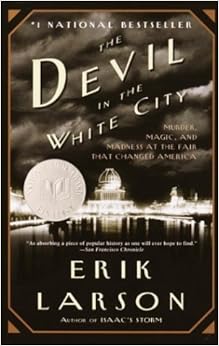
It's the story of the 1893 Chicago World's Fair, the Columbian Exposition, completed for the four-hundredth anniversary of Columbus's voyage to America. The fair is the origin of Columbus Day in the United States, a holiday I remember getting out of school for when I was a grade school student (I don't recall ever getting it off for work or for school once I was older). It's also the origin of the Ferris wheel--the first one was built by William Ferris for this exposition, a huge one, that carried hundreds of people in each car. It was built as the exposition's centerpiece, just as the Eiffel Tower had been built as the Paris World's Fair centerpiece only a few years before.
Reading about how this exposition came about, about the marvelous architecture that was put up in less than a couple of years, I was entranced. The story reminded me, in fact, of my own job, editing books. There, those of us who work in production, I often asked to do similar miracles, to put out books within what seem to be impossible time frames. Often, we do. And often, those time frames are made more difficult by our own coworkers, as was the case with the fair, where the first six months of construction and planning was wasted arguing over where to even put the fair within Chicago. That so much could be built within so little time, that so many bad odds could be overcome, seems amazing--and makes putting out a book actually quite easy. (Cost is always one other issue, and on that, the planners did have an advantage in that virtually no dollar was spared. The fair only made back what it cost to build in the last twenty days of its existence.)
The other story that Larson tells is that of a serial killer who used the fair to prey on mostly innocent people. He builds a hotel that becomes a death trap--rooms with gas pumps in them, with doors that lock soley from the outside. And he builds it largely with borrowed money. He kills his victims for his own pleasure, listening to them suffer, and then he makes money on them--selling their bodies for medicine, collecting life insurance, and so on. This story, I found, surprisingly less compelling than that of the fair. Certainly, such an audacious character is interesting at some level, but fairly early in the book, I became so disgusted by him that I wasn't sure I wanted to know any more. I found myself dreading each next passage about him. At least ten people died by his hand, though some people estimate as high as a couple of hundred (the true number is unknown but likely somewhere in the twenties or thirties).
That Larson incorporates the latter story with the fair, however, as well as with stories of the Chicago mayor's assassination and with the country's economic woes (I couldn't help but identify the Panic of 1893 with our own current fiscal problems), makes the story of Chicago's fair all the more interesting, however. It becomes a story not only of putting on a fair but of life near the turn of the century and of the city of Chicago.
Thursday, January 8, 2009
On "Flight from Tomorrow" by H. Beam Piper (8154 words) ***
A deposed dictator gets away--in a time machine. He'll be back (in Arnold's words)! He's coming back to reap revenge. But there's a problem. The time machine takes him back further than he intended--and then it stops working. So here he is, stuck, in the 1950s. Easy enough, one would figure, for a person with a lot of two-thousand-years-in-future tech savvy to take advantage of virtually anyone. (Though I keep thinking I'd know even less than most people in the 1750s knew about day-to-day getting along. I may know how to use some tech things, but I don't know how to make them!) However, for our dictator, there's a slight problem: all living things in the place where he landed appear to be suffering from disease. Will he succumb and die too? Read the story here at Project Gutenberg, or listen to it here at Project Gutenberg Audio.
On "Five Sci-Fi Short Stories" by H. Beam Piper ***

About a decade ago, I read Philip K. Dick's Do Androids Dream of Electric Sheep. I enjoyed it quite a bit, though I found the writing style to be pretty unmemorable. What intrigued me about it were the plot and the ideas. And I guess, really that's what science fiction usually excels in--ideas or well-crafted plots. Being a literary fiction person, plot is not something I typically read for; though I do enjoy something that is well put together that way, I'm not motivated generally to seek out such works.
I would say that Piper's work falls into that sci-fi mode. Of the five stories presented in this collection, two I could have probably gone without reading. The plots were derivative, the ideas not terribly fresh. But I was digging on Piper by the third story. Now, suddenly, the plots took on a freshness reminiscent of a good movie. A dictator travels in a time machine and ends up in a place he didn't expect with unexpected consequences. A set of farmers chase after some wild creature, little realizing just what that creature is. A young man's return from education on another planet promises much for his home--or maybe nothing at all. In this latter story, the people's hopes become a taking off point for discussion on what gives us hope and how real that hope is. If Piper's stories faulter anywhere, it's probably in that he sees a need to explain the pseudoscience to his readers. Maybe sci-fi people get into that; for me, however, if it's not real science, I'm not particularly interested in the theoretical aspects of space travel.
Piper's collection is in the public domain. You can listen to the stories here.
Monday, January 5, 2009
On "The Novelist" by Tao Lin (1503 words) ****
Of the many stories in Tao Lin's online collection Today The Sky is Blue and White with Bright Blue Spots and a Small Pale Moon and I Will Destroy Our Relationship Today, this concluding one is my favorite. It's about, well, a novelist, and about the way in which writers and artists tend to turn anything and everything that is an aspect of their lives into art, sometimes self-consciously so. Perhaps, as this story hints, we do art to add meaning to our lives, which, like the events in this story, are generally pretty nonconsequential, pretty mundane, unless of course they're in a novel--or about to be. Read the story here at Bear Parade.
Thursday, January 1, 2009
On "Informed Consent" by Plastik/Jimi Five (82 words) ***
Plastik Press specializes in stories about plastic surgery. That's right. If you're into that, then this is the site for you. For my part, I'm not sure if what's appealing about these stories is the writing itself or the accompanying pictures, but appealing they are. "Informed Consent" clocks in at under one hundred words but manages to sum up the heart of a relationship, putting new meaning into an old saying. Read the story here.
On "Angels" by Denis Johnson ***

All that said, I've never been attracted to Johnson's longer works. I've picked up novels of his before and have never gotten past the first two or three pages. Admittedly, this isn't giving a work much of a chance, but this was in bookstores, in places where I had to decide quickly what was worth my spending a few dollars to join my reading for the next couple of months. (This was when I lived in Fort Worth--or rather, lived barely a few yards outside Fort Worth [the half of the apartment complex I lived in was outside the city limits]--and couldn't get a library card. Used books became my lifeline for a few years. I had to be careful what I purchased, had to make those books were worth it and would last a good while.) These days, with a library card in hand (so that I can actually afford to read as much as I do), I'm a bit more open to discovery and to trying new things.
Angels came to my attention--again--through Francine Prose's book How to Read like a Writer. That book was amazing in terms of making one excited about writing, making one think writing matters, and also making one excited about the books she discusses. Last year, I finally got back to Jane Austen, whose work I couldn't stand in high school and whose work I never managed to get past page 50 in. Pride and Prejudice took a while to get into, but by the time I'd gotten half way, I was singing its praises. Wonderful writing.
Prose analyzed the opening of Angels and made me want to go back and give this book a real try. And so it joined my list of reading, and now it's read. But my feelings about are pretty much the same as they were, years ago, before I read it. Fine, accomplished writing, but for whatever reason, the book didn't speak to me. Moments toward the end, I did care for the main man in it, though mostly I didn't feel much sympathy for him throughout; I never did quite understand Jamie, why she would like Bill, why she would leave her husband (boredom?), why she would be attracted to this underworld. And my lack of understanding, in turn, affects the way I feel about this work
Sunday, December 28, 2008
On "Trauma Plate" by Adam Johnson (5624 words) ****
I don't stay at Motel 6. It's nothing personal. I actually think Motel 6 is a great chain if you're looking to save some dollars. I wish, in fact, that I could stay at Motel 6. I don't stay there, though. I don't stay there because of my mom. I don't stay there because my mom once heard of dangers that lurk at Motel 6's. Someone got robbed or stabbed or beaten, and it was at a Motel 6, and now Motel 6 is banned from my life. It is banned because my mom hounded me until I promised never to stay at a Motel 6 again. So I don't stay at Motel 6's. In the literal letter-of-the-law words of the promise, I could stay at Jo Bob's Country Motel with Color TV for twenty dollars a night, but no Motel 6.
Adam Johnson's story "Trauma Plate" is about a similar kind of irrationalism, the way media and marketers feed on our fear. And fear, fear is a great way to sell things, for if the easiest things to sell are things we need, rather than just desire, than we will do anything to have such things, will spend on money there before we'll by that new pair of Adidas shoes. In Johnson's story, that fear is one of being shot, one that makes people wear Kevlar and other body armor as an everyday accessory. And why not? We'd certainly be safer with it on (though why not just aim for the head if everyone has his or her heart covered?). (Would I too fall into such fear? I sometimes wonder. I can walk a street at night with not too much fear, but were I ever mugged, would my attitude change? Would I insist on driving to destinations at night rather than walking? Would I start carrying maize? One doesn't know until the unfortunate happens to one's self.)
But of course, Johnson's story is about more than literal body armor. It's about the figurative armor we wear around our hearts, the things we do to protect our emotions and ourselves, and what removing such armor suggests about love. Read the story here at the Barcelona Review.
Adam Johnson's story "Trauma Plate" is about a similar kind of irrationalism, the way media and marketers feed on our fear. And fear, fear is a great way to sell things, for if the easiest things to sell are things we need, rather than just desire, than we will do anything to have such things, will spend on money there before we'll by that new pair of Adidas shoes. In Johnson's story, that fear is one of being shot, one that makes people wear Kevlar and other body armor as an everyday accessory. And why not? We'd certainly be safer with it on (though why not just aim for the head if everyone has his or her heart covered?). (Would I too fall into such fear? I sometimes wonder. I can walk a street at night with not too much fear, but were I ever mugged, would my attitude change? Would I insist on driving to destinations at night rather than walking? Would I start carrying maize? One doesn't know until the unfortunate happens to one's self.)
But of course, Johnson's story is about more than literal body armor. It's about the figurative armor we wear around our hearts, the things we do to protect our emotions and ourselves, and what removing such armor suggests about love. Read the story here at the Barcelona Review.
On "Emporium" by Adam Johnson ***

Unifying motifs of Johnson's collection include guns and technology. The technology bit is particularly interesting insofar as Johnson, at points, ends up telling what are essentially science fiction stories in the guise of literary fiction. And that is good. I find that science fiction is often too hung up on its ideas to bother with real characters and real places; in Johnson's work, by contrast, the characters and the settings are front and center, and whatever odd technological items that might be part of the world of his fiction are just that--little items in the background that his characters take for granted the same way we take our flat screen televisions for granted.
For me, the most successful stories are those that manage to keep the narratives personal, to keep the weirdness from overwhelming the rest of the work. "Teen Sniper"--the story of young police snipers who take the lives of supposed criminals but who seem still to immature to really understand their own hearts--provides an interesting start to the book. "The Eighth Sea"--the story of a nineteen-year-old kid assigned to a drunk driving class having an affair with one of his twice-his-age classmates--provides emotional punch to the end of the book. "Trauma Plate" (available online and discussed here) is another fine story. My favorite piece, though, is "Your Own Backyard," the tale of a man struggling to raise a son but who finds, as the story progresses, that the harder he tries, the further away his son seems to be moving. The story ends with a wonderful metaphor that mirrors the entire thrust of the story.
Sunday, December 21, 2008
On "Go Fish" by Mary Miller (2256 words) ***
Longing and desire. It's the foundation of many a story, including this one. One girl's going straight--or trying to. The lives her friends lead seem fairly empty--given to meaningless sex and drugs. The problem is that the life she's trying to lead doesn't, at this point, seem all that much more meaningful. And as with all the girls, there's this one guy . . . Read the story here.
On "The History of Time" by Leofranc Holford-Strevens **
Calendars have come to seem less certain for me in the past few years in part because of a lack of consensus regarding which one to use within the very small faith to which I belong. We use the Jewish calendar, but which one? While most of the Jewish world follows a calendar put into writing by Hillel centuries ago, others rejected that calendar, preferring instead other systems. Does the Passover always have to fall after the vernal equinox? Does the Day of Atonement always have to fall either on the weekly Sabbath or at least one day away from it? Does the festival of the Eighth Day always have to fall at least one day away from the Sabbath also? All these are things set up in the intercalated calendar used by most, but not by all--and practices have varied with time and place.
Such controversies are no less evident in the mainstream Christian world, where the date of Easter has varied also with the calendar one chooses to use, and Holford-Strevens in fact provides an entire chapter on the varying customs of reckoning this holiday throughout time and place.
Or what of societies whose years are calculated by these different calendars, where our years start in different places? Or, worse, where there is no such thing as BC and AD? No doubt, historians have their work cut out for them when the dating of years is given in such broad terms as "three generations ago" (as it was in some ancient Greek histories), but similarly confusing, no doubt, is trying to reconcile dates of events in nations who remained on the Julian calendar long after the Gregorian calendar had come into vogue (one's June 19 may be another's June 8).
On the level of spurring thinking about what we take as so commonplace, Holford-Strevens's book does a great job. As for the writing itself, I found it a bit too technical for an introduction for a general reader, and I wonder, with it clocking in at under 150 very-small pages, how useful it would be as a reference to someone more technically inclined. For my liking, a book on the clock by Jo Ellen Barnett, Time's Pendulum, would have been more along the lines of the kind of introduction to timekeeping in general that I was hoping for.
Wednesday, December 17, 2008
On "The Cost of Doing Business" by Michael Penncavage (3264 words) ***
What I admire about good pulp stories is the strong, forceful writing, the clipped sentences, the cadence, the action verbs. Good pulp writing also tells a compelling story, and this one does just that, with a memorable character to boot. I'm not too keen on this sheriff, and I don't think too many other people would be either, but he's fascinating to watch in action. Like many a pulp story, at the end, I'm left wanting more. Sometimes, that can be a good thing. Read the story here at Thuglit.
On "The War against Parents" by Sylvia Ann Hewlett and Cornel West ***
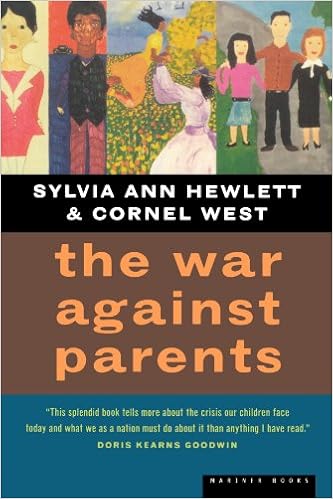
There's a certain nostalgia for better times--that is, the 1950s--that kind of bothers me about this book. Although the tax code was, from what I've read, quite a bit more redistributive then, there was also, I would argue, more tax money to go around--the United States was the sole power after World War II who didn't have to substantially rebuild. That in turn allowed the country to spend in ways that the nation could likely not spend now. CEOs do take home an unfair amount of income, but their bonuses are a drop in the bucket compared to overall company expenses. And certainly today's sitcoms do make fun of parents, but some sitcoms also show parents at their best; popular entertainment in the 1950s had its share of scummy people too (just think: pulp fiction). At the same time, the authors credit certain advances since the 1950s, such as women having more opportunities in the workplace, without--in my view--really exploring how those opportunities have also contributed to some of the problems parents now have. If good parenting means sacrifice, then sacrifice often also includes one's career--it is certainly so now, but it was so in the 1950s as well.
That said, West and Hewlett do a great job of stirring the ire of common folk like me. I can't help but get angry when I read of how conservatives, who on one hand talk family friendly and on the other remove media educational-programming requirements under the theory that the "market will take care of that." I can't help but get angry at CEOs who get a bonus at the same time their company lays off tens of thousands of employees. I can't help but be angry when liberal media lambasts men for trying to do a better job of being men--that is, of being true men, whose main priority is their family. The authors of this book show many of our nation's hypocrisies, on both the left and the right, and though the authors' own views skew to left, they do enough critiquing of that left to keep the overall picture of the problems parents currently have fairly well balanced.
And the authors make a number of common sense proposals I'd love to see our government take up. Some of these could be done at virtually no cost--a day off for voting, for example. Some are very practical--longer school days, for example. And some are grand wishes--almost all the parents in the surveys the authors reference support various tax deductions at the same time they support greater government services; the authors only rarely talk about where the extra income would come from to pay for these simultaneous tax cuts and increases in spending.
At the least this book is a great call to action. At the most, it provides a blueprint, a starting place, toward creating a nation that takes better care of its children. I hope some politicians out there have read it and will take it to heart.
Sunday, December 14, 2008
On "Whatever's Left of Normal" by Don Evans (3791 words) ***
Two Christmases, two stories, each one wrapped around the other to provide meaning and context. Parallel stories are a much-used technique, and this piece uses the technique to full effect. To understand that effect, I ponder what Don Evans's piece would be with only one of the stories. If one stuck with only the war story, certainly there'd still be quite a bit at stake--we're talking a life here, a quandary between saving one's self, following the rules, or saving another (or possibly simply losing both one's self and the other). It would be a compelling story, but it probably wouldn't have as much heart, wouldn't seem as real. It's the other story, the reminiscence, that grounds the war story here, that makes it something we can all feel, that pushes the story of lives at stake into our everyday life. And yet, that story by itself would not seem like much. It is only when the stakes are raised--at war--that suddenly a story about a bat becomes fraught with meaning. You can think about the technique for yourself by reading the story here at Narrative (Story Quarterly) (log-in required--but it's free!).
Sunday, December 7, 2008
On "Naming the Giraffe" by Lynn Watson (304 words) ***
Something seems missing in this story. There's a tension, a set of events, that underlies everything after the first paragraph, but the cause of that tension is a mystery that is only hinted at as one reads further. First we learn that . . . but I won't go into the details and ruin the story for you. Each revelation is a bit like discovering a maggot in your food, each one bigger than the next. This is flash fiction that succeeds at doing what flash fiction does best--evading the story, making us curious, making us want to read and know more, and never giving it to us. Read the story here at Pindeldyboz.
On "Author Unknown" by Don Foster ****
The first case study, on Foster's first foray into this field, is on a poem called "A Funeral Elegy," which Foster attributed to Shakespeare. He raises a lot of good reasons for why one should believe such. He also recounts the academic politics that keep his observations from being wholly accepted (the account of which--all the egos and one upmanship--reminds me so much of why I didn't want to stick around to earn a doctorate over a decade ago; arguments like "This can't be Shakespeare because it's not brilliant enough" hardly seem logical to me, but coming from big names seem to be acceptable). But Foster too may have been a victim of his own desire to assign the poem to an important writer. He sets out to "find the author," though in his mind the author very well might be Shakespeare. Wanting it to be so, he argues it is such. Years later, apparently, after this book was written, another author comes forward and proves, perhaps a bit more conclusively, that the author was more likely one John Ford. I give Foster credit for, after reviewing the evidence, apparently changing his own views--truth, for him, it seems, is more important than his own reputation. But the case goes to my anxiousness about textual analysis and attribution--unless Shakespeare or Ford can come forward and say who is the author, we really cannot know. We can only surmise, only say it's probable.
In the second case Foster follows, the one that would bring him to popular knowledge, the author does just that. Foster shows that Joe Klein is the likely author of the novel Primary Colors, the fictionalized account of a presidential campaign eerily similar to Bill Clinton's own. Klein denied, of course, for a full year, before finally saying, Yeah, twas me. What was interesting in this chapter was to hear Foster's own angst expounded, the way in which Klein's denial in effect hurt Foster's own standing in academe.
The rest of book is also a great read, covering four more literary mysteries, in which Foster holds out his own conclusions until far into a given chapter, making readers read on and on, turning pages as if they were reading some sort of potboiler. STOP reading here if you don't want spoilers!
Foster covers the case of the Unabomber (for which defense lawyers tried to hire him--he eventually did some work for the prosecutors). He covers the Talking Points mentioned in the Starr Report, finding the likely author to be both Lewinsky and various lawyers (the chapter mostly just reminded me of the disgust I felt in the 1990s at the behavior of President Clinton and at the Republican Congress and Starr himself who seemed bent on looking for anything, anything at all, that would allow them to impeach Clinton, that they strayed far, oh so far, from the original special prosecution mandate). He covers Wanda the bag lady, whose letters some attributed to Thomas Pynchon (the real author, Foster contends, was an mostly unsuccessful Beat poet who tragically killed his wife and himself at about the same time Pynchon moved from California). His final chapter looks for the author of "Twas the Night before Christmas" and makes a convincing case that Clement Clarke Moore more or less stole the attribution from a Dutch doggerel poet named Henry Livingston.
Wednesday, December 3, 2008
On "Robbers" by Tao Lin (789 words) ***
Here's another absurd story by Tao Lin in which the normally horrifying becomes simply hilarious. If only real life burglaries could be this funny or this much fun. I'm reminded of a recent break-in at a friend of mines, all the inconvenience of it, beyond just the awkward feeling of being violated. That was not funny. And yet, put it in a story, distance one's self from it, and there's plenty of place for humor. In her case, the thief, as here, was caught in the act. It became a kind of neighborhood social event, people all hanging out in the front yards, as the police staked out the house, waiting for the thief to surrender. Lemonade, a few baked cookies, some gossip--a good time had by all, except the terrified thief, of course, who tried to hide in the duct system, as if the police surrounding the house were simply going to go away. Read a slightly different story here at Bear Parade.
On "Love among the Chickens" by P. G. Wodehouse ***

Why I never made it back to Waugh or Wodehouse, I'm not sure. It's not for lack of reading. And it's not for lack of wanting to read more. I've just been distracted by others, I suppose.
But now, coming to Wodehouse twenty years later, he doesn't seem as fresh or funny, at least not in this particular book. The story of a man who is cajoled into working on a chicken farm with his friend and who in turn falls in love with a local woman seems a bit stock in terms of the characters and even some of the plot twists. Is it me, this book, or Wodehouse that is the reason for my relative disappointment? That I won't know unless I read another. Of course, that might be another twenty years.
The text itself I actually listened to, on my walk home each night, now that it's dark as I leave work. And the audio available online for free is, in fact, quite good. One thing I can say for Wodehouse is that his work, as light and modern as it is, is sure a lot more enjoyable to listen to than one of those verbose Victorians, even if a bit stock. Read the novel here. Listen to it here.
Monday, December 1, 2008
On "Mosey Is As Mosey Goes" by Jeanne Marie Beaumont, "Lover Who Never Was," by Penelope Shuttle, and "Occurrence on Washburn Avenue" by Regan Huff **
I'm taking a break from the online stories to highlight three really great poems, scattered at different locations across the Net. Each one is quite different but speaks to me in some way. The reason I don't feature more poetry is probably that, for me, it seems to come down to such a personal taste. And yet, with these three, I can't help myself.
Beaumont's poem is a work of technical vibrato, working the alliteration and the occasional rhyme to full effect in simply declaring a definition. I love how this poem becomes the definition itself in its very sound, slowly wandering toward its point. Read the poem here at Pool Poetry.
Shuttle's poem is one that works on a more personal level, speaking to that ideal that rests within each of us. In that she is able to capture that, to write about it, I love it. (It reminds me, actually, of a joke that used to go around a former workplace. A few coworkers of mine--or maybe it was just one coworker--used to talk of starting a virtual boyfriend service. He'd leave messages, send flowers, make dates, but he's always fail to show up. I suppose the idea was to give people who wanted to be dating someone--but not someone real, not someone with faults and eccentricities--a chance to have that special someone, and the ability to more easily turn down those unwanted dates.) Read it here at Poetry Bay.
Huff's poem is more of a narrative, but a short one, a very short one. It does what a good narrative poem can do but what a short story technically can't (though that doesn't stop many from calling such things stories, even if they're really just vignettes). That is, it explores a single moment, a moment of wonder. It doesn't present a conflict to resolve--it merely lets us bask in that single instant. I love the repetition in the last line, the way it shows off the glorious repetition in the moment itself. Read the poem here at the Beloit Poetry Journal.
Beaumont's poem is a work of technical vibrato, working the alliteration and the occasional rhyme to full effect in simply declaring a definition. I love how this poem becomes the definition itself in its very sound, slowly wandering toward its point. Read the poem here at Pool Poetry.
Shuttle's poem is one that works on a more personal level, speaking to that ideal that rests within each of us. In that she is able to capture that, to write about it, I love it. (It reminds me, actually, of a joke that used to go around a former workplace. A few coworkers of mine--or maybe it was just one coworker--used to talk of starting a virtual boyfriend service. He'd leave messages, send flowers, make dates, but he's always fail to show up. I suppose the idea was to give people who wanted to be dating someone--but not someone real, not someone with faults and eccentricities--a chance to have that special someone, and the ability to more easily turn down those unwanted dates.) Read it here at Poetry Bay.
Huff's poem is more of a narrative, but a short one, a very short one. It does what a good narrative poem can do but what a short story technically can't (though that doesn't stop many from calling such things stories, even if they're really just vignettes). That is, it explores a single moment, a moment of wonder. It doesn't present a conflict to resolve--it merely lets us bask in that single instant. I love the repetition in the last line, the way it shows off the glorious repetition in the moment itself. Read the poem here at the Beloit Poetry Journal.
On "The Bin Ladens" by Steve Coll *****
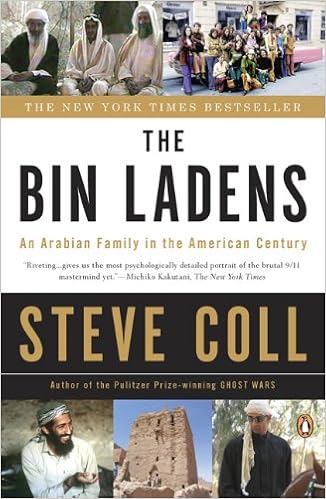
He would also have fifty-four children. As a fairly devout Muslim, who would help to refurbish the holy cities of Mecca and Medina, he could and would take four wives, as allowed in Islamic tradition. (What strikes me as interesting in this is that the men often take not just four wives in a lifetime but four wives at a time. Divorce seems fairly common, so that, where in the United States, we have serial monogamy because of rampant divorce, among some circles in the Islamic world you have essentially serial polygamy.)
Those children would be bequeathed a huge fortune when Mohammed died in a place crash. Mohammed's oldest son Salem would then take the reigns of the family and the family businesses. Salem, as the book shows, was a natural salesman--and, as many salesmen are, a kind of party animal with a tremendous sense of humor. Salem's own recklessness would lead to another tragedy in a plane twenty years later.
Under Bakr, Salem's half-brother, the family businesses would move toward being more professional, more corporate--or so, that was my impression from the book. At this point, the book becomes a bit drier as a result, though still quite fascinating. For this is also the time when Osama begins to create problems for the Saudis and for his own family. And perhaps one of the most interesting themes throughout the whole book is the way in which this one family straddles the Muslim and Western worlds, how some are very devout, conservative Muslims, some Muslims in seeming name only, and most Muslims somewhere in the middle, each of them donning different personalities as necessary in and out of Saudi Arabia.
And finally there are the Bin Ladens themselves, the awkwardness that one black sheep family member can create for all the others, the loyalty to one another, the devotion to the royal family and to Islam itself. This is as full and textured a portrait one could expect in six hundred pages, and so far the best of the four historical books I've read that have come out of our obsession with September 11, save perhaps the 9/11 Commission Report, itself an amazing work.
Subscribe to:
Posts (Atom)

 Posts
Posts


