Thursday, July 16, 2009
On "Boy, a Cat, a Lifeboat" by Claudia Smith (641 words) ****
The Web site A Boy, a Cat, a Lifeboat is devoted to one concept--stories involving these three things, a play on Yan Martel's novel The Life of Pi, for which Martel was accused of stealing the idea. The Web site rightly shows that ideas aren't things one can protect, that one concept can be taken any number of directions. Each of the stories on the site are interesting in their own way, but among them, Smith's is my favorite. It conveys loss so strongly in just a bit over six hundred words. Sure, tigers are involved, as is a boy. The lifeboat is metaphorical--and a strong metaphor at that. At the start, the boy's mother thinks of herself as a lifeboat, but by the end she's looking for one. Read the story here at A Boy, a Cat, a Lifeboat.


On "Something Wicked This Way Comes" by Ray Bradbury ***
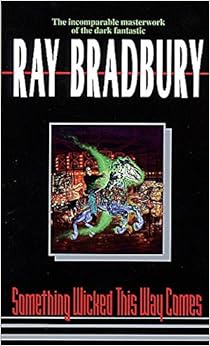
But the book turns mean quick, with the arrival of a fair of freaks. Watch out for the weirdos--they might just be trying to get your soul. Seems kind of fifties--you know, "strange people means strange things." Watch out for folks who are different. And the people who do the best watching--why, of course, twelve-year-old boys. I found the whole thing rather unbelievable, and given that this is a fantasy novel, some level of belief needs to be obtained if I'm to enjoy the thing. Beyond that, parts of these early passages seemed deliberately preaching as well as deliberately lyrical (lyricism is great; forced lyricism not so much).
But then what happened? Somewhere in here the janitor (one of the boy's father) gets involved, and I started to actually feel like this world perhaps made sense. And the action picked up, and there were moments of suspense. And then? And then came the crazy ending, the solution, the means of chasing the demons away. I won't bother telling folks who haven't read it what it is, but my feelings were jolted back to my initial ones. In the end, I didn't really much care.
Monday, July 13, 2009
On "Coulrophobia" by Cody Walker (344 words) ***
Some people hate clowns. Some people dread them. Me, I find them amusing in a theoretical kind of way. What I mean is that, say, you mention that there is a clown at the mall. Ooo, I would say, and want to go see the clown. Then, we'd actually go. I'd see the clown, and I'd be disappointed. The clown, in reality, would fill me with apathy, although the clown in theory would be particularly interesting. More interesting to me is the person who plays the clown, the person who actually puts on the clown makeup. What's the deal with that? I wonder. Why would anyone set out to be a clown? I mean, a made-up clown, not a comedian. Walker's story (or prose poem or whatever you want to call it) takes clowns a step further. He puts them into an underground society of has beens and drunkards. The effect is at once engaging and--to those who find clowns strangely scary (you know who you are, you, who watched too many psycho killer movies growing up)--horrifying, and also sort of funny, which is sort of the point of a clown. Read the story here at Tarpaulin Sky.
Friday, July 10, 2009
On "The Beat of Sorrow" by Brett Rosenblatt (1901 words) ***
In one of the best moments in Rosenblatt's story, the narrator recounts how the life of the drummer is one of numbers, of counting. The passage is beautiful, and this concern--with time, with counting, with the beat of the heart--is what the story focuses on. Rosenblatt uses the drumming motif throughout the story to tell a sadder, deeper story of a relationship heading south. Read the story here at Susurrus.
On "The Year's Best Fantasy Stories 11" edited by Arthur W. Saha ***
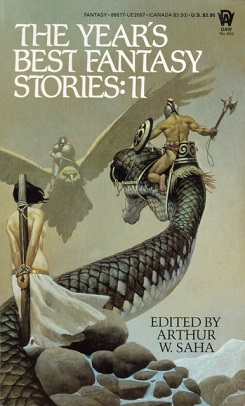
What makes the stories typically more generic, however, and what in some ways is what I find disappointing about most genre fiction is that each story wrapped up fairly well and succinctly. There were a lot of loose ends. One need only look at one of my favorite stories in the collection, "The Storm," by David Morrell. Ostensibly, a story about a storm that literally follows on man around, this was a piece about as fascinating as T. C. Boyle's story "Blood Rain." Watching the character discover what was happening and and all the trouble that this situation brought to those around him was fascinating. Then the story gave us an explanation--a curse placed on the man. I was with the story until the curse, but the latter seemed such a letdown--an easy out for an intolerable but intriguing situation. (The very end, a bit of a twist, at least makes up for some of my disappointment.)
Other favorites included "Unmistakably the Finest," by Scott Bradfield, the story of a woman who discovers success in the form of a preacher she follows--and the resulting trouble that eventually ensues. If one notices a trend here, with me, it's that, for me, the best fantasy is that which seems to be part of our world and twists it around a bit, rather than something that is set in a world of dragons and knights. Realism--and fantastic realism--has always been more to my taste.
An exception to this would be Jane Yolen's "The Foxwife," the tale of a man who discovers he is married to a literal fox. The way in which this story is told reminded me of many of the strange tales I read on the Japanese reading list that I undertook last year. Bizarre enough that I wasn't sure what I was to make of it.
Tuesday, July 7, 2009
On "Rod and Gun Club" by Marcelle Heath (655 words) ****
Try this for a tight story. Heath makes every word count. I had to read the piece twice to a clear sense of what's going on, but it's short enough and beautiful enough that it was well worth it. I'm going to read it again. And again. She's got the ambiance of a country club/beach club down. Little details like the jump that the dessert cart takes on the bunched-up section of carpet make this story what it is. Add to that some kind of intrigue, some kind of danger, and you're in for quite the read. Read it here at Pindeldyboz.
Saturday, July 4, 2009
On "Raimundo" by Dan Moreau (2388 words) ***
Echoes of Gary Soto's Nickel and Dime here. This is a story about an Hispanic migrant who's settled down in a home in San Antonio and who dreams of a woman in his past. The neighborhood he lives in is one where even the cops litter and where calls to 911 are about as effective as take-out orders to that restaurant that went out of business fifteen years ago would be. And the woman he likes seems just as unobtainable. This is a story of dreams unfulfilled--of dreams impossible to fill. Read it here at Segue.
Wednesday, July 1, 2009
On "Seamus, Then" by J. M. Patrick (644 words) ***
I'm not sure this piece qualifies as a story in terms of the conventions of rising conflict, climax, and resolution, but I like the way the author pulls the story of a life into a single moment at the blackboard, how the present and future mix here. What makes the mix of future tense with the present tense interesting is how the letters that Seamus writes are used as a kind of analysis of his future--and of the narrator's future. We're left wondering, is this the actual future or is it the narrator's imagined future. In the end, though, I suppose it doesn't matter. Read the story here at Contrary Magazine.
On "The Once and Future King" by T. H. White ***

What's interesting also is how White uses Arthur to comment on contemporary times--his contemporary times, namely, with the rise of Hitler. The Great War is discussed in terms of Arthur's war to end all wars--and yet which fails to do just that. There is discussion of how borders seem to make the world the sad place it is (we know they aren't real, but we fight over them anyway). Part of how White does this is to have Merlin live backwards, and thus, he knows even what is happening in our day, given his long life (how Merlin knows these things when confined to a cave--not the underside of a stone, as in Malory--I'm uncertain, but I suppose he must get out at some point). And part of how he does this is by having Arthur train with Merlin by becoming various animals. This first section of the book, largely not featured in Malory, features Arthur and Merlin front and center. I found it also perhaps the most boring section, which is a shame really, because it was the one section whose plot wasn't mostly borrowed. So it goes. White's book is good mostly because of how it is able to update Malory and give him the unity of form modern readers expect.
Sunday, June 28, 2009
On "Sexy, Hot, Sad, Tragic, Accident" by Krishan Coupland (2404 words) ****
Look the words of this title up on the Internet and see what you find. You probably won't find this story, but such is the cruelty of Google's automated search and recover. Why not this story? Why some other site? Unless you're up on all of what goes in to search engine ratings, you probably will never know. Just like you'll never know "Em," the character at the center of this story--though if you had the film that this story discusses, you might get an understanding of what people think of Em, not the real Em but the Em projected on our screens. This story of loss, of trying to recapture what was, is quite the thing to save and hold on to for as long as you can. Read it here at Eclectica.
Wednesday, June 24, 2009
On "The Ways You Are Gone" by Kami Westhoff (3804 words) ***
Somewhere in the middle of this story we get the rundown of a life that could have been--all of it within a week. It's poetry. The life that could have been is fairly mundane, something out of an Updike novel, and yet--for someone who has gone through an incredibly emotional experience that will never actually end--it's also the stuff of dreams. How many of our dreams really are simply a simple life? Read that potential life here at Carve Magazine.
Sunday, June 21, 2009
On "The Shorty" by Zachary T. Vickers (7990 words) ****
This is a long one, but it kept me reading. I liked the voice. Vickers, here, is able to channel the world of a short man who wants--well, basically--a normal life. Sure, there's the part about him wanting to high jump, but that's more a comment on something he can't even try to do. There is also the desire to own a house, the desire for a decent job, and most important the desire for respect. Does he get it? I don't know. But maybe that doesn't matter. Maybe what Vickers is hinting at here is that respect starts off in one's own mind. Read it here at TPQ Online.
Thursday, June 18, 2009
On "Warnings Accompanying Your Inflatable Universe" by Justin Kahn (580 words) ***
I have tried to keep the online references merely to short stories--that is, stories in a traditional form insofar as they have a beginning, middle, and end, a climax, a conflict. I don't know if this qualifies as a story using those sort of priciples--it reads more like some of the humor one might find on Yankee Pot Roast or McSweeney's--but the idea here is so compelling that I bring it to the blog anyway. Café Irreal often seems to be focused more on ideas anyway--the pieces Irreal published aim to make you think, and they often make me do just that. Read the piece here at Café Irreal.
Monday, June 15, 2009
On "The Queen of Swords" by Jen Michalski (4932 words) ***
Sometimes it's all in the ending, and in the symbols and metaphors. I like how this story works with broken things, looking at them from several different angles--broken dishes, broken relationships, broken businesses, broken lives. Still, where the story really caught me was in the last line. Read it here (and don't skip ahead) at StorySouth.
Friday, June 12, 2009
On "Christmas Tree" by Lydia Copeland (469 words) ****
Here's another nice flash piece by Copeland, the wordsmith. Here, we get a rundown on a niece's life, on an aunt she adores and on moments made weird by new members in the family (something that I myself have always felt a little odd about when meeting some girl's parents or hanging out with her family--me this relative stranger her might one day be a part of the family, though not from birth).
As for the aunt, I remember my own precious aunt. She didn't let us get away with things like smoking or drinking. In some ways, she was more strict than my quite strict mother. My mom cleaned the house twice a week; this aunt cleaned it every day. My mom let us play in the living room, as long as we put our toys away. This aunt didn't let us play anywhere but in the bedrooms. But what this aunt let us get away with that my mom would never have let us get away with was putting sugar on our cereal, and what's more, eating cereals like Fruit Loops, deemed unhealthy by my parents. We were limited to Shredded Wheat, oatmeal, Grape Nuts; if lucky, we might get honey on the cereal from time to time. Looking back on it, however, I'm glad my mom wasn't into letting us have so much sugar. Read the story here at Menda City Review.
As for the aunt, I remember my own precious aunt. She didn't let us get away with things like smoking or drinking. In some ways, she was more strict than my quite strict mother. My mom cleaned the house twice a week; this aunt cleaned it every day. My mom let us play in the living room, as long as we put our toys away. This aunt didn't let us play anywhere but in the bedrooms. But what this aunt let us get away with that my mom would never have let us get away with was putting sugar on our cereal, and what's more, eating cereals like Fruit Loops, deemed unhealthy by my parents. We were limited to Shredded Wheat, oatmeal, Grape Nuts; if lucky, we might get honey on the cereal from time to time. Looking back on it, however, I'm glad my mom wasn't into letting us have so much sugar. Read the story here at Menda City Review.
On "The Mabinogion" translated by Sioned Davies ***
But what The Mabinogion lacks that Morte D'Arthur has is an arc and a series of continual characters (yes, Arthur, Guenivere, and some of Arthur's knights show up in several tales, but not in every one). As a result, one doesn't recall as much when the tale is completed. A woman's son is stolen away (but is set up so that she looks as if she killed him), and she is forced to tell all visitors to the castle how she apparently killed her son. The son grows up. Someone discovers his true identity, and mom and son are reunited. A fine story, but one I recall probably because it was the very first. In the next to last story, a young man is told to marry a particular woman. He goes to Arthur's court to request the help of the king, his cousin. The knights then venture off to a new kingdom, meet with a man who requires of them some impossible tasks (lest they die) in order to win the lady, they do them, and the young man gets a wife (this piece reminded me how, in Christian lore, God does all these things for his people, who in turn reap the reward, even though they've done very little). In between are similar tales, full of quests and knights. But I'd be hard pressed to recount their plots.
Tuesday, June 9, 2009
On "How to Measure Your Breast Size" by Laura Madeline Wiseman (2813 words) ***
I don't know if this piece appeals to me so much because it tells me all sorts of things about shopping for bras that I didn't know and, at least until the manzere (ala Seinfeld) comes into style and I gain a noticeable amount of weight, probably will never know or if this appeals to me because Wiseman manages to imbue this how-to lesson with so much verve and vitality. I want to buy a bra! I want to buy a bra! Don't I deserve something wonderful to? Maybe the story is enough wonderful for me. Try some wonderful on for yourself, here, at Blackbird.
Saturday, June 6, 2009
On "Conversations You Have at Twenty" by Maud Newton (5665 words) ***
There's a moment in Newton's apparently autobiographical story (if the word "Memoir" is to be believed) where she notes that "it's one of those conversations you have at twenty." That sort of conversation is one where a man you barely know enters your room in the middle of the night and talks to you while you're half dressed until dawn. I have never had a woman do that to me, and perhaps that's where my own lack of success in that domain springs from. I do remember, one night, late, chatting with a woman eleven years my junior online--this was almost a decade ago--and she noted a similar experience to Newton's. In Newton's case, it led to her having a pretty unhealthy relationship (one of a string apparently); in the chatter's case, it was taken as being very rude and led nowhere.
The closest I've come to the kind of oddball situation like Newton's would have been when I was about eighteen. A girl, a friend of my sister's, who came to live with us with her mom after her mom's divorce, ran into my bedroom early in the morning and laid herself atop me (we were both fully clothed). Was I turned on? You betcha--and really uncomfortable. My mom walked in on us but didn't say anything, which seemed odd as well. Was it a dream? Am I imagining this? Maybe so, though I doubt it. I mean, she was wearing red sweatpants. It can't be a dream.
Newton's story doesn't come across as a dream either, unless it's a bad one. She's coming from a place very different from my own very conservative life, and for that I appreciate the honesty and freshness. Read the story here at Narrative Magazine. (Log-in required--but it's free!)
The closest I've come to the kind of oddball situation like Newton's would have been when I was about eighteen. A girl, a friend of my sister's, who came to live with us with her mom after her mom's divorce, ran into my bedroom early in the morning and laid herself atop me (we were both fully clothed). Was I turned on? You betcha--and really uncomfortable. My mom walked in on us but didn't say anything, which seemed odd as well. Was it a dream? Am I imagining this? Maybe so, though I doubt it. I mean, she was wearing red sweatpants. It can't be a dream.
Newton's story doesn't come across as a dream either, unless it's a bad one. She's coming from a place very different from my own very conservative life, and for that I appreciate the honesty and freshness. Read the story here at Narrative Magazine. (Log-in required--but it's free!)
Wednesday, June 3, 2009
On "Groove" by Claudia Smith (347 words) ****
Flash fiction, when as quick as this, demands keen attention to the detail of a moment. Smith does something wonderful with this short piece, building up to that moment with a list of details from early in a relationship, leading finally to a moment later on when the relationship becomes sort of commonplace--but also completely new--and wonderful. Read the story here at Quick Fiction.
On "Le Morte Darthur" by Thomas Malory, edited by R. M. Lumiansky ***
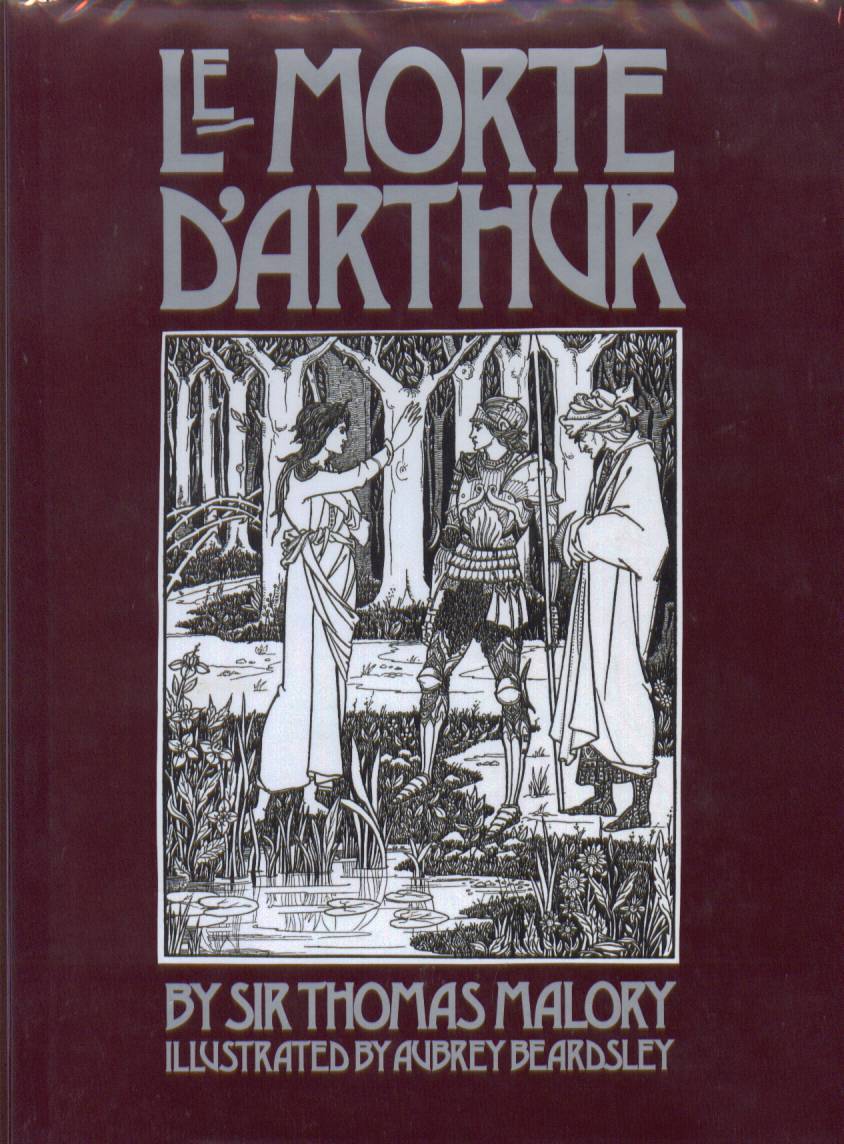
On the whole, this 750-page tome was at its most interesting at the beginning and end, for its first 100 pages and last 100. In the early chapters comes the setup, all the prophecies about what is to unfold in the faraway future, as well as a history of King Arthur's ascent to the throne. In the later chapters comes the fulfillment of those prophecies and the story's tragic end. In between are accounts of numerous battles and quests and tournaments with little or no real climactic buildup. This is a romance in the medieval sense, so the text is episodic, and while some episodes occasionally make for compelling short stories, the whole does not amount to much. I found myself terribly bored during most of the accounts of the battles. But the overall trajectory of the story is mythic, and it's easy to understand why Arthur's legend has inspired so many derivative works.
Subscribe to:
Posts (Atom)

 Posts
Posts


