It's been a while since I featured an Amelia Gray story. Sometimes I check out her tweets, which are almost always amusing (one critic even claims they're better than her stories). And she's come quite a ways since I first came across her work online: two short story collections, then a novel from a major publisher, then another novel. And now this: a story in the New Yorker, the cream of the cream. Congratulations! This one features Gray's typical fascination with the absurd, though it's set in a mundane location, one that when we think about it, really is rather absurd: a corn maze. Only this one isn't just a maze--it's a labyrinth, full of the threat of evil just around the bend (again, another typical element in Gray's stories, as if extraordinary trouble lies within the ordinary). Are you hero enough to follow it through? Jim is. Try it here at the New Yorker.
Tuesday, October 27, 2015


Thursday, October 22, 2015
On "The Babysitter" by Robert Coover *****
This story, which I read my freshman year of college, blew me away then and still does to this day. I didn't read it for a class. I read it because it was in my textbook for a class, and I read the first line and couldn't stop. I've read other Robert Coover, and none of it compares. This is his climax.
Just a short time after that first read, the story would be adapted into a movie, which I eventually watched and was a shade disappointed in. It's not really a story that lends itself to being adapted. It has no straight through-line in terms of plot, and at the time I first read it, my goal was to try to fit all the disparate pieces together. But of course, Coover isn't intending this. This story is everyone's idea of a babysitter--and so she is sexy, mean, a threat, a nice girl, and much more all at the same time. As we read, plots come into being, some disappearing, others merging into others. It's a world of alternate worlds. If you haven't read this masterpiece, you can find it online here.
Just a short time after that first read, the story would be adapted into a movie, which I eventually watched and was a shade disappointed in. It's not really a story that lends itself to being adapted. It has no straight through-line in terms of plot, and at the time I first read it, my goal was to try to fit all the disparate pieces together. But of course, Coover isn't intending this. This story is everyone's idea of a babysitter--and so she is sexy, mean, a threat, a nice girl, and much more all at the same time. As we read, plots come into being, some disappearing, others merging into others. It's a world of alternate worlds. If you haven't read this masterpiece, you can find it online here.
On "Pricksongs and Descants" by Robert Coover ***
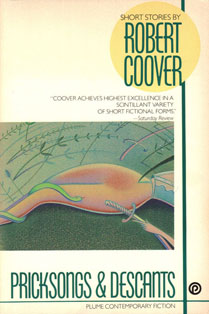
Unfortunately that novel got lost in its strangeness, becoming so inordinately weird that I lost interest about two-thirds of the way through (though I did finish it). I didn't return to Coover again.
Until now. And I wish I could say that I was mistaken in failing to read Coover for all these years. I can see how his work might have appealed slightly more in my early twenties, but I could also see myself not being that much more moved. That isn't to say I was not interested in his techniques--and in fact I still find those fascinating. Long before I had a computer or before the Internet was a widely used public utility, Coover was talking about the use of hypertext in fiction. I thought the ideas intriguing, but I didn't quite know how they would work or what they meant, not having the technology to refer to. The article, for those interested, is available here at the New York Times.
However, this Coover book is, as it is probably meant to be, deliberately alienating in many places, and I was left as if I were watching a showman, but in doing so, the showman fails to be a showman because I continue to see him as such throughout.
The stories in this collection are very much self-conscious. They are, many of them, a rerendering of fairy tales. They consider the process of storytelling itself, how we come to create narratives and what that means. They are also very male-centric stories, focusing often on sex and the female form. But the book is called Pricksongs, so what should be expected? Perhaps, Coover is intimating the sexual desire and story go hand in hand. Given how much best-selling fiction is romance or erotica, that's probably true.
The book opens with a prologue that makes the tie-in to fairy tales explicit. From there, the collection moves to a story called "The Magic Poker," which might qualify as my second-most favorite of the book (perhaps, "The Elevator" could also take the position). Coover is explicit here in saying the story is a story, telling us that he is the author and that he is about to introduce a character or that he regrets introducing a character because he seems to have little to do with the story, and so on. Vaguely, it involves two sisters who find a magic poker--one attracted to it, one repulsed; one who turns it into a prince and one who does not. The poker stands in for the frog the way you might expect the male anatomy to stand in for the prince here.
"Seven Exemplary Tales" features a prologue of its own and seven very short stories--some of them again, retellings of famous other stories. "The Elevator" discusses a man who plots revenge for constantly being accused of flatulence, when in fact another man is the one responsible. As with "The Babysitter" it ends up including several plotlines of possibility--sex with the woman who runs the elevator, revenge, the elevator dropping everyone to their deaths, being let off on the wrong floor or at a floor from which there is no return, and so on. "Quenby and Ola, Swede and Carl" recounts the tale of a family who lives in a touristy fishing area and the man who comes to fish with them, told as per usual with Coover, out of order and with seeming conflicts in terms of what actually happens. "A Pedestrian Accident" focuses on a man who is hit by a truck but is told as a kind of farce.
Another theme of this Coover book is performance. "Romance of the Thin Man and Fat Lady" recounts circus performers, for instance. And the final story in the collection involves a magician, acting as a kind of epilogue for the collection, one in which the magician can perform some great feats but in which he will inevitably disappoint, as indeed, the collection as a whole seems to do.
Saturday, October 17, 2015
On "Dead Reckoning" by Vincent Scarpa (5861 words) ***
Bereft of family and job, Frank is looking for something to console him, for some kind of meaning to interrupt his life again. Frank is a firefighter who has the fire turn against him, whose way of life has become his means of death. And it is only in consoling others--saving others--again that he has any chance to live. The question is how he'll do that. Read the story here at Swarm Lit.
Monday, October 12, 2015
On "On the Way to the Killing Spree the Shooter Stops for Pizza" by Tom McAllister (2401 words) ***
McAllister imagines what goes on in the head of a mass murderer before the actual incident. As he notes, no one really knows or can figure it out. And in this world, even McAllister's sinister young man isn't all that deep thinking. Depressed, bored, full of feelings that things don't mean much, he opts to become one of the slayers before becoming one of the slayed. Read the story here at Sundog.
Wednesday, October 7, 2015
On "Poetry Pool Party" by Megan Martin (50 words) ***
More a humorous thought than a story, Martin here contemplates an invite to the titular event. Somehow, methinks said party would be more intriguing than she lets on. Not long ago, just weeks before my wedding, I went to do a reading, the first in a decade. I had attended readings, but I hadn't done one myself in a long while. It was a great deal of fun, and at least one of the writers (not me) read something that was truly entertaining and rather mindblowingly good. Afterward, a slate of us all went out for drinks--and for talking literature. Ah, the people there--mostly idealistic twentysomethings--it was nice to think literature important again and that we all were destined to have a part in it. That's what I imagine a poetry pool party would look like. Read the story here at Wigleaf.
Friday, October 2, 2015
On "Like Sand, or Lanterns" by Brent Rydin (3176 words) ***
Essentially a tale of two men going to scatter the ashes of a dead man, Rydin's piece stands out for its raw use of language. I love the description of the sky as sand. The dialogue has some zingers as well. Read it here at Pithead Chapel.
Sunday, September 27, 2015
On "Kind of like You" by Tania Moore (4642 words) ***
Here's a painful story I know too much about and quite well identify with. Archie has a hard time working up the courage to ask girls out, wondering often what each action might mean. In this tale, he finds himself with a crush on a woman in his building, who unbelievably to him takes an interest in him. Originally published in Opium, you can still read the story here.
On "Blood and Guts in High School" by Kathy Acker ***
.jpg/220px-Blood_and_Guts_in_High_School_(Acker_novel).jpg)
I was reminded of two other things while reading this book. I was reminded of some photocopied literary journals that I would come across in Los Angeles when I was in my early twenties and idealistic. These journals generally aimed to be shocking in some way, dropping swear words vicariously and including pornographic drawings and generally being anticapitalist, antiwar, antisociety. The purveyors of these magazines were somehow going to change the world. I wanted to change the world too but not in such an anarchistic way. This book looked like one of those journals. I would immediately not have liked it as a young man--mostly because it was too lewd in a coarse obvious way.
The other thing the book reminded me of was a David Lynch movie, something akin to Mulholland Drive or Inland Empire. The movie makes sense at the beginning and is interesting because it's so strange, but as the film continues, it becomes stranger and stranger and more and more impossible to follow. Eventually, we don't know what's going on--and we're left with just bits and pieces we were introduced to early on that show up from time to time that we can sort of wrap around our minds around to give the piece structure.
And that's what happens here in Acker's book. We're introduced straight off to Janey, a ten-year-old who is in a sexual relationship with her father/boyfriend. Acker, of course, is looking to shock right from the start. But as I read, I saw the relationship as in some ways not really literal, as I saw the book as not being literal. Acker walks in the realm of dream and desire, as Lynch does. Sure, we have an incestuous/pedophilic relationship at the center of the piece, but what Acker is doing is making psychological theory literal. The book then at the start is about how women, in relationships, are seeking their fathers, at least as some psychologists might theorize. A boyfriend is simply an image of the father who raised the woman. Read that way, the early sections are theoretically interesting (is what we look for in a relationship inevitably a mirror image of a parent?), especially as Janey's boyfriend breaks up with her to pursue another woman who is sexier and who allows him more freedom. This could be any relationship. (I particularly enjoyed a paragraph that was repeated multiple times as a refrain throughout certain pages as the relationship comes to an end--a set of incidents being played over and over, the way we tend to obsess over breakups, looking for meaning.)
As the novel continues, however, we begin to lose sight of Janey at times. And we descend more and more often into the realm of dream--Acker even provides us with some sketches of dreamscapes. Janey leaves her father to go to school in New York, where she works, falls in with a group called the Scorpions, has lots of sex, and eventually loses all her acquaintances in an auto accident.
Janey is kidnapped by a couple of men who intend to turn her into a prostitute/sex slave. She is kept in a room by a Persian man. She writes poetry, a book. She gets cancer, and the Persian man leaves her. She ends up walking around Tunisia with Genet, but not having a passport, she can't go back to the United States. And then she dies. And then she goes into some kind of Egyptian otherworld, where of course sex and death meet, because they often do in literature. Meanwhile, Acker gives us asides on President Carter, The Scarlet Letter, and other famous works, people, and ideas, often without really identifying how these necessarily fit in with the narrative or who the particular speaker is.
It's nice to read something that is not a straightforward narrative from time to time, and I enjoyed some of the writing just for its sheer inventiveness. But in many ways, I did not feel invested in the book--just wanting to get through it. Had I slowed down, I'm sure I'd have picked up on more themes, and were I to trace some of the motifs, I'm sure I could make more of what's here, but given the lack of investment I generally felt, the book does not lend itself to me wanting to reread it, which is what would be required to dig those ideas out.
Tuesday, September 22, 2015
On "The Opposition Party" by Rick Stinson (4942 words) ***
Exoticism can lend a certain automatic interest to a story. Pilvax specializes in Hungarian writing--writing about or by or from Hungary. Here, a music professor gets caught up in a violent political situation due to his interest in learning more about the culture. Read it here at Pilvax.
On "Forty Years a Gambler on the Mississippi" by George H. Devol *
I'm not sure now where I read about this book--whether it was suggested to me on Good Reads or whether I came across it in some other work--but it was not nearly as interesting as I thought it might be. Devol's work is not an autobiography in a standard sense. Had it been, I might well have liked it. Instead, it is a collection of anecdotes about his life, more or less put down in the order in which he recalls them. There is no chronology, no narrative development. And many of the anecdotes are so similar in form that they become hard to distinguish from one another: Devol walks onto a boat (or a train), meets up with his partner, and plays cards with a group of suckers who don't know that Devol and the partner are in cahoots. Devol is a gambler, he says, but he doesn't seem to gamble much at all--he seems more often simply to be a cheater and a conman. Lose a few rounds to your friend, get everyone else thinking you're no good at the game, and then whallop them with a huge take at the end. And be sure to mark your cards.
The more I read, the more I despised this man, who thinks himself generous when he hands back enough money for some poor sucker to get home on, having taken him for all else he was worth. Sorry you won't get to buy that ranch you were looking forward to moving to or go duck hunting with that new gun you purchased or travel around the United States, having come here from Europe. Sure, one can argue that the people who agree to gamble with Devol are responsible for choosing to do so in the first place and thinking that they could cheat Devol out of his own cash, but sometimes, in reading, I found my heart renching for all that such men sometimes lost.
Devol also spends a good time writing about his ability to fight--and especially to head butt. I'd thought the latter was something kids gave up by second grade. Devol claims to have a hard head that can take down anyone--but one he's used so frequently that is covered in abrasions.
And yet, the irony is that come Civil War time, Devol spends just a short period in the military, and coming to see the danger in war, runs off to return to gambling--and most especially to despoiling the soldiers who happen to come through New Orleans during and after the war. I can, I suppose, give Devol credit for showing his own dishonor and pure selfishness when it comes to national service.
Whatever I may think of Devol and his profession, Devol seems to think highly of it and of himself. He claims that gamblers are more honest folks than most of society, accepting their losses, when they happen, unlike some who try to recoup their "fairly" squandered money. Gambling, as Devol points out at the end, is something only human beings do, and as such, it shows off human intelligence.
The more I read, the more I despised this man, who thinks himself generous when he hands back enough money for some poor sucker to get home on, having taken him for all else he was worth. Sorry you won't get to buy that ranch you were looking forward to moving to or go duck hunting with that new gun you purchased or travel around the United States, having come here from Europe. Sure, one can argue that the people who agree to gamble with Devol are responsible for choosing to do so in the first place and thinking that they could cheat Devol out of his own cash, but sometimes, in reading, I found my heart renching for all that such men sometimes lost.
Devol also spends a good time writing about his ability to fight--and especially to head butt. I'd thought the latter was something kids gave up by second grade. Devol claims to have a hard head that can take down anyone--but one he's used so frequently that is covered in abrasions.
And yet, the irony is that come Civil War time, Devol spends just a short period in the military, and coming to see the danger in war, runs off to return to gambling--and most especially to despoiling the soldiers who happen to come through New Orleans during and after the war. I can, I suppose, give Devol credit for showing his own dishonor and pure selfishness when it comes to national service.
Whatever I may think of Devol and his profession, Devol seems to think highly of it and of himself. He claims that gamblers are more honest folks than most of society, accepting their losses, when they happen, unlike some who try to recoup their "fairly" squandered money. Gambling, as Devol points out at the end, is something only human beings do, and as such, it shows off human intelligence.
Thursday, September 17, 2015
On "Occupational Hazard" by Hassan Riaz (5424 words) ***
More a reminiscence than a well-plotted story, Riaz here recounts the life of a cook and his run-ins with various women. The story focuses most specifically on three women who in some way or another are related to the restaurants where he works--and all of whom eventually almost kill the narrator. And yet, like a dangerous job, the narrator keeps coming back--he needs women like he needs a job. Read the story here at Penduline.
Saturday, September 12, 2015
On "The Mad Butcher of Plainfield’s Chariot of Death" by Adam Howe (3518 words) ***
Gibbons is looking for some easy cash. He's a carnie purveyor short on his luck. His luck changes, or so he thinks, when he gets his inheritance at just about the same time a grave-digging psycho's possessions go on sale. People love to look at this kind of dark stuff, Gibbons reasons. He's about to make a killing off other people's horror. Things don't always turn out so well when we try this sort of thing. Read the story here at Nightmare Magazine.
Monday, September 7, 2015
On "Would You Mind Not Talking to Me?" by Robert Cormack (1730 words) ***
Out of work and drinking--or just at work and drinking--it makes little difference. Our lives are full of terror: fear of the people around us, whether potential bosses or the women and men next to us at the bar, or the circumstances we find ourselves in: down to our last dime or starting a new job. Cormack mines this arena with intriguing dialogue. Read the story here at Northwind.
On "The Invention of Morel and Other Stories" by Adolfo Bioy Casares ****
I'm not sure how this book ended up on a list of titles I wanted to read. I must have read somewhere that Casares was a friend and collaborator with Jorge Luis Borges. That alone probably would have been enough to ellicit some interest. As such, Casares is in the same Argentinean fantastic realist tradition. He's a writer like Borges--the same pseudointellectualism behind many of the stories, the same tricks of storytelling--but more long winded. Whereas Borges's stories rarely clock in longer than about ten pages, Casares's pieces clock in around thirty, and The Invention of Morel itself is a novella.
If I were writing a paper on this book, I would focus on the use of time in the collection, particularly in reference to space, eternity, and reality. Many of the stories, indeed, seem to focus on the manner in which time is an illusion. We can collapse time through memory and various tricks of the mind. These tricks can thus establish a kind of eternity, an alternate reality. They can bring the "past" into the present or make the present disappear into some other universe.
The novella The Invention of Morel certainly focuses on this. The invention that Morel is responsible for is some kind of machine that allows people to continue living. It "steals" life and replays it on a continuous loop. But these people are not really people once their souls are stolen. They are shadows of another world that we can see and walk among but that we cannot really interact with. The story itself is not focused as much on the invention, however, as on the narrator's discovery of it. The narrator, for adventure and exploration, goes to an island from which no one has escaped alive. Conceivably he too gets pulled in by Morel's invention, although somehow he manages to pass a missive off to others that becomes the scholarly description of the place. Much of the story focuses on his fascination with one particular woman--one of the illusions--with whom he wishes to forge a relationship.
The novella was not particularly to my taste. I actually much preferred Casares's shorter pieces. My favorite of those pieces was the story "In Memory of Pauline," which details a man's lifelong friendship with a gal and his disappointment as a jilted lover (spoilers follow). It is his expectation that they will marry, but instead, one night, he introduces her to a friend, and this friend and she fall for each other, and that's that. In despair, the narrator goes overseas for a couple of years. When he returns, Pauline is waiting for him. She apologizes for running off with the other man and slips into the narrator's bed. The next day, the narrator goes in search of Pauline and of the story of what's happened during the two years that he's been gone. He finds out that Pauline is in fact dead, that her lover killed her. So this becomes a ghost story. Not so fast. As the narrator puts the facts together, he discovers certain details that cannot have been true. There's a gift that he gave Pauline that shows up in the apartment in a place where it should not be; they make love to the sound of rain but there is no rain on the ground when he goes outside afterward; his image in the mirror is shady; she speaks more like the narrator's friend than the way the narrator remembered her speaking. What he discovers is that Pauline didn't just die but that her lover, now in prison, killed her, jealous of the narrator. It is the narrator's projected jealousy that has visited him. Pauline never loved the narrator, he realizes, and their consummation upon his return was merely an illusion of the jealous man's mind. This is where, of course the mind takes over, changing our conception of time and reality.
I liked the rest of the stories to different degrees, though not nearly as much. "The Future Kings" is about a spy novelist who becomes a spy when he goes to visit some old friends who are believed to be involved in some kind of plot; they turn out to be people who can speak telepathically to seals. "The Idol" involves an antique dealer who gets hold of a wood sculpture with a dog's head that seems to have supernatural powers (to make one fall in love with the owner's daughter, to kill one in one's sleep, etc.). "The Celestial Plot" involves the crossing of parallel worlds, where a pilot lands in a universe where none of his friends know him, while another pilot lands in a universe where he is flying a different plane than the one he took off in, and so on. The paragraph ending of this story summarizes many of the book's themes quite well. It talks of "old notions" of planetary and spherical worlds versus "bundles of parallel spaces and times." "The Other Labryinth" is a story that unfolds slowly and that I found difficult to get through, but the last ten pages upend the entire piece, and what one thought one was reading turns out to be something entirely other. In the story, a man is obsessed with a manuscript that may or may not be a fraud. We think we know that the fraud was put upon the man by his rival, but the true author of the fraud turns out to be someone quite different. And in "The Perjury of Snow," a poetry critic recounts the murder of a famous poet; as with the previous story and several others in the collection, our perception of the tale is changed significantly at the end, when the interpretation offered of the story of the murder is upended so that another murderer is revealed. And as in those others stories, time plays a key role here, as one man cuts his family off from the rest of the world in order to impose an eternity on his loved ones so that his daughter won't die. It is when that outside world impinges on that man's house, that time reestablishes its power over the family's life.
If I were writing a paper on this book, I would focus on the use of time in the collection, particularly in reference to space, eternity, and reality. Many of the stories, indeed, seem to focus on the manner in which time is an illusion. We can collapse time through memory and various tricks of the mind. These tricks can thus establish a kind of eternity, an alternate reality. They can bring the "past" into the present or make the present disappear into some other universe.
The novella The Invention of Morel certainly focuses on this. The invention that Morel is responsible for is some kind of machine that allows people to continue living. It "steals" life and replays it on a continuous loop. But these people are not really people once their souls are stolen. They are shadows of another world that we can see and walk among but that we cannot really interact with. The story itself is not focused as much on the invention, however, as on the narrator's discovery of it. The narrator, for adventure and exploration, goes to an island from which no one has escaped alive. Conceivably he too gets pulled in by Morel's invention, although somehow he manages to pass a missive off to others that becomes the scholarly description of the place. Much of the story focuses on his fascination with one particular woman--one of the illusions--with whom he wishes to forge a relationship.
The novella was not particularly to my taste. I actually much preferred Casares's shorter pieces. My favorite of those pieces was the story "In Memory of Pauline," which details a man's lifelong friendship with a gal and his disappointment as a jilted lover (spoilers follow). It is his expectation that they will marry, but instead, one night, he introduces her to a friend, and this friend and she fall for each other, and that's that. In despair, the narrator goes overseas for a couple of years. When he returns, Pauline is waiting for him. She apologizes for running off with the other man and slips into the narrator's bed. The next day, the narrator goes in search of Pauline and of the story of what's happened during the two years that he's been gone. He finds out that Pauline is in fact dead, that her lover killed her. So this becomes a ghost story. Not so fast. As the narrator puts the facts together, he discovers certain details that cannot have been true. There's a gift that he gave Pauline that shows up in the apartment in a place where it should not be; they make love to the sound of rain but there is no rain on the ground when he goes outside afterward; his image in the mirror is shady; she speaks more like the narrator's friend than the way the narrator remembered her speaking. What he discovers is that Pauline didn't just die but that her lover, now in prison, killed her, jealous of the narrator. It is the narrator's projected jealousy that has visited him. Pauline never loved the narrator, he realizes, and their consummation upon his return was merely an illusion of the jealous man's mind. This is where, of course the mind takes over, changing our conception of time and reality.
I liked the rest of the stories to different degrees, though not nearly as much. "The Future Kings" is about a spy novelist who becomes a spy when he goes to visit some old friends who are believed to be involved in some kind of plot; they turn out to be people who can speak telepathically to seals. "The Idol" involves an antique dealer who gets hold of a wood sculpture with a dog's head that seems to have supernatural powers (to make one fall in love with the owner's daughter, to kill one in one's sleep, etc.). "The Celestial Plot" involves the crossing of parallel worlds, where a pilot lands in a universe where none of his friends know him, while another pilot lands in a universe where he is flying a different plane than the one he took off in, and so on. The paragraph ending of this story summarizes many of the book's themes quite well. It talks of "old notions" of planetary and spherical worlds versus "bundles of parallel spaces and times." "The Other Labryinth" is a story that unfolds slowly and that I found difficult to get through, but the last ten pages upend the entire piece, and what one thought one was reading turns out to be something entirely other. In the story, a man is obsessed with a manuscript that may or may not be a fraud. We think we know that the fraud was put upon the man by his rival, but the true author of the fraud turns out to be someone quite different. And in "The Perjury of Snow," a poetry critic recounts the murder of a famous poet; as with the previous story and several others in the collection, our perception of the tale is changed significantly at the end, when the interpretation offered of the story of the murder is upended so that another murderer is revealed. And as in those others stories, time plays a key role here, as one man cuts his family off from the rest of the world in order to impose an eternity on his loved ones so that his daughter won't die. It is when that outside world impinges on that man's house, that time reestablishes its power over the family's life.
Wednesday, September 2, 2015
On "Mazes" by Lisa Martens (6331 words) ***
An exploration of real life mazes is what this story is about. In the center of the story, the narrator draws a maze that looks like a brain--three ways in. The goal is to get out the other side, but most often you end up circling around to the place you've come from. Indeed, the story itself works that way. It's a story about domestic abuse, an overprotective--even obsessive--boyfriend and other unpleasant characters. Read it here at Northwind Magazine.
Friday, August 28, 2015
On "Skull" by Steve Almond ***
One of the stories from Almond's collection, The Evil B. B. Chow, this one involves a drawn-out conversation about a man's weird sex life with his woman, who happens to be missing an eye. It's the kind of story I would expect in Nerve, which often tends to focus on strange sex, if only because a story that focuses merely on sex is generally really going to be a story about a relationship. Read the story here.
On "The Evil B. B. Chow and Other Stories" by Steve Almond ***
I've been coming across Steve Almond's stories in various literary journals for about a decade now and seen his name on various blurbs. The stories were always quality but never particularly stand-out works. I could probably say the same for the collection as a whole, though in this case, a few individual stories do stand out. I'd expected the collection would all revolve around a theme--probably romance--but in the end, the chosen stories seemed more random, like a best of what Almond's published.
Among the standouts are the title story, which involves a woman who works for a glossy woman's magazine who dates a seemingly mundane man who at first proves to be surprisingly sexy and sympathetic then becomes something quite the opposite, a man who strings women through similar arcs and drops in relationships with the same old excuses and lines.
Going along with that same theme is "Appropriate Sex," which involves a female student who tries to seduce her creative writing teacher and the despised student whom the teacher falls back on to help him avoid the girl.
"A Happy Dream" is about a blind date in which the lies people tell one another prove to be just that--and that's okay, because it's fun to dream.
"The Problem of Human Consumption" involves a man and his daughter recovering from--or perhaps, more appropriately, dealing with--grief over the lost wife/mother.
"Wired for Life" might well be called "Wired for Love." It's about a woman who finds herself oddly drawn to her computer repairman as the sex life with her own significant other seems largely unsatisfying to nonexistent.
"Summer, as in Love" seems like a long prose poem, a hymn if you will, to a short relationship, that is beautiful precisely because of the writing itself.
Another strong story, and perhaps my favorite in the book, is "Larsen's Novel," which is in the end about relationships but which seems, for most of it, to be about the awkward situation that is created when one is ask to read a friend's manuscript. What is the proper etiquette when someone has worked on something so long? Do you tell the truth about how bad it is, how wasted the work has been, or do you lie? And do you even read it? And if so, how do you manage to read it, when it is extremely bad and extremely long?
Other stories, though, seem far from this theme. "Soul Molecule" involves a family of alien abductees in conversation with an old (and somewhat skeptical) friend. Of note here is the way the Almond keeps the tale fairly mundane, given the point of view, which adds to the uncertainty about the reality.
"I Am as I Am" is about a boy who hits another with a baseball bat in a game after school, killing the kid and the change that that brings to the kid's life.
"Lincoln, Arisen," one the the weakest stories in the book is a historical retelling/imagining of a friendship/relationship between Lincoln and Frederick Douglass. Another weak story involves a conversation about a part of Michael Jackson's body.
Overall, though, the book is a good introduction the Almond's oeuvre and makes me curious to see what else I might have missed over the last few years that has not been collected.
Among the standouts are the title story, which involves a woman who works for a glossy woman's magazine who dates a seemingly mundane man who at first proves to be surprisingly sexy and sympathetic then becomes something quite the opposite, a man who strings women through similar arcs and drops in relationships with the same old excuses and lines.
Going along with that same theme is "Appropriate Sex," which involves a female student who tries to seduce her creative writing teacher and the despised student whom the teacher falls back on to help him avoid the girl.
"A Happy Dream" is about a blind date in which the lies people tell one another prove to be just that--and that's okay, because it's fun to dream.
"The Problem of Human Consumption" involves a man and his daughter recovering from--or perhaps, more appropriately, dealing with--grief over the lost wife/mother.
"Wired for Life" might well be called "Wired for Love." It's about a woman who finds herself oddly drawn to her computer repairman as the sex life with her own significant other seems largely unsatisfying to nonexistent.
"Summer, as in Love" seems like a long prose poem, a hymn if you will, to a short relationship, that is beautiful precisely because of the writing itself.
Another strong story, and perhaps my favorite in the book, is "Larsen's Novel," which is in the end about relationships but which seems, for most of it, to be about the awkward situation that is created when one is ask to read a friend's manuscript. What is the proper etiquette when someone has worked on something so long? Do you tell the truth about how bad it is, how wasted the work has been, or do you lie? And do you even read it? And if so, how do you manage to read it, when it is extremely bad and extremely long?
Other stories, though, seem far from this theme. "Soul Molecule" involves a family of alien abductees in conversation with an old (and somewhat skeptical) friend. Of note here is the way the Almond keeps the tale fairly mundane, given the point of view, which adds to the uncertainty about the reality.
"I Am as I Am" is about a boy who hits another with a baseball bat in a game after school, killing the kid and the change that that brings to the kid's life.
"Lincoln, Arisen," one the the weakest stories in the book is a historical retelling/imagining of a friendship/relationship between Lincoln and Frederick Douglass. Another weak story involves a conversation about a part of Michael Jackson's body.
Overall, though, the book is a good introduction the Almond's oeuvre and makes me curious to see what else I might have missed over the last few years that has not been collected.
Sunday, August 23, 2015
On "Walled" by Lucy Taylor (4618 words) ***
I was reminded of Edgar Allan Poe's fiction while reading this. The tale takes place in an insane asylum and involves a cat. These two dark forces seem like Poe's territory. Plush is the woman walled up in the asylum--or is it something else? Read the story here at Nightmare Magazine.
On "Day of the Locust" by Nathanael West *****
One of the best Hollywood novels of all time, reads a few of the reviews of this classic book. I'd call the book Hollywood gothic, and of West's body of work, it probably is my favorite, despite my liking for the aesthetic experiments in his other famous work Miss Lonelyhearts. This one feels like more of a narrative, and the characters are a bit more fully realized and drawn out.
West's main character is an aspiring artist named Tod Hacket (get it, a hack) who has come to Hollywood to do backdrops and other art needed for the studios. In his spare time, he thinks about drawing the dead--that is, a Los Angeles that is on fire and burning, because Hollywood, as the narrator puts it, is where people go to die.
Death here could mean any number of things. It could mean the death of morality--a kind of moral vacuum that people enter into when going into the movies. It could mean death of meaning (religion, art). It could mean a death of a the soul.
Death, in fact, pervades the book. Tod is in love with Faye Greener (the name suggesting life of a sort, I suppose--or at least "life" in comparison to others). But a lot of other men are into Faye as well (in this respect, she reminded me of Brett in Hemingway's The Sun Also Rises but of a lower class and less intelligent sort). She won't have the men--or at least not Tod. He's not rich or successful, so he can't advance her career--she's an aspiring actress. Despite this, Tod befriends her father Henry so as to spend more time around her. Tod's a rather sad aspiring beau.
Henry is an old Vaudeville hand who is literally dying.
Among Faye's other suitors are Homer Simpson, an older man who has some money from before he moved to Hollywood and who agrees to take care of Faye after her father's death (in an arrangement wholly benefiting Faye not unlike Tod's); Earle, a fake cowboy whose dates with Faye Tod pays for; a dwarf; and a Mexican.
A scene I remember from earlier readings is one involving a cock fight. Simpson's property is used for the contest, even though he disapproves, since it is Faye's friends who insist on it. The fight is gruesome, as one chicken takes care of another--and here there seems a parallel to the bullfight in The Sun Also Rises. In fact, one could almost look at the novel as being a kind of parody of Hemingway's work, since what is high brow there is now reduced to low brow. Instead of army veterans and drunks we have fake army soldiers and drunks, just as instead of regal bullfights we have cheap cockfights.
At the end of the novel, we get a kind of living fulfillment of Tod's imagined painting as a mob devolves into violence.
West's main character is an aspiring artist named Tod Hacket (get it, a hack) who has come to Hollywood to do backdrops and other art needed for the studios. In his spare time, he thinks about drawing the dead--that is, a Los Angeles that is on fire and burning, because Hollywood, as the narrator puts it, is where people go to die.
Death here could mean any number of things. It could mean the death of morality--a kind of moral vacuum that people enter into when going into the movies. It could mean death of meaning (religion, art). It could mean a death of a the soul.
Death, in fact, pervades the book. Tod is in love with Faye Greener (the name suggesting life of a sort, I suppose--or at least "life" in comparison to others). But a lot of other men are into Faye as well (in this respect, she reminded me of Brett in Hemingway's The Sun Also Rises but of a lower class and less intelligent sort). She won't have the men--or at least not Tod. He's not rich or successful, so he can't advance her career--she's an aspiring actress. Despite this, Tod befriends her father Henry so as to spend more time around her. Tod's a rather sad aspiring beau.
Henry is an old Vaudeville hand who is literally dying.
Among Faye's other suitors are Homer Simpson, an older man who has some money from before he moved to Hollywood and who agrees to take care of Faye after her father's death (in an arrangement wholly benefiting Faye not unlike Tod's); Earle, a fake cowboy whose dates with Faye Tod pays for; a dwarf; and a Mexican.
A scene I remember from earlier readings is one involving a cock fight. Simpson's property is used for the contest, even though he disapproves, since it is Faye's friends who insist on it. The fight is gruesome, as one chicken takes care of another--and here there seems a parallel to the bullfight in The Sun Also Rises. In fact, one could almost look at the novel as being a kind of parody of Hemingway's work, since what is high brow there is now reduced to low brow. Instead of army veterans and drunks we have fake army soldiers and drunks, just as instead of regal bullfights we have cheap cockfights.
At the end of the novel, we get a kind of living fulfillment of Tod's imagined painting as a mob devolves into violence.
Subscribe to:
Posts (Atom)

 Posts
Posts


