Sunday, September 12, 2021
On “New Testament History” by F. F. Bruce *****


Wednesday, September 1, 2021
On “Three Kingdoms” by Lo Kuan-chung, translated and abridged by Moss Roberts ****
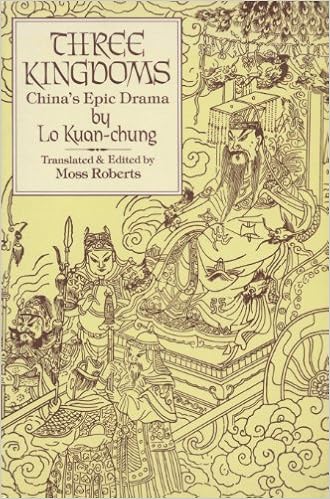
The story recounted here essentially involves the three kingdoms period in China, just as the Han dynasty was ending and three kings fought for control of the land, leading eventually to the short-lived Sung dynasty and the domination of China by the Mongols.
In the book, the Hans are beset by a disloyal general in the north lands Tsao-Tsao. Although he proclaims his loyalty to the emperor, he is most certainly looking to gather power to himself. Poised against him is a southern kingdom that has broken away and Liu Pei, the book's hero. Liu Pei aims to restore the Han dynasty.
The book, however, starts on a more personal note. Liu Pei becomes friends with two men with whom he forges a pact—namely, that they will always look out for each other. These two men thus forge Pei's main helpers during the course of his attempt to restore the empire. However, the pact proves also to be Pei's downfall, as the killing of one of the men means that he has to take revenge for his death by attacking a potential ally, even though his real enemy is Tsao-Tsao. Indeed, it is Tsao-Tsao who got the potential ally to kill the friend, knowing it would distract Pei.
Roberts discusses the various themes in the book and the way in which Pei represents both ultimate duty and honor but also how that intransigence to such order can lead to one's downfall. The other characters have similar links to larger ideas that are played out in the plot of the book.
Sunday, August 15, 2021
On "The Travels of Marco Polo" by Marco Polo **

The Yule edition was heavily annotated, such that the notes were often two or three times the length of Polo's original text. Polo's text itself might have been fairly interesting, although it would have been extremely repetitive. Many a chapter recounts how a given region was infidels, etc. Polo uses nearly the exact same wording each time. Of course, the annotations are necessary because many of Polo's place names are now out of date, such that it's hard to know what location he is writing about. However, the nineteenth-century place names are also many times out of date, such that the annotations weren't much help. And this truly seemed a scholarly edition insofar as the notes recounted numerous opinions with regard to what Polo actually meant every location that he wrote about.
A case in point would be Madagascar. Polo talks of giraffes and other creatures that are not at all on the island. Most scholars l think he has the wrong place and meant another location. After all, the big southern island would have been off his route anyway. Of course, Polo wasn't averse to writing about nearby places that he'd heard about. This really is a kind of geography book in many ways and was likely fascinating to readers of the time.
This isn't to say that there aren't parts that are fascinating even now. His account of Japan, I found a bit interesting, even if most scholars dispute his historical accounts of the battles that he describes. Another particularly intriguing account was of a nation that consisted of two islands. On one island only women lived, and on the other only men lived. The men would visit the women's island for three months of the year. Children lived with the women until the age of fourteen, at which time the boys moved to the men's island. Not many people, even in Yule's time, though the account accurate or true. Finally, there is the religious variety that he encountered, something we often don't think of now when we think of Asia. That is, in Polo's time, while there were plenty of Buddhists and others of so-called Eastern religious affiliations, in his time, there were also a fair number of Muslims and Nestorian Christians scattered across the continent all the way across China.
Sunday, August 8, 2021
On "Hidden Gospels" by Philip Jenkins ****
Jenkins shows quite convincingly why such scholarship has proliferated and received so much attention. On the former score, the increase in academic programs in religion in recent years has meant that more graduate students have had to find fodder for original research. Gnostic gospels, Qumran scrolls, and other newly discovered documents are prime candidates for such study, since there has been less written about them. Add to that the agenda that many scholars have--for example, writing from a feminist perspective (or a Marxist one or a deconstructionist one, etc., depending of the critical school one wants to apply)--and there is ample desire then to enlarge the canon to include works that support one's point or to interpret them in such a way that they do. Finally, media, looking for good stories on religion, as it does, gravitates toward the controversial. Hence, even though 90 percent of the scholars might have conservative views on Christian faith, it's the 10 percent claiming that Jesus wasn't believed to be divine among the first two generations of followers or Jesus was a Cynic philosopher or Jesus was never crucified and in fact had a regular family, and so on, who get the attention.
Jenkins points out that many of the claims being made today by such scholars are actually quite old--that is, they have been made since the 1800s and in some cases even made only generations after the foundation of the Christian movement. Many of the newly discovered documents are merely new manuscripts of works of which we already have preserved copies. There is not much "new" to much such "new scholarship." In many cases, the agenda that such scholars have is actually subverted by the works they point to with such aplomb. Gnostic views, as Jenkins points out, were not generally so feminist, so egalitarian, so antiauthoritarian, as such scholars portray. Many were more misogynistic than anything seen in the accepted Bible. And they were very much focused around establishing some as better than the vast majority of people. Indeed, the simplicity with which Gnostic views are presented was usually anything but, with levels of gods (aeons) separating us from the divine, such that there was a great deal of knowledge to be gleaned before one could even claim to be truly informed.
Sunday, July 11, 2021
On "The Roots of Anti-Semitism" by Ernest L. Abel ****
The attitude among the Greeks and Romans, however, was more complex. Jews were sometimes respected for their "philosophical" religion, which presented a moral world unlike that in the Greco-Roman culture. At the same time, the Jewish refusal to honor the gods, outside of their own, set them apart and disgusted their neighbors insofar as such views made the Jews seem to be self-righteous. Despite various uprisings that occurred throughout the history of the Roman Empire, the Jews were largely allowed to maintain their religion and were not looked down upon, though other peoples sometimes were annoyed by the exceptions made for the Jews, a view that was extended by the special tax eventually levied on the Jews after one of their revolts. This tax was not heavy, but it further set the Jews apart. That said, the luxuries extended to the Jews were not extended so much to converts to Judaism, a practice Rome did its best to quell, given the way that Jews didn't take full part in Roman society.
The real start of anti-Judaism feeling began with Christianity, which attempted to set itself apart from Judaism, both to avoid religious persecution from the Jews and social persecution by the Romans. When Christianity took the helm as the favored religion of Rome, its anti-Jewishness spread throughout society in a way that continues to reverberate even today.
Sunday, June 27, 2021
On "Christianity outside the Roman Empire" by F. Crawford Burkitt ***
We get a taste for Christianity as it developed outside Rome near Edessa and in other parts of the world that sat just outside its realm, where the Greek and Persian world collided, and where there were remnants of Semitic culture. Because there's little literature from this church, we don't know much about it until the middle of the second century. Burkitt sees this Christianity as having "changed less" than that further to the west, but given its predilection for ascetism, transubstantiation, and baptism only for monks (as doctrine apparently shared with the Marcionites), it would seem to me not that the church in the east changed less but that it changed in different ways--less influenced by Greek philosophy and more influenced by more eastern ways of thinking. Although Burkitt's other book on the subject is in part so long because it reproduces some primary sources in full, on the whole, it is the more thorough work and only about twice as long--thus more recommended.
Tuesday, May 18, 2021
On "Early Eastern Christianity" by Francis Burkitt ****
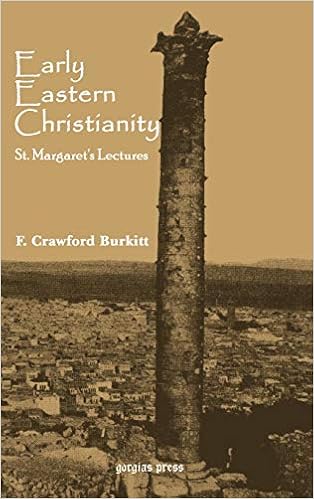
The lack of sources at the time is, of course, the central issue with research in this area. What we have comes from a period much later or is questionable legend. What we do know, however, suggests that Christianity started among the Jewish people (as we are told that it came along through merchants). The first person to bring the message, Addai, apparently died in peace, but those who followed suffered or seem out of chronological time--it's claimed, for example, that the second following Addai, Palut sought ordination from Serapion in Antioch, but that would have been long after Addai, if Addai had connection the apostles. Thus, Burkitt posits that Palut was likely connected to the Catholic church (insofar as it was connected to Rome) while those before perhaps had not been (rather, the church before was more loosely configured).
What's also interesting is how the church in the East was influence by Gnostic ideas from the East itself. So often, I've read about the differing culture in the East, but Burkitt does a good job of showing how differing Christian ideas were not just a later phenomenon. The Church in the East, thus, was a different kind of Christianity, but it was, at least by the time it enters the historical records, not much more connected to its Jewish roots than Roman church of the West.
Thursday, May 6, 2021
On "The First Edition of the New Testament" by David Trobisch *****
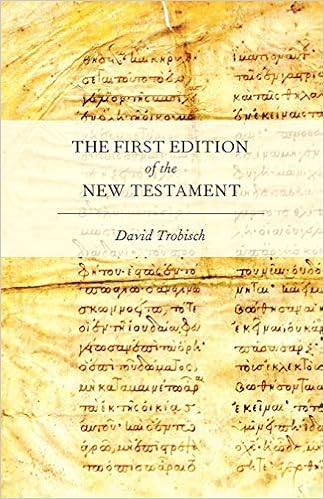
As an example of canonization, Trobisch examines the writings of the Christian Fathers, those who came directly after the New Testament. Here, there is significant variance with regard to what is placed into any one collection. One editor might include the letter of Polycarp, while another might drop it or use another rescention. If the New Testament had been canonized over the course of centuries, he claims, as most scholars believe, there would be little agreement as to what belongs in it. Instead, later ancient writers who question the legitimacy and inclusion of certain books in the New Testament are not, Trobisch notes, engaging in arguments over what gets canonized--or rather, included--in the New Testament but rather are engaging in criticism regarding an already established book, even as today's critics do. (This is not to say that there weren't other versions of the "New Testament"; Marcion, for example, created his own, though largely from the larger book, quite possibly already in large distribution.)
Other arguments for the singular editorial hand include the following, some more convincing or easier to understand than others. One is the common set of abbreviations (the Nomina Sacra) used throughout different versions of the manuscripts (though they are not, be any means, used consistently), mainly for the names of God. Another is the common use of the codex rather than the scroll in the early writings. Another is the manner in which the New Testament is arranged, with four distinct parts--Gospels, Acts and General Epistles (called Praxapostolos), Paul's epistles (with Hebrews coming before the pastoral epistles), and Revelation. These allow for easy splitting into separate codexes. They also mirror the pattern of the Old Testament, at least as it is presented in most English Bibles (histories first, then writings and prophecy). The presentation of the General Epistles first, right after Acts, with Paul's following, as is the case in most early manuscripts, also mirrors the presentation of the figures as they appear in Acts (with Paul coming last). Another item pointing to an editor is the uniformity of the naming conventions (Epistle of . . .; Epistle to . . .; Gospel according to . . .). Finally, from very early on, the work was known as the "New Testament" (this is the name all the second-century writers use), suggesting that this was the name the editors affixed to it. A later chapter of Trobisch's book looks at the way the New Testament is cross-referenced such that it sets up a particular unified view of the church and introduces readers to specific characters who can then be identified again later when one comes across their writings or their persona in other portions of the work (e.g., we figure the letters of Peter are from the Peter described in the Gospels, where we first read of him, and mentioned in Acts and Paul's letters, etc.).
Sunday, May 2, 2021
On "Facing the Snow" by Tu Fu, translated by Sam Hamill *****
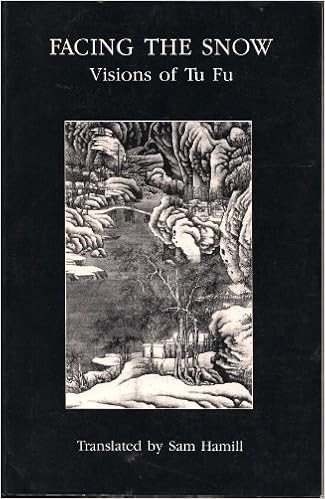
Hamill's introduction makes clear that Tu Fu suffered many of the same difficulties that Li Po did, as their lives ran roughly parallel, with Tu Fu, the younger, dying earlier also. However, both failed to obtain government jobs except on the lowest end, and both suffered the consequences of the wars that broke out in China around 750 that lasted for a decade or so. The poems reflect that. Like Li Po's work, we have only a segment of what Tu Fu actually wrote, maybe one-third.
Hamill's intrdocution, however, only touches on Tu Fu's life. Most of it is about translation--the difficulties of moving a poem from one language to another and the reason for his choices. Tu Fu was apparently quite a formalist, with many of his poems built around set stanzas and rhymes. English offers so much less in terms of rhyming opportunities that Hamill chooses instead to focus on the images and content, which seems a wise move.
The selection here connected more to me personally than the poems in the Li Po collection I read. Both poets write their share of nature poems, and poems about drinking, but Tu Fu also deals a lot with relationships and with the effects that world events have had on his life. It likely helped that Hamill doesn't leave some words untranslated, as did Hinton with the Li Po poems. As such, one doesn't feel quite as much the foreigness of Tu Fu's work. But beyond that, Tu Fu just seemed better at expressing the anguish of the world around him and of his own life. My favorite poems were those about war. He didn't delve so much into generic expressions about soldiers fighting as personal ones about how wars affect him and those around him. The communities he lives in feel the pain that having their young men and eventually old men too stripped from them to go fight yet another battle against the invading forces; they also feel the anguish of not having a strong government to defend them. There are poems expressing the difficulties of both positions. It's as if the people are pained either way. The speakers in Tu Fu's work migrate as invaders take over their land. They express the pain of the refugee. And later, when able to return, there is both a kind of joy in coming home again and a sadness. The homes they lived in five years ago are run down, unmaintained; many of the old neighbors have returned, but some never will. What is left but to wander out into the forest or along the river, seeking solace, knowing that you'd like to have a drink but that the folks you'd have shared one with are now gone.
Thursday, April 29, 2021
On "The Selected Poems of Li Po" by Li Po, translated by David Hinton ****

The poems themselves are very enjoyable to read. What's amazing is the way that Li Po focuses on his surroundings such that the poems generally speak to us now even more than one thousand years later. A description of a mountain lends to thoughts about life and about moments in a given life, ones we share even now. Much is made of such thoughts especially toward the end of the collection, which I think I enjoyed even more than the beginning. Hinton had noted that Li Po's poetry had a certain carefree quality in his youth that was lost midlife as war took its toll. Indeed, the poems about war weren't that intriguing to me, but I found myself slightly more taken by the older Li Po than the younger. Experience leant a certain melancholy to the descriptions of nature that made the pieces seem all the more touching. It is amazing to think about how the wind and stream are the same that people generations ago also experienced and yet also how those things are never the same, even for us, from moment to moment, day to day.
Monday, April 26, 2021
On "Church: The Early Years" by Dennis Hawkes ***
It makes me wonder also about a book that simply records what we know about the various people mentioned in the New Testament. Sure, Paul and Peter and John are noted frequently and often the subject of writing, but putting together a set of various mentions of the more minor characters might also be a great new way to see the Bible and the various connections between its books.
Sunday, April 25, 2021
On "A History of the Jews in Babylonia: The Parthian Period" by Jacob Neusner ***
Neusner puts most of his history together from Jewish Talmudic sources, quoting generously from them. The sources are not terribly compelling, which is part of why the reading proves dull in the end. Neusner seems focused on discovering how much the Babylonian Jews depended on the Palestinian ones for their religious practices--that is, how much the two influenced each other and the degree to which they exercised power over one another.
Of note is the fact that the numerous Jews in the Parthian empire were not inclined to rebel against Parthia in the same manner in which those of Rome rebelled. One reason is that they were given a great degree of self-rule. This, in turn, inclined to make them likely not to get involved in Palestinian uprisings. That said, the animosity Parthia had for Rome meant that it had no problem letting Jewish animosity play to the Parthian advantage in times of war with Rome.
The destruction of Jerusalem led to a fair number of Palestinian Jews fleeing to Babylon and then forging academies that were similar to those that had been common in Palestine. That said, the Palestinian academies did not look kindly on Babylonian scholars doing such things as setting the calendar, even when there was an absence of authority in Palestine with regard to doing so. The expectation was that only people near Jerusalem could do such a thing, and the Babylonians, at least during this time, largely conceded to the Palestinians in this regard once a calendar was set.
Given that this is one of the few books on the subject, I found Neusner's book useful and interesting, despite its overtly scholarly nature.
Sunday, April 11, 2021
On "Social Life at Rome in the Age of Cicero" by W. Warde Fowler ****
Fowler's book itself doesn't start off very well. He tries to lay the groundwork for his study by describing the physical geography of Rome as a city. He essentially walks its streets in prose, telling us where this and that thing is. That sounds more interesting then it really is. I felt as if I'd have gotten a better sense of the city's layout by looking at a map. Missing from that description is much of a sense of how those streets actually would have felt at the time, which would have been a larger reason for providing such a long description.
However, after that first chapter, the book becomes markedly more interesting, as Fowler becomes more invested in the subject of the actual work--the social life of people living in Rome. There are chapters on the lower class, the business class, and the aristoricracy; chapters on women, slaves, and family life; a chapter on education and a couple chapters about the lives of the well-to-do. Finally, he closes with chapters on religion and festivals.
What he does well in these chapters is show how the life of the Romans was changing--and also why that change was occuring. His book does this better than many others books I've read by giving readers a clear sense of why such changes were occurring and by making comparisons to Britain in the 1900s, when he was himself writing. Of course, his views regarding why such changes were occurring are weighted in his own perspective, but such still makes one feel as if one understands what's happening more than just being told that there were more immigrants or there was an increasing amount of entertainment. Fowler gives readers a sense that Rome was a society in moral decline, and that that decline is part of what enabled a number of social changes as well as a change to the system of government.
War had led Romans to feel less of a connection to the gods. As philosophy (most especially Epicureanism) replaced religion at the core of elite thinking, a certain kind of wayward lifestyle took hold, as well as lesser concern for the state as opposed to the individual (the reason the republic eventually folded), such that population began to decline. To make up for the loss of labor, slaves were imported, then given more and more power; as such, foreign elements made up more and more of the population. The import of foreign slaves, as well as the inadequacies of philosophy, led to the import also of foreign religions--new gods. In addition, Stoic philosophy managed to merge religious concerns with philosophy such that it became more popular as the age of Cicero came to an end. As such, religion also made its recovery, as the age of the emperor took hold.
Thursday, April 8, 2021
On "The Book of Songs" translated by Arthur Waley ***

The real beautiful pieces of the collection come in the first third of the book. Those are the love and marriage songs. The human heart, it seems, doesn't change, and many of the songs about losing one's loved ones seem to carry the same anguish that folks today would also serve up. I look forward to turning my attention to some more contemplative classical Chinese poets, who may well run down similar paths to these songs.
Sunday, March 28, 2021
On “Small Is Beautiful” by E. F. Schumacher *****

Years later, during my first quarter in college, I took a class called Engineering and Technology, which ended up being more about the intersection between environmentalism and science than about hard-core engineering. The textbook for that class was a collection of essays that had come out of a conference at which E. F. Schumacher was one of the speakers. His imprint was all over the book (along with others such as Barry Commoner and Jeremy Rifkin)--and I finally discovered what my dad had been talking about and why he believed what he believed and came to see much as he did.
My father died a few weeks ago, and one of the items I saved for myself was this book from his library. It has all his notes and highlighting in it—rather extensive for general nonfiction—so reading the book was also in some ways like reading my father's thoughts on the work, taking me back to what he was thinking when I was around eight or ten.
One thing that struck me about the work, written in the early 1970s as it was, is how economically “socialist” it is at the same time as being “Christian,” a combination that receives much less attention in the post-Reagan United States than perhaps existed before, and one that I see little of in the church I attend now, wherein free market capitalism as being identified with “God's proper way” has become rather expected. I think that sad, given that Christianity should not be politically left or right. (My dad was not one typically to link himself to one political persuasion, though in his later years, even he seemed to espouse much of the Republican right positioning, something he broke from again in the last months of his life.) Things, as far as the link between faith and politics or economics, were definitely different in the 1970s.
Schumacher is not writing a Christian book, however. He is an economist, who also happens to be a Christian and whose creed often becomes part of his reasoning—but he also draws on Eastern philosophy and Buddhism. These sort of ideas impact his thinking. The book, as a whole, is written for a lay audience, which makes it easy to read but which also makes it perhaps a bit less persuasive than it might have been with extensive graphs, charts, figures, tables, and data. As such, one comes away feeling as if one is getting the simplified version of his reasoning, which in turn makes it seem at times like perhaps his arguments lack actual substance behind them. But at about three hundred pages, that is to be expected; a hard economics book would hardly have appealed to the general audience for which Schumacher is writing.
The gist of the book is that technology should be appropriate to the purpose for which it is being created and proposed rather than being blindly pushed upon society. In this sense, Schumacher's work falls in line with lots of other technological critics (a book published where I work, Not So Fast, makes various similar arguments). Technology (and indeed economics), in other words, should serve the needs of real people rather than economic statistics. What good does a high GNP do if most people are unemployed? But if GNP is growing, most economists would classify that economy as doing well or improving. This, Schumacher says, is the wrong measure—especially for developing economies. There, technology to scale is actually going to be of more value in lifting people out of poverty. Farms don't need motorized combines that are going to do the labor of fifty workers if one hundred people need jobs; rather, the technology provided should be one that will give those people some sort of living. That is real improvement, more than the supposed gains to productivity and profit. And for a first-world power attempting to aid third-world communities, such “appropriate” technologies are often cheaper to provide.
Schumacher also spends time writing about the faux value of nuclear power, which he sees as more costly than just about any energy technology. Indeed, he sees the energy sector as a whole as being built around faux economics. The long-term cost of such technology is not taken into account when determining the profit taken. If there is no place to store nuclear waste, then it is not a technology that we want. Similarly, while oil and coal may be useful, they are not replaceable, which means that they should be used carefully and selectively. Schumacher, in other words, is making his argument from the point of view of scarcity rather than of discoverability or continuing technological advance. Conservatives, by contrast, would typically make the argument that while new oil will continue to be discovered. This latter view is the one that has, for now, been proven correct. We seem to always find more sources. The problem, however, is that at some point, we won't. At some point, it will be gone. That may be hundreds of years away, though.
Schumacher also makes the argument that small businesses are better than large ones. He sees businesses of more than 350 people as having lost their human face. Those that keep below this threshold are likely to be better citizens and better run. Larger companies are best divided into smaller divisions to take advantage of smaller size. Along with this argument is one that Schumacher makes with regard to profit—namely that the assumption that company profit is an inherent good. In this view, government (and its accompanying taxes) interfere with private enterprise, but those taxes go toward paying for capital that a company uses (such as roads). Instead, he argues, larger companies should in fact be nationalized so that the profit, gained in part of public capital, is shared with the public. This does not mean that government should run said companies but rather that there should be a kind of board that ensures such companies are fairly run for the general public good. It's an interesting argument, though one wonders how it would work in a multinational context. Schumacher's answer to that question is an unsatisfying single paragraph that equates to essentially “we'll figure it out.”
Still, Schumacher's ideas are enjoyable as being a bit out of the box. The work has had quite a bit of “influence” apparently on the world of economics, and yet I don't really see that its ideas have been widely applied. One wonders what would happen if they were.
Wednesday, March 17, 2021
On "The Portrait of an Artist as a Young Man" by James Joyce *****

Coming to Portrait twenty-five years since its last reading, I can easily see what I found so impressive about it when I was younger. It features a lot of classy technical virtuosity. The stream-of-consciousness works here without seeming too difficult to understand, and as Stephen Dedalus grows up, so too does the language used. The technique and language are something hard for me not to enjoy, even on the third or fourth pass all the way through the book (and innumerable passes through various passages). The book also gets into a lot of aesthetic discussions about art (and its relation to religion) that I would have found intriguing at the time.
Reading it now at an older age, however, I found myself having a hard time taking young Stephan terribly seriously. He seems so earnest in his thinking. The idea that art could replace religion, outside of giving one something to do with one’s life, seems silly. I found myself thinking that any such work I’d write now would make such points ironically, would poke fun at such notions--or really at nearly any serious notion at all. And I wonder how much I should actually identify Dedalus’s views with Joyce’s--could Joyce really be serious? Such is the cynicism of age and of our age.
I was also surprised by the brevity of the chapter (3) on awfulness of hell that had once seemed very long to me and somewhat less enjoyable. And I was surprised by the manner in which, in some ways, the book is slow and slow to develop. It is high modernism to be sure, and something I liked when younger. I still enjoy these modernist manifestos, but as a novel, Portrait seemed to me to be a bit too intellectually focused to be truly enjoyable to most folks looking for a good read, including these days to an extent even myself.
Saturday, March 13, 2021
On "California" by Kevin Starr ****
Reading about the state's history also made me realize one other thing, given that I'm also reading a list of Chinese literature. It's much easier to get a grasp on new elements of history that one is already familiar with. With China, I largely feel lost in many cases. A basic history of the country, while useful and interesting, remains difficult to remember once the book is read. Here, because so much of the history was drilled into me over the years, I understand the outline of the events and can better figure out where new facts fit in.
Starr's book doesn't dwell much on the prehistory of the land--just a few pages on the geography and landscape and a few more on the Native cultures that preceded the arrival of Western settlers. In other words, Starr focuses his account on what we have written records for, and that worked well for my own interests.
Starr's overall point with the book is that California is in many ways a microcosm for the United States. The same political, cultural, and environmental issues that have so impacted the nation have played similar roles in this one state, which has come under the control of Spanish, Mexican, and American governments. One thing that I found interesting regarding the pre-American California was the degree to which the United States, as well as other powers, such as Britain and Russia, were scheming, from fairly early on, to take the area for themselves. It seemed rather inevitable, in Starr's telling, that once Mexico gained independence it would lose much of its North American territory. Such was the greed of the colonial powers.
Other passages of interest included Starr's exploration of the development of California's culture in the late 1800s. I was unaware of the extent of the bohemian movement in the state and would like to read more about that--what such people's views were and how they lived their lives during that period.
Also of interest to me was Starr's discussion of the rather contemporary development of California's politics. I was alive for much of this, and remember many of the events, but coming to them in a book, as an adult, was intriguing. I don't think I quite realized how nonidealogical many of the state's politicians were from about the 1950s to the early 1970s (even as Republicans dominated elections). Since then the state has moved toward the same sort of liberal/conservative division that has afflicted our nation, with rural areas much more conservative and urban areas, where most of the population is, more liberal.
Friday, March 5, 2021
On "The Christian Passover" by Fred Coulter *****
The exploration of that theme is not Coulter's purpose, however. His focus is on how the Passover in the New Testament was celebrated and how the Jewish Passover transformed itself coming out of the Old Testament. In that sense, it is a fascinating read, because few other authors I've read have really explained, chronologically, how the Jewish Passover became a seder meal.
Coulter does a convincing job showing how the original Passover was celebrated on the night of Abib 14 in individual homes, throughout most of Jewish history. His contention is that the Passover was transformed into a Temple-priest-orchestrated sacrifice during the late first kingdom period of Judah, in an attempt to rid Judah of pagan traditions that had crept into the nation.
In this exploration, Coulter also shows how the at-home Passover continued into Jesus's day, even as the priestly Temple Passover had come to dominate the practice of some Jewish sects. At the same time, he shows how some Jews kept the Passover at the start of the fourteenth and some at the end, demonstrating how the biblical scriptures actually mandate the Passover at the beginning of the fourteenth. The move to the fifteenth, he contends, was caused by Hellenization and calendar/time changes, as the Jewish way of reckoning the day moved from sunset to sunset to, for a time, sunrise to sunrise, among other events.
Using this understanding, Coulter is able to document a timeline for Jesus's crucifixion and his own keeping of the Passover, at the start of the fourteenth. He also, surprisingly, shows how in the year that Jesus was killed, the Temple Passover was likely stopped before it could be completed, because of the earthquake that tore portions of the Temple apart.
One could say that the book really falls into three parts: a discussion of the Hebrew terms used with regard to the timing of the Passover; a discussion of the history and transformation of the Passover among the Jews; and a discussion of the meaning of the Passover. Appendixes go into even more detail with regard to mostly the first item.
The one thing I did not find sufficiently discussed in the book is Coulter's interpretation of Paul's term the "Lord's Supper." Coulter contends, but never really explains why he believes it to be so, that Paul was using the Lord's Supper in reference to the Jewish Old Testament Passover. Indeed, the meal Paul describes in the passage in First Corinthians could be just such a meal. However, at least in my research, I find that the term could be a reference to many different things, few of them definitive (other than a likely comparison on the part of Paul between the sacrifices pictured in such a supper). Although I'd agree with Coulter that "Lord's Supper" in reference to the Eucharist is a comparatively modern innovation--and quite likely a misinterpretation of Paul's usage--early uses of the term by later early Christian writers show it being a synonym for various fellowship meals; hence, the Old Testament Passover interpretation of the term isn't necessarily a given, the way that Coulter makes it seem. I needed more explanation for why Coulter believes that was Paul's intent with regard to the terminology.
Still, one would be hard pressed to find a more thorough book on the subject of the New Testament Passover. I much enjoyed it.
Thursday, March 4, 2021
On "The Pearlkillers" by Rachel Ingalls *****
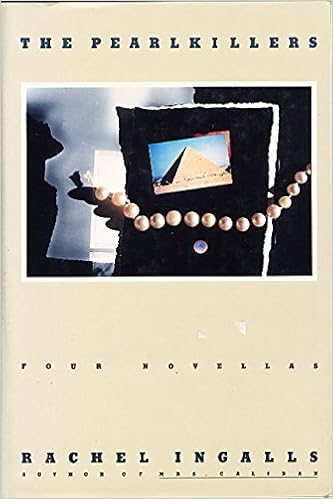
All these years after that initial read, I've kept this book on my shelf. I knew I liked it--a lot. Strangely, however, I haven't read it in the ensuing decades, and that same old prejudice has stuck with me on this one. Do I really want to read this book again? What did I see in it? However, I was taking a trip and I needed a book to read, and in my systematic way of rereading, I was on the letter I. I chose Ingalls. What had I liked about it?
Wow. This book is killer--and that quite literally. The title suggests a theme that continues through the four long stories (or novellas) that make up the work. It comes from a passage in the third story in the collection, which is about a woman who goes to meet her deceased mother's family, whom she's barely ever met. One of her aunts tells of people who when they wear beautiful pearls literally kill them--somehow sucking the vitality and life, the sheen, out of the jewel. Such is the family itself, as we come to feel and see, as the story, which has a magical realism feel, winds its way to its end, wherein the family appears to have some sort of secret to immortality, one that involves sucking the life from others.
The central idea, then, conveyed in the collection, is one of killing the people you love in order to manage your own survival. In the first story, a twice-married young woman goes on her honeymoon with her third husband, scared that somehow she is cursed with an ability to kill off lovers but also aware that she doesn't really love the man she is with.
The second story is my favorite of the book--a thriller and an absolute brute of a piece. College friends accidentally kill/bully a young man in their dorm and hide their part in the death. Years later, one of them decides to come clean. What to do? That is the heart of the discussion among the other surviving friends.
The fourth story, the longest, is also quite brutal. It tells the tale of a explorer/sailor returned to his family after a decade missing, the lone survivor of the journey. Or so we are made to believe.
Tuesday, February 23, 2021
On "Tao Te Ching" by Lao Tzu *****
The Tao, I would take from the work in general, as being "the way," and the "Te" as being a sort of life force. The general idea throughout seems to be to remain humble, to not make a show of one's self, and in that way one will reach the greatest degree of value in society. As I said, any summary by a person who lacks a real understanding of the ideas behind the work is going to seem rather silly. If I were a wise man, I would write nothing at all about it.
Subscribe to:
Posts (Atom)

 Posts
Posts


