Sunday, June 18, 2023

On "Hadrian and the Triumph of Rome" by Anthony Everitt ****

This biography of the Roman emperor that ruled from about 117 to 138 might as well also have been a biography of the late life of his predecessor Trajan, as much of it discusses how Trajan adopted and oversaw the education of Hadrian. It provides a nice insight into Roman society at the time and much color lacking in other accounts, both those focused on larger issues and those focused on small. Everitt really shows his mastery of the subject.

Hadrian was from Spain. Orphaned at an early age, his overseers gave him a fine Roman education. In his early life, he was often less than exemplary, but he worked hard to impress Trajan as he grew older so that he might be seen as the proper heir to the throne, a role he was eventually placed into with the help of various women in Trajan's household with whom Hadrian had close relationships. Several things stand out to me about Hadrian, from Everitt's portrait:

1. Hadrian was a lover of all things Greek. He studied the literature and culture, became a devotee to Greek mystery religions, attempted to visit Greece as often as he could, and attempted to model much of his governance on Greek ideas insofar as he aimed to inculcate a kind of Roman-Hellenistic culture across the empire as a unifying force, which is a reason he ended up with so much trouble with the Jews, who he was otherwise, or at least early in his reign, rather sympathetic to. Hadrian even brought the Greek preference for facial hair to the Roman throne--all previous emperors had been clean shaven.

2. Hadrian was a fan of astrology. He used horoscopes and other divination tools to attempt to learn his future and the best means to accomplish certain tasks.

3. Both Hadrian and Trajan were homosexual. This is an interesting attribute of both these emperors insofar as this aspect of their lives played out on the throne. Hadrian had a wife, but it's questionable whether the marriage was every consummated, and he never had his own biological children, much like Trajan. He had a romantic relationship with at least one younger man/teen. Such was a lifestyle that went well with his love of things Greek, as the ancient Spartan society had encouraged military men to have relations with their underlings. In Roman society, apparently, there were few qualms with regard to men having other men as long as you were the dominant one in the relationship; if you were not, then you were considered something "less than." I suppose one could say that the point was, as a "true man," to be the dominant person in a relationship, whether your underling was a woman or a man.

4. Hadrian took a different tact in governorship than previous emperors insofar as he attempted to shore up the bounds of the empire rather than expand it. In some ways, this seems to have been a very good thing, arguably bringing more stability to the empire, save for the Jewish rebellion that broke out toward the end of his reign and that required extensive use of Roman resources (perhaps as much as half the army) to put down. It's a shame that more info isn't available about this event, but one can understand why the Romans weren't keen to write much about it.

Monday, May 29, 2023

On "A History of Christianity in Asia, volume 1" by Samuel Hugh Moffett ****

If you want a book about world history from about 0 to 1500, as processed through the lens of the spread of Christianity, you probably can't do better than this work. Moffett lays down the various theories about the earliest church, much of which we are essentially dependent on legends for. How much of any of these are true, we don't know. Then, he proceeds to explore the Nestorian and Jacobite faiths as they developed out of the more known portions of Christian history.

Christianity in the East at one time might well have had more adherents than in the West, but you wouldn't know it today. The history Moffett tells explains many of the reasons. Unlike in the West, Christianity in the East never had a major empire-wide political promoter--no Constantine--though there were occasional small kingdom adherents. As such, its popularity remained always at the mercy of whichever entity was in charge, as well as remaining often something seen as "foreign." Some kingdoms, such as that of the Mongols, were relatively open religiously, thus allowing Christianity to thrive as one religion among many, but others not so much. Thus, Christianity, rose and fell and rose and fell again throuough Asia, with the rise of various kingdoms and with the advent of Islam, whose influence grew stronger than in the West.

All that said, 1500 years across thousands of miles of land is a lot of material to cover. At some point, though accessibly written throughout, the work became for me more a set of names with a few highlights. I found it hard to keep track of all that was going on. Indeed, any history of nations outside the West, being less familiar culturally to me, tends to be difficult reading, a testimony to what we focus on in school. When more is unfamiliar, it's harder to find holds on which to ground one's self; were I to go read more and more histories of the East until events and people became easier to place, I'd probably find this book more accessible.

Friday, May 26, 2023

On "The Assassination of Jesse James by the Coward Robert Ford" by Ron Hansen *****

Perhaps I ruined this book by watching the movie a few months ago, unwilling to wait to see something that had gotten such great reviews. The book received great reviews too, and I understand why, even if as I read, I often saw Brad Pitt and Casey Affleck in my mind. In a way, seeing the movie first may have helped, insofar as the book includes a lot of characters and keeping them straight might have been more difficult had I not known where the story was already going.

Hansen comes from a different school of fiction writing than that to which I've become accustomed and generally come to see as professional. What I mean is that unlike so many purveyors of modern fiction, he doesn't seem to descend as much from the concrete, action-is-character line of writers like Hemingway or Carver. Hansen has no problem using abstractions, describing people's character and feelings without reference to an act. Yet he manages to do so with great power. The book is also heavy on physical descriptions of people and places, which while beautifully rendered, seem somehow pertinent despite their length.

As historical fiction, there's a degree to which it's sometimes hard to distinguish what is fact and what fiction. Hansen noted that he didn't make up anything that would have strayed from known facts, but clearly in smaller scenes, he rendered some dialogue and so forth (but how much of this itself was pulled from newspaper accounts and so on is difficult to know without looking at his source material). At points, the novel felt more like history, as he covered material that seemed less connected to the action, providing readers with information about people and what happened to them once they left the main plot of the story. The last portion of the book, likewise, feels a bit of a letdown, as insofar as once Jesse is killed and we focus almost entirely on Ford, the chronological pacing picks up rather rapidly. Years go by in the page span where previously only a few days would have. And yet, in a way, that's Hansen's point. The letdown is not just ours but also Ford's. He had thought killing Jesse would bring him fame and fortune and popularity. He had not considered the emotional consequences (after all, he kind of idolized Jesse but also felt a bit envious of Jesse's own fame and wanted that for himself--even as Jesse was a quasi friend). In the end, the fame turned out to be more infamy, and the fortune short lived. As Ford notes, at one point, he died long before his actual death.

It's curious also how one comes to care about both James and Ford, who were both rascals and not people we would term good human beings insofar as what they did to others. Yet even after all the killing and stealing James did and how much you hate the way he treated others, when James dies, you end up feeling a little sad and a little angry at Ford; likewise, you feel somewhat similarly about Ford at his death, though he'd proven to be not much better. Perhaps that's because Hansen portrays them a little as men who come to rue their life choices and who wish that somehow, could they go back to pivotal moments in their past, they'd have taken a different path, like the one Jesse hopes for for his son, whom he shelters from stories about his bandit life.

Tuesday, May 23, 2023

On "The Question of Canon" by Michael Kruger *****

This well-argued book essentially attempts to show the difference between the extrinsic theory of biblical canon formation and the intrisic theory and the shortfalls of the former, which seems to be the more popular contemporary view. The extrinsic view of the canon posits that it was created by the church in the third or fourth century and that many works were considered--in other words, that there was little agreement regarding what constituted scripture until the church defined it in this late period.

Kruger argues that what constituted scripture came into being much earlier than that--possibly as early as the early second century--even if the canon was not established until many years later. Unlike those who claim the Christianity was an oral faith until much later, he shows how even if most people were illiterate, the Jewish faith--and the Christian faith that derived from it--was a textual religion. That is, these faiths dealt in texts, which served as authority. Oral readings of texts still constitute a written center to the religion.

He also shows how even in the second century, many of Christian writers talked of "scripture" when referring to many of the works that would become part of the New Testament. Even the apostles themselves seemed conscious of their attempt to forge a scripture that would, in fact, complete the scripture of the Old Testament.

What I like about Kruger's work (but also what is perhaps a bit maddening about it too) is that he doesn't overplay his hand. He makes little claim to the idea that the New Testament "canon" existed by the second century, only that the outlines of it were largely already there. Indeed, there is little one could point to that would definitively show that all the New Testament books had been selected by that period. And yet, at the same time, the fact that all these folks in the second century refer to New Testament scriptures as scripture does seem to suggest to me that perhaps a canon really already did exist (Eusebius and others' debates about what counted notwithstanding). After all, there is not a lot of debate about what constitutes New Testament canon to this day, and that suggests, as David Trobisch's work suggests, that fairly early on, someone "edited"--or rather, selected--what would constitute the collection such that the matter was closed; what we lack, alas, is hard documentation.

Wednesday, May 10, 2023

On "The Collected Works of Billy the Kid" by Michael Ondaatje ****

When I set out to read a group of Westerns, a genre I have had little experience reading, I mostly intended to focus on the pulp fiction, and indeed, most of the books so far that I've ready have fit into that category, but now, for the last few, I'm moving toward reading "high-brow" Westerns, those that intend to be Literature with a capital L. Ondaatje's work certainly fits into that because it's not a Western aiming for a popular audience, with a heavy-handed plot and a likeable character at its center. Rather, it's a book of poetry, with the legendary Western antihero Billy the Kid at its center.

The book, in large part, is a kind of "found poetry," extracts from real-life documents rearranged in a poetic format. Ondaatje aims to describe the final days of Billy from multiple points of view, as his partners are gunned down and he is taken prisoner by and then escapes from his one-time friend and now sherriff Paul Garrett. All this seeps through what narrative is provided, because, this being poetry, we're more focused on the thoughts of the people at any given moment than on what's happening. In that sense, not having read Billy's history, I found the earlygoing parts of the book difficult to follow, but as I read on, I began to understand who was talking when and how events came to be.

As a piece of descriptive and experimental literature (Ondaatje includes various types of prose, rhyming poetry/lyrics, free verse, photographs), the Collected Works works admirably. One gets a pretty good set of views of the young man--from his friend, lovers, enemies, and self--while also coming to see how real-life people enter into myth. It was an enjoyable read, though I can't say that the work made me empathize too much with anyone or made me want to read a ton more about Billy.

Sunday, May 7, 2023

On "The Early Christians in Ephesus from Paul to Ignatius" by Paul Trebilco ****

I was looking for a book about the Johannine cricle or about second-century Ephesus, and there really don't appear to be as many as I thought there would be. Trebilco's book is a huge tome, though, and was well worth time involved in getting through it, though it only goes up to the time of Ignatius.

Trebilco largely makes the argument that Ephesus housed several Christian groups and that certain groups were friendly toward one another, while others were beyond the pale. Pauline and Johannine circles, in other words, borrowed from each other, but Nicolatains and the like were not acceptable. These folks left the Johannine circle, forging their own docetist circle that were not acceptable to Ignatius.

The first small bit of the work looks at the social context, providing a short history of Ephesus, its religious and trade importance, and the Jewish community within it. Next, Trebilco turns to the accounts in Acts and in Paul's letters, finding Acts to be mostly trustworthy. He's less certain about what we can glean directly from Paul about Ephesus, as the Pauline imprisonment in Ephesus isn't perhaps as clear as might be desired. The letter to the Ephesians, furthermore, was likely not directly to the group--in fact, it may have actually been written in Ephesus. It bears, in early manuscripts, a blank to whom it is written, suggesting that it was an enciclical for sorts, sent out to various churches and that Ephesus was just a convenient name to attach to it in the end.

Next, Trebilco turns to the pastoral epistles, the Johannine epistles (and gospel), and Revelation. He takes the view that the pastorals were pseudonymously written by Paul by people from a Pauline group in Ephesus. The Johannine works, he believes, were written not by the apostle John but by John the Elder. The pastorals were written in the 80s, the letters from John in the 90s, so we're looking at two groups nearly contemporarily to each other. From this, Trebilco draws out various ideas about what the leadership practices and theological concerns were among the two groups.

Although one has to go along with Trebilco's ideas with regard to authorship and time of writing (which are fairly common among scholars) to glean what he does about the community(ies), the argument is well put out (if often redundant) such that his ideas are easy to follow. I didn't learn quite as much about Christianity in Ephesus as I would have liked, but what Trebilco shows is that after Acts, we really have little to go on other than theoretical leaps about where works derived and what those works represent about the people who wrote them and to whom they were written.

Thursday, March 30, 2023

On “Little Big Man” by Thomas Berger ****

I'm not sure how to take much of this book. I read that it was a parody of westerns, and I suppose one could read it that way, but it wasn't particularly spoofy. I read that it was a picaresque novel, and it is at some level like that—a story in episodes with various parts pulled in from almost every western trope you could imagine. I read that it is a western from the point of view of the Native peoples on the other side, and it does that to an extent, but not really. It's just its own weird book, one that gave me some pause especially early on. It opens with a preface by a supposed expert, the man who gathered the tales from Jack Crabb, a 112-year-old man who lived in the Old West. The preface is hilarious, full of faux learnedness and silly asides. And so I was expecting something similar of the book—but not so. The book seemed much more serious, even in its rendition of tall tale after tall tale. Further, the portrayal of the Native Americans seems problematic, at once clichĂ©, overly positive and overly negative—but I suppose that that is Berger's point in such a portrayal: we never do fully understand them.

The tale starts when Crabb was a kid whose family is slaughtered by the Indians on a journey out west. He's taken captive and raised as a Native American—a Cheyenne—for about five years. In the process, he becomes something of a warrior, killing one man and saving the village—and specifically a frenemy named Little Bear. For this, Crabb is given the name Little Big Man. Eventually, in a fight with whites, Crabb finds himself in danger of being killed, so he ditches the Cheyenne garb and identity and now again becomes white.

As such, he's put into a preacher's family—really just the preacher and his wife—and raised proper for a short while, but the high living and moralizing doesn't suit him well, so eventually he runs away.

He ends up back with the Cheyenne somehow at some point—actually, at various points—so without rereading, it's exactly to recall what happens when. He does a stint as a businessman, gets ripped off, dallies among the Cheyenne some more. He gets married to a Swedish gal, gets himself mixed up with some bandits, meets Wyatt Earp, is again clobbered by Indians, to whom he loses his wife and kid. He becomes a drunkard, goes searching for gold, befriends a Cheyenne gal and son and marries the gal, and takes up life as a Cheyenne again, having another son by her. Then Custer wipes out his Indian family and he vows revenge. But instead of that, he gets mixed up with his long lost sister (actually, this happens more than once as well), and meets Wild Bill Hickock, who teaches him how to be a marksman, even as they play poker night after night. Meanwhile, he rescues a gal from prostitution. Eventually, Crabb meets up with Custer again and somehow ends up in Custer's calvary, but his desire for revenge has long since died. This takes him to Little Big Horn, where he once again meets his Indian family. In other words, Crabb is a Forest Gump of the western, somehow ending up in every part of history during a certain set of years. Are we to take him seriously? Even the learned scholar responsible for recording the story doesn't know, but it's an intriguing yarn.

Tuesday, March 14, 2023

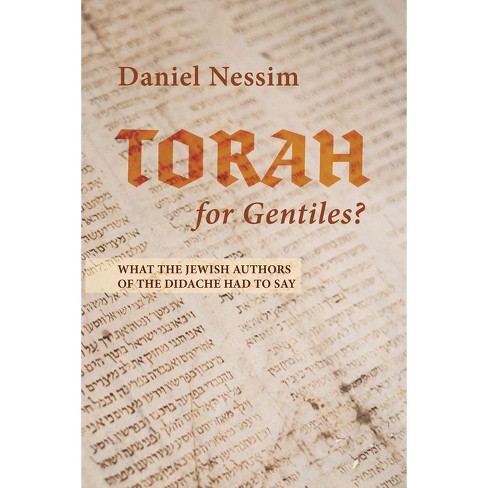
On "Torah for Gentiles?" by Daniel Nessim ***

Nessim sets out to discuss how the Didache depends on the Torah for much of its teaching, essentially laying out a Torah for Gentiles as opposed to Jews. It's a decent if heavily focused introduction to the Didache, with a focus especially on the Didache's first half (the so-called "two ways" section, which would have been a common idea in the Jewish world that also would have played well for Gentiles).

The work derives from Nessim's dissertation, and it feels like one. As such, it really is a technical work aimed largely at scholars. There's a chapter that features a thorough literature review, and untranslated quotes of German and French scholars, as well as writing in the original Hebrew and Greek, abound. Such makes it difficult if less rewarding reading to the general reader.

Nessim takes the stands that the Didache emerged from a Jewish world in Syria around 80 CE, was written to and for Gentiles, and likely was written in at least two phases (with the first part written earlier than later). The work also probably contains elements of oral tradition and may have been intended for memorization by a community that was not very literate.

Tuesday, March 7, 2023

On “Last Stand at Saber River” by Elmore Leonard *****

This short novel is the best western I've read so far among those in this most recent genre list (though not nearly as good at classic Van Tillberg's classic The Oxbow Incident). There's reason, I suppose, Leonard was the writer dujure for many movies in the 1990s. This work includes full characters, an engaging plot (with cliff hangers at the end of each chapter), and historical tie-ins. I was thoroughly entertained and wanting to read more than I am by a lot of fiction these days. The only thing disappointing was the end, which was sudden—I could have actually wished for a coda or an epilogue, though in a way that would have dissuited a work that was generally full of suprises. Still, without the coda, a certain amount of emotional payoff seemed absent.

The work concerns Paul Cable, a Confederate veteran returning to his home in the Arizona territory. In his absence, some Union-leaning ranchers have taken his property. Family (wife and three young kids) in tow, Cable needs his farm back, but the ranchers aren't about to surrender it. Meanwhile, the local general store has change hands. The new owner is himself a Confederate veteran but something seems off about him. Indeed, as Cable soon discovers, he's about as untrustworthy as most of the Yanks. For both, the Civil War looms large, even out here on the territory, where the war is far away.

Wednesday, March 1, 2023

On "Beyond the Great Snow Mountains" by Louis L'Amour ***

Only one story in this collection is a Western; most fall under the adventure or crime/detective genres, but this was the only book available by L'Amour in the library, and I wasn't going to skip him in a reading list on Westerns.

A friend of mine growing up was a huge fan of L'Amour, had probably read all of this stuff. The friend could read at an incredibly fast clip, but if he had only read L'Amour, I would likely not be impressed, now that I've read this writer. The reading is not challenging. My friend, though, who had mastered speed reading to such an extent that he could look not just at sentences at a time but whole pages, would read Leon Uris or Charles Dickens novels in a night, so I know that he wasn't sticking just to short, simple books when he bragged of finishing so much so quickly.

That said, his admiration of L'Amour does make me think that perhaps he was more inclined to like heavily plotted material rather than strong characters. Indeed, from the collection, I would get the feeling that that is really all L'Amour was about. Sometimes, character motivations and actions seem secondary and nearly defy logic. Then again, I was reading a book published after L'Amour's death, made up of stories he did not publish in a collection in his lifetime, which suggests that even he may not have thought this his strongest work.

The collection consists of four stories. The sole Western, "Roundup in Texas," involves the familiar tale of a cattle rustlers and a man who sets out to save the cattle for a gal, ending, of course, in a shootout.

Among the adventure stories is "By the Waters of San Toledo," about a woman whose father dies and who is stranded in a faraway place with a man who she doesn't like but who thinks she should not belong to him. There is gunfighting, and a daring escape attempt. "Crash Landing" is about a man attempting to save passengers from a plane wreck that is precariously propped on a mountainside. "Coast Patrol" involves World War II pilots and ship captains and takes the prize for the most ridiculous character transformations--a woman whose father dies (a common trope, it seems, in these stories) is now due to be married to one of the seamen, having known him for a year and come to depend on him; Turk Madden, however, a U.S. flying ace who is flying for Russia, after discovering much of the ship's crew dead, tells her that the seaman is the one responsible and, in fact, that he is a traitor to the United States government who is on Japan's side. The woman immediately, despite receiving nothing but Madden's word, turns sides, taking up for Madden, and disavowing the seaman, her fiancee, despite his protests. After Madden kills the traitor, she and Madden get together. Not sure why she would betray her one true love on the word of a stranger. The title story also fits the adventure model, this one about a woman stranded in a faraway Asian country, who marries a local and who finally has a chance to return to the United States, but whose true desires are very much tested.

"Meeting at Falmouth" involves a twist ending that is hardly worth the fifteen or so pages it takes to get to it.

Two stories involve boxing and tough guys' attempts to make boxers throw fights for gambling money--"Sideshow Circus" and "The Money Punch."

Contemporary crime stories include "Under the Hanging Wall," about the murder of a mining employee, and "The Gravel Pit," about a man whose attempt to take off with a company's payroll goes awry such that he has to kill another man.

A man who writes adventure has to know how to describe a fight, I suppose, and L'Amour was certainly good at that. Much of many of the stories runs through the various punches each character throws, and somehow, one is able to keep track of what is happening. It's good action--but often not much more.


Sunday, February 19, 2023

On "Shane" by Jack Schaefer ****

This classic western is essentially the tale of a mysterious superhero who rides into "town," does away with the bad guys, and leaves. It is told from the point of view of a kid who witnesses the action, and it's interesting to see how Schaefer manages to get the kid to places where he can witness the important events.

My wife, in her own reading of The Virginian, is the one who first brought up the superhero comparison to westerns, and it made me think a bit about how most of the books I've read so far fall into just that sort of set of cliches. Indeed, there are numerous sites on the internet that claim superhero movies are the new western--and then a whole bunch rebutting that claim (westerns are more varied is the standard reply). But so far, I'd say there's a fairly common throughline with regard to standard western elements. Most involve a super gunslinger, generally mysterious, who saves a woman from some baddies. There are variations, of course. Some involve more than one gunslinger, as in Zane Gray's Riders of the Purple Sage. Some, as in the case of Shane, avoid the woman--the romantic love interest. Here, the gunslinger saves a family.

The work itself is set out on rangeland that is transitioning toward farmland. The resident rancher wants to keep the land free for his cattle to roam, and so he's doing his best to push out the homesteaders who have taken up residence on the vast open federal land with the intention of claiming their 160 acres. Threats of violence and then actual violence follow. The focus of the rancher's attack is the Starret family, because that's where the manliest man of the small and not yet official community resides. When I say, "not yet official," I mean that this is the wild west, land where there is no sherriff to enforce the law. It's neighbor against neighbor. And in that sort of situation, one needs men like Shane to protect the "decent" folk.

The writing here is assured, and the narrative point of view provides a kind of innocence and wonder that works well in what is a kind of tall tale. That gives the work a feeling of genuiness that has seemed lacking in most of the other westerns I've read, so that even if it's much the same story, it feels heartfelt.

Tuesday, February 14, 2023

On “Ignatius of Antioch and the Parting of the Ways” by Thomas A. Robinson *****

This is probably the best book I’ve read on first- and second-century Christianity in Antioch. The work is in many ways a critique of scholars who have tried to argue that the reason for Ignatius’s martyrdom was an internal division within his congregation and of scholars who have argued that there were multiple Christianities or multiple Judaisms. Robinson is intent on arguing that the fractiousness was likely from outside Ignatius’s church and that Ignatius’s church was the main body, if not the only, of Christianity at the time. He makes good arguments on both counts, but at the same time, I remain unconvinced that Ignatius necessarily presents us with orthodoxy and that there was really only one church.

The book starts out with an exploration of the history of the city and Christian culture within it. This first half, as noted, sets a very good stage for all that follows and is probably about as thorough as Downey’s chapter on the subject of the church in this period in his book on the history of Antioch of Syria in general. That history, which Robinson lays out, is then used to discuss Ignatius in context.

One interesting argument Robinson notes is that we don’t today speak of Mormonisms. Clearly, there are various offshoots, small branches, break-off groups of Mormonism. But the whole is still seen as Mormonism singular, and there is still generally also one major Latter Day Saints group. It’s a good point. Critics probably are too much inclined to think that early Christianity had no main group or that all the various offshoots and branches were every bit as large as the main (thus, the misemphasis that “Christianities” present). That said, I think Robinson may be a bit bold in trying to claim, as he seems to do, that all the docetists and Judaizers were mixed in with the one church and had no means of meeting on their own. Clearly, even today, heretical teachings within one Christian sect that are orthodox in another still make their way across sects at times, and you can have a person with a few odd views meeting among others who have another set of views, even if another sect might be closer to that person’s views on a particular point.

Another interesting claim is that Ignatius’s concern about Judaizing was not so much that Jews were converting to Christianity and bringing their Jewish practices with them, and insisting Gentiles fall in line, but rather that Gentiles were becoming Christians, then as they became familiar with the teachings, were becoming more attracted to full-on Judaism, such that they were leaving Christianity to become Jewish proselytes (in other words, there wasn’t a lot of Jewish proselyte to Christian movement; rather, it was more often Christian proselyte to Jewish movement). It’s an interesting argument, and Robinson presents a good case. Again, however, I think one should be careful about taking a hard line with regard to what was happening. My guess is that there were some who did exactly as Robinson claims, but I’m less inclined to believe that there weren’t also still Jews who were attempting to influence Christian practice. Maybe everything was settled in Acts 15, but it seems to me like even after that, there were plenty of people in the church who seemed unwilling to abide by the decision (at least if we take Galatians as being written after the Acts 15 decision) and that that had not all come to an end by 100 CE.

Monday, February 13, 2023

On “The Didache” by Thomas O'Loughlin ***

This second book on the Didache that I read was aimed at a more general audience and yet seemed much less interesting and useful. The work lays out the discovery of the Didache and then focuses on themes within the Didache and what those would have said about the community that used the document. O’Loughlin often seems more concerned, however, about how we read the Didache in our contemporary day and what that says about contemporary Christianity. He notes how various scholars have accepted or rejected it, or dated it late or earlier, based on their preconceptions about what Christianity is like now. If a given doctrine or practice seems odd, then that is good reason to reject part of the document or to argue that this particular sect was heretical in some way or that the ideas represent something before full development and so on. O’Loughlin closes with a section on the Eucharist and how one’s views on that are often used to separate Christians today, whereas, he claims, the Didache, shows that the Eucharist was really about unifying Christians rather than separating—once one was baptized, one was “in.” Baptism, thus, was the distinguishing feature. Point taken, except that even the Didache notes that the Eucharist was for members only, and is that not also then a way of distinguishing one set of people from another, just like baptism? Today, with so many Christian sects, many with differing views on the Eucharist and baptism, it really isn’t much different. One might be baptized and then be “in”—and able to participate in the Eucharist, but only in the group. Go to another Christian sect and a rebaptism might be necessary, but afterward . . . Although I suppose there are sects where only the ministry participates in the Eucharist, but that’s a whole other issue. Anyway, with a focus so much on critiquing contemporary Christian practices, the book proved to be less than I was looking for historically.

Sunday, February 12, 2023

On “The Way of the Didache” by William Varner **** I

I figured I needed to read more about the Didache and its connection to Antioch and the early church. I chose two books in hard copy. This was the shorter, but it looked more technical, in part because of the extensive notes and the much smaller print. I figured it would take longer to read than the other and would be less interesting. Surprisingly, that turned out not to be the case. This was by far the better book of the two. Perhaps, that's because I was looking for something that would be more historical in focus, and this certainly was that.

 Varner discusses the history of the discovery of the Didache, a handbook used by earlier Christians, and how that discovery led us to understand that we'd had versions of what was referenced in other works all along in yet other early works. Varner than provides his own translation of the Didache with extensive notations regarding how various passages mirror passages in the New Testament, which itself was very useful. He then focuses on the where and when it was written and to whom; whether the work, which uses parallel passages in Matthew, predated Matthew, postdated Matthew, or drew from the same source, presenting various interesting theories; posits an idea that the first part of the work (the so-called Two Ways chapters) was intended as a baptismal preparation guide; questions whether Jewish sources were the origin of that material; discusses the various rites and church organization guidelines discussed in the second half of the book (baptism, eucharist, ordination) and the short apocalypse section at the end of the book, offering cogent points at each about what this community was likely like.

Saturday, February 4, 2023

On "The Treasure of the Sierra Madre" by B. Traven ****

"We don't need no stinking badges"--a comment my friend Mike used to often make. I'd forgotten about that line, but when I came across something quite like it in Traven's work, I realized that Mike likely was referring to this book or to the old Humphrey Bogart movie based on it, or, more probably, he was saying, "We don't need no stinking badgers," a line from some comedy (Strange Brew?--turns out it was Weird Al's UHF) or cartoon strip that he found uproarious that I didn't get the full meaning of. I've long intended to watch the movie--still haven't--but with Traven's work (in German) reaching public domain this year, I thought it a good thing to add to my westerns list.

But is this book even a western? It's certainly an adventure story, but one could debate whether it qualifies as a strict western. It's set in Mexico, in the mountains but also in the tropics--and in the 1920s. However, in the broader view of what qualifies as a western it would be: it involves bandits, Indians, and a search for gold. Nary a car appears, though oil plays a big role in the start of the book.

The tale focuses on one Dobbs, who, as the story opens, is homeless in Mexico. He begs, gets more than he expects--enough for a restaurant meal. The next day, he asks the same man for money again. The man tells Dobbs he needs to be more frugal. Indeed, Dobbs takes up residence at a cheap place, just a bed. He gets work at an oil field. The employer pays him only a small portion of what he's owed when the job comes to an end--there's promise of more work, though, and he'll get paid fully then (fat chance!). He and another guy essentially threaten the boss to get paid their full wages. Those paid, they settle in at their cheap hotel. Oil work is drying up; they are unsure what to do.

That's when they meet Howard, an old-timey gold prospector. If they can get together $100, they could head to the mountains to mine for gold. Somehow, the two guys wrangle up the money--debts they'd forgotten they were owed--and the three men head into the mountains.

Howard, through a couple of stories, warns them about the ill effects of gold. One can never have enough. Once you have what once seemed like a lot, you'll want more. And you'll do anything to get it. This is obvious foreshadowing.

Once they hit the gold and grab what they can. Howard again warns them. It's one thing to obtain the gold. It's another to actually sell it and cash out. The story involves a lady whose husband is killed for the gold; she hangs on and continues prospecting, making a bundle. When she's ready to cash out, she meets a dashing man who knows of her riches and a marriage is planned. Shortly before the wedding, however, she disappears.

And so it goes. In a way, the gold itself becomes the main character for a while. The story seems to be Dobbs's, but Traven's limited third-person drifts from man to man and eventually to other characters who don't show up till near the end of the book. Gold comes and goes, Traven seems to note; the real treasure is in the respect one has in the community.

Sunday, January 22, 2023

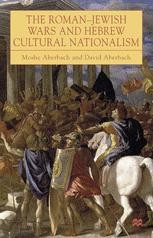
On “The Roman-Jewish Wars and Hebrew Cultural Nationalism” by Moshe Aberbach and David Aberbach *****

I was looking for something about the Bar-Kokhba revolt. This wasn't quite it. However, it proved to be a very interesting and solid book about the causes and implications of that revolt and the earlier ones. The work includes perhaps the best short summary I've read on the leadup to the 66-70 Jewish War, but it does so with the intent of getting to its bigger point: how those wars changed Jewish culture.

The work is split into two parts, one on the causes of the conflicts (and the culture as it existed before them) and one on the responses to the conflicts. The first part was the stronger section. Aberbach and Aberbach explore both short-term and long-term causes of the conflict. They include bad (particularly local) Roman leadership, high taxation and poverty, a corrupt priesthood, demographic changes in Rome (the Jewish nation was growing at a much faster pace than the declining Roman population), the differing religious cultures, and the differing responses to Hellenism (Rome turned itself much more heavily toward Greek culture, whereas Jewish culture internalized Greek culture into its own; in other words, one was more heavily transformed by it, while the other transformed it into its own).

The destruction of the Jewish nation as a political entity meant the preserving the nation became much more of a cultural endeavour. In ridding the empire of the Jewish temple, ironically, the authors show, Rome helped to ensure that Judaism would survive, because it was forced to transform itself into something not beholden to a particular place, in turn also helping to unify Jewish culture.


Sunday, January 15, 2023

On "Riders of the Purple Sage" by Zane Grey **

Imagine your spouse, who you dearly love, was having an affair for the past three years and that your best friend knew and decided to kill your spouse and the lover to avenge you without your knowledge. Imagine that you learned of the spouse's death and later learned that your best friend had killed the spouse (but that you don't know about the affair). How would you feel about your best friend? Imagine that ten minutes later, you learn that the spouse had been having an affair? Would that instantly absolve feelings and restore your friendship? Such calamities and sudden revelations of truth are the making of Grey

s book. Not those exact sort of revelations but ones like it--ones, dare I say, even more ridiculous. Here, plot takes precedent over feeling, character development, and logic. As such, this classic western seemed much like I usually imagined genre fiction being growing up; having now read a number of classic genre works, however, I've found that most are actually well written in almost every way. Not so here.

The riders are those who guard the cow herds of Jane Witherspoon, who of late lost her father, who was a rich man and from whom she inherited well. She is supposed to marry a man named Tull, as per the convention and command of the Mormon overseers of her local town. Her refusal has created a ruckus. What's more, she's been sort of carrying on with a non-Mormon named Venders, one of the few riders who hasn't quit her because of Mormon hostility and loyalty. As the book opens, Venders has been caught by Tull's men and is about to be beaten. In rides Lassiter to the rescue, a famous Mormon killer (that is, a man who kills Mormons). He's looking for a woman or the person who killed her, in order to seek revenge, but he just happens also to save Venders.

Jane had seemed to be into Venders, but saved, Venders goes off to save one of her herds, and Lassiter and Jane fall in. So much for the other seeming budding relationship. In fact, Venders ends up finding another gal, via a shootout with some rustlers, and spends most of the rest of the novel with her. Jane continues to lose cows to Tull and his group, who are intent on making her pay for not cowtowing to her Mormon overseers, and eventually things come to a head. I won't bespoil the rest of it, since plot "surprises" is pretty much all this book has.

Well, and this. Grey is pretty masterful at describing the landscape. That was the one redeeming factor--all those long passages about the scrub and the cliffs and the sage and the sunsets against them. It's a same such a setting had to be wasted on such an inane story.

Friday, December 30, 2022

On "Gunman's Reckoning" by Max Brand ***

I was long under the impression that Max Brand was a pulp writing active and working today. This is because years ago when I worked in a bookstore, Brand's books still came out about once a month, staying on the shelves about a year before going out of print in favor of some other title. (Our western section was very small, mostly made up of Louis Lamour, which was the only author who actually sold much.) Brand wrote a lot, I suppose, and the mass market company publishing his stuff was still pumping it out on a schedule--putting it back into print and then taking it back out of print. But in terms of when he was writing, well, that part I had dead wrong. His stuff goes back to the 1920s; the publisher was merely recycling old stuff.

I discovered this rather recently, as I started reading this list of westerns, a genre I haven't spent much time with. I'm reading mostly chronologically, so I had intended next to turn to Zane Grey, but I wanted to be devoted to that book, and Brand was available for free public domain download on my phone--I figured I'd read it in between the more serious other reading I was doing, that is, whenever I found myself in a waiting room with nothing but my phone in hand.

The text definitely is what I would have expected from a pulp western. It was rather silly overall, with lots of tough talk, lots of fighting, lots of plot twists, and characters who seem too over-the-top to be real. The book centers on one Donnegan, but it doesn't start off with him. Rather, we're introduced first to some hobo on a train who is out to murder a man who has broken up his gang. That man who is to be killed as it turns out to Donnegan, who remains a rather shadowy figure for much of the novel. He seems more like a sheriff in these early passages, but once he jettisons from the train, holding on to his life, he is seen for what he is: a hobo also, a wanderer of the world--but one with a keen ability to wield a gun, to see through people, and to manipulate people.

Donnegan finds his way to a house, where he meets a woman (Lou) whom he almost instantly falls for, even though they've barely spoken a word. He wants a place to stay, but that requires the approval of the woman's father (the colonel), who won't take visitors. Donnegan insists, and somehow the old man comes to view Donnegan as an asset who can help him reclaim a mine for himself and his daughter's fiancé (Landis) for herself. In fact, the woman is in love with this fiance, who in turn has gone to work in the mining town, fallen in love with yet someone else, and run off with the old man's fortune. Donnegan is on the trail to help. Sure, he wants the daughter, but since the daughter wants this other man, Donnegan, because he truly loves this woman, sets out to get this other man back for her. I can't say the motivation here really convinces me: men will do lots for folks they love, but for someone they've barely met and mostly to enable that person to have someone else? It seems rather crazy to take one's life in hand that way.

 Donnegan's plan essentially involves making himself into a "big" deal in the town, impressing folks with his gunwork and some money he comes into through a shady interaction with another shady character, a gambler whom Donnegan robs and sends away. This plan involves making the mining town woman (Nelly) who has run off with the fiancĂ© (Landis) of the woman who is in love with him (Lou) fall in love with Donnegan himself. The plan largely works, it seems, but as it turns out, the woman, Nelly, who has taken the fiancĂ© is actually just doing so as a ruse, as she's in love with yet another man (Nick), who in turn is absconding with the old man's mining interests through the fiancĂ© but only because the old man himself had absconded with the mining interests of a friend of Nick's. More plot twists follow, and love seems to come and go quick for the men and women at the center of the story. In the end, of course, there's a reckoning, a shootout, and most all is sorted out (except maybe what happens to Landis in the end, but who cares--he's just a plot point).

Sunday, December 25, 2022

On "Christian Antioch" by D. S. Wallace-Hadrill ***

This work details the culture and ideas that developed among Christians in Antioch in the third century through into the seventh and even the ninth. As such, it's a bit out of my usual reading about Christian history, insofar as I mostly focus on the first two centuries. Still, knowing how thought progressed later can be helpful in understanding how it progressed earlier--or at least, that was my hope. The work is very much one of scholarship and not terribly accessible. Although terms are defined and people introduced, the degree to which such specialist terms and people are referenced throughout the work means that you have to read very slowly, take notes, or have recourse to some kind of reference work to get the full scope. That said, the gist of the arguments can still be gleaned from even a quicker read.

Watson-Hadrill shows how Antioch grew in distinctive ways from the process of thought that came to be more acceptable in Alexandria and, by extension in Rome. Antioch, though influenced by ideas coming out of these places, turned much of its attention to the east--to Mesopotamia and Persia, where its ideas found slightly more accepting ground.

After a brief introduction on the background of the church, Watson-Hadrill focuses on six major themes: biblical interpretation, historiography, the nature of God, the use of Greek philosophy, Christology, and desert monks. With regard to interpretation, I'd long read that Antioch took a more literal view of scripture as opposed to the Alexandrian way of reading scripture allegorically. What Watson-Hadrill brought out was somewhat surprising, however. Certainly, qualifiers must be made, insofar as many Antiochenes still used typography and this is really not easily differentiated at times from allegory. But what came to me as a surprise is the fact that some Antiochenes read the scriptures really literally--to extents that some come off sounding like today's secular reading of scriptures. They might go so far as to reject the idea, even though its made explicit in the New Testament, that Noah's ark or the Red Sea were types of baptism. More to the point, they often rejected prophecies taken to be about Jesus or future events, stating that these pertained only to ancient Israel.

With regard to historiography, the writers Watson-Hadrill studies are mostly later ones. As such, he talks a bit about Eusebius's history as being an interpretation of Christianity as reaching its fullness with the adoption of it by Constantine. It is a story, in other words, of triumph. Later historians in the region would try to pick up where Eusebius left off, but by then, such triumph was clearly not the end of the story, given how much infighting there had been in the church. As such, one might pick up the history from where Eusebius leaves off, but no one picks up the same story.

The nature of God, philosophy, and Christology discussions get truly into the weeds, with the Arians versus the Trinitarians and various groups in between (Monophysites, Nestorians). I always find this discussion a bit frustrating if not over my head. It's frustrating because these theologians get so caught up in the philosophy behind theology and lose track of, it seems to me, the real message--the way one should act (in some cases, it's not even clear that they're really that far apart in terms of thinking--but that doesn't stop them from treating each other horribly). The Nestorians, we might say, largely emphasized the human side of Jesus, while the Monophysites emphasized his divinity and the unity of God. Interestingly, Wallace-Hadrill points out how the Antiochenes and the Eastern church focused more on Aristotle's philosophy than Plato's, even though they might not have known it. Rather than the "ideas" being real and everything physical being a copy of those ideas, as in Plato's system; Aristotle focused on the particulars being real and the "ideas" being abstractions. As such, one can read the trinity as three persons who are unified as "God" as a kind of concept, rather than as a concept that finds form in three manifestations (although, in asserting that last part, I'm really presenting the trinity as modalism, which of course is another heresy to most Christian thinkers and so not a precise way to think of the concept).

In a final section, Wallace-Hadrill focuses on the religious devotion of many of the Antiochenes, Syrians, and Eastern Christians. He makes a case that their form of asceticism differed from that of the earlier Gnostics insofar as it was not asceticism based on the evil nature of physical things but on a desire to get closer to God, in the same way that Jesus was close. It's a valuable distinction but also, like so much that the church in the third through seventh centuries argued over, one that is difficult to really see. After all, the Gnostics too, even if rejecting the physical as evil, were aiming to get closer to God and the spiritual; that, after all, was the whole point.


Saturday, December 17, 2022

On “Paul, Antioch, and Jerusalem” by Nicholas Taylor ***

This book aims to correct a common view that Paul squared off against Peter and James and the Jerusalem church, that he had one brand of Christianity, they another, and the two were essentially enemies after Paul attempted to correct Peter in Antioch. That said, even as Taylor aims to correct this view, he seems in many ways to defend it. Mostly, what he tries to do is point out that the situation was actually much more complex than that summary affords. In the end, we get a viewpoint that is more inclined to see Paul as squaring off against certain of the Jerusalem church but coming to respectful terms with Peter and James themselves sometime after that Antioch meeting. Much is made of the two gospels, one by Paul to Gentiles and one by Peter to Jews.

The author essentially aims to show that Paul's relationship with the Jerusalem church varied over time. He did not contact Jerusalem early on and did not have a relationship with the church early on. Only when called to deal with how fellowship with Gentiles should be configured did Paul really start to deal with Jerusalem. This led eventually to the confrontation with Peter. After that, he tried to establish his own apostleship independent of Jerusalem (and Antioch, which had accepted Jerusalem's authority over his own) and created a number of independent church. In time, however, he came to some reconciliation with Jerusalem, or at least with the lead apostles, enough that he, as per agreed upon earlier, went forward with plans to collect donations for the Jerusalem church as a way of folding his own churches in with the lead church. This agreement was actually via/through Antioch, so Paul was actually doing something beyond or outside that agreement. When the timing proved to olate for Antioch's own donations, he had to go forward to Jerusalem on his own, which then led to troubles with the Jerusalem authorities and his eventual deportation to Rome and death. Or at least, that's much of what I got out of it. Taylor, as noted, seems to thread the needle a lot, showing how Jerusalem was never not in charge except that Paul was somewhat independent of it. It's a complex argument—much more difficult than simply saying Paul was on his own or Paul was not on his own.

The book itself is based on Taylor's dissertation. It doesn't appear that more than small changes have occurred between the two. The book is long on literary review and very definitely aimed at scholarly audiences, as his argument is one that would likely appeal only to those deep in the mud over what Paul's break or nonbreak with Antioch and Peter really consisted of.