Thursday, June 18, 2009
On "Warnings Accompanying Your Inflatable Universe" by Justin Kahn (580 words) ***
I have tried to keep the online references merely to short stories--that is, stories in a traditional form insofar as they have a beginning, middle, and end, a climax, a conflict. I don't know if this qualifies as a story using those sort of priciples--it reads more like some of the humor one might find on Yankee Pot Roast or McSweeney's--but the idea here is so compelling that I bring it to the blog anyway. Café Irreal often seems to be focused more on ideas anyway--the pieces Irreal published aim to make you think, and they often make me do just that. Read the piece here at Café Irreal.


Monday, June 15, 2009
On "The Queen of Swords" by Jen Michalski (4932 words) ***
Sometimes it's all in the ending, and in the symbols and metaphors. I like how this story works with broken things, looking at them from several different angles--broken dishes, broken relationships, broken businesses, broken lives. Still, where the story really caught me was in the last line. Read it here (and don't skip ahead) at StorySouth.
Friday, June 12, 2009
On "Christmas Tree" by Lydia Copeland (469 words) ****
Here's another nice flash piece by Copeland, the wordsmith. Here, we get a rundown on a niece's life, on an aunt she adores and on moments made weird by new members in the family (something that I myself have always felt a little odd about when meeting some girl's parents or hanging out with her family--me this relative stranger her might one day be a part of the family, though not from birth).
As for the aunt, I remember my own precious aunt. She didn't let us get away with things like smoking or drinking. In some ways, she was more strict than my quite strict mother. My mom cleaned the house twice a week; this aunt cleaned it every day. My mom let us play in the living room, as long as we put our toys away. This aunt didn't let us play anywhere but in the bedrooms. But what this aunt let us get away with that my mom would never have let us get away with was putting sugar on our cereal, and what's more, eating cereals like Fruit Loops, deemed unhealthy by my parents. We were limited to Shredded Wheat, oatmeal, Grape Nuts; if lucky, we might get honey on the cereal from time to time. Looking back on it, however, I'm glad my mom wasn't into letting us have so much sugar. Read the story here at Menda City Review.
As for the aunt, I remember my own precious aunt. She didn't let us get away with things like smoking or drinking. In some ways, she was more strict than my quite strict mother. My mom cleaned the house twice a week; this aunt cleaned it every day. My mom let us play in the living room, as long as we put our toys away. This aunt didn't let us play anywhere but in the bedrooms. But what this aunt let us get away with that my mom would never have let us get away with was putting sugar on our cereal, and what's more, eating cereals like Fruit Loops, deemed unhealthy by my parents. We were limited to Shredded Wheat, oatmeal, Grape Nuts; if lucky, we might get honey on the cereal from time to time. Looking back on it, however, I'm glad my mom wasn't into letting us have so much sugar. Read the story here at Menda City Review.
On "The Mabinogion" translated by Sioned Davies ***
But what The Mabinogion lacks that Morte D'Arthur has is an arc and a series of continual characters (yes, Arthur, Guenivere, and some of Arthur's knights show up in several tales, but not in every one). As a result, one doesn't recall as much when the tale is completed. A woman's son is stolen away (but is set up so that she looks as if she killed him), and she is forced to tell all visitors to the castle how she apparently killed her son. The son grows up. Someone discovers his true identity, and mom and son are reunited. A fine story, but one I recall probably because it was the very first. In the next to last story, a young man is told to marry a particular woman. He goes to Arthur's court to request the help of the king, his cousin. The knights then venture off to a new kingdom, meet with a man who requires of them some impossible tasks (lest they die) in order to win the lady, they do them, and the young man gets a wife (this piece reminded me how, in Christian lore, God does all these things for his people, who in turn reap the reward, even though they've done very little). In between are similar tales, full of quests and knights. But I'd be hard pressed to recount their plots.
Tuesday, June 9, 2009
On "How to Measure Your Breast Size" by Laura Madeline Wiseman (2813 words) ***
I don't know if this piece appeals to me so much because it tells me all sorts of things about shopping for bras that I didn't know and, at least until the manzere (ala Seinfeld) comes into style and I gain a noticeable amount of weight, probably will never know or if this appeals to me because Wiseman manages to imbue this how-to lesson with so much verve and vitality. I want to buy a bra! I want to buy a bra! Don't I deserve something wonderful to? Maybe the story is enough wonderful for me. Try some wonderful on for yourself, here, at Blackbird.
Saturday, June 6, 2009
On "Conversations You Have at Twenty" by Maud Newton (5665 words) ***
There's a moment in Newton's apparently autobiographical story (if the word "Memoir" is to be believed) where she notes that "it's one of those conversations you have at twenty." That sort of conversation is one where a man you barely know enters your room in the middle of the night and talks to you while you're half dressed until dawn. I have never had a woman do that to me, and perhaps that's where my own lack of success in that domain springs from. I do remember, one night, late, chatting with a woman eleven years my junior online--this was almost a decade ago--and she noted a similar experience to Newton's. In Newton's case, it led to her having a pretty unhealthy relationship (one of a string apparently); in the chatter's case, it was taken as being very rude and led nowhere.
The closest I've come to the kind of oddball situation like Newton's would have been when I was about eighteen. A girl, a friend of my sister's, who came to live with us with her mom after her mom's divorce, ran into my bedroom early in the morning and laid herself atop me (we were both fully clothed). Was I turned on? You betcha--and really uncomfortable. My mom walked in on us but didn't say anything, which seemed odd as well. Was it a dream? Am I imagining this? Maybe so, though I doubt it. I mean, she was wearing red sweatpants. It can't be a dream.
Newton's story doesn't come across as a dream either, unless it's a bad one. She's coming from a place very different from my own very conservative life, and for that I appreciate the honesty and freshness. Read the story here at Narrative Magazine. (Log-in required--but it's free!)
The closest I've come to the kind of oddball situation like Newton's would have been when I was about eighteen. A girl, a friend of my sister's, who came to live with us with her mom after her mom's divorce, ran into my bedroom early in the morning and laid herself atop me (we were both fully clothed). Was I turned on? You betcha--and really uncomfortable. My mom walked in on us but didn't say anything, which seemed odd as well. Was it a dream? Am I imagining this? Maybe so, though I doubt it. I mean, she was wearing red sweatpants. It can't be a dream.
Newton's story doesn't come across as a dream either, unless it's a bad one. She's coming from a place very different from my own very conservative life, and for that I appreciate the honesty and freshness. Read the story here at Narrative Magazine. (Log-in required--but it's free!)
Wednesday, June 3, 2009
On "Groove" by Claudia Smith (347 words) ****
Flash fiction, when as quick as this, demands keen attention to the detail of a moment. Smith does something wonderful with this short piece, building up to that moment with a list of details from early in a relationship, leading finally to a moment later on when the relationship becomes sort of commonplace--but also completely new--and wonderful. Read the story here at Quick Fiction.
On "Le Morte Darthur" by Thomas Malory, edited by R. M. Lumiansky ***
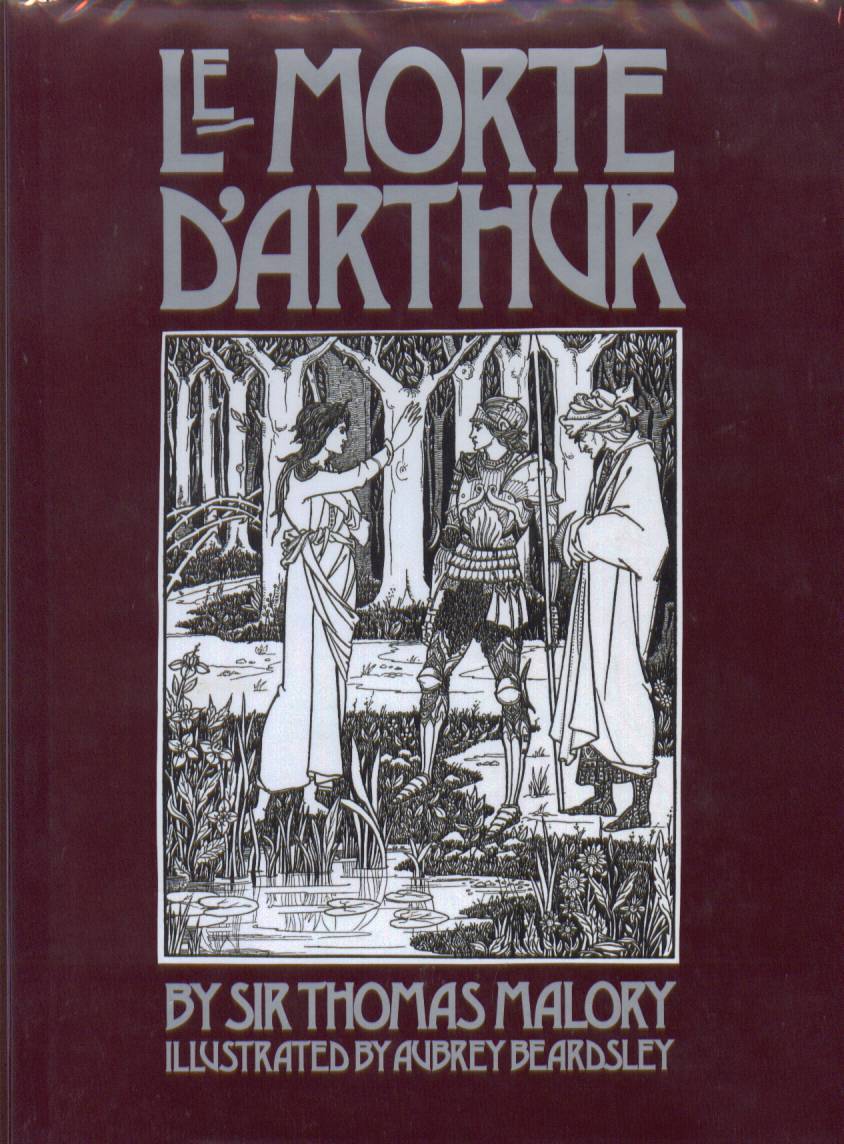
On the whole, this 750-page tome was at its most interesting at the beginning and end, for its first 100 pages and last 100. In the early chapters comes the setup, all the prophecies about what is to unfold in the faraway future, as well as a history of King Arthur's ascent to the throne. In the later chapters comes the fulfillment of those prophecies and the story's tragic end. In between are accounts of numerous battles and quests and tournaments with little or no real climactic buildup. This is a romance in the medieval sense, so the text is episodic, and while some episodes occasionally make for compelling short stories, the whole does not amount to much. I found myself terribly bored during most of the accounts of the battles. But the overall trajectory of the story is mythic, and it's easy to understand why Arthur's legend has inspired so many derivative works.
Sunday, May 31, 2009
On "Treatment" by Barbara DeCesare (314 words) ***
In the film Stranger Than Fiction, poor Will Ferrell discovers that his life is being made into a movie--and it's a tragedy. In my own life, as a kid, I used to pretend my doings were all being captured on television, as in that Jim Carrey movie The Truman Show. I'd go to the bathroom, and the TV station would go to commercials. I know longer think that way, knowing my life is about as exciting as watching a snail eat a leaf (or whatever a snail eats). But that my concept of life on film is not unique is evidenced by the many movies that take such an idea as their subject. And stories too. In this story by Barbara DeCesare, however, the protagonist is not the main character (or is, depending on how one reads the story), which is itself an interesting twist on the theme. Not even the main character of one's own life. These days, in the midst of all the turmoil, with forces we have little to do with crumbling our lives around us, it seems apropos. Read the story here at Tarpaulin Sky.
Thursday, May 28, 2009
On "A Close Call" by Ashley S. Kaufman (2643 words) ***
What happened? I suppose that's the question virtually all stories told in the past tense pose. Many a story does it by juxtaposing the present with a discontinuous past. How did the characters get from point A to point B? Kaufman's "Close Call" works within these parameters. We know something is wrong, but we're not quite clear. Midway in, we get the full story--that past incident. And then, the story does something a little out of the ordinary. It changes the past, gives us another version. The characters' sanity comes into play, and that is as it should be given the situation. Read the story here at Susurrus.
Monday, May 25, 2009
On "& (sixty-nine)" by J. A. Tyler (223 words) ****
Here's a story I love almost completely because of the language, the way the words rustle across my lips as I read. It's short. It's more a poem than a story. But what a wonderful, beautiful little piece, all about writing a story. This story. Read it here at Keyhole Magazine.
Friday, May 22, 2009
On "Customer of Size" by Mary Jones (2169 words) ***
Here's how I'd expect a story about an overweight customer who is put through the indignity of having to "try out" a seat to find out whether he'll have to purchase two (something tells me an airline would be better off just placing a weight limit on the ticket itself at the time of purchase so as to make the problem less personal): I expect anger. I expect shouting and lost tempers and fights. But that's the beauty of this piece. We don't get the expected. Instead, we have a man who knows he's gotten too large and who takes all of the sad indignity in stride--and who in the process manages to teach others a few lessons in humility. Read the story here at Carve Magazine.
Tuesday, May 19, 2009
On "Shoes, Falling" by Melanie Haney (4525 words) ***
If I were to write of binaries here, of opposing principles, yes and no, the lack of any other choices, I'd say something like, "There are two types of people in this world: those who trust, those who don't; those who use lawyers, those who rely on the kindness of others." Reading this, I couldn't help but identify with the mother, with the truster, the one who is hesitant to sue. The story seems to come down on the side of trust as well. But what's interesting is that, while I'm heartened that everything comes out well in the story, and while my own proclivity would be to do just what the mom does, theoretically it seems like the more cynical daughters more often win out. I mean, when you've got neighbors turning against neighbors in places like Iraq and Georgia (the country, that is), people killing or looting others they once ate dinner with, how can one not be? Why do things work sometimes, and why not others? I would like to think that it's just that we're not kind enough to one another. But it takes two to be kind. And knowing whether that's going to be is the hard part. Read the story here at Summerset Review.
Saturday, May 16, 2009
On "Girls Who Love Horses" by Amanda Goldblatt (3926 words) ****
I am persuaded to love this piece because of the beauty of the writing. The tale of a journalist sent to write a wedding announcement (don't families write their own?) is in itself not the most interesting fodder, but the images Goldblatt invokes, the reworkings of old lines, and the metaphors make this tale seem fresh. Case in point: There's a paragraph where the narrator talks about her ex-husband and his paintings. The paragraph ends with a standard cliché and then it broaches one more line, making readers take stalk of the cliché and it's actual meaning, rethink what's been said. Read the linguistic play here at Diagram.
Wednesday, May 13, 2009
On "Tsunami" by Larry Lefkowitz (1974 words) ***
So here's a story that's as breezy and matter of fact as much of its subject matter. I'd like to think of it as a story that replies, not so much to another story, as another idea, another piece of writing. Indeed, the other work--Zen and the Art of Motorcycle Maintenance--makes up much of what is happening here. Each action is rendered in response to that work, and even the silent and unseen ending. Read the story here at Cha.
Sunday, May 10, 2009
On "For Those about to Rock, We Salute You" by Sacha A. Howells (3850 words) ****
At the tail end of my previous job, when all of us working for the company were being laid off due to a merger, all of us having to reapply for our jobs in this new company, in new places, where we would have to move if we wanted to stay employed, the assistant to the managing editor applied for and got quite a few possible positions. Her cubicle was right outside my office, so I got to know what was going on in her life quite well. Her husband had told her he was willing to move. But when those positions were hers, suddenly his tune changed. He was a member of a rock band. It was going to be something, he was sure. He couldn't just leave. They were newlyweds--I got to see all the angst and trouble such new couples often have played out in front of me.
The narrator of this story isn't unlike that husband, isn't--I dare say--unlike so many of us, ever hopeful, ever dreamy. What I like about this piece is the desperation. It's a desperation that comes out in the anxiousness around this main character. It's a party that has ended, a youth that is going down. But our main character refuses to acknowledge it. He's going to be something. He's going to be something. Is it pitiful? Is it heroic? Most likely we'd think of him as the former, were we to meet him in real life, but in other ways there is a certain heroicism to him as well--or perhaps childishness. Is a dream given up part of becoming an adult or a lack of perseverance. No matter, one thing this character definitely is is funny. Read the story here at Menda City Revew.
The narrator of this story isn't unlike that husband, isn't--I dare say--unlike so many of us, ever hopeful, ever dreamy. What I like about this piece is the desperation. It's a desperation that comes out in the anxiousness around this main character. It's a party that has ended, a youth that is going down. But our main character refuses to acknowledge it. He's going to be something. He's going to be something. Is it pitiful? Is it heroic? Most likely we'd think of him as the former, were we to meet him in real life, but in other ways there is a certain heroicism to him as well--or perhaps childishness. Is a dream given up part of becoming an adult or a lack of perseverance. No matter, one thing this character definitely is is funny. Read the story here at Menda City Revew.
Thursday, May 7, 2009
On "The Ledger Angel" by Bruce Holland Rogers (434 words) ***
Some stories simply explore really interesting ideas. Many of Jorge Luis Borges's stories are like this. We learn, for example, that there is a library full of every book that could ever be written but that the problem is that because it contains every combinations of symbols that could ever be, most of it is nonsense. What are we to make of such a library? Could it ever be of much use? How is the library our understanding of our own world? Rogers's "The Ledger Angel" works along the same principle. Should there be such a creature, we have little hope. This is karma times multitudes. Read the story here at Café Irreal. Then pass it on and on and on and on.
Monday, May 4, 2009
On "Johnny Cash Beset by Darkness" by John Marshall Daniel (3918 words) ***
You know a story is doing something right when only half the page will load. What I mean is that my computer failed to download the entire story the first several times I tried to read it. Why does that mean something with the story is working? Because I read the first half and was desperate to read the end. Glad I got there, eventually.
Circus stories are rather fascinating--to me at least. I'm not sure why. I mean, offer me the opportunity to go to a circus, and I doubt you'd see me pulling out my wallet. Maybe it's just the thrill of returning to childhood that makes me like such stories, the thrill of returning to a time when circuses were interesting. Or maybe it's the freak nature of the business and the constant road life that intrigues, and finding out the lives behind the circus is my way of being in a circus myself, albeit vicariously. I think it is probably this latter prospect. The open road no longer holds that same fascination as it did when I was twenty, but down deep, maybe, it still does--you just have to dress it up as circus fiction.
"Trip across the country, man?" "Nah." "How about in a clown suit?" "Hmmm . . . Okay--I'm there."
Read the story here at StorySouth.
Circus stories are rather fascinating--to me at least. I'm not sure why. I mean, offer me the opportunity to go to a circus, and I doubt you'd see me pulling out my wallet. Maybe it's just the thrill of returning to childhood that makes me like such stories, the thrill of returning to a time when circuses were interesting. Or maybe it's the freak nature of the business and the constant road life that intrigues, and finding out the lives behind the circus is my way of being in a circus myself, albeit vicariously. I think it is probably this latter prospect. The open road no longer holds that same fascination as it did when I was twenty, but down deep, maybe, it still does--you just have to dress it up as circus fiction.
"Trip across the country, man?" "Nah." "How about in a clown suit?" "Hmmm . . . Okay--I'm there."
Read the story here at StorySouth.
On "The Lord of the Rings" by J. R. R. Tolkien ***

About four years ago, I read Tolkien's The Hobbit. Although it wasn't my "type" of book, I admired his skill and craft. He had a way with telling a story, ending those chapters in the perfect spot to make you want to read on and speed through it. Not so much here, where chapters often ended in dead space. Dialogue was often atrocious, and the descriptions often seemed simply like filler. The plot was fairly predictable.
So why three stars? Because despite all that Tolkien does manage to do something very unique. He creates a complete world, full of its own history and legend, its own calendars and peoples. Few worlds have been so richly imagined and so wrought in such fine detail. Moments in this book shine--like when the hobbits return to their homes or when Sam and Frodo get stuck in a spider's lair. Had the entire work spoken to me as much, I'd have likely been able to rank it up there with The Hobbit as one of those works that entertains through and through, even if it doesn't speak to me personally.
Friday, May 1, 2009
On "In the Air a Shining Heart" by Lydia Copeland (1204 words) ****
Sometimes writers get on a rant. They string together sentences and images in pursuit of an object, a word, an emotion, a thing. I think of the first half of Dostoevsky's Notes from the Underground. Admittedly, I'm not a big Dostoevsky fan; I tend not to go for maximalism, not to go for those huge books that throw everything into them including the author's grandmother's underwear and the shiny snowglobe the cat knocked off the dresser at age three. But for those fifty or one hundred pages in that first half of Underground, Dostoevsky proves entirely interesting. He's a man with an attitude, and as a reader, you're certain to know it.
The few short pieces I've read of Copeland's each draw me toward them in their own way. Copeland's a writer of great skill and style, able to evoke a moment or scene with just a few chosen words and to do it so well that you think, for a moment, wait, you stole that from my memory (and then wait, that isn't one of my memories!). But here, Copeland's tops even herself. This is a piece that makes me want to go out and write something, that makes me want to scream its words out in public, on a stage, in a concert. Like a really good song, it makes me want to live. Read the story here at Night Train.
The few short pieces I've read of Copeland's each draw me toward them in their own way. Copeland's a writer of great skill and style, able to evoke a moment or scene with just a few chosen words and to do it so well that you think, for a moment, wait, you stole that from my memory (and then wait, that isn't one of my memories!). But here, Copeland's tops even herself. This is a piece that makes me want to go out and write something, that makes me want to scream its words out in public, on a stage, in a concert. Like a really good song, it makes me want to live. Read the story here at Night Train.
Subscribe to:
Posts (Atom)

 Posts
Posts


