Thursday, April 8, 2021

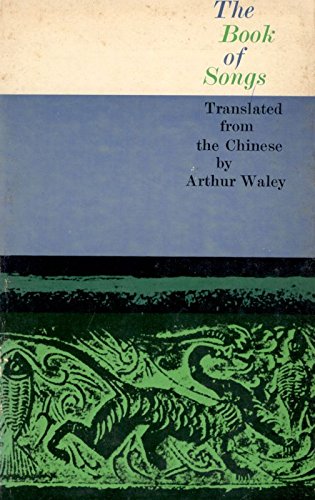
On "The Book of Songs" translated by Arthur Waley ***

This book of ancient Chinese poetry proved less interesting than earlier passages I'd read from the work had led me to believe it would be. The poetry included here definitely are song lyrics insofar as the pieces usually quite repetitive, with minor variations made in each stanza. As such, the work can be interesting. But as well as Waley does in terms of trying to provide context for the poetry through occasional introductions and frequent footnotes, much of it didn't really speak to me in our contemporary times (in fact, the footnotes often proved distracting, as they provided alternative translations or generally ruined the feel of the songs when I paid attention to them). There are poems here about serving the king, about sacrificing to the gods, about dynasties, about hunting, about farming, much of the material seeming quite remote.

The real beautiful pieces of the collection come in the first third of the book. Those are the love and marriage songs. The human heart, it seems, doesn't change, and many of the songs about losing one's loved ones seem to carry the same anguish that folks today would also serve up. I look forward to turning my attention to some more contemplative classical Chinese poets, who may well run down similar paths to these songs.


Sunday, March 28, 2021

On “Small Is Beautiful” by E. F. Schumacher *****

I have been waiting years to read this book but have never gotten around ot it. I first became familier with it through my father, when I was a child. He would talk about it quite often. In those younger days, I was enthused and amazed by technology and by anything big. My father, however, typically disagreed.

Years later, during my first quarter in college, I took a class called Engineering and Technology, which ended up being more about the intersection between environmentalism and science than about hard-core engineering. The textbook for that class was a collection of essays that had come out of a conference at which E. F. Schumacher was one of the speakers. His imprint was all over the book (along with others such as Barry Commoner and Jeremy Rifkin)--and I finally discovered what my dad had been talking about and why he believed what he believed and came to see much as he did.

My father died a few weeks ago, and one of the items I saved for myself was this book from his library. It has all his notes and highlighting in it—rather extensive for general nonfiction—so reading the book was also in some ways like reading my father's thoughts on the work, taking me back to what he was thinking when I was around eight or ten.

One thing that struck me about the work, written in the early 1970s as it was, is how economically “socialist” it is at the same time as being “Christian,” a combination that receives much less attention in the post-Reagan United States than perhaps existed before, and one that I see little of in the church I attend now, wherein free market capitalism as being identified with “God's proper way” has become rather expected. I think that sad, given that Christianity should not be politically left or right. (My dad was not one typically to link himself to one political persuasion, though in his later years, even he seemed to espouse much of the Republican right positioning, something he broke from again in the last months of his life.) Things, as far as the link between faith and politics or economics, were definitely different in the 1970s.

Schumacher is not writing a Christian book, however. He is an economist, who also happens to be a Christian and whose creed often becomes part of his reasoning—but he also draws on Eastern philosophy and Buddhism. These sort of ideas impact his thinking. The book, as a whole, is written for a lay audience, which makes it easy to read but which also makes it perhaps a bit less persuasive than it might have been with extensive graphs, charts, figures, tables, and data. As such, one comes away feeling as if one is getting the simplified version of his reasoning, which in turn makes it seem at times like perhaps his arguments lack actual substance behind them. But at about three hundred pages, that is to be expected; a hard economics book would hardly have appealed to the general audience for which Schumacher is writing.

The gist of the book is that technology should be appropriate to the purpose for which it is being created and proposed rather than being blindly pushed upon society. In this sense, Schumacher's work falls in line with lots of other technological critics (a book published where I work, Not So Fast, makes various similar arguments). Technology (and indeed economics), in other words, should serve the needs of real people rather than economic statistics. What good does a high GNP do if most people are unemployed? But if GNP is growing, most economists would classify that economy as doing well or improving. This, Schumacher says, is the wrong measure—especially for developing economies. There, technology to scale is actually going to be of more value in lifting people out of poverty. Farms don't need motorized combines that are going to do the labor of fifty workers if one hundred people need jobs; rather, the technology provided should be one that will give those people some sort of living. That is real improvement, more than the supposed gains to productivity and profit. And for a first-world power attempting to aid third-world communities, such “appropriate” technologies are often cheaper to provide.

Schumacher also spends time writing about the faux value of nuclear power, which he sees as more costly than just about any energy technology. Indeed, he sees the energy sector as a whole as being built around faux economics. The long-term cost of such technology is not taken into account when determining the profit taken. If there is no place to store nuclear waste, then it is not a technology that we want. Similarly, while oil and coal may be useful, they are not replaceable, which means that they should be used carefully and selectively. Schumacher, in other words, is making his argument from the point of view of scarcity rather than of discoverability or continuing technological advance. Conservatives, by contrast, would typically make the argument that while new oil will continue to be discovered. This latter view is the one that has, for now, been proven correct. We seem to always find more sources. The problem, however, is that at some point, we won't. At some point, it will be gone. That may be hundreds of years away, though.

Schumacher also makes the argument that small businesses are better than large ones. He sees businesses of more than 350 people as having lost their human face. Those that keep below this threshold are likely to be better citizens and better run. Larger companies are best divided into smaller divisions to take advantage of smaller size. Along with this argument is one that Schumacher makes with regard to profit—namely that the assumption that company profit is an inherent good. In this view, government (and its accompanying taxes) interfere with private enterprise, but those taxes go toward paying for capital that a company uses (such as roads). Instead, he argues, larger companies should in fact be nationalized so that the profit, gained in part of public capital, is shared with the public. This does not mean that government should run said companies but rather that there should be a kind of board that ensures such companies are fairly run for the general public good. It's an interesting argument, though one wonders how it would work in a multinational context. Schumacher's answer to that question is an unsatisfying single paragraph that equates to essentially “we'll figure it out.”

Still, Schumacher's ideas are enjoyable as being a bit out of the box. The work has had quite a bit of “influence” apparently on the world of economics, and yet I don't really see that its ideas have been widely applied. One wonders what would happen if they were.

Wednesday, March 17, 2021

On "The Portrait of an Artist as a Young Man" by James Joyce *****

At one time, I considered this my favorite book. When I look back at when that was so, I realize that I likely had lots of favorite books, rotating as I got to work after work--Dumas’s The Three Musketeers, various books by John Steinbeck (To a God Unknown, Tortilla Flat, and The Winter of Our Discontent come to mind), McInerny’s Bright Lights, Big City, Kerouac’s On the Road. Somehow, though, I put this Joyce novel at the top of the list for quite some time. Today I don’t know what book I’d put atop that list, let alone what novel at the top of the best novel list. (Joshua Ferris’s And Then We Came to the End may qualify as the best novel I’ve read in the past couple of decades, but how could I really say that it tops The Great Gatsby or The Sun Also Rises or whatever other great novels are out there.) The issue is generally that no one book fits every occasion, mood, or use. Of great short story collections/books, I’d rank Jesus’ Son as one of my favorites, but I certainly am not always in the mood to read about heroin addicts. Sometimes one wants a good plot, sometimes lyrical language, sometimes deep thoughts, sometimes new techniques or a very particular technique. As a much more widely read reader at age fifty than at age twenty, I find fewer techniques seem truly novel and so am often less easily impressed. The fact that some classic books still stand out to me may be a sign of how great those books are or of how the “first” book I read that did X or Y or Z continues, because of its personal connection to me, to hold sway over more recently read work.

Coming to Portrait twenty-five years since its last reading, I can easily see what I found so impressive about it when I was younger. It features a lot of classy technical virtuosity. The stream-of-consciousness works here without seeming too difficult to understand, and as Stephen Dedalus grows up, so too does the language used. The technique and language are something hard for me not to enjoy, even on the third or fourth pass all the way through the book (and innumerable passes through various passages). The book also gets into a lot of aesthetic discussions about art (and its relation to religion) that I would have found intriguing at the time.

Reading it now at an older age, however, I found myself having a hard time taking young Stephan terribly seriously. He seems so earnest in his thinking. The idea that art could replace religion, outside of giving one something to do with one’s life, seems silly. I found myself thinking that any such work I’d write now would make such points ironically, would poke fun at such notions--or really at nearly any serious notion at all. And I wonder how much I should actually identify Dedalus’s views with Joyce’s--could Joyce really be serious? Such is the cynicism of age and of our age.

I was also surprised by the brevity of the chapter (3) on awfulness of hell that had once seemed very long to me and somewhat less enjoyable. And I was surprised by the manner in which, in some ways, the book is slow and slow to develop. It is high modernism to be sure, and something I liked when younger. I still enjoy these modernist manifestos, but as a novel, Portrait seemed to me to be a bit too intellectually focused to be truly enjoyable to most folks looking for a good read, including these days to an extent even myself.

Saturday, March 13, 2021

On "California" by Kevin Starr ****

This fairly brief history of the state covers the beginnings of the land we have come to call California to the early 2000s. An interesting thing about reading a history of the state in which I grew up is the fact that I recognized far more history than I thought I knew. State history was covered in seventh grade; I have always wished that state history was covered again at a slightly later time when I would be prone to remember it better and when history could be discussed with slightly more nuance, so discovering that I knew the state better than I thought I did was in some ways a pleasant surprise.

Reading about the state's history also made me realize one other thing, given that I'm also reading a list of Chinese literature. It's much easier to get a grasp on new elements of history that one is already familiar with. With China, I largely feel lost in many cases. A basic history of the country, while useful and interesting, remains difficult to remember once the book is read. Here, because so much of the history was drilled into me over the years, I understand the outline of the events and can better figure out where new facts fit in.

Starr's book doesn't dwell much on the prehistory of the land--just a few pages on the geography and landscape and a few more on the Native cultures that preceded the arrival of Western settlers. In other words, Starr focuses his account on what we have written records for, and that worked well for my own interests.

Starr's overall point with the book is that California is in many ways a microcosm for the United States. The same political, cultural, and environmental issues that have so impacted the nation have played similar roles in this one state, which has come under the control of Spanish, Mexican, and American governments. One thing that I found interesting regarding the pre-American California was the degree to which the United States, as well as other powers, such as Britain and Russia, were scheming, from fairly early on, to take the area for themselves. It seemed rather inevitable, in Starr's telling, that once Mexico gained independence it would lose much of its North American territory. Such was the greed of the colonial powers.

Other passages of interest included Starr's exploration of the development of California's culture in the late 1800s. I was unaware of the extent of the bohemian movement in the state and would like to read more about that--what such people's views were and how they lived their lives during that period.

Also of interest to me was Starr's discussion of the rather contemporary development of California's politics. I was alive for much of this, and remember many of the events, but coming to them in a book, as an adult, was intriguing. I don't think I quite realized how nonidealogical many of the state's politicians were from about the 1950s to the early 1970s (even as Republicans dominated elections). Since then the state has moved toward the same sort of liberal/conservative division that has afflicted our nation, with rural areas much more conservative and urban areas, where most of the population is, more liberal.

Friday, March 5, 2021

On "The Christian Passover" by Fred Coulter *****

I pulled this book up online hoping to find out more about the origins of the Christian Eucharist and the history of how the Passover came to be transformed into it. Coulter's work, over five hundred pages, was mostly a disappointment in that regard. He refers readers to various anthropological and anti-Catholic polemics in that regard, which mostly focus not on the transformation but on the parallels between the Eucharist and various pagan rituals but never really explain how the latter became part of Christianity in a narrative sense.

The exploration of that theme is not Coulter's purpose, however. His focus is on how the Passover in the New Testament was celebrated and how the Jewish Passover transformed itself coming out of the Old Testament. In that sense, it is a fascinating read, because few other authors I've read have really explained, chronologically, how the Jewish Passover became a seder meal.

Coulter does a convincing job showing how the original Passover was celebrated on the night of Abib 14 in individual homes, throughout most of Jewish history. His contention is that the Passover was transformed into a Temple-priest-orchestrated sacrifice during the late first kingdom period of Judah, in an attempt to rid Judah of pagan traditions that had crept into the nation.

In this exploration, Coulter also shows how the at-home Passover continued into Jesus's day, even as the priestly Temple Passover had come to dominate the practice of some Jewish sects. At the same time, he shows how some Jews kept the Passover at the start of the fourteenth and some at the end, demonstrating how the biblical scriptures actually mandate the Passover at the beginning of the fourteenth. The move to the fifteenth, he contends, was caused by Hellenization and calendar/time changes, as the Jewish way of reckoning the day moved from sunset to sunset to, for a time, sunrise to sunrise, among other events.

Using this understanding, Coulter is able to document a timeline for Jesus's crucifixion and his own keeping of the Passover, at the start of the fourteenth. He also, surprisingly, shows how in the year that Jesus was killed, the Temple Passover was likely stopped before it could be completed, because of the earthquake that tore portions of the Temple apart.

One could say that the book really falls into three parts: a discussion of the Hebrew terms used with regard to the timing of the Passover; a discussion of the history and transformation of the Passover among the Jews; and a discussion of the meaning of the Passover. Appendixes go into even more detail with regard to mostly the first item.

The one thing I did not find sufficiently discussed in the book is Coulter's interpretation of Paul's term the "Lord's Supper." Coulter contends, but never really explains why he believes it to be so, that Paul was using the Lord's Supper in reference to the Jewish Old Testament Passover. Indeed, the meal Paul describes in the passage in First Corinthians could be just such a meal. However, at least in my research, I find that the term could be a reference to many different things, few of them definitive (other than a likely comparison on the part of Paul between the sacrifices pictured in such a supper). Although I'd agree with Coulter that "Lord's Supper" in reference to the Eucharist is a comparatively modern innovation--and quite likely a misinterpretation of Paul's usage--early uses of the term by later early Christian writers show it being a synonym for various fellowship meals; hence, the Old Testament Passover interpretation of the term isn't necessarily a given, the way that Coulter makes it seem. I needed more explanation for why Coulter believes that was Paul's intent with regard to the terminology.

Still, one would be hard pressed to find a more thorough book on the subject of the New Testament Passover. I much enjoyed it.

Thursday, March 4, 2021

On "The Pearlkillers" by Rachel Ingalls *****

I read this book decades ago, when I was in the twenties, at the suggestion of the manager of a bookstore where I worked. Although the manager's taste in books was good, I always remained somewhat resistant to her suggestions. I think the reason is that she was an older white lady, which gave me the feeling that she would like tasteful English women's novels. It is not--and was not--a fair stereotype. The books she recommended that I actually got around to reading proved to be extraordinary--and nothing like the dainty works I imagined she would have been into. This is one of those.

All these years after that initial read, I've kept this book on my shelf. I knew I liked it--a lot. Strangely, however, I haven't read it in the ensuing decades, and that same old prejudice has stuck with me on this one. Do I really want to read this book again? What did I see in it? However, I was taking a trip and I needed a book to read, and in my systematic way of rereading, I was on the letter I. I chose Ingalls. What had I liked about it?

Wow. This book is killer--and that quite literally. The title suggests a theme that continues through the four long stories (or novellas) that make up the work. It comes from a passage in the third story in the collection, which is about a woman who goes to meet her deceased mother's family, whom she's barely ever met. One of her aunts tells of people who when they wear beautiful pearls literally kill them--somehow sucking the vitality and life, the sheen, out of the jewel. Such is the family itself, as we come to feel and see, as the story, which has a magical realism feel, winds its way to its end, wherein the family appears to have some sort of secret to immortality, one that involves sucking the life from others.

The central idea, then, conveyed in the collection, is one of killing the people you love in order to manage your own survival. In the first story, a twice-married young woman goes on her honeymoon with her third husband, scared that somehow she is cursed with an ability to kill off lovers but also aware that she doesn't really love the man she is with.

The second story is my favorite of the book--a thriller and an absolute brute of a piece. College friends accidentally kill/bully a young man in their dorm and hide their part in the death. Years later, one of them decides to come clean. What to do? That is the heart of the discussion among the other surviving friends.

The fourth story, the longest, is also quite brutal. It tells the tale of a explorer/sailor returned to his family after a decade missing, the lone survivor of the journey. Or so we are made to believe.

Tuesday, February 23, 2021

On "Tao Te Ching" by Lao Tzu *****

This Chinese work of pithy sayings, much like other works of ancient Chinese philosophy, is difficult to summarize. That said, I much enjoyed the reading. Each chapter, consisting of only a few sentences, posed much to think about, especially as the work very heavily poses sets of seeming contradictions: the best kings obey the people; the best warriors don't fight; things like that.
The Tao, I would take from the work in general, as being "the way," and the "Te" as being a sort of life force. The general idea throughout seems to be to remain humble, to not make a show of one's self, and in that way one will reach the greatest degree of value in society. As I said, any summary by a person who lacks a real understanding of the ideas behind the work is going to seem rather silly. If I were a wise man, I would write nothing at all about it.

Thursday, February 18, 2021

On "The Shorter Columbia Anthology of Traditional Chinese Literature" edited by Victor H. Mair ****

This concise volume of Chinese literature mostly dating to pre-1800 seems like a nice introduction to someone like me who is largely unfamiliar with Chinese literature outside of a few fundamental philosophical texts. Mair also aims to present lesser known contemporary translations, most of which seemed accessible and interesting.

That said, while I enjoyed the basic introduction, I found the book's layout and structure to be less than ideal. In terms of layout and design, the introductions to each of the individual pieces are set as footnotes rather than as headnotes, making for confusing reading. Sure, it's easy enough to figure out how the layout works after the first couple of entries, but the fact that the "headnotes" were set as footnotes means that on the few occassions where an introduction to a given reading is really long, the footnote runs across several pages; one then has to turn back several pages to begin the reading. The annotative footnotes can be useful and are appropriately set at the bottom of the page, though I found as I got deeper into the anthology that I read fewer and fewer of them, as many of them weren't essential for the understanding of the work and thus interrupted my enjoyment of the text; that said, as "optional" reading for further, they certainly are nice to have.

Another complaint I had with the general set-up was the choice to split the work up by genre. This, obviously, is the volume editor's choice, and it has some advantages, such as giving one a sense of the differing genres within Chinese literature as a whole. However, the editor doesn't really use the set-up to advantage because there are no general introductions to each genre outside of the extended footnotes at the start of a given reading. I would have preferred to have read the works in wholly chronological order, which would have given me more of a sense of the developing literary output over Chinese history, be it poetry, fiction, letters, drama, philosophy, criticism, prefaces, or whatever. The genre divisions were particularly frustrating when a given author wrote within several genres (some of which were related--lyric vs. poetry; poetry criticism vs. poetry; letter to another poet vs. poetry); thus, the book splits up his (and it generally is men who are the writers) various selections across hundreds of pages, with footnotes/headnotes referencing one back to some much earlier selection for a biography and more info. One doesn't get a feel for how a given author's criticism relates to his creative output or his work in another genre as a result. As such, I felt like I didn't really get as good a sense for Chinese literature as I might have.

Individual selections I found particularly interesting included the following.

I really enjoyed the passages from the Tao te ching that were selected, and I will gladly read this work in whole later in my study (in fact, I've already started).

I also really enjoyed much of the poetry that the editor selected. The poetry, in fact, is probably the only genre of traditional Chinese literature that I can say impressed me, as the rest seemed heavily folk oriented, pat, or too culturally centered to speak to a person thoroughly ensconsed in Western culture (one chapter is devoted to jokes, few of which made much sense to me, outside of the accompanying explanations, which of course made them less than funny). Of the poetry, I enjoyed, of course, the classic poets Li Po and Tu Fu. I also really liked the selections from the Book of Songs and hope to read more of that work down the road. What I came away with in regard to the poetry specifically was an understanding of how human feelings really cross time and space; many of the works seemed quite modern in terms of the issues the poets were dealing with, and yet the poems are often thousands of years old.

Li Shang-yin's Miscellany was a particularly interesting selection. Though not a poem in the anthology (it is in the genre Miscellany, because it is a list), the work is a set of lists on various topics that might as well be poetry, given how interesting most of the lists are--what is shameful, what is not to be despised, what is unlucky, and so on, more than forty lists in all.

In the novels section, I really enjoyed the passage from Ts'ao Hsueh-chin's Dream of Red Towers (more commonly known as Dream of the Red Chamber), which I'll likely given a full read of at a later time.

One nice thing about reading an anthology such as this is that I was able to read in a few genres, such as drama, that I'll likely not otherwise explore as I begin selecting invidual longer works to read. That's, of course, one reason I chose to read an anthology early on in my Chinese reading list and why I'll likely read the companion volume of modern Chinese literature sometime soon as well.

Tuesday, February 9, 2021

On "An Education in Georgia" by Calvin Trillin ****

Part of a campus read at UGA this month, this work recounts the integration of the university largely from the point of view of the two first African American students to attend--Charlayne Hunter, Hamilton Holmes, and Margaret Early. Each represent different tacts and backgrounds taken in the fight for equal rights, and each experienced the events in different ways reflective of those tacts and backgrounds.

Early was a graduate student, so her experience was in some ways different from that of Hunger and Holmes, who tend to get more attention in the book (and, I find, in general). Hunter and Holmes went to the same high school, and both started off college somewhere else because of bogus rejections from UGA--Hunter went to Wayne State, Holmes to Morehouse.

Once accepted at UGA, Hunter lived on campus, while Holmes lived at a family's house. Holmes came from a family who had long been part of the civil rights movement, and his decision to apply and attend seemed a much more conscious (and family motivated) choice with regard to furthering that agenda. Hunter largely stayed on campus, while Holmes went home to Atlanta each weekend. Holmes took his studies very seriously; Hunter did not seem as focused on study. As such, Holmes excelled at the school but had a much less social experience; Hunter became more integrated into the university's social fabric, such as she could (some students and most faculty appear to have treated her well, but those same students at times had to step away from friendships because of threats and pressure from their other white friends).

Attending the university launched both Hunter and Holmes into their eventual professional fields. Holmes notes that while he did not enjoy his UGA years, his attendance allowed him the opportunity to attend Emory Medical School, which would not have been the case had he stayed on at Morehouse. Hunter would go on to become a renowned journalist, which is how I knew of her growing up in California, as she was often on PBS. Hunter's experience, as portrayed in the book, seems to be more about just trying to be a full-fledged person rather than an emblem of civil rights, though the two go hand in hand, since being treated equal as a person was the goal of civil rights movement. At the end of the book, for example, we learn that she married a white guy, something that she didn't want played up in media--this was her life, her love, her relationship, not something to be strutted out for some political end. And yet, it's impossible to separate the two when forces from outside raise the issue.

Some of the most interesting parts of the book to me had to do with the other Black students, the ones who came slightly later. This is a point Holmes makes very strongly at a presentation he gives later: that if others don't come, his and Hunter's and Early's efforts are wasted, as they become mere tokens. And indeed, as Trillin brings out, few tried to follow up, at least in those early years. Those who did included some younger female coeds who were pushed into Hunter's room on campus--indeed, all the Black girls were pushed to live together and thus separately from other students. More interesting was the story of one young man who opted to live in the dorm, who took part in various extracurricular activities, and who began attending a white church in town. He seemed determined to live the typical college life--to some success and, as the book shows, to a degree of failure to. His is a story that I would like to hear about in more detail, but being sixth or so in the set of names of early integrators, he is not the focus of most people's attention.

Sunday, February 7, 2021

On "The Millennial Hope" by Shirley Jackson Case ***

Case follows the history of millennial thinking from the ancients to her contemporary times in the early twentieth century. She does this not just for Judeo-Christian thought, with which millennialism is most associated, but for ancient non-Jewish cultures as well. It is this latter exploration that is perhaps the most interesting portion of her book.

In terming non-Jewish beliefs "millennialism," Case is stretching the term a bit. What's she's really exploring is end--of-the-world ideas and apocalyptalism, though millennialism--the idea that some kind of one-thousand-year reign of peace on earth--certainly had correspondence among some non-Jewish peoples. Egyptians, Babylonians, and Persians all had their counterpart ideas regarding a Messiah-like figure, mediator, or god who would somehow bring about new hope and/or judgment of the forces of darkness. The Greeks had a tendency to view the world as constantly growing more evil. Romans viewed world history as happening in cycles, from decadence to order and back again, with the Augustine age being one in which order was at the ascendant.

Case next covers Jewish ideas, before crossing over to Christian. The ideas of Messiah among the Jews of the first century are well covered elsewhere, so Case's exploration didn't particularly anything new to me. Early Christianity fit well within these ideas of a Messiah to appear and then reappear, one that proved to be shockingly disappointing to many when that return of the Messiah did not come within the first generation of believers' lifetime. With time, messianisim and millennialism faded among Christians to a heavier emphasis on individual salvation and spiritual rewards rather than a physical kingdom--the subject of the first part of Case's next chapter. The rest of that chapter focuses on millennial movements through time, including in the Middle Ages and 1800s. The historical summary here is just that--and thus not wholly satisfying.

But Case has another point in exploring her topic, and that is largely to argue that such world views are actually destructive to human endeavors to bring about a better world. After all, if we believe that the world is to be brought to a devastating end by forces beyond our control, prophetic ones that are fated long ago, then there is little reason for us as a human race to change our ways and to strive for a better society. There is some merit to such an argument, one that fits well with the fears and arguments over climate change today; at the same time, espousing a hope beyond ourselves is perhaps the only hope there is--but it should not preclude our doing the best that we can. Unfortunately, for many, such fatalism is exactly the excuse that is used to posit doing nothing--or even helping to bring on terrible events (as we might think of various religious adherents who actually try to spark conflict in order to, in their view, force God's hand).

On "The Stromata" by Clement of Alexandria **

I decided to follow up reading by Justin Martyr, Ignatius of Antioch, and Irenaeus of Lyons, with this work by Clement, another long book that is exactly what its translated title suggests it is: miscellanies. As such, the work does not easily hold ones interest for long periods, though certainly it does a good job of showing some of the development of Christian thinking among those in Egypt in the late second century. (I am somewhat amazed as what remains from this period before printing--that folks felt a desire to write copies of this out to preserve it, given its length and lack of through-line.)

Clement spends much of the work referencing Greek and Roman philosophy, in addition to various biblical passages. The latter, he sometimes engages with by offering analogies to show how a given biblical idea fits within a moral concept of Christians (e.g., clean and unclean meats as symbolic of different kinds of thinking). The former, he spends much time referencing as inferior to Christian thinking, as antithetical to it, and as a predescessor to it. Through philosophy, Clement claims at some points, God brought Gentiles to a knowledge of the truth and of Jesus, just as through scriptures were Jews brought to such knowledge. But being a miscellany, Clement's views differ from section to section and purpose to purpose.

Book 8, being the most freshly on my mind, shows something of how Clement's thinking was in many ways more philosophically disposed than biblically. That book focuses not on anything religious but on ideas about symbology, writing, words, and names--how language came to exist as it does.


Saturday, January 2, 2021

On "Resurrection" by Kevin J. Madigan and Jon D. Levenson ****

In this very readable summary of the history of the concept of resurrection in Jewish history--and eventually in that very early Christian history--Madigan and Levenson do much to defend the Jewish roots of the idea. Ehrman's Heaven and Hell makes much use of the idea that early Jewish faith that early Jewish thinkers thought of resurrection mostly on a national restoration level rather than on that of a personal level. That idea is present in this book as well, but Madigan and Levenson do much to show how this concept was still tied in to later more personal ideas and how the rabbis were able to easily interpret passages from the Torah in such a way.

The gist of the argument is that eternal life--like one's identity--in the ancient Jewish belief system was tied to one's genetic descendents, one's family. One lived on through them--and through one's name (through one's descendents). Eventually, once there was a nation of Israel, this was extended to that nation--and the idea of national restoration. This is the emphasis of resurrection passages in scriptures like those of Ezekiel 37.

That said, even with emphasizing nation and family, there's something of a hint of what would later be made explicit in Daniel and in various works written during the second temple era. The promises of an enduring name offered to families are offered also to people like eunuchs, who obviously have no hope that their name won't be expunged. Likewise, ideas of God being a giver of life began to be extended to a giver of eternal life--if he could create life, why could he not restore it? Tales of restoration of physical life became types for restoration of human life in general.

This Jewish belief was passed along to Christians, who took it up in their cause with regard to Jesus and eventually all Christians. What changed, however, in the years following was Judaism's interaction with Greek philosophy (and though not covered in the book, Christianity's as well). Eternal life was not a given in ideas about resurrection; the Greeks, however, believed in an immortal soul apart from the body. Eventually, this belief, in a soul apart from the body rather than with the body, would work its way into Judaism, and then the idea that that soul was eternal. As such, old ideas about resurrection would begin to fall by the wayside in medieval times, and current systems of belief among Jewish religious authorities often leave the belief regarding the ultimate reward of believers to believers themselves.


Tuesday, December 22, 2020

On "The Analects of Confucius" ***

I chose to read the James Legge translation available at Project Gutenberg. This is not the best version of The Analects, as became readily apparent in my reading. Other versions, some available online, offer substantial commentary, which is almost essential if one wants to grasp all that is being said. There are heavy references to various ancient Chinese figures and historical incidents, such that without the commentary, one often doesn't really understand what is being said.

For an overall "feel" of what The Analects are like, however, Legge's work will suffice. The work isn't so much first person as it is a series of short chapters in which various Chinese figures come to the Master (or sometimes others) for advice about a given situation. The Master then dispenses his wisdom. It is the dispensation of wisdom that, in many cases, resembles a collection of aphorisms: "A wise man is . . . ; a fool is . . ." and so on. The early books focus most especially on filial duty, while the later ones focus more and more on government. These two ideas, however, are related. Much emphasis is given to being a person of high moral values.

One particular little anecdote/piece of advice really struck me in the book. Confucius notes, at one point, that if one knows that a particular action/life course will lead to great wealth, one should pursue it with one's all, but since one is never assured that wealth is at the end of a course of action, one should instead pursue what brings joy. It's another way of saying, do what you love, and the money will follow, I suppose, but I hadn't ever quite seen it put this way. We don't control the future, so we should think of the present when setting goals. There is no point to pursuing riches that may or may not come if we don't enjoy what we do in the here and now, as the latter is all we can really be assured of.

Wednesday, December 16, 2020

On "Resurrection of the Dead in Early Judaism, 200 BCE-CE 200" by C. D. Elledge ***

This book traces the history of theories regarding resurrection within Judaism shortly before and after Jesus's time. As Elledge notes in his introduction, resurrection was an idea largely unique to the Jewish people. However, his main point seems to be that resurrection was neither fully embraced nor fully defined by the Jewish people during this period, during which such thinking largely took hold.

With regard to the definition of resurrection, there are numerous ways to think about what it entails. Here are some possibilities: (1) It is a resurrection to a physical body from a state of "soul sleep." (2) It is a resurrection to a transformed (spiritual) body from a state of unconsciousness. (3) It is a resurrection to spirit, sans body. (4) It is a resurrection from a middle state of semiconciousness to full consciousness again. (5) It is a reuniting of the physical body with the eternal soul. (6) It is only for a few of the very righteous. (7) It is only for the righteous, with those who are evil remaining dead or in a semiconscious state. (8) It is for everyone, for judgment, with those who are evil being sent to further punishment. Elledge passes through various early Jewish writings to show how all of these are possibilities depending on which work you focus on. In other words, he shows that there was not full unity with regard to what resurrection meant or entailed. He also shows how some accepted mere death as the end all and be all for all and others accepted the idea of an immortal soul.

Elledge also delves into various theories regarding the origins of the belief, including that it came from Persian Zoroastrainsim, that it came from Babylonian and Assyrian mythologies, and that it developed natively within the Jewish community. (Early Jewish teaching emphasizes "immortality" through one's descendants.) He discusses why the theory likely found acceptance--that it tied into concepts regarding creation and regarding the need for justice. Next, he focuses on resurrection in specific works, before closing out with a discussion of where Josephus got his ideas with regard to the differing sects' beliefs on resurrection and how the varying beliefs came to affect Jewish rabbinical views and Christians toward the end of the period discussed. With regard to Josephus, Elledge notes that he was likely simplifying and "translating" said belief for others, putting it into terminology that Greeks and Romans would understand, which while presenting a truth necessarily loses some degree of precision in said translation.

Although a fine overview, the work is definitely a scholarly one--detailed and difficult in places.


Friday, November 27, 2020

On "China" by Harold M. Tanner ****

This basic history of China lays out the political and cultural history of this huge nation that I know little about. It's strange in a way, how much more I've read about Japan and how much more I feel I know its culture (even before I did a Japanese reading list, I had read many works by Japanese writers, whereas I've read virtually no Chinese literature). That isn't to say that I know Japan well. As with China's history, the history of Japan is one I've read on multiple occassions and have quickly forgotten outside of the twentieth century. I don't know why that is exactly, but I suspect that there are various reasons: (1) Western history is drummed into us in school growing up, while the history of the East is only touched on; and (2) the history that most touches on us and our world directly is the one that we remember best--hence, why I can remember twentieth-century history in addition to that of the West but not so much the East.

One thing Tanner does a good job of in terms of setting up his account is denoting how multicultural China really is. We tend to think of the nation as a single people, but in fact, while the Han dominate the country, there are many other ethnic groups who have been integrated into the nation--and that over centuries: Monguls, Manchus, Tibetans, Urghars, Turks, and so on. Tanner does a good job of showing how many of these ethnic groups have dominated the nation at one time or another--and how they are different from one another.

In a sense, Chinese history until the twentieth century is fairly repetitive. It is a tale of the rise and fall of various monarchies, usually with periods of destablization and disunity between said monarchies. An epigraph about one-third of the way into the book sums up the first third of the work (and arguably sets up the pattern for the next third of the work):

"They say the momentum of history was ever thus: The empire, long divided, must unite; long united, must divide. Thus the House of Zhou reached its end and the empire as partitioned into save warring kingdoms. Thus these seven were absorbed into the House of Qui. Then Han and Cho destroyed Qin and waged war on each other until the empire was reunited under the House of Han, reinvigorated by Guangwudi and passed down the generations to Xiandi, the last of the Han, after whose generation the land was partitioned into three kingdoms."

After these would come the Sui, Tang, Song, Yuan, Ming, and Qing dynasties, with a similar pattern as noted. The Mongols would rule China under the Yuan dynasty, the Mings under the Ming dynasty, the Manchus under the Qing. Each conquering peoples would, in fact, often take on various Chinese customs in order to better fit in with the peoples and the former noble classes, including most especially Confucianism and to a lesser extent Taoism. The Mongols included a number of Nestorian Christians. Indeed, while religion was very much a background item in this book, I would be curious to know more about some of the religions that less associated with China in the present day, like Eastern Christianity and Islam, because they clearly had their adherents at one time in the land.

Things change quite a bit in the nineteenth and twentieth centuries. The weakness of the later Qing dynasty meant that the country was in large part ruled over by local warlords whose in-fighting left the door open for manipulation by colonial Western powers, who established areas of control over commerce and the subjugation, in many ways, of the Chinese nation. China moved during this stage toward the establishment of a republic, but the inability of political leaders to bring the nation into true unity and to throw off Western powers left open the door for a growing Communist movement (which itself had been part of the movement toward the Republic). Consigned to the rural areas, Mao Zedong and others built a loyal following that eventually established political dominance and the eventual of exile of the republic to the island of Taiwan. Most of the political moves during this time were to a large extent motivated by a desire to reestablish Chinese hegemony over its own territory, and the Communist movement essentially succeeded.

After pushing landlords out of much of their property, the Communists forged various programs to encourage economic growth of the country. Communal farms were given quotas of various sorts and people rewarded for them. Excess production was allowed to be sold on the market by individuals, which led to further growth. But there were also various problems that centralization created. Rosy but inaccurate reports from locals regarding production eventually led famine.

The Communist Party largely dissuaded people from dissenting with the powers that be, except again for brief periods when moderate criticism and openness was encouraged. Those who participated in such, however, usually rued the day for expressing such opinions, for when the dissent grew too intense, the Communist Party would change tactics, closing off free expression and cracking down on those who had previously expressed dissatisfaction (even though they were doing so with government approval and support, as a means to improve the system). A particular intense period of such crackdown was the Cultural Revolution, wherein various young peoples forged the Red Guard who in turn accused many of turning on the State. Like our own "Red Scare" of the 1960s, but with consequences that were even more deadly, the crackdown got out of hand, as people began to turn one another in so as to avoid being turned in themselves even as no one had in fact engaged in nefarious activity or thought.

Economic liberalization, which had kept moderately under wraps under Mao Zedong, took on a fiercer pace after his passing. China encouraged foreign investment and reaped the rewards with larger, more modern cities (Shanghai went from having one building over twenty stories tall to having over one hundred in a span of something like twenty years)--but also with growing economic disparity.

I read this book in part as a precursor to a Chinese reading list I am finally starting on. The sections on culture, in that sense, will be very useful. Writers and works I will want to consider for the list (if I can find them) are as follows:

I Ching [already read]
Dao De Jing
Sun Tzu, Art of War [already read]
Confucious, Analects
Daniel K. Gardner, The Four Books (Analects, Mencius, Doctrine of the Mean, and Great Learning)
Wu-chi Liu and Iring Yucheng Lo, Sunflower Splendor: Three Thousand Years of Chinese Poetry
Victor H. Mair, The Columbia History of Chinese Literature
Mengzi (Menchius), Mengzi
John Minford and Joseph D. S. Lau, Classical Chinese Literature
Wai-lim Yip, Chinese Poetry
Book of Songs/Classics of Poetry
Li Bo (poet)
Tu Fu (poet)
Shi Nalan, Water Margin
Luo Guanzhong, Romance of the Three Kingdoms
Wu Cheng'en, Journey to the West
Cao Xueqin, Dream of the Red Chamber
Xiaoxiao Sheng, Jin Ping Mei
Bai Hua, Bitter Love
Wang Shuo (contemporary novelist)

On Chinese literary history, I might try Herbert Giles's 1901 History of Chinese Literature.

Saturday, November 21, 2020

On "Truth Triumphant" by Benjamin George Wilkinson ****

One might call this an alternative history of Christianity. Wilkinson was, so far as I am aware, a Seventh Day Adventist. Thus, he routes the history of Christianity through Sabbath-keeping groups across time, arguing essentially that Protestantism has its foundation not so much in the Reformation of the Roman Catholic Church as in those surviving sects from the early church that continued to observe the seventh-day Sabbath, most particularly the Church of the East. Inspired by such sects and making their move based on the teachings from such sects, Luther and others brought schism to Rome.

Wilkinson grounds his argument in Biblical prophecy, seeing the "1260 days" of Daniel and Revelation as being symbolic of 1260 years in which the church would be in the wilderness, which he dates from around 538, when Justinian unified church and state, to the Reformation and, more precisely, Napoleon's eventual takeover of the Italian peninsula and the religious freedom that that brought to the peoples of Europe in 1798. The prophetic elements make up the first and last chapters of the twenty-four chapters in the book, which means that they don't take up that much space, which is good, since one could likely argue quite a few things with regard to what the 1260 days of the Bible refer to. My interest was more in the history.

What I really enjoyed about the book is that Wilkinson pulls in a lot of sources with which I was not otherwise terribly familiar. Most studies I've read about church history focus on the West, and generally they follow a pretty straight line through Rome, ignoring many of the "heretical" sects that continued to exist long after Christianity was institutionalized within the realm of the Papacy. Beyond that is the Church of the East, which had a much different history, much of which has either not been studied as extensively (since the languages of such people are non-Western) or has been expunged in the course of time with the spread of Papal teachings further to the East.

But there disadvantages to Wilkinson's study as well. Much of his case with regard to the history of the Church of the East is based on the idea that the Christians in the East, though not necessarily Nestorians (a particular heretical sect), were generally called such, no matter their actual beliefs. While this is probably the case, given that often our understandings of the doctrines of particular peoples are not terribly complete and given that doctrines change over time such that a certain type of Christian in once century is not nearly the same type centuries later, even though they might share a secterian name. But there is also a level on which one has to be careful in making such claims, and often, it seemed to me that Wilkinson made claims that were a bit more than what other scholarship and what the primary sources actually attest to. Lucian of Antioch, for example, plays a large role in Wilkinson's work, and of course, Lucian was important. His own Bible translation was based on a different kind of translation theory and was into a language other than Greek, and it would form the foundation for much of the work of the Church of the East. But what Lucian actually believed is, so far as what I have read elsewhere, largely conjecture. He didn't leave other writings behind. In Wilkinson's work, Lucian becomes a non-allegorist, as opposed to the kind of scriptural readings occurring in Alexandria and Rome. That is one interpretation offered by scholars; here, that is the only one offered, which means one gets a sort of twisted picture of Lucian and whoever Wilkinson connects to him, which in turn draws into question the accuracy of his others observations (many of which, in the footnotes, are backed up merely by cross-references to chapters within his own book rather than outside sources).

But that qualm I have is balanced against the many sources that Wilkinson has drawn on and his focus on areas less written about. It's a fantastic foundation for further study. The work can be found online here.

Sunday, October 25, 2020

On "Heaven and Hell" by Bart D. Ehrman ****

The latest from Ehrman explores ancient concepts of the afterlife, ultimately showing how our contemporary mainstream Christian concepts of heaven and hell were not shared by Christians of Jesus's generation. Ehrman does most of this work by summarizing ancient texts and then trying to draw conclusions from there; as he notes, this is a somewhat problematic system but is what we are essentially limited to. The common men didn't leave behind written records other than gravesites, and telling what a person believed regarding the afterlife is very difficult from the pithy statements left behind as epitaphs.

Ehrman spends most of his time among the Greeks and the Jews, with a bit thrown in from the Babylonians--but little time with the Egyptians, which is something of a shame, since their own views had such an impact on later Greek ideas. As Ehrman notes, among the early Greeks, concepts of the afterlife were hazy and generally unappealing. Unless you were some sort of hero who went on to reign in the world of the dead, you were likely to become a mere shadow, a sort-of half-conscious/half-existent being, which left questions as to what exactly the heroes among the dead ruled over. The philosophers had their own views, including that of Socrates, who thought that there either was no afterlife or that if there was one, it was most excellent. Either way, death was not to be feared, for we had no pain or sorrow before life and thus will feel none after either way. As time went on, Plato, via various Eastern cultures, adopted views that included an immortal soul and various rewards and punishments that went with a good life or a bad one. All came from the One, in Plato's view, and all were headed back there--as one moved closer in viewpoint to that First Cause through proper living and thought.

Among the Jews, in Ehrman's interpretation, there was concern only with national restoration, which resulted in the concept of a resurrection. But the scriptures focus on that resurrection as a way of restoring God's nation, more than on individuals. In time, however, the concerns with national restoration and the nation's resurrection became individualized such that there came to be a view that there was a resurrection and a judgment for individuals. (I am not completely swayed by Ehrman's view that resurrection was solely a national prospect in the early-going, but certainly I'd agree that the emphasis was on the nation rather than the individual.) PUnishment was generally simply not being resurrected or being destroyed for all time--burned up.

By Jesus's day, the individualized view of the resurrection and judgment was a common Jewish viewpoint, though there were others--no afterlife (common among the Sadducees) or immortal soul (common among the Essenes).

Early Christians emphasized a resurrection to life on Earth (sometimes in the flesh, sometimes as something bodily but somehow more than flesh), according to Ehrman, as part of the idea that Jesus would be returning soon and establishing his Kingdom. As this did not happen on the quick time scale people expected, other theories began to predominate, including an idea that the soul would be taken to heaven to await unifying with the body at the last judgment and Jesus's return or the idea that the body would be done away with completely. Punishment for an evil life moved from being eternal death to being eternal punishment. Likewise, in time, some Christians began to believe that there was likely some kind of intermediate state, or even a set of Platonic reincarnations, to purify those who had not been that evil (or even though who had been evil) so that all would have a chance at eternal bliss.

It is this last section of Ehrman's book that I found somewhat disappointing. After setting up his discussion so well with regard to what ancients believed regarding the afterlife and what people of Jesus's day believed, he pretty much wraps up the book, paying scant attention to how we get to the views so many Christians have today. To be sure, such views vary widely, as Ehrman notes--not everyone believes in Purgatory, for example. But in leaving out the chronological development of thought after the first century, we don't get a very clear sense of just how and when certain views came to predominate. As a history of the afterlife, the book could have easily continued into the Middle Ages to give a clearer sense of how we end up with the views that are so common today.

Tuesday, September 29, 2020

On "The Road to Los Angeles" by John Fante ****


I last read this book in my early twenties, during a Fante fix, when I first discovered him. Alas, outside of Ask the Dust and one of the novellas in West of Rome, his work proved disappointing to me, but three very good works is not a bad record really, in the scheme of of things.

Not much matches Ask the Dust for quality. This work, though, keeps much of what maked that book intriguing. It is another book in the Arturo Bandini saga, but unlike the two of the four, it keeps the narrative voice of Ask the Dust pretty firmly in place (if perhaps with less balance than that one). None of the Bandini novels are particularly consistent among each other with regard to the facts of Bandini's life. In Ask the Dust, Bandini's mom and dad are in Colorado, and he's alone and twenty in Los Angeles. In this book, his father is dead, and his mom and sister live near the beach on the California coast. But as with Ask the Dust, the narrator here is exceptionally bombastic. Everything is superb or awful to the utmost extreme. There is little middle ground with Bandini. And as in Ask the Dust, the narrator is a misogynist and a racist--here, even more disturbingly. He kills animals in cruel and purposeless ways for fun. One can kind of like the characters in Ask the Dust; it's much more difficult to like them in this book--but most especially Bandini.

The main character is a high-school dropout who on some level supports the family. One could feel for such a person whose life has been placed into one of sacrifice for future chances because of his father's death. He works dead-end jobs (cannery work is the central job in this book and is well described). There's a certain intelligence that seems to be going to waste.

And yet, Bandini is also a scoundrel. He steals from his family. He is a slacker at any job he takes and usually quickly loses. He claims to be a writer, but it's clear that he has little talent. He is disrespectful to all and deliberately hurtful. He gloms on to philosophy without really understanding it, the same way that he uses big words for the sake of using big words (sometimes not completely accurately). We see within him a certain maniacal will to power and faith in himself (countered with occasional self-hatred). He is not someone you would want to be friends with.

The empty bravado reminds me a lot of Holden Caulfield. What we really see is a boy who is forced too early to be a man--but who is ultimately still a boy. As his writing is immature, so is he. 

Wednesday, September 23, 2020

On "Ask the Dust" by John Fante *****

I read this book multiple times in my early twenties, but it has been probably more than a decade since the last time that I read it. I remember loving the book, though on the last read, being disappointed by its second half. This time around, I didn't find the second half as disappointing, though clearly the best portions of the book are in its early-going.

What makes this book so utterly enchanting is Fante's use of language. Although he writes simply, he does so in a way that is poetic, even without being luscious in his description. The simple turns of phrase and occasional perfectly placed metaphors do the trick. And he knows it, as evidenced in a passage early on. The book centers around a writer named Arturo Bandini and his love of Camilla Lopez/Lombard. In one passage shortly after he first sees Camilla, Arturo begins an excited oratory to her: Oh, Camilla, you . . . but he abruptly quits with these simple words: "but not here." It's inappropriate, Bandini/Fante seems to be saying to begin with such praise. We don't even know the gal--and what's more, to do so would actually break down how much we understand Bandini's connection to her.

Another thing that makes the book so engaging is Bandini's sense of confidence in his own skill as writer. He is hubristic to the extreme--so cocky that it's funny, so cocky it's hard to believe he's serious. In addition, that cockiness spills over to equal moments of despair. Bandini is a man of extreme emotions.

Finally, there is the dialogue, which consists of constant punches between the performers, most especially Camilla and Arturo. There is not a lot of lover speak here; instead, each line spoken is a surprise, insult after insult, and yet, somehow, beneath it, longing.

Of course, that longing is more on Arturo's end than Camilla's. Camilla is in love with another man--Sammy--a man who unlike Arturo plainly cannot write, even though he wants to.

On this read, one thing that stood out very much to me was Fante's interest in what constitutes an American. Both Arturo and Camilla talk of being American but also denigrate each other as not so, most especially because they are not Anglo. Both want desperately to fit into that narrow definition of American but push each other (and others) down in that effort. Were I writing a paper, I'd likely look at the theme more closely and draw some conclusions, but that is not my place here.

Near the end, Arturo and Camilla reach a sort of understanding that softens their relationship, as Camilla becomes addicted to marijuana and goes crazy (the extremity of this addiction and insanity seems a bit unrealistic given what is known of the drug now), and that certainly makes the writing less compelling (now come those Oh, Camilla! lines that were put off earlier), but that section of the book is relatively short and fits well the work's overall arch.


Monday, September 14, 2020

On "The Death of WCW" by R. D. Reynolds and Bryan Alvarez ****

I didn't care for professional "wrestling" when I was a teen or young adult, when it was on television from time to time, preempting programming I actually did want to watch. I didn't like the violence, the production values, the stupidity. And I don't think I'd care for it now. But I read a book about it.

One thing changed between then and now. Back about fifteen years ago, I went to see a wrestling event in a tiny town, a small event, with maybe one hundred in the audience. It was a hoot. But I also came to respect what the men who work as wrestlers do. Yes, of course, it's fake (only youngsters would think it might not be), but there is a great amount of athleticism involved for most of the wrestlers. These guys are gymnasts, acrobatics, and stuntmen. They learn how to properly fall, how to fake being hit and fake hit, and more than that, they learn how to flip and jump and perform a number of other tasks that high school gym taught me just how difficult such things were to do. And if you don't take things to seriously, a lot of sketches can be pretty funny. That doesn't mean I'd want to watch it on TV--or become a regular at the arena, but in a small venue where many of the guys are just learning, yeah, it's worth the price of admission.

This book is about the big boys, the ones on television, mostly specifically in the late 1990s and early 2000s, in an era when WCW (World Championship Wrestling) was in high competition with the WFF (the World Wrestling Federation--now World Wrestling Entertainment). The latter had some big stars, but WCW, purchased by Ted Turner, as it was a mainstay of his TV empire, threw cash at some big players and brought them over to itself.

But WCW didn't just have the new guys wrestle. It created a storyline in which a new set of wrestlers--the New World Order--was coming to set the WCW right, whipping up on all the WCW stars. This put the wCW in control of the ratings game, as WFF and WCW competed against each other on Monday nights. So successful was the WCW that it expanded its show an hour and also had shows on Saturday and Thursday nights in addition to its regular Monday night slot.

But the success was not to last. Wrestlers get old. And as many of the stars had creative control written into their contracts, they didn't want to lose. That meant there was no room to craft new stars among young guys coming up, which meant that like a really successful pro-sports team that doesn't have young guys waiting in the wings to take over when one generation passes, the WCW's ratings began to fade. And that's when desperation set in in terms of storylines that were nonsensical, such that audiences began to fade, and the WWF retook its dominant role.

In the meantime, Turner sold to Warner Brothers, which in turn merged with AOL, which meant that money guys came to make the decisions, money guys who didn't appreciate how wrestling had helped build Turner's TV stations and how wrestling's audiences waxed and waned. Beyond that, wrestling wasn't good on advertising dollars, even when successful in the ratings, as sponsors tended to take the view that only poor folk watched such stuff. And so it was the WCW, with its TV contract cancelled and running at massive debts, found itself without much of an audience.

In the end, it was sold to the WWF, which, as the authors bring out, squandered its chance for a ratings coup, given how many viewers had wanted to see various WCW stars fight WWF stars. Instead, the WWF essentially reaped vengeance on the WCW wrestlers who came over, writing total domination into the shows and taking on mostly second-tier stars rather than the more expensive ones.

The book, in essence then, is about how to create and squander a TV audience. In between, the authors spend a lot more time talking about the details of this or that episode and its ratings, which, while written with a good deal of jokes and winks, at times becomes cumbersome to a nonfan.