Being a successful writer, it seems at times, is simply about catching the next wave--or rather, being the first to get there. That's the schtick in this short piece, which dashes out several ideas that inevitably seem to have already been tried. I don't know if there really are any new ideas. Read the story here at Lowestoft Chronicle.
Sunday, September 25, 2016
On "Great Streets" by Allan B. Jacobs *****
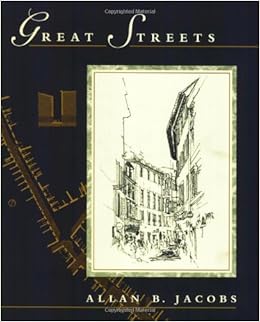
Jacobs is interested in why some streets are better than others--why we return to certain streets more than others regardless of what's on them. The issue, of course, in trying to define such things is that a street's greatness is always defined within a context. What exactly does a person need the street for? That's going to make a large difference in the definition of "great street."
Jacobs, thus, lays out several criteria. Great streets do the follow:
1. Great streets contribute to (a feeling of) community.
2. Great streets are safe and comfortable.
3. Great streets encourage participation.
4. Great streets are memorable.
5. Great streets are representative.
I can see the object of points 1-4, though I'm a bit less taken in by point 5. But definition really does affect our criteria here. A highway can be a great street in terms of its function when it works well, but that is not the kind of street Jacobs is talking of here--a street that is only really meant to be a conduit for getting us from one place to the other in the quickest and most direct way. Jacobs is talking more about streets in which people linger--or want to.
After the initial criteria is laid out, he begins discussing specific streets--a short residential street in Pittsburgh that has very dense population and nothing by street parking; a few streets going back to medieval times, with their attendant winding and narrowing and widening; wide boulevards with trees and separate parklike areas for pedestrians, the Grand Canal of Venice.
Jacobs makes me contemplate what I would consider a great street--among places I've visited or lived. In terms of large boulevards, I am reminded of the Beacon Hill area of Boston, where I stayed for a week, with its occasional street-level businesses, its three or so stories of dense living space, its wide sidewalk, its park running down the center, and its termination at the Commons. It was a wonderful street. Is it a street that would foster community or participation? That, I can't say, not having lived there.
The streets I most remember in towns where I've lived, I find, tend to have been those in downtown areas--it's really the downtown that I remember, more than the street. For me, a great street is an area conducive to walking--great sidewalk, lots to look at and see, many people around. In Pasadena, most of the major shopping areas are located on Colorado or Lake, meaning that these are the streets I most walked on and that I focus on when thinking of great streets. But sidewalks were almost everywhere, so the town was really conducive to walking no matter what street one was on. Colorado and Lake, however, offered the most in terms of people milling around. Lake died after six p.m., however, meaning that Colorado (and specifically the Old Pasadena section of it) was really the only one for people watching at night. What made this road successful, however, was that there was a nightlife. At the time in which I was growing up, the Hastings Ranch area, which is essentially a large strip mall (parking lots surrounding various outdoor shops and eateries), was not pretty, but it was actually a place where one could venture for an evening and leave the car mostly behind--there were theaters, a bowling alley, lots of restaurants, and some shopping. I would not describe the streets around these places as great, however. Why not? Perhaps because the streets themselves were merely byways--ways to get to the parking lot. Businesses did not abut the streets. And yet, not too far from where I grew up was Washington, which in parts have such abutting buildings and quite a few businesses. Really, it has potential to be charming, but there were few pedestrians and traffic whizzed by as if on a highway. I think ultimately it is that people make for a great street.
In Oxford, Mississippi, walking was more difficult. Some older streets made for a pleasant ambiance, but they were short, the town small. Mostly, it was the downtown square and its few immediate blocks around it that I remember most. In Fort Worth, again, the downtown Sundance Square is most memorable. The streets in other parts of downtown (south and east) should have been memorable--they had the same makings of those near the "square" (which was mostly just a parking lot)--but fewer pedestrians ventured out to those parts of downtown, especially at night. In Athens, Georgia, it is again downtown that is most memorable. That said, for walking, I used to like Lumpkin, Milledge, and Prince, when I lived closer to those areas. They featured occasional pedestrians as well, and old buildings, most of which were not set back from the street by parking lots (though quite a few might have yards or gardens of a sort). And what made these streets special? In part, it was the possibility of seeing or meeting someone I know. It was the feeling of neighborliness.
Even among residential areas, the ones I like best are great for walking, but even more for watching. The street I grew up on had wonderful sidewalks, and some large porches. It had the makings of a good street, but again, few walked it. Those porches sat sadly empty virtually all the time. Compare this to Adams Street in Oxford, which also featured some large porches but which, being close to downtown, featured more pedestrians--people greeted each other from the porch. It too had the makings of a good street, but it lacked a sidewalk, which meant that people could not linger. In fact, few residential neighborhoods really feature many people milling around. And in a way, that too is right--in context. I mean, when I go home, part of me wants to be alone, with my family. Part of me. Part of me likes that constant possibility of social interaction. It depends on my mood.
But as far as defining great streets, perhaps his strongest examples are those of streets which used to be great. Sometimes, seeing what is wrong, what is not working, is more useful in terms of diagnosing what "great" means. His examples include the Champs-Elysees. This one still has retail businesses on it and a good deal of pedestrian traffic, but it is not as great as it once was. Why? Because, Jacobs contends, the trees have been pruned too much and temporary buildings have been allowed to invade the wide sidewalk, creating dead space along the pedestrian portion of the street on each side, as people are forced out away from the other buildings. Ironically, many of these types of changes have been brought about by the businesses that have suffered--demanding smaller trees so that their signage is more evident, more space to sell wares. His next example of a street gone bad is Via del Corso, which suffers, he says, from being too long. Plazas mark the beginning and end of the street, but they're too far away to see. The narrowness couples with the height of the buildings makes for some parts of the street that almost never see sun. And while the street no doubt was once great, in the centuries since it came into being, many other great streets have come into being also, making it no longer stand out. (Oddly, this street, in his description, seems very robust even today, which would suggest to me quite the opposite: that this still is a great street, though admittedly I've been been a huge fan of those corridors of shadow that some streets are.) His last example is Market Street in San Francisco, which in its heyday was full of people and streetcars. But modernism has done away with much of that--the streetcars have been turned into subway stops (and that, only four); the people don't come as much because the buildings lining the streets have gone from big to bigger. Modern skyscrapers often don't have street-side retail--they demand that you go in, and when you do, you get the lobby for, say, a bank, which is hardly a large public draw. The windows are not individualized, so you can't tell how many stories there are from the outside or where the people are--the street, in its modern incarnation, lacks the feeling of the personal and the communal.
Throughout the various accounts of great streets, certain themes seem to emerge. Buildings tend to be of similar design or at least of similar height so that everything fits together. There are windows on the first floor; if it is a business district, shops and restaurants appear on that first floor. Windows and architecture ensure that we know that these are individual lived spaces. There is room for pedestrians on the sidewalk. There are usually trees providing ample shade. Often, traffic is kept to a moderate pace.
In his discussion of great residential boulevards, for which he uses Monument Avenue, in Richmond, as his case study, he makes a shoutout to Orange Grove Boulevard in Pasadena, which I'm well familiar with. I didn't mention it among talk of Washington, Colorado, and Lake. I can see the street's appeal, most especially on the west side before the road turns from north-south to an east-west direction. There, the street is lined with those ample trees, and there is a large sidewalk, and the homes are large and imposing and beautiful (Millionaire's Row, they were once called). But traffic along that part of the street is very busy; when I was a kid, I knew of someone from church who was run over while mowing a lawn on that street. Turn the corner, and the street loses identity in my mind (close to where the Rose Parade switches from Orange Grove to Colorado)--until it gets further east and hits my childhood neighborhood. There, the homes were more middle class, and the wide street was wonderful in some ways (my dad always commented on how all streets should be so wide), but at least in my mind, there was also trouble with such a wide street, especially as one got toward Allen Avenue. The trouble was the trees. They just weren't large enough to cover such width, which made for difficult and hot walks. (Further east still, there was a nice park along the street at least that I remember enjoying.) Certainly, the sidewalk was large enough to allow for many pedestrians, but there rarely were not many as one got further east. It was the north-south section of the boulevard that to me offered the most excitement and pleasure for a walk or a job, but it was also an area that I knew I would never live on, as it was pricy (unless one found an apartment on the far south end). Are great streets always expensive in terms of adjoining land?
Later, in a second section, Jacobs focuses on specific streets in diagrams and short bulletted lists of features, with the streets gathered together by category (e.g., residential boulevards, commercial districts, etc.). There, Orange Grove makes its full appearance. He notes that the curve at Colorado is the most intriguing area, which I find a bit of a surprise, since there's not much there at that corner (large parking lot), though the Norton Simon Museum is close by as well as the old Ambassador Gardens, though I suspect that the latter is mostly defunct now. Reviewing the street on Google maps, I realize that I've forgotten what much of it looks like--and that it has changed a lot since I was a kid. I suspect that one thing Jacobs likes about it is how it does twist and turn all along the way. He notes that it's a more compelling street to drive than to walk, and I would agree.
Also featured in that second section is Main Street in Disneyland. He notes how this little piece of land shows how an urban feel can be pushed into a small space. Main Street's main problem? It doesn't know whether it's a semblance of a big city or a small town. In other words, it's idealized but also obviously fake.
One of the more interesting failures that Jacobs features is the Ringstrasse, Vienna. It is a road that rings around a section of town. The drawings of it look beautiful--full of trees and wide spaces to walk. However, buildings are kept off at a distance, and the most direct path to anything you want is to go through the ring, not around on it. Hence, the Ringstrasse, while potentially a nice place to walk, is not a compelling street because it serves little real function.
A startling success occurs is Motomachi in Yokohama. Confined to a small space, the street actually burls through buildings of a sort. What I mean is that the base of the buildings is smaller than the buildings as they appear above--the buildings overhang the roadway, leaving room for cars and people at the bottom to wind their way through them. (I am left wondering, however, how much shadow would potentially make this area seem dreary, which Jacobs doesn't indicate.)
Next, in the third section, Jacobs compares city grids. Now, streets are placed in a context. Each grid is presented at the same size so that the size of the streets and blocks is evident in comparison to other city grids. What became evident to me quickly was that cities that developed later, after the advent of the automobile, feature larger streets and blocks--in other words, they appear to be less pedestrian friendly. American cities tend more toward square grid patterns, where no street stands out from another (or sadly, in some newer town with subdivisions, dead ends). Some older cities around the world have very small streets, and it is in these cities that you are more likely to encounter grand streets as well, in comparison to those small ones.
As cities, like Boston, have aged, however, many have imposed more modern grids--larger blocks and streets (merging blocks, widening streets)--so there are fewer intersections. This, in turn, affects wealth, power, and real estate distribution and pricing. Larger blocks tend to encourage wealthier landholders, so in a sense then, the commoner has become less and less powerful as streets have been modernized. Downtown belongs to the rich landholder, the corporation or billionaire.
Finally, Jacobs begins to summarize his findings. What makes a good street? A good street will have these characteristics: (1) It will be walkable. (Sidewalks play a big role here, but streets without sidewalks can still be walkable if that lack forces cars to flow at pedestrian speed. Trees and curbs can also bring a sense of safety to walkers by separating them from cars. The main thing is being able to walk securely at a leisurely pace, with not so many people around that one can't stay on the road and not so few that you feel alone while walking.) (2) It is comfortable--relatively sheltered from the elements (warm in the winter, cool in the summer, not too windy). (3) It will have definition. You can tell where the sides of the street are and often where the street begins and ends. A street that is too wide is seemingly not a street at all. A human-scale street allows you to interact with people--to recognize people from the other side. The scale of buildings is generally small (three stories or less), though taller is possible as long as the buildings don't begin to seem oppressive (comfort fits in here--too tall can mean too cold because of shadows or can create a wind tunnel). Monuments can make up for streets that might be wider than usual, providing focal points and definition; trees can do the same in terms of establishing borders. Finally, there needs to be a fair amount of density. A street with buildings too far apart and nothing else to establish a border, meaning that one can see across the block into backyards and other streets, will seem like less of a street. (4) It will be visually compelling. There have to be things to look at. Shadow plays a role--and the complexity of building faces. A completely smooth building face does not provide as many opportunities for different ways to light to play off of it as a face that has lots of juttings out and cornices and other fixtures on the façade. The movement of people and of leaves can be interesting. Things have to change. (5) Things have to be transparent at the street's edges. Windows must provide views into the buildings. Or there must be a suggestion that something is beyond the building or wall, like overhanging tree limbs, encouraging people to move into the space. (He gives as a counterexample a building on Colorado Boulevard in my hometown made of black glass. I don't remember the building, so it is likely the kind of black hole he references. I'm thinking it's one of the two or so office buildings splitting the One Colorado area from the Old Pasadena area, making that portion of the street, which is only a couple of blocks, seem desolate and long, even though the two areas on either side are not that far apart.) (6) Complementarity is essential. Buildings must be of a similar style; they must seem like they belong together. Similar heights help. Great buildings might occasionally stand out--but it is the otherwise mostly uniform type of building that makes such buildings stand out. (7) Great streets must be well maintained. (8) Great streets must have quality workmanship. (This is one reason most section 8 districts don't feel like great streets. Their buildings usually have a single, simple box design that is repeated over and over and feel as if they were put up quickly and cheaply.)
Beyond the requirements above, Jacobs notes, great streets often have the following (though they aren't as essential): (1) trees; (2) starts and finishes; (3) lots of buildings (which provides for variety of sight and of use); (4) ornaments, as in gates, benches, fountains, fancy streetlights, and signs; (5) occasional breaks (these are open spaces on longer streets--squares, piazzas, parks); (6) accessibility (you must be able to get to the street with ease); (7) density (streets need people); (8) diversity; (9) relative shortness (long streets lose their appeal over the long haul); (10) incline (completely flat streets are boring); (10) less than enough parking (too much parking, Jacobs contends, actually takes away from the street's character--usually, one is best off with minimal on-street parking and no parking lots; lots behind the buildings are not a solution, as these will tend to funnel people to the back instead of to the street; people must find parking elsewhere, on a different nongreat street, perhaps in a garage not on the main/great street); (11) contrast (different from other streets); (12) historicity (though the author then seems to contradict this by saying a great street can be from any time period).
In the end, Jacobs says, what a great street has is magic. And that, in itself, is undefinable. But the hope is that his book will help designers come closer to it when creating new streets.
The book itself is very well done, full of wonderful drawings of the streets and sketches of the streets in the context of other streets in the town, all drawn to the same scale. It's definitely well worth a look, as this summary does little to give the full feeling of the book.
Jacobs, thus, lays out several criteria. Great streets do the follow:
1. Great streets contribute to (a feeling of) community.
2. Great streets are safe and comfortable.
3. Great streets encourage participation.
4. Great streets are memorable.
5. Great streets are representative.
I can see the object of points 1-4, though I'm a bit less taken in by point 5. But definition really does affect our criteria here. A highway can be a great street in terms of its function when it works well, but that is not the kind of street Jacobs is talking of here--a street that is only really meant to be a conduit for getting us from one place to the other in the quickest and most direct way. Jacobs is talking more about streets in which people linger--or want to.
After the initial criteria is laid out, he begins discussing specific streets--a short residential street in Pittsburgh that has very dense population and nothing by street parking; a few streets going back to medieval times, with their attendant winding and narrowing and widening; wide boulevards with trees and separate parklike areas for pedestrians, the Grand Canal of Venice.
Jacobs makes me contemplate what I would consider a great street--among places I've visited or lived. In terms of large boulevards, I am reminded of the Beacon Hill area of Boston, where I stayed for a week, with its occasional street-level businesses, its three or so stories of dense living space, its wide sidewalk, its park running down the center, and its termination at the Commons. It was a wonderful street. Is it a street that would foster community or participation? That, I can't say, not having lived there.
The streets I most remember in towns where I've lived, I find, tend to have been those in downtown areas--it's really the downtown that I remember, more than the street. For me, a great street is an area conducive to walking--great sidewalk, lots to look at and see, many people around. In Pasadena, most of the major shopping areas are located on Colorado or Lake, meaning that these are the streets I most walked on and that I focus on when thinking of great streets. But sidewalks were almost everywhere, so the town was really conducive to walking no matter what street one was on. Colorado and Lake, however, offered the most in terms of people milling around. Lake died after six p.m., however, meaning that Colorado (and specifically the Old Pasadena section of it) was really the only one for people watching at night. What made this road successful, however, was that there was a nightlife. At the time in which I was growing up, the Hastings Ranch area, which is essentially a large strip mall (parking lots surrounding various outdoor shops and eateries), was not pretty, but it was actually a place where one could venture for an evening and leave the car mostly behind--there were theaters, a bowling alley, lots of restaurants, and some shopping. I would not describe the streets around these places as great, however. Why not? Perhaps because the streets themselves were merely byways--ways to get to the parking lot. Businesses did not abut the streets. And yet, not too far from where I grew up was Washington, which in parts have such abutting buildings and quite a few businesses. Really, it has potential to be charming, but there were few pedestrians and traffic whizzed by as if on a highway. I think ultimately it is that people make for a great street.
In Oxford, Mississippi, walking was more difficult. Some older streets made for a pleasant ambiance, but they were short, the town small. Mostly, it was the downtown square and its few immediate blocks around it that I remember most. In Fort Worth, again, the downtown Sundance Square is most memorable. The streets in other parts of downtown (south and east) should have been memorable--they had the same makings of those near the "square" (which was mostly just a parking lot)--but fewer pedestrians ventured out to those parts of downtown, especially at night. In Athens, Georgia, it is again downtown that is most memorable. That said, for walking, I used to like Lumpkin, Milledge, and Prince, when I lived closer to those areas. They featured occasional pedestrians as well, and old buildings, most of which were not set back from the street by parking lots (though quite a few might have yards or gardens of a sort). And what made these streets special? In part, it was the possibility of seeing or meeting someone I know. It was the feeling of neighborliness.
Even among residential areas, the ones I like best are great for walking, but even more for watching. The street I grew up on had wonderful sidewalks, and some large porches. It had the makings of a good street, but again, few walked it. Those porches sat sadly empty virtually all the time. Compare this to Adams Street in Oxford, which also featured some large porches but which, being close to downtown, featured more pedestrians--people greeted each other from the porch. It too had the makings of a good street, but it lacked a sidewalk, which meant that people could not linger. In fact, few residential neighborhoods really feature many people milling around. And in a way, that too is right--in context. I mean, when I go home, part of me wants to be alone, with my family. Part of me. Part of me likes that constant possibility of social interaction. It depends on my mood.
But as far as defining great streets, perhaps his strongest examples are those of streets which used to be great. Sometimes, seeing what is wrong, what is not working, is more useful in terms of diagnosing what "great" means. His examples include the Champs-Elysees. This one still has retail businesses on it and a good deal of pedestrian traffic, but it is not as great as it once was. Why? Because, Jacobs contends, the trees have been pruned too much and temporary buildings have been allowed to invade the wide sidewalk, creating dead space along the pedestrian portion of the street on each side, as people are forced out away from the other buildings. Ironically, many of these types of changes have been brought about by the businesses that have suffered--demanding smaller trees so that their signage is more evident, more space to sell wares. His next example of a street gone bad is Via del Corso, which suffers, he says, from being too long. Plazas mark the beginning and end of the street, but they're too far away to see. The narrowness couples with the height of the buildings makes for some parts of the street that almost never see sun. And while the street no doubt was once great, in the centuries since it came into being, many other great streets have come into being also, making it no longer stand out. (Oddly, this street, in his description, seems very robust even today, which would suggest to me quite the opposite: that this still is a great street, though admittedly I've been been a huge fan of those corridors of shadow that some streets are.) His last example is Market Street in San Francisco, which in its heyday was full of people and streetcars. But modernism has done away with much of that--the streetcars have been turned into subway stops (and that, only four); the people don't come as much because the buildings lining the streets have gone from big to bigger. Modern skyscrapers often don't have street-side retail--they demand that you go in, and when you do, you get the lobby for, say, a bank, which is hardly a large public draw. The windows are not individualized, so you can't tell how many stories there are from the outside or where the people are--the street, in its modern incarnation, lacks the feeling of the personal and the communal.
Throughout the various accounts of great streets, certain themes seem to emerge. Buildings tend to be of similar design or at least of similar height so that everything fits together. There are windows on the first floor; if it is a business district, shops and restaurants appear on that first floor. Windows and architecture ensure that we know that these are individual lived spaces. There is room for pedestrians on the sidewalk. There are usually trees providing ample shade. Often, traffic is kept to a moderate pace.
In his discussion of great residential boulevards, for which he uses Monument Avenue, in Richmond, as his case study, he makes a shoutout to Orange Grove Boulevard in Pasadena, which I'm well familiar with. I didn't mention it among talk of Washington, Colorado, and Lake. I can see the street's appeal, most especially on the west side before the road turns from north-south to an east-west direction. There, the street is lined with those ample trees, and there is a large sidewalk, and the homes are large and imposing and beautiful (Millionaire's Row, they were once called). But traffic along that part of the street is very busy; when I was a kid, I knew of someone from church who was run over while mowing a lawn on that street. Turn the corner, and the street loses identity in my mind (close to where the Rose Parade switches from Orange Grove to Colorado)--until it gets further east and hits my childhood neighborhood. There, the homes were more middle class, and the wide street was wonderful in some ways (my dad always commented on how all streets should be so wide), but at least in my mind, there was also trouble with such a wide street, especially as one got toward Allen Avenue. The trouble was the trees. They just weren't large enough to cover such width, which made for difficult and hot walks. (Further east still, there was a nice park along the street at least that I remember enjoying.) Certainly, the sidewalk was large enough to allow for many pedestrians, but there rarely were not many as one got further east. It was the north-south section of the boulevard that to me offered the most excitement and pleasure for a walk or a job, but it was also an area that I knew I would never live on, as it was pricy (unless one found an apartment on the far south end). Are great streets always expensive in terms of adjoining land?
Later, in a second section, Jacobs focuses on specific streets in diagrams and short bulletted lists of features, with the streets gathered together by category (e.g., residential boulevards, commercial districts, etc.). There, Orange Grove makes its full appearance. He notes that the curve at Colorado is the most intriguing area, which I find a bit of a surprise, since there's not much there at that corner (large parking lot), though the Norton Simon Museum is close by as well as the old Ambassador Gardens, though I suspect that the latter is mostly defunct now. Reviewing the street on Google maps, I realize that I've forgotten what much of it looks like--and that it has changed a lot since I was a kid. I suspect that one thing Jacobs likes about it is how it does twist and turn all along the way. He notes that it's a more compelling street to drive than to walk, and I would agree.
Also featured in that second section is Main Street in Disneyland. He notes how this little piece of land shows how an urban feel can be pushed into a small space. Main Street's main problem? It doesn't know whether it's a semblance of a big city or a small town. In other words, it's idealized but also obviously fake.
One of the more interesting failures that Jacobs features is the Ringstrasse, Vienna. It is a road that rings around a section of town. The drawings of it look beautiful--full of trees and wide spaces to walk. However, buildings are kept off at a distance, and the most direct path to anything you want is to go through the ring, not around on it. Hence, the Ringstrasse, while potentially a nice place to walk, is not a compelling street because it serves little real function.
A startling success occurs is Motomachi in Yokohama. Confined to a small space, the street actually burls through buildings of a sort. What I mean is that the base of the buildings is smaller than the buildings as they appear above--the buildings overhang the roadway, leaving room for cars and people at the bottom to wind their way through them. (I am left wondering, however, how much shadow would potentially make this area seem dreary, which Jacobs doesn't indicate.)
Next, in the third section, Jacobs compares city grids. Now, streets are placed in a context. Each grid is presented at the same size so that the size of the streets and blocks is evident in comparison to other city grids. What became evident to me quickly was that cities that developed later, after the advent of the automobile, feature larger streets and blocks--in other words, they appear to be less pedestrian friendly. American cities tend more toward square grid patterns, where no street stands out from another (or sadly, in some newer town with subdivisions, dead ends). Some older cities around the world have very small streets, and it is in these cities that you are more likely to encounter grand streets as well, in comparison to those small ones.
As cities, like Boston, have aged, however, many have imposed more modern grids--larger blocks and streets (merging blocks, widening streets)--so there are fewer intersections. This, in turn, affects wealth, power, and real estate distribution and pricing. Larger blocks tend to encourage wealthier landholders, so in a sense then, the commoner has become less and less powerful as streets have been modernized. Downtown belongs to the rich landholder, the corporation or billionaire.
Finally, Jacobs begins to summarize his findings. What makes a good street? A good street will have these characteristics: (1) It will be walkable. (Sidewalks play a big role here, but streets without sidewalks can still be walkable if that lack forces cars to flow at pedestrian speed. Trees and curbs can also bring a sense of safety to walkers by separating them from cars. The main thing is being able to walk securely at a leisurely pace, with not so many people around that one can't stay on the road and not so few that you feel alone while walking.) (2) It is comfortable--relatively sheltered from the elements (warm in the winter, cool in the summer, not too windy). (3) It will have definition. You can tell where the sides of the street are and often where the street begins and ends. A street that is too wide is seemingly not a street at all. A human-scale street allows you to interact with people--to recognize people from the other side. The scale of buildings is generally small (three stories or less), though taller is possible as long as the buildings don't begin to seem oppressive (comfort fits in here--too tall can mean too cold because of shadows or can create a wind tunnel). Monuments can make up for streets that might be wider than usual, providing focal points and definition; trees can do the same in terms of establishing borders. Finally, there needs to be a fair amount of density. A street with buildings too far apart and nothing else to establish a border, meaning that one can see across the block into backyards and other streets, will seem like less of a street. (4) It will be visually compelling. There have to be things to look at. Shadow plays a role--and the complexity of building faces. A completely smooth building face does not provide as many opportunities for different ways to light to play off of it as a face that has lots of juttings out and cornices and other fixtures on the façade. The movement of people and of leaves can be interesting. Things have to change. (5) Things have to be transparent at the street's edges. Windows must provide views into the buildings. Or there must be a suggestion that something is beyond the building or wall, like overhanging tree limbs, encouraging people to move into the space. (He gives as a counterexample a building on Colorado Boulevard in my hometown made of black glass. I don't remember the building, so it is likely the kind of black hole he references. I'm thinking it's one of the two or so office buildings splitting the One Colorado area from the Old Pasadena area, making that portion of the street, which is only a couple of blocks, seem desolate and long, even though the two areas on either side are not that far apart.) (6) Complementarity is essential. Buildings must be of a similar style; they must seem like they belong together. Similar heights help. Great buildings might occasionally stand out--but it is the otherwise mostly uniform type of building that makes such buildings stand out. (7) Great streets must be well maintained. (8) Great streets must have quality workmanship. (This is one reason most section 8 districts don't feel like great streets. Their buildings usually have a single, simple box design that is repeated over and over and feel as if they were put up quickly and cheaply.)
Beyond the requirements above, Jacobs notes, great streets often have the following (though they aren't as essential): (1) trees; (2) starts and finishes; (3) lots of buildings (which provides for variety of sight and of use); (4) ornaments, as in gates, benches, fountains, fancy streetlights, and signs; (5) occasional breaks (these are open spaces on longer streets--squares, piazzas, parks); (6) accessibility (you must be able to get to the street with ease); (7) density (streets need people); (8) diversity; (9) relative shortness (long streets lose their appeal over the long haul); (10) incline (completely flat streets are boring); (10) less than enough parking (too much parking, Jacobs contends, actually takes away from the street's character--usually, one is best off with minimal on-street parking and no parking lots; lots behind the buildings are not a solution, as these will tend to funnel people to the back instead of to the street; people must find parking elsewhere, on a different nongreat street, perhaps in a garage not on the main/great street); (11) contrast (different from other streets); (12) historicity (though the author then seems to contradict this by saying a great street can be from any time period).
In the end, Jacobs says, what a great street has is magic. And that, in itself, is undefinable. But the hope is that his book will help designers come closer to it when creating new streets.
The book itself is very well done, full of wonderful drawings of the streets and sketches of the streets in the context of other streets in the town, all drawn to the same scale. It's definitely well worth a look, as this summary does little to give the full feeling of the book.
Labels:
Allan B. Jacobs,
Books,
Five-Star Nonfiction,
Nonfiction,
Urban Theory
Monday, September 12, 2016
On “Calamity” by Daphne Kalotay (4248 words) *****
"Calamity," one of the better stories in the collection of the same name, focuses Rhea's flight to the aforementioned wedding. The plane turns out to have mechanical difficulties, for which Rhea's seat mate blames herself (because she is a jinx with regard to everything). Rhea and the woman become fast friends, however, after Rhea announces to the plane how the woman beside her is responsible. They discuss regrets and secrets, and Rhea learns that her former propriety is because she is a woman, which means she's learned to be quiet in the face of things that demand saying something. Read the story here at Agni.
Labels:
4000+ words,
Agni,
Daphne Kalotay,
Five-Star Stories,
Stories
On "Calamity and Other Stories" by Daphne Kalotay ***

A collection of twelve mostly loosely interrelated tales involving characters headed ultimately to a wedding, Kalotay does a good job of presenting middle-class life and concerns. These are well-written pieces that I am not surprised to see in print. They tell contemporary stories well, but they don't revolutionize the form or do anything else that might make them differ from other polished work.
"Serenade" recounts a girl's experiences with her piano teacher, who her next-door neighbor best friend also has for tutoring. The teacher is an artist of sorts, an effete musician, who appreciates all things beautiful, most especially women, in a somewhat lecherous way. But there's more going on than initially meets the eye, and not all of it involves the teacher, who essentially plays the part of a voyeur.
"A Brand New You" concerns a woman who meets her ex-husband (from eight years before) and ends up bedding him, even as she is trying to change her life, to become someone better than she used to be. What she finds, however, is a man who himself is on the decline, his good looks--his main attraction when a younger man--fading. There's certain poignancy in this story, the way this woman recognizes in the man weaknesses and sorrows that she hadn't seen before, ones that mirror some of her own.
Many of Kalotay's stories end on something of a subtle twist. That's the case with "All Life's Grandeur," which focuses on a teen forced to spend the summer with his father and his father's new love--and with an eleven-year-old girl whose devotion and friendship the teen dismisses and dislikes. There's a lot of sorrow in this story, wisely delivered.
That quiet despair is also part of "Prom Season," in which boys are told they must bring dates to the prom, and one, Mack, learns that there are things more important than getting the girl you want, things that can cause you to lose all you set out to accomplish.
The next several stories didn't hold my interest as much, as if having hit her stride, Kalotay was simply skating along traditional themes. The last and weakest of these, “Anniversary," focuses on women getting together for drinks to talk about a son's impending wedding to the "wrong girl." This was the first time I got the sense that the characters in these stories might be linked, as the name of a dropped girlfriend corresponded to the name of the woman in the previous story, and the name of the son corresponded to the boy in "Prom Season." The two women talk of love, and one of them thinks a lot about a dead husband. Thematically the story fit in well with the tales in this section of the collection, but I didn't feel like this piece really went anywhere. The main topic of the son Mack is almost completely dropped by the story's end as the piece changes focus to the dead husband.
"Snapshots" involves a wife's complaints about a house that her husband likes for its views and location. At times, there are wonderful moments in the marriage, like snapshots, but we get the sense that the marriage is ultimately doomed. A next-door neighbor holds much curiosity for the couple--the husband tries to figure out where the neighbor works, the wife goes with the neighbor into his house (the husband suspects there might be an affair occurring). The neighbor builds a tunnel into a closet in the couple's house, where he hides from time to time from the law. I thought this story, as odd as it was, seemed a good, realistic summary of a couple's relationship.
"Difficult Thoughts" does an intriguing thing insofar as Kalotay does not follow the usual script for a work that involves a majorly otherworldly detail. Most of the time, the story would focus on the odd turn of event that occurs in the tale; instead, Kalotay uses the event to bring the story to a close, leaving us uncertain to an extent as to its reality. The tale itself is about a woman student (Rhea, of "Allston Electric," among others) in Italy who falls for a pair of brothers who turn out to be playboys of a sort. Are they to be believed?
"Rehearsal Dinner" ruminates on love and breaking up and on how essential it is to have a significant other. It does so through a focus on Geoff, who a year earlier dropped a girl and who has been avoiding relationships since and how he comes to see a couple who pick him up on his visit into town and how natural they seem to fit together.
The title story, “Calamity,” is one of the better ones in the collection and sets up well the last, "Wedding at Rockport," which brings the characters from the various stories together, which proves an interesting way to construct the book. Knowing the background of the various peoples at the wedding makes for a different reading than one would make without the eleven stories preceding. A drunk maid of honor, for instance, is much more sympathetic when one knows the experience through which she's just passed. And that is really what is the most redeeming part of this collection, which does what great story cycles do--it builds little by little something much greater than the sum of its parts. It gives us a sense of a community of characters.
"Serenade" recounts a girl's experiences with her piano teacher, who her next-door neighbor best friend also has for tutoring. The teacher is an artist of sorts, an effete musician, who appreciates all things beautiful, most especially women, in a somewhat lecherous way. But there's more going on than initially meets the eye, and not all of it involves the teacher, who essentially plays the part of a voyeur.
"A Brand New You" concerns a woman who meets her ex-husband (from eight years before) and ends up bedding him, even as she is trying to change her life, to become someone better than she used to be. What she finds, however, is a man who himself is on the decline, his good looks--his main attraction when a younger man--fading. There's certain poignancy in this story, the way this woman recognizes in the man weaknesses and sorrows that she hadn't seen before, ones that mirror some of her own.
Many of Kalotay's stories end on something of a subtle twist. That's the case with "All Life's Grandeur," which focuses on a teen forced to spend the summer with his father and his father's new love--and with an eleven-year-old girl whose devotion and friendship the teen dismisses and dislikes. There's a lot of sorrow in this story, wisely delivered.
That quiet despair is also part of "Prom Season," in which boys are told they must bring dates to the prom, and one, Mack, learns that there are things more important than getting the girl you want, things that can cause you to lose all you set out to accomplish.
The next several stories didn't hold my interest as much, as if having hit her stride, Kalotay was simply skating along traditional themes. The last and weakest of these, “Anniversary," focuses on women getting together for drinks to talk about a son's impending wedding to the "wrong girl." This was the first time I got the sense that the characters in these stories might be linked, as the name of a dropped girlfriend corresponded to the name of the woman in the previous story, and the name of the son corresponded to the boy in "Prom Season." The two women talk of love, and one of them thinks a lot about a dead husband. Thematically the story fit in well with the tales in this section of the collection, but I didn't feel like this piece really went anywhere. The main topic of the son Mack is almost completely dropped by the story's end as the piece changes focus to the dead husband.
"Snapshots" involves a wife's complaints about a house that her husband likes for its views and location. At times, there are wonderful moments in the marriage, like snapshots, but we get the sense that the marriage is ultimately doomed. A next-door neighbor holds much curiosity for the couple--the husband tries to figure out where the neighbor works, the wife goes with the neighbor into his house (the husband suspects there might be an affair occurring). The neighbor builds a tunnel into a closet in the couple's house, where he hides from time to time from the law. I thought this story, as odd as it was, seemed a good, realistic summary of a couple's relationship.
"Difficult Thoughts" does an intriguing thing insofar as Kalotay does not follow the usual script for a work that involves a majorly otherworldly detail. Most of the time, the story would focus on the odd turn of event that occurs in the tale; instead, Kalotay uses the event to bring the story to a close, leaving us uncertain to an extent as to its reality. The tale itself is about a woman student (Rhea, of "Allston Electric," among others) in Italy who falls for a pair of brothers who turn out to be playboys of a sort. Are they to be believed?
"Rehearsal Dinner" ruminates on love and breaking up and on how essential it is to have a significant other. It does so through a focus on Geoff, who a year earlier dropped a girl and who has been avoiding relationships since and how he comes to see a couple who pick him up on his visit into town and how natural they seem to fit together.
The title story, “Calamity,” is one of the better ones in the collection and sets up well the last, "Wedding at Rockport," which brings the characters from the various stories together, which proves an interesting way to construct the book. Knowing the background of the various peoples at the wedding makes for a different reading than one would make without the eleven stories preceding. A drunk maid of honor, for instance, is much more sympathetic when one knows the experience through which she's just passed. And that is really what is the most redeeming part of this collection, which does what great story cycles do--it builds little by little something much greater than the sum of its parts. It gives us a sense of a community of characters.
Labels:
Books,
Collections,
Daphne Kalotay,
Three-Star Collections
Wednesday, August 31, 2016
On "Glass Mountain" by Donald Barthelme (1503 words) ***
Man climbs skyscraper. Man retells fairy tale of ascending great heights against odds. Man does the incredible. So is this story. Read it here.
Labels:
1000+ words,
Donald Barthelme,
Stories,
Three-Star Stories
On "The Urbanization of Capital" by David Harvey ***
One of a set of books that Harvey has written on the subject of capital and the city, this one, he announces, focuses more on theory (than, say, history, as he does in another book). In his preface, Harvey denotes some of the problems with any approach to a given subject--how theory or point of view can lead us to the conclusions we want to see, even when we examine concrete examples, and how that box is difficult to get out of. Still, with this acknowledgment in hand, Harvey sees Marxian theory as the best means to read a city existing within a capitalist framework. And so he starts . . .
Marxist theory of cities rests around two major concepts, Harvey says: accumulation and class struggle. The desire of capitalists is to maximize capital--to accumulate. Laborers have only one thing to sell--their labor. So capitalists want to use that labor in such a manner that they can maximize profit (and accumulate more capital), just as laborers want to maximize the labor they have to sell for the most profit. Thus, we have a society grounded in "accumulation for accumulation's sake, production for production's sake."
And indeed, I can't help but be reminded of presidential promises of 4 percent GDP growth or of the unending need of companies to bank not just profit but ever increasing amounts of it in order to satisfy their stockholders/owners. Why this system? What are its benefits? If we are one of the blessed few, we gain more and more--more houses and cars and computers and phones and toys. It is nice to have more of these things, true, but is this life? Is this what we strive and live for? Is not the need for more and more things also a curse, the harnessing of us to a never-ending race to nowhere?
Harvey then goes into a very short summary of Marx's Das Kapital, useful for someone like me who hasn't read the book or that much of Marx. He talks of how laborers gather together to make their resource scarce and to bargain with the capitalists. Capitalists, in turn, are always trying to decrease the cost of capital by raising productivity (i.e., more capital from one laborer through either longer hours or increasing mechanical and systemic efficiencies). Also, he talks of the irony of capitalism, how it brings about its own fall: as profits soar on the backs of ever-less-paid labor, those who can buy the goods become fewer, eventually leading to a downfall of profits. (And so that is why we have business cycles, which tend to last about nine years, wherein a downturn in growth occurs, prices readjust, and we start again with building profit.)
Harvey discusses circuits of capital. The primary one involves the process I just described. The secondary one involves aids to this process of production and consumption--that is, infrastructure, so roads and airports and other generally governmentally created assets. A third circuit involves research and development. To achieve these latter two ends, laborers and capitalists (most especially the latter) constitute themselves as a class in order to bring about developments they could not achieve as individuals. And this in turn is how capital affects urbanity and vice versa.
Harvey then turns his attention to crises that develop as overaccumulation of capital occurs. Such overaccumulation is offset by investments in these other circuits, but eventually these too become overwhelmed. The discussion that follows becomes more heavily theoretical and hard to follow, though the various charts demonstrating the historical examples Harvey gives help explain.
One interesting point Harvey raises toward the end of that discussion is how spending on the second circuit--infrastructure--both helps with the accumulation of capital and interferes with it. That is, a road that helps speed production creates more capital, but it also costs a lot. If the road's usefulness is curtailed before the capital accumulation pays for it, then it's actually a loss to capital. And if that road actually makes capital accumulation more difficult toward its latter years, because of its outdatedness, then it slows down production. So for example, new cable fiber might double the production of an Internet company but cost a billion dollars to implement, which would take twenty years to pay off. The company might see its proceeds double over the next five years, but then growth might level off as the fiber's capacity is reached. Then, say, if a new technology comes along and renders the cable outdated, the company might actually see losses--that is, it must pay for new infrastructure before the old is paid off or it must give in to lower productivity until the twenty-year project is paid off.
Next, Harvey turns his attention to capital's role in space. Here, he denotes that a major desire of capitalists to help with accumulation of capital is to shrink space through smaller usages of time. Transportation obviously has a big role here, as does credit. Also, placing manufacturing near areas conducive to that task is helpful, though technology can also do away with the need for that--for example, the steam engine reduces the need to be near a waterfall to produce power for a mill. Merchants act as middlemen who bring goods to consumers' locales, also accumulating capital. (In the sense that the Internet provides instant exchange of credit for media-type goods like music, it is a perfect reducer of time and space, except that of course it also allows for easy sharing of materials for free, reducing accumulation.)
Here's where cities have their function, in bringing many resources into one small space, thus cutting down on the time involved in production--and also giving to capitalists a large labor pool. Another issue with fixed capital such as infrastructure is that while it facilitates the movement of goods within a city, it also can become over time a barrier to such movement. Not only might a road become too small for its task, but a building might lose its primary function and be left as a "landmark" to its previous use, thus violating the space that might be more usefully put into production and causing things to spread out.
Capital also has its effect on space in the way that accumulation must be dealt with to keep production constant in the face of inevitable overaccumulation. Thus capitalists are always seeking new markets into which to dispense their goods. This can be accomplished by expanding the land for which such capital is produced, as in a nation or territory that has a frontier, an area to expand into or "conquer." It can also be accomplished by selling goods to a foreign entity that is producing less capital. The issues that this creates, however, are multifold. One is getting said entities to pay for said goods; this often happens through the extension of credit. But eventually even here a market is saturated, and the debt eventually has to be paid. Keeping a foreign nation poor--unable to produce its own goods, as in a colony--means that the country will eventually not be able to purchase enough goods to take on the overproduction from the ever-richer, overaccumulating, colonizing country. Letting the foreign nation use the capital it is taking on to become a producer itself allows that nation to more ably buy goods from the colonizing country, since it grows its means by which to pay for more goods, but it also eventually creates a situation wherein it too is producing goods and trying to get rid of excess capital, in essence then entering into competition with its former colonizer and thus looking for its own spaces into which to expand.
Thus, Harvey denotes, capitalist accumulation carries with it a basic contradiction with regard to how it uses space. In essence, space is only overcome through the production of space. That's because in resolving the issues created by capitalism through space, those issues are transferred into an ever-larger sphere.
(This all seems to work the way that I see our economy working. What a Marxian reading of production doesn't take into account, however, is how production resources that are freed via overaccumulation might well be put to work producing other goods and services. That would be the capitalist argument. Technological gains raise productivity, creating excess labor, enabling those workers then to take on other tasks creating and eventually manufacturing yet other technologies that will raise productivity further, thus repeating the cycle. That is, to some extent, how we shorten work weeks and lengthen vacations over time [as has occurred from 1850 to 2000], but it is also, more fundamentally, how we get technological advances and an ever larger accumulation of goods that eventually trickle down to even the poorest laborers. This is the basic difference between liberal policy makers who insist on a more balanced distribution of the pie and conservative ones who wish instead to simply grow the pie--under the latter, you might have a smaller share relative to the well-off but it's still more in reality than you'd have had with a larger share of a smaller pie. The latter theory makes a lot of sense to me in some ways; the issue, for me, with a hands-off "grow the pie" idea, however, is that it allows for ever-increasing amounts of power to be vested in a smaller number of people, leading to oligarchy and conceivably oppression, which would then arguably bring about some of the issues Marx raises, wherein the system begins to implode as laborers, lacking power, are unable to free themselves to bring about the gains that they previously could and thereby actually slowing down and eventually wrecking the capitalist system.)
Next, Harvey turns to land and property and its role in these tasks of production and accumulation. Since space is of importance to efficient production, being at the center of that space becomes of importance, as it raises one's productivity (the speed and efficiency with which one can obtain the goods needed to produce more and the speed and efficiency at which one can move those products to customers/market). Hence, land values at these central points rise, as landowners rent out the land to those most able to pay the higher fees. For those areas where lower rents are charged, the goal of a landowner is to make the most profit from that property, either by making improvements such that higher rent can be charged or by making fewer improvements such that the owner makes a higher return from the rent levied. In the former case, lower classes are constantly pushed away, as the property rises in value; in the latter case, lower classes constantly replace the higher classes, as the property drops in value.
Although a class might gather together to pursue its own interests in the face capitalist owners (for example, in labor unions or company towns), Harvey notes, this is less common in urban areas, where classes are often divided into groups competing against one another.
The next few chapters go into a discussion of rent and land. Essentially, it seems, Harvey argues that via rent, land in a capitalist system becomes a form of capital, which seems a no-brainer. People look to land value to make money. Land ceases to be merely space and becomes comoditized. This is especially true in countries without a feudal heritage. A comparison of land between feudalism and capitalism draws out a basic difference between the two. In the former, land ownership is a constant and workers work to provide produce for the landowner for the right to use the land; in the latter, land is bought and sold as a commodity itself and workers produce materials to have access to the commodity.
Chapter 5 seeks to answer a basic question as to why certain kinds of people band together in certain areas. That is, do similar people live in the same area because they are similar; or do similar areas create a set of similar people? Of course, complicating this is the definition of "similar." Politics within capitalism works to hide class difference through the use of other idealogies and groupings, such as ethnicity and race or religion. By employing such groupings, classes will fail to unite and may even seek to deter others of the same class for other reasons. Distinctive communities, whether physical or cultural, thus fragment class consciousness and thereby frustrate class struggle. (Herein is one of the weaknesses of Marxism, which assumes that class is the only REAL motivator and that all other motivations are shams employed to keep classes in their place. Humans thus are reduced to monetary commodities, whereas we are much more complicated than that.)
From here, the book begins to feel like it's circling around the same ideas and themes. We learn, again, that capitalists like cities because there are more laborers available; laborers like cities because there are more opportunities. Capitalists try to monopolize the goods produced (through, for example, branding) so as to reap more profits and avoid devaluation. Cities compete with one another, avoiding overaccumulation through expansion or through debt spending on infrastructure. This is all to set up Harvey's discussion of how urbanization can interfere with the process of accumulation, more specifically with regard to how "community" fostered in urban living interferes with the process of overaccumulation by class. Community, in essence, breaks up class, creating sectors of people who benefit from the accumulation of capital that don't necessarily match up with class. This is, essentially, what happens in a lot of political situations, wherein, say, business leaders team up with minority workers, or technologists team up with educators, or property owners small and large team up against labor, and so on. These odd bedfellows make a Marxist's job hard in arguing for the effect of class on the economy in urban sectors. Labor can end up with odd partners, and capitalists too. (I think of the attempt to open a downtown Wal-Mart here in my town that did not come to fruition. The African American community was largely for it, as were certain businesspeople keen on development, but small local businesses and the local creative class were very much against it. The African American community near the area under proposed development saw the Wal-Mart as a job creator and as a source of groceries in a supermarket desert; certain business-friendly persons keen on development saw it as a source of tax revenue; but downtown businesses saw it as a death knell to their small retail shops [mostly catering to middle-class and rich whites], and the creative class saw it as a faceless entity stealing the town's cultural uniqueness. Here, then, the most underprivileged teamed up with the most privileged, and the middle class stood on the other side. No teaming mass of lesser clout could rise up against the most advantaged, since the bottom 99 percent were split into two warring parties, one of which sided with the 1 percent--and arguably for its own economic benefit, though at the cost of others' economic well-being.)
Harvey then turns his attention to urban planners. He notes that the job of such planners in a capitalist society is to balance the needs of laborers, capitalists, and landowners so that the system doesn't get out of whack and accumulation can continue at a steady pace, avoiding economic crises created by overproduction and the like. As an example he points to the suburbs, along with their attendant transportation networks, which he sees as being created to give laborers a means to "own" homes and to have cheaper places to live and thus to avoid social unrest that cities generate when capitalists accumulate too much at the expense of labor. He talks of urban planners now are focused mostly on "efficiency" (though one hundred years ago it would have been called "moral uplift," the actual purpose is more or less the same). In a capitalist society, urban planners focus on how to make the system continue to work equitably to smooth out and continue accumulation, and thus the system is still focused ultimately on capitalists (the ones who are extracting the profits--accumulating) rather than on laborers.
The book ends with an account of the history of urbanism and capitalization, wherein Harvey argues that cities moved from being centers of production to being centers of consumption (under Keynesian economic theories). One result of this was the creation of suburbs, as even land become part of this "consumption" aesthetic. If underaccumulation was a problem during the Great Depression and more consumption was the solution, a problem arises when one runs out of consumers, as happened in the 1960s, as the entire world began to produce again. Thus, cities had to turn to new ways to bring about accumulation and restore capitalism's equilibrium. Harvey rehearses four strategies cities have used to draw in more consumers: (1) lower labor costs (which tends to bring about a return of class warfare); (2) creation of tourist meccas; (3) becoming a government or corporate mecca (which involves investing in transportation and other capital); or (4) becoming the object of redistribution (what I take to mean as the object of some kind of national/government spending, such as that on defense). Cities can practice one or more of these--and compete with one another in this way. This competition leads to uneven geographical development.
And the lack of consumers means the death of Keynesianism. What, Harvey asks, is to follow? He seems to believe a socialist system of some sort is to be it, if we can figure out how to create such a system.
This book proposed a lot of ideas but stayed deeply theoretical, which made it a slow and at times difficult slog. I'd love to see the theories put down with more practical examples to make the reading easier to understand and more interesting.
Marxist theory of cities rests around two major concepts, Harvey says: accumulation and class struggle. The desire of capitalists is to maximize capital--to accumulate. Laborers have only one thing to sell--their labor. So capitalists want to use that labor in such a manner that they can maximize profit (and accumulate more capital), just as laborers want to maximize the labor they have to sell for the most profit. Thus, we have a society grounded in "accumulation for accumulation's sake, production for production's sake."
And indeed, I can't help but be reminded of presidential promises of 4 percent GDP growth or of the unending need of companies to bank not just profit but ever increasing amounts of it in order to satisfy their stockholders/owners. Why this system? What are its benefits? If we are one of the blessed few, we gain more and more--more houses and cars and computers and phones and toys. It is nice to have more of these things, true, but is this life? Is this what we strive and live for? Is not the need for more and more things also a curse, the harnessing of us to a never-ending race to nowhere?
Harvey then goes into a very short summary of Marx's Das Kapital, useful for someone like me who hasn't read the book or that much of Marx. He talks of how laborers gather together to make their resource scarce and to bargain with the capitalists. Capitalists, in turn, are always trying to decrease the cost of capital by raising productivity (i.e., more capital from one laborer through either longer hours or increasing mechanical and systemic efficiencies). Also, he talks of the irony of capitalism, how it brings about its own fall: as profits soar on the backs of ever-less-paid labor, those who can buy the goods become fewer, eventually leading to a downfall of profits. (And so that is why we have business cycles, which tend to last about nine years, wherein a downturn in growth occurs, prices readjust, and we start again with building profit.)
Harvey discusses circuits of capital. The primary one involves the process I just described. The secondary one involves aids to this process of production and consumption--that is, infrastructure, so roads and airports and other generally governmentally created assets. A third circuit involves research and development. To achieve these latter two ends, laborers and capitalists (most especially the latter) constitute themselves as a class in order to bring about developments they could not achieve as individuals. And this in turn is how capital affects urbanity and vice versa.
Harvey then turns his attention to crises that develop as overaccumulation of capital occurs. Such overaccumulation is offset by investments in these other circuits, but eventually these too become overwhelmed. The discussion that follows becomes more heavily theoretical and hard to follow, though the various charts demonstrating the historical examples Harvey gives help explain.
One interesting point Harvey raises toward the end of that discussion is how spending on the second circuit--infrastructure--both helps with the accumulation of capital and interferes with it. That is, a road that helps speed production creates more capital, but it also costs a lot. If the road's usefulness is curtailed before the capital accumulation pays for it, then it's actually a loss to capital. And if that road actually makes capital accumulation more difficult toward its latter years, because of its outdatedness, then it slows down production. So for example, new cable fiber might double the production of an Internet company but cost a billion dollars to implement, which would take twenty years to pay off. The company might see its proceeds double over the next five years, but then growth might level off as the fiber's capacity is reached. Then, say, if a new technology comes along and renders the cable outdated, the company might actually see losses--that is, it must pay for new infrastructure before the old is paid off or it must give in to lower productivity until the twenty-year project is paid off.
Next, Harvey turns his attention to capital's role in space. Here, he denotes that a major desire of capitalists to help with accumulation of capital is to shrink space through smaller usages of time. Transportation obviously has a big role here, as does credit. Also, placing manufacturing near areas conducive to that task is helpful, though technology can also do away with the need for that--for example, the steam engine reduces the need to be near a waterfall to produce power for a mill. Merchants act as middlemen who bring goods to consumers' locales, also accumulating capital. (In the sense that the Internet provides instant exchange of credit for media-type goods like music, it is a perfect reducer of time and space, except that of course it also allows for easy sharing of materials for free, reducing accumulation.)
Here's where cities have their function, in bringing many resources into one small space, thus cutting down on the time involved in production--and also giving to capitalists a large labor pool. Another issue with fixed capital such as infrastructure is that while it facilitates the movement of goods within a city, it also can become over time a barrier to such movement. Not only might a road become too small for its task, but a building might lose its primary function and be left as a "landmark" to its previous use, thus violating the space that might be more usefully put into production and causing things to spread out.
Capital also has its effect on space in the way that accumulation must be dealt with to keep production constant in the face of inevitable overaccumulation. Thus capitalists are always seeking new markets into which to dispense their goods. This can be accomplished by expanding the land for which such capital is produced, as in a nation or territory that has a frontier, an area to expand into or "conquer." It can also be accomplished by selling goods to a foreign entity that is producing less capital. The issues that this creates, however, are multifold. One is getting said entities to pay for said goods; this often happens through the extension of credit. But eventually even here a market is saturated, and the debt eventually has to be paid. Keeping a foreign nation poor--unable to produce its own goods, as in a colony--means that the country will eventually not be able to purchase enough goods to take on the overproduction from the ever-richer, overaccumulating, colonizing country. Letting the foreign nation use the capital it is taking on to become a producer itself allows that nation to more ably buy goods from the colonizing country, since it grows its means by which to pay for more goods, but it also eventually creates a situation wherein it too is producing goods and trying to get rid of excess capital, in essence then entering into competition with its former colonizer and thus looking for its own spaces into which to expand.
Thus, Harvey denotes, capitalist accumulation carries with it a basic contradiction with regard to how it uses space. In essence, space is only overcome through the production of space. That's because in resolving the issues created by capitalism through space, those issues are transferred into an ever-larger sphere.
(This all seems to work the way that I see our economy working. What a Marxian reading of production doesn't take into account, however, is how production resources that are freed via overaccumulation might well be put to work producing other goods and services. That would be the capitalist argument. Technological gains raise productivity, creating excess labor, enabling those workers then to take on other tasks creating and eventually manufacturing yet other technologies that will raise productivity further, thus repeating the cycle. That is, to some extent, how we shorten work weeks and lengthen vacations over time [as has occurred from 1850 to 2000], but it is also, more fundamentally, how we get technological advances and an ever larger accumulation of goods that eventually trickle down to even the poorest laborers. This is the basic difference between liberal policy makers who insist on a more balanced distribution of the pie and conservative ones who wish instead to simply grow the pie--under the latter, you might have a smaller share relative to the well-off but it's still more in reality than you'd have had with a larger share of a smaller pie. The latter theory makes a lot of sense to me in some ways; the issue, for me, with a hands-off "grow the pie" idea, however, is that it allows for ever-increasing amounts of power to be vested in a smaller number of people, leading to oligarchy and conceivably oppression, which would then arguably bring about some of the issues Marx raises, wherein the system begins to implode as laborers, lacking power, are unable to free themselves to bring about the gains that they previously could and thereby actually slowing down and eventually wrecking the capitalist system.)
Next, Harvey turns to land and property and its role in these tasks of production and accumulation. Since space is of importance to efficient production, being at the center of that space becomes of importance, as it raises one's productivity (the speed and efficiency with which one can obtain the goods needed to produce more and the speed and efficiency at which one can move those products to customers/market). Hence, land values at these central points rise, as landowners rent out the land to those most able to pay the higher fees. For those areas where lower rents are charged, the goal of a landowner is to make the most profit from that property, either by making improvements such that higher rent can be charged or by making fewer improvements such that the owner makes a higher return from the rent levied. In the former case, lower classes are constantly pushed away, as the property rises in value; in the latter case, lower classes constantly replace the higher classes, as the property drops in value.
Although a class might gather together to pursue its own interests in the face capitalist owners (for example, in labor unions or company towns), Harvey notes, this is less common in urban areas, where classes are often divided into groups competing against one another.
The next few chapters go into a discussion of rent and land. Essentially, it seems, Harvey argues that via rent, land in a capitalist system becomes a form of capital, which seems a no-brainer. People look to land value to make money. Land ceases to be merely space and becomes comoditized. This is especially true in countries without a feudal heritage. A comparison of land between feudalism and capitalism draws out a basic difference between the two. In the former, land ownership is a constant and workers work to provide produce for the landowner for the right to use the land; in the latter, land is bought and sold as a commodity itself and workers produce materials to have access to the commodity.
Chapter 5 seeks to answer a basic question as to why certain kinds of people band together in certain areas. That is, do similar people live in the same area because they are similar; or do similar areas create a set of similar people? Of course, complicating this is the definition of "similar." Politics within capitalism works to hide class difference through the use of other idealogies and groupings, such as ethnicity and race or religion. By employing such groupings, classes will fail to unite and may even seek to deter others of the same class for other reasons. Distinctive communities, whether physical or cultural, thus fragment class consciousness and thereby frustrate class struggle. (Herein is one of the weaknesses of Marxism, which assumes that class is the only REAL motivator and that all other motivations are shams employed to keep classes in their place. Humans thus are reduced to monetary commodities, whereas we are much more complicated than that.)
From here, the book begins to feel like it's circling around the same ideas and themes. We learn, again, that capitalists like cities because there are more laborers available; laborers like cities because there are more opportunities. Capitalists try to monopolize the goods produced (through, for example, branding) so as to reap more profits and avoid devaluation. Cities compete with one another, avoiding overaccumulation through expansion or through debt spending on infrastructure. This is all to set up Harvey's discussion of how urbanization can interfere with the process of accumulation, more specifically with regard to how "community" fostered in urban living interferes with the process of overaccumulation by class. Community, in essence, breaks up class, creating sectors of people who benefit from the accumulation of capital that don't necessarily match up with class. This is, essentially, what happens in a lot of political situations, wherein, say, business leaders team up with minority workers, or technologists team up with educators, or property owners small and large team up against labor, and so on. These odd bedfellows make a Marxist's job hard in arguing for the effect of class on the economy in urban sectors. Labor can end up with odd partners, and capitalists too. (I think of the attempt to open a downtown Wal-Mart here in my town that did not come to fruition. The African American community was largely for it, as were certain businesspeople keen on development, but small local businesses and the local creative class were very much against it. The African American community near the area under proposed development saw the Wal-Mart as a job creator and as a source of groceries in a supermarket desert; certain business-friendly persons keen on development saw it as a source of tax revenue; but downtown businesses saw it as a death knell to their small retail shops [mostly catering to middle-class and rich whites], and the creative class saw it as a faceless entity stealing the town's cultural uniqueness. Here, then, the most underprivileged teamed up with the most privileged, and the middle class stood on the other side. No teaming mass of lesser clout could rise up against the most advantaged, since the bottom 99 percent were split into two warring parties, one of which sided with the 1 percent--and arguably for its own economic benefit, though at the cost of others' economic well-being.)
Harvey then turns his attention to urban planners. He notes that the job of such planners in a capitalist society is to balance the needs of laborers, capitalists, and landowners so that the system doesn't get out of whack and accumulation can continue at a steady pace, avoiding economic crises created by overproduction and the like. As an example he points to the suburbs, along with their attendant transportation networks, which he sees as being created to give laborers a means to "own" homes and to have cheaper places to live and thus to avoid social unrest that cities generate when capitalists accumulate too much at the expense of labor. He talks of urban planners now are focused mostly on "efficiency" (though one hundred years ago it would have been called "moral uplift," the actual purpose is more or less the same). In a capitalist society, urban planners focus on how to make the system continue to work equitably to smooth out and continue accumulation, and thus the system is still focused ultimately on capitalists (the ones who are extracting the profits--accumulating) rather than on laborers.
The book ends with an account of the history of urbanism and capitalization, wherein Harvey argues that cities moved from being centers of production to being centers of consumption (under Keynesian economic theories). One result of this was the creation of suburbs, as even land become part of this "consumption" aesthetic. If underaccumulation was a problem during the Great Depression and more consumption was the solution, a problem arises when one runs out of consumers, as happened in the 1960s, as the entire world began to produce again. Thus, cities had to turn to new ways to bring about accumulation and restore capitalism's equilibrium. Harvey rehearses four strategies cities have used to draw in more consumers: (1) lower labor costs (which tends to bring about a return of class warfare); (2) creation of tourist meccas; (3) becoming a government or corporate mecca (which involves investing in transportation and other capital); or (4) becoming the object of redistribution (what I take to mean as the object of some kind of national/government spending, such as that on defense). Cities can practice one or more of these--and compete with one another in this way. This competition leads to uneven geographical development.
And the lack of consumers means the death of Keynesianism. What, Harvey asks, is to follow? He seems to believe a socialist system of some sort is to be it, if we can figure out how to create such a system.
This book proposed a lot of ideas but stayed deeply theoretical, which made it a slow and at times difficult slog. I'd love to see the theories put down with more practical examples to make the reading easier to understand and more interesting.
Labels:
Books,
David Harvey,
Nonfiction,
Three-Star Nonfiction,
Urban Theory
Monday, August 8, 2016
On "Dynamics in the Storm" by Greg Jackson (8244 words) *****
"Dynamics in the Storm" pulls off a very difficult trick that had me scratching my head and rereading the piece. It's about a man who takes an old woman acquaintance on a drive to escape from a hurricane hitting the East Coast, but it's also about two people who are estranged from their spouses wondering whether they'd have been better off with someone else. It's a rare story that essentially recounts a single conversation over a brief period of time, paying attention to every nuance and detail, and it's brilliant, one of my favorite stories in a long while. In it use of POV, it reminds me of Rick Moody's novel The Ice Storm, but whereas I found that book's POV, in the end to be clunky and gimmicky (in what is otherwise a fairly good novel), Jackson pulls the POV off perfectly and of necessity. Read the story here at Granta.
Labels:
8000+ words,
Five-Star Stories,
Granta,
Greg Jackson,
Stories
On "Prodigals" by Greg Jackson *****
Jackson's language is beautiful but a tad difficult (his stories aren't quick beach reads that roll easily across the eye; you have to do a bit of sentence parsing and pay attention--but luckily, there's enough beauty that you want to pay attention). It is the language itself, I figure, that has led to his publication in various big-name journals. The stories themselves are often a bit light on plot.
Such is certainly the case with the first tale, "Wagner in the Desert," which recounts events among friends and involves much in the way of drugs, a theme that will be returned to at the end of the collection. "Serve-and-Volley, Near Vichy" also involves friends, but this time the focus is clearer--on a couple and a tennis star family.
"Epithalamium" rehearses the story of a soon-to-be-divorced woman who shows up at her vacation cabin to find another woman, much younger, already there. The soon-to-be ex has rented out the cabin for charity. Angry at first, the woman continues to live with the charity winner, finding herself more and more drawn to the companionship the younger woman offers. In the process, the divorcee begins to reveal--perhaps, see--parts of herself that are perhaps not so healthy.
"Dynamics in the Storm" is one of the best stories I've read all year, pulling off a very difficult trick that had me scratching my head and rereading the piece.
One of the weaker stories, "Amy's Conversations" recounts the tale of a close friend's encounters with Amy, as she moves from conventional faith to activism to the seemingly banal existence that we all desire to lead.
"Tanner's Sisters" manages to be as mesmerizing as the conversation it recounts--namely that of a man who has been through a relationship that has changed his view of the world. The story's conclusions, unfortunately, are not nearly as bold or transcendent as the tale itself, one in which a man falls first for one sister and then for another, one beautiful and amusing, the other sad and profound.
"Summer 1984" and "Metanarrative Breakdown" move into the subject of storytelling itself. The latter tale returns to some of the drug themes of the opening story--and also to the seeming lack of plot. The narrator is at a wedding when he gets word that his grandfather is dying. After catching a plane to the grandpop's residence, he has a conversation with his cousin Misty, a woman who takes up new pursuits every year or so and drops them before much is accomplished. This conversation involves him recounting another conversation with a woman named Gaby, a conversation that involves them taking mushrooms and other drugs and that in turn brings them into contact with a car impounder, who then tells them a story. Hence, we have stories within stories within stories, which are all brought back to the frame story by the end. This story dives deep into theory, and if it weren't for the interesting characters and their interesting manner of talking, I'd have lost interest. Instead, I found myself pulled forward despite myself. And it is this, this ability to make me want to read more that makes Greg Jackson's book such a pleasurable read.
Such is certainly the case with the first tale, "Wagner in the Desert," which recounts events among friends and involves much in the way of drugs, a theme that will be returned to at the end of the collection. "Serve-and-Volley, Near Vichy" also involves friends, but this time the focus is clearer--on a couple and a tennis star family.
"Epithalamium" rehearses the story of a soon-to-be-divorced woman who shows up at her vacation cabin to find another woman, much younger, already there. The soon-to-be ex has rented out the cabin for charity. Angry at first, the woman continues to live with the charity winner, finding herself more and more drawn to the companionship the younger woman offers. In the process, the divorcee begins to reveal--perhaps, see--parts of herself that are perhaps not so healthy.
"Dynamics in the Storm" is one of the best stories I've read all year, pulling off a very difficult trick that had me scratching my head and rereading the piece.
One of the weaker stories, "Amy's Conversations" recounts the tale of a close friend's encounters with Amy, as she moves from conventional faith to activism to the seemingly banal existence that we all desire to lead.
"Tanner's Sisters" manages to be as mesmerizing as the conversation it recounts--namely that of a man who has been through a relationship that has changed his view of the world. The story's conclusions, unfortunately, are not nearly as bold or transcendent as the tale itself, one in which a man falls first for one sister and then for another, one beautiful and amusing, the other sad and profound.
"Summer 1984" and "Metanarrative Breakdown" move into the subject of storytelling itself. The latter tale returns to some of the drug themes of the opening story--and also to the seeming lack of plot. The narrator is at a wedding when he gets word that his grandfather is dying. After catching a plane to the grandpop's residence, he has a conversation with his cousin Misty, a woman who takes up new pursuits every year or so and drops them before much is accomplished. This conversation involves him recounting another conversation with a woman named Gaby, a conversation that involves them taking mushrooms and other drugs and that in turn brings them into contact with a car impounder, who then tells them a story. Hence, we have stories within stories within stories, which are all brought back to the frame story by the end. This story dives deep into theory, and if it weren't for the interesting characters and their interesting manner of talking, I'd have lost interest. Instead, I found myself pulled forward despite myself. And it is this, this ability to make me want to read more that makes Greg Jackson's book such a pleasurable read.
Labels:
Books,
Collections,
Five-Star Collections,
Greg Jackson
Monday, July 25, 2016
On "Where Are All the Women" by David Morgan O'Connor (1522 words) ***
There is dread in this story, the kind of dread that happens in foreign places where you don't really know the landscape or the language and you only sort of know what's going on. And you kind of suspect that something worse may in fact have happened or be happening. Read the story here at Great American Lit Mag.
On "The Human Zoo" by Desmond Morris ****
Morris's premise is an interesting one--that animals in zoos suffer from loneliness and deprivation and act out in unwholesome ways that do not occur in nature. So, too, man is housed in a zoo. It's called a city. As such, we have murder, thievery, and so on--actions you would see nowhere in nature.
Our natural environment is one of small tribes, where we hunt and gather. There are maybe fifty of us to twenty square miles. Instead, we have supertribes--cities where we don't know our neighbors and we're piled on top of each other. Yet somehow we thrive and survive. How? Because cities also foster creativity in ways that subsistence living does not. It's a constant fight between our desire for smaller tribes (hence, religion, sports clubs, civil wars) and the power that comes with larger tribes (hence, demigogs, dictatorships).
Morris writes from an evolutionary anthropologists perspective, believing that man has for most of existence been akin to an ape. While I don't subscribe to this view, it sets up an intriguing line of argument. (My view is that man is created and that the banding together into cities did not occur thousands of years after man's evolution but rather within hundreds if not tens of years after man's creation. We are social creatures. We see this desire to band even in the story of the Tower of Babel, which takes place not long after man is almost completely banished from earth. So to me the city is not unnatural. Spending time in the country is likely to reveal as odd a set of behaviors and sometimes depravities as any city might. Rather, it is cultural moires, fostered best in smaller towns--tribes, I suppose, in Morris's view [so maybe he isn't far off the mark]--but also evident in some Asian cultures, in some religions, and in tightknit families, that create conformity and a relatively smaller scale of "immoral" behavior.)
Morris's foray into specific behaviors created by city living dwells chiefly on the subject of status. In tribes, people vie for status, but in super-tribes this vying becomes something much more dangerous, pumped up on steroids, if you will, because of the size of the group. The first form that this competition takes is one based on authority and power. People look for a dominant leader--a king, a dictator. And all people want to be this leader. Morris spends much time comparing symbols of dominance among babboons to those among humans to make his point. And then he gets into the subject of its modern manifestations in the city: cliques, materialism, murder, and suicide. Because not everyone can be top dog, we split into smaller groups--hobbyists, generations, classes, workers, etc.--that we might manage to dominate: to be the big fish in the small pond. But this isn't always satisfactory either, and so we sometimes pretend to be something we aren't, which is the source of consumerism. A lower-class person mimics a high-class person by buying goods he or she can't afford or by buying cheap ripoffs that look like the higher-class goods (diamond necklaces, or fake diamond necklaces, instead of beads). As a result, folk art is pushed aside in favor of manufactured imitations. (Interesting, fifty years later, folk art and DIY culture is pushed the fore in some ways as an example of leisure and class--one has time to make a beaded necklace, instead of working!) Likewise, people commit violent acts against less powerful creatures, be they animals, children, family, or themselves. It is community standards that keep people from killing others, which then causes them to turn that violence against themselves. Suicide rates are higher in cities than in the country, and they are higher during times of peace than during times of war (when violence against others in condoned). Here, then, Morris says, is one result of our city, our human zoo: violence and consumerism to show status within the tribe.
The next means by which status is shown has to do with sex. Again, Morris rehearses a set of rules: why people have sex--to procreate, to enjoy the physical simulation, to pair up, to be relieved of stress or boredom. He makes his comparisons to apes and other animals, who often show off their penises to maters and who use mating as a means to show their dominance or submission to one another. Men display their genitals as well, as we see in society through the use of various phallic symbols, often used as a means of insulting others (demonstrating dominance). Status is further demonstrated by sex through the accumulation of large numbers of partners (harems, serial monogamy) and through violent acts like rape. The need to pair up, bred into us from evolution, is slow to change, however, and interferes with promiscuity. (The arguments here seem forged around men showing dominance, as if it is men who are chiefly or solely the ones seeking status.) How sex as a status symbol is tied into the city is not entirely clear to me, other than that the number of available partners and the ease of demonstrating status is increased.
In the next chapter Morris turns his attention to in-groups and out-groups and how they are established. An in-group is unified; an out-group is that which the in-group unifies against. Absence of an out-group usually means the in-group turns against itself, resulting in civil war. We establish what is out usually by easily delineated physically differences: skin color, shape of eyes, language. The possibility for war is increased via city living because people have land--rather than being nomads--to defend, and the tribes they defend are now supertribes, contributing to the size of the out-group and in-group and to the interaction these two will have (they can't just wander off, because there's insufficient extra land to allow that). (In nature, we defend self, family, and tribe. In the city, we defend possessions and supertribe as well.) Specialization means that some people are devoted to warmaking in and of itself and that leaders don't have to fight and risk their own lives to wage war, resulting, again, in even more wars. Furthermore, the seeking of status, frustrated in such supertribes, finds home is violence against out-groups, even as the desire to cooperate with those in the in-group encourages such violence and warring. Morris completes the chapter by making various dire comments on the population explosion and how that is going to exacerbate the situation (if only we could all go back to small hunter-gatherer tribes on huge ranges).
Next, Morris writes about imprinting--how certain good or bad experiences can have undue effects on us and on animals. Ducklings reared with ony members of their own sex might only try to mate with other members of their own sex later in life; peacocks raised with monkeys might come to think they are monkeys; and so on. Humans, caged off from one another in a city--socially ostracized--might well forge odd behaviors too, such as sexual fetishes (caused by having focusing on some inanimate object during first sexual encounters, be it a shoe or a leather glove or underwear) and even a desire for pets (which are made to mimic babies). My issue here is that the social alienation that Morris writes of would not necessarily be solved in small hunter-gatherer groups. A city is a place of large social gathering; that some don't take advantage, that they stay cooped up with their small, immediate family to escape the evils around them, doesn't mean that being raised alone, within a small family unit, in the middle of nowhere would change experiences--they're still socially isolated. At this point, I felt as if Morris's claims were getting less and less defensable.
Morris returns to form with his chapter on stimuli. Like animals in zoos, people in cities generally lack for stimuli (or are occasionally overstimulated). Whereas humans used to have to eak out an existence hunting and gathering just enough to eat, now most of their needs are supplied in a relatively short period of time. The excess time leftover leads to boredom and a need to find other means of stimulation. Ways to find such stimulation include (1) making problems to solve where there were none, (2) overreacting to mundane tasks, (3) creating new things to do, (4) making much out of less stimulating activities, and (5) magnifying selected items. For those who are overstimulated, they can blot out incoming sensations. An example of the latter might be taking certain kinds of drugs or sleeping excessively. Examples of the other strategies include crime and adultery (1); overeating and gossip (2); playing games, looking at and making artwork, listening to and making music, writing and reading books (3); masturbation (4); and new fashions that emphasize different sexual parts of the body (5). Number 2 actually seems a good result of city life to me. Morris's contention with regard to fashion, which seems something of a detour, though intriguing, is that women's fashion focuses on exaggerating a rotating selection of errogenous zones; men's fashion, by contrast, among modernists, has tended to emphasize how leisurely a person is (thus, we borrow our clothes from various sports--and as those become commonplace, we find another sport to borrow from). While Morris's arguments here seem to make somewhat more sense, he doesn't always keep his examples to the city, which belies his point. Ironically, for instance, one of the examples he gives of making much of less-than-normal stimulation is nothing a city person would have opportunity nor, in most cases, temptation or desire to participate in: bestiality. Such an example rather makes his larger point seem more tendentious, for if country living leads to such actions, then the issue is not lack of stimulus caused by the city. Rather, the issue becomes one of modern life and living, but here too the argument might not be so strong, for a lack of leisure time does not necessarily equate to a lack of depravity. Busy people tend not to do as many bad things out of boredom, but people with fewer resources still have drives to fulfill that might lead them to steal or do other things frowned upon by larger society. The issue than is not city or country, but the degree to which a society maintains social control. A close tribe or family will exert more pressure on an individual's lifestyle than will a society (or lack thereof) that allows for more individual freedom of choice. But that, of course, is the tradeoff, for both individualism and groupthink come with their own advantages and disadvantages.
In Morris's final chapter, he turns to education and issues attendant with it. He notes that people tend to be most innovative out of two needs: (1) panic or scarcity; and (2) security. In the former, troubles become so overwhelming that people are motivated to find new ways to do something. In the latter, people are so provided for that they find new things to do out of a desire to fill time and to explore. It's the middle ground that tends to lack for innovation--where people are eeking out a living but are neither secure enough to explore nor so poor as to have to explore. Most of human existence fit in this middle ground, but modern man fits in the latter. That need to explore, to be curious, is taken up by childlike adults, who do odd things either because they rebel against constraints set on them as kids or because they continue in the curious lifestyle their parents afforded them as kids. Elders in supertribes tend to want to squash innovation, but instead they should encourage it. In a sense then, Morris ends his discussion on the human zoo with a call for, not a return to hunting and gathering, but for more urbanization, more change, more moves away from our evolutionary beginnings.
Our natural environment is one of small tribes, where we hunt and gather. There are maybe fifty of us to twenty square miles. Instead, we have supertribes--cities where we don't know our neighbors and we're piled on top of each other. Yet somehow we thrive and survive. How? Because cities also foster creativity in ways that subsistence living does not. It's a constant fight between our desire for smaller tribes (hence, religion, sports clubs, civil wars) and the power that comes with larger tribes (hence, demigogs, dictatorships).
Morris writes from an evolutionary anthropologists perspective, believing that man has for most of existence been akin to an ape. While I don't subscribe to this view, it sets up an intriguing line of argument. (My view is that man is created and that the banding together into cities did not occur thousands of years after man's evolution but rather within hundreds if not tens of years after man's creation. We are social creatures. We see this desire to band even in the story of the Tower of Babel, which takes place not long after man is almost completely banished from earth. So to me the city is not unnatural. Spending time in the country is likely to reveal as odd a set of behaviors and sometimes depravities as any city might. Rather, it is cultural moires, fostered best in smaller towns--tribes, I suppose, in Morris's view [so maybe he isn't far off the mark]--but also evident in some Asian cultures, in some religions, and in tightknit families, that create conformity and a relatively smaller scale of "immoral" behavior.)
Morris's foray into specific behaviors created by city living dwells chiefly on the subject of status. In tribes, people vie for status, but in super-tribes this vying becomes something much more dangerous, pumped up on steroids, if you will, because of the size of the group. The first form that this competition takes is one based on authority and power. People look for a dominant leader--a king, a dictator. And all people want to be this leader. Morris spends much time comparing symbols of dominance among babboons to those among humans to make his point. And then he gets into the subject of its modern manifestations in the city: cliques, materialism, murder, and suicide. Because not everyone can be top dog, we split into smaller groups--hobbyists, generations, classes, workers, etc.--that we might manage to dominate: to be the big fish in the small pond. But this isn't always satisfactory either, and so we sometimes pretend to be something we aren't, which is the source of consumerism. A lower-class person mimics a high-class person by buying goods he or she can't afford or by buying cheap ripoffs that look like the higher-class goods (diamond necklaces, or fake diamond necklaces, instead of beads). As a result, folk art is pushed aside in favor of manufactured imitations. (Interesting, fifty years later, folk art and DIY culture is pushed the fore in some ways as an example of leisure and class--one has time to make a beaded necklace, instead of working!) Likewise, people commit violent acts against less powerful creatures, be they animals, children, family, or themselves. It is community standards that keep people from killing others, which then causes them to turn that violence against themselves. Suicide rates are higher in cities than in the country, and they are higher during times of peace than during times of war (when violence against others in condoned). Here, then, Morris says, is one result of our city, our human zoo: violence and consumerism to show status within the tribe.
The next means by which status is shown has to do with sex. Again, Morris rehearses a set of rules: why people have sex--to procreate, to enjoy the physical simulation, to pair up, to be relieved of stress or boredom. He makes his comparisons to apes and other animals, who often show off their penises to maters and who use mating as a means to show their dominance or submission to one another. Men display their genitals as well, as we see in society through the use of various phallic symbols, often used as a means of insulting others (demonstrating dominance). Status is further demonstrated by sex through the accumulation of large numbers of partners (harems, serial monogamy) and through violent acts like rape. The need to pair up, bred into us from evolution, is slow to change, however, and interferes with promiscuity. (The arguments here seem forged around men showing dominance, as if it is men who are chiefly or solely the ones seeking status.) How sex as a status symbol is tied into the city is not entirely clear to me, other than that the number of available partners and the ease of demonstrating status is increased.
In the next chapter Morris turns his attention to in-groups and out-groups and how they are established. An in-group is unified; an out-group is that which the in-group unifies against. Absence of an out-group usually means the in-group turns against itself, resulting in civil war. We establish what is out usually by easily delineated physically differences: skin color, shape of eyes, language. The possibility for war is increased via city living because people have land--rather than being nomads--to defend, and the tribes they defend are now supertribes, contributing to the size of the out-group and in-group and to the interaction these two will have (they can't just wander off, because there's insufficient extra land to allow that). (In nature, we defend self, family, and tribe. In the city, we defend possessions and supertribe as well.) Specialization means that some people are devoted to warmaking in and of itself and that leaders don't have to fight and risk their own lives to wage war, resulting, again, in even more wars. Furthermore, the seeking of status, frustrated in such supertribes, finds home is violence against out-groups, even as the desire to cooperate with those in the in-group encourages such violence and warring. Morris completes the chapter by making various dire comments on the population explosion and how that is going to exacerbate the situation (if only we could all go back to small hunter-gatherer tribes on huge ranges).
Next, Morris writes about imprinting--how certain good or bad experiences can have undue effects on us and on animals. Ducklings reared with ony members of their own sex might only try to mate with other members of their own sex later in life; peacocks raised with monkeys might come to think they are monkeys; and so on. Humans, caged off from one another in a city--socially ostracized--might well forge odd behaviors too, such as sexual fetishes (caused by having focusing on some inanimate object during first sexual encounters, be it a shoe or a leather glove or underwear) and even a desire for pets (which are made to mimic babies). My issue here is that the social alienation that Morris writes of would not necessarily be solved in small hunter-gatherer groups. A city is a place of large social gathering; that some don't take advantage, that they stay cooped up with their small, immediate family to escape the evils around them, doesn't mean that being raised alone, within a small family unit, in the middle of nowhere would change experiences--they're still socially isolated. At this point, I felt as if Morris's claims were getting less and less defensable.
Morris returns to form with his chapter on stimuli. Like animals in zoos, people in cities generally lack for stimuli (or are occasionally overstimulated). Whereas humans used to have to eak out an existence hunting and gathering just enough to eat, now most of their needs are supplied in a relatively short period of time. The excess time leftover leads to boredom and a need to find other means of stimulation. Ways to find such stimulation include (1) making problems to solve where there were none, (2) overreacting to mundane tasks, (3) creating new things to do, (4) making much out of less stimulating activities, and (5) magnifying selected items. For those who are overstimulated, they can blot out incoming sensations. An example of the latter might be taking certain kinds of drugs or sleeping excessively. Examples of the other strategies include crime and adultery (1); overeating and gossip (2); playing games, looking at and making artwork, listening to and making music, writing and reading books (3); masturbation (4); and new fashions that emphasize different sexual parts of the body (5). Number 2 actually seems a good result of city life to me. Morris's contention with regard to fashion, which seems something of a detour, though intriguing, is that women's fashion focuses on exaggerating a rotating selection of errogenous zones; men's fashion, by contrast, among modernists, has tended to emphasize how leisurely a person is (thus, we borrow our clothes from various sports--and as those become commonplace, we find another sport to borrow from). While Morris's arguments here seem to make somewhat more sense, he doesn't always keep his examples to the city, which belies his point. Ironically, for instance, one of the examples he gives of making much of less-than-normal stimulation is nothing a city person would have opportunity nor, in most cases, temptation or desire to participate in: bestiality. Such an example rather makes his larger point seem more tendentious, for if country living leads to such actions, then the issue is not lack of stimulus caused by the city. Rather, the issue becomes one of modern life and living, but here too the argument might not be so strong, for a lack of leisure time does not necessarily equate to a lack of depravity. Busy people tend not to do as many bad things out of boredom, but people with fewer resources still have drives to fulfill that might lead them to steal or do other things frowned upon by larger society. The issue than is not city or country, but the degree to which a society maintains social control. A close tribe or family will exert more pressure on an individual's lifestyle than will a society (or lack thereof) that allows for more individual freedom of choice. But that, of course, is the tradeoff, for both individualism and groupthink come with their own advantages and disadvantages.
In Morris's final chapter, he turns to education and issues attendant with it. He notes that people tend to be most innovative out of two needs: (1) panic or scarcity; and (2) security. In the former, troubles become so overwhelming that people are motivated to find new ways to do something. In the latter, people are so provided for that they find new things to do out of a desire to fill time and to explore. It's the middle ground that tends to lack for innovation--where people are eeking out a living but are neither secure enough to explore nor so poor as to have to explore. Most of human existence fit in this middle ground, but modern man fits in the latter. That need to explore, to be curious, is taken up by childlike adults, who do odd things either because they rebel against constraints set on them as kids or because they continue in the curious lifestyle their parents afforded them as kids. Elders in supertribes tend to want to squash innovation, but instead they should encourage it. In a sense then, Morris ends his discussion on the human zoo with a call for, not a return to hunting and gathering, but for more urbanization, more change, more moves away from our evolutionary beginnings.
Labels:
Books,
Desmond Morris,
Four-Star Nonfiction,
Nonfiction,
Urban Theory
Thursday, July 14, 2016
On “Zilkowski's Theorem” by Karl Iagnemma (7438 words) *****
“Zilkowski's Theorem” is about a man who is in such love with a woman that he essentially sacrifices his relationship, his reputation, and his career for her--even though the man she loves is the narrator's former roommate and friend. Watching this happen--and trying to figure out why (even as the man himself tries to figure out why)--is the great pleasure of the story. Why does "love" cause us to do such crazy things? Read the story here at Zoetrope.
Labels:
7000+ words,
Five-Star Stories,
Karl Iagnemma,
Stories,
Zoetrope
On "On the Nature of Human Romantic Interaction" by Karl Iagnemma ****

Iagnemma is a deserving winner of multiple prizes. I came to his collection blind, however--and was in for quite a treat. His writing, especially in the first half of the collection, is of a nature that I was fully entranced, hanging on the beauty of the sentences even as the plots themselves unfolded. How does a writer write so well? Iagnemma does more than just tell a good story; he rolls it out like a fine piece of art that feels as if it has weight and importance without being so heavy as to seem ponderous.
The opening/title story is about math--or about how logic interacts with our understanding of relationships, which I believe is essentially nill. The lead character is a former student in love with the daughter of his former advisor, who is in turn in love with an undergrad. The daughter does not want the weight of a relationship; the narrator wants to have the daughter for himself. Why this need to possess things? Why not just enjoy?
"The Phrenologist's Dream" focuses on a nineteenth-century scientist who has great doubts about his career. He travels the country studying women's skulls in order to ascertain the levels at which women can love, and yet he knows that his science is likely quackery, as he can find no real patterns. Enter Sarah, a bald woman on trip to reunite with her husband and who is also something of a scoundrel.
Both these opening stories involve women unwilling to commit to a relationship, which led me to believe that perhaps this theme might run throughout the collection, but the next story, "Zilkowski's Theorem," does not involve such a character and begins to take the collection in new directions.
“The Confessional Approach” takes a break from the math-heavy backround that forges part of the first three stories. This one involves a couple who make mannequins deciding how ethical it is to sell those mannequins to someone who wishes merely to use them for target practice.
"The Indian Agent" simulates the journal of a man sent to Michigan to broker good will and piece between white settlers and a small band of "peaceful" Indians. Alas, distrust between the two and white greed creates a situation the agent begins to lose control of and patience with. Here, a romantic relationship is not the center of the story but rather its lack--the isolation that comes with being alone in a foreign land.
"Kingdom, Order, Species" returns to the science and math world, as a mediocre academic stalks the author of her favorite field guide. Here, we have a romance story of sorts, complete with a happy ending of sorts and, thus, different in tone than most of the other stories.
"The Ore Miner's Wife" deals with a woman whose miner husband takes an interest in science. This interest leads her to believe that perhaps he is cheating on her.
A similar theme creeps into the last story, "Children of Hunger," which recounts the experiments of William Beaumont on an injured man, experiments that allow him to see in to a man's digestive track. So obsessed does he become--so in love with science--that he sacrifices the love of his wife.
And that, I suppose, is what the collection is about, that intersection between science and love, logic and feeling, as if somehow we might be able to quantify love in some mathematical sense.
The opening/title story is about math--or about how logic interacts with our understanding of relationships, which I believe is essentially nill. The lead character is a former student in love with the daughter of his former advisor, who is in turn in love with an undergrad. The daughter does not want the weight of a relationship; the narrator wants to have the daughter for himself. Why this need to possess things? Why not just enjoy?
"The Phrenologist's Dream" focuses on a nineteenth-century scientist who has great doubts about his career. He travels the country studying women's skulls in order to ascertain the levels at which women can love, and yet he knows that his science is likely quackery, as he can find no real patterns. Enter Sarah, a bald woman on trip to reunite with her husband and who is also something of a scoundrel.
Both these opening stories involve women unwilling to commit to a relationship, which led me to believe that perhaps this theme might run throughout the collection, but the next story, "Zilkowski's Theorem," does not involve such a character and begins to take the collection in new directions.
“The Confessional Approach” takes a break from the math-heavy backround that forges part of the first three stories. This one involves a couple who make mannequins deciding how ethical it is to sell those mannequins to someone who wishes merely to use them for target practice.
"The Indian Agent" simulates the journal of a man sent to Michigan to broker good will and piece between white settlers and a small band of "peaceful" Indians. Alas, distrust between the two and white greed creates a situation the agent begins to lose control of and patience with. Here, a romantic relationship is not the center of the story but rather its lack--the isolation that comes with being alone in a foreign land.
"Kingdom, Order, Species" returns to the science and math world, as a mediocre academic stalks the author of her favorite field guide. Here, we have a romance story of sorts, complete with a happy ending of sorts and, thus, different in tone than most of the other stories.
"The Ore Miner's Wife" deals with a woman whose miner husband takes an interest in science. This interest leads her to believe that perhaps he is cheating on her.
A similar theme creeps into the last story, "Children of Hunger," which recounts the experiments of William Beaumont on an injured man, experiments that allow him to see in to a man's digestive track. So obsessed does he become--so in love with science--that he sacrifices the love of his wife.
And that, I suppose, is what the collection is about, that intersection between science and love, logic and feeling, as if somehow we might be able to quantify love in some mathematical sense.
Labels:
Books,
Collections,
Four-Star Collections,
Karl Iagnemma
Friday, July 8, 2016
On "Rebecca" by Donald Barthelme (1361 words) ****
Not sure if much of this story adds up, but it's an interesting one, an exploration of friendship--the way that jealousy and intimacy and worries about inferiority can sneak into a relationship and make it hurt and last. Read the story here.
Labels:
1000+ words,
Donald Barthelme,
Four-Star Stories,
Stories
On "The Image of the City" by Kevin Lynch ***
Kevin Lynch is concerned not so much with the actual physical substance of the city but rather with the image that that substance conveys. Our ideas of a city, he says, are mixed with memories and meanings. In this sense, his thinking is not unlike that of David Kolb in Sprawling Places, which argues suburbs need to be seen as areas of greater complexity than they typically are via the memories and meanings attached to locales. Rather than mourn chain stores taking over an area, we can see them as having connections to the local. In a sense, this is true. One landmark that I think of in Victoria, British Columbia, is McDonald's. Why? It's two stories and features a huge chandelier. Probably, it was something grander at one time, but it has become a McDonald's--and a grand one at that. I remember eating at it one night with my friend Mike and a fascinating but troubled gal he liked named Diane. Or take the city of my birth, Pasadena. There, I remember well a string of fast-food restaurants along North Lake Avenue (eating at them; working at one; walking to/by them with my friend Tim, who lived closeby). They're nothing special, and yet they've been there from my birth to the present day, longer than many other truly "local" venues. They are landmarks of their own, even if not cherished and loved in the same way. Their very endurance has aided in their becoming part of my image of the city.
Lynch focuses, however, on downtown cores--and most specifically of three cities: Boston, Jersey City, and Los Angeles. The purpose of looking at our image of the city is to see how we might better plan and build cities as we move forward. What do people remember? How do they organize their viewpoints? How do they structure the city in their heads so that they can move around it?
Boston is chosen because of its age and historicity. It offers people many, many landmarks. And indeed, Lynch finds that people have a relatively easy time placing several districts within downtown. Still, there are portions of the area studied that remain amorphous in most people's views, largely centered around larger highways that cut off foot traffic. The relative irregularity of the streets, however, also means that people have difficulty "shaping" areas like the Boston Commons.
Jersey city is chosen because of its seeming disrepair. It's a town on the way to somewhere else--either New York City or Newark. And the views local people have of the city seem to confirm this. Nothing much stands out. There are not many landmarks, many places on must see--other than perhaps looking across the river to the skyline of New York City. People organize their city by street names and shopping districts that they visit regularly.
Los Angeles is something of a go-between. It is chosen because of its newness. It features more landmarks than Jersey City but less historicity. People's views of it are somewhat amorphous but slightly more definite than that of Jersey City. People organize the city by street names. Still, they do recall Pershing Square and a few other landmarks, that they can place. Interestingly, people's views of the city are more detailed in where they live, grow blurry in midrange areas (transit), and have slightly more detail downtown where they work (but not as much as where they live). Los Angeles, in other words, offers a specificity of view on the hyperlocal and on the macro but little on the midrange that connects the two.
Lynch shows differing views with maps--photos of an area, professionally created maps of an area, and maps based on people's memories and views of an area. The latter are interesting to compare with the professionally rendered insofar as certain areas disappear.
The next chapter focuses on five elements that go in to people's created images, or maps, of a city: paths, edges, districts, nodes, and landmarks. Each of these play a role in how people organize their views. Travel along a path might render more detail there with other items organized around it--and so on for each element. Interestingly, landmarks occasionally might be "baseless"--that is, they form part of the skyline but people really don't know what their base looks like, what their function is, or where exactly they are. Folks forge maps in different ways--along paths and radiating out, from basic grids with items placed on them, with edges (e.g., Boston's waterfront) with the interior slowly filled in, as adjacent regions that are filled in and connected, or from one small place and filled outward from there. The best images are put together with both a hierarchy and a continuity, but rarely do both elements come together.
Since we are constantly organizing our view of the city, good city planning should facilitate this organizing process, Lynch says. Hence, paths should lead toward some sort of destination; landmarks should be singular or, if smaller, bunched to create a sort of landmark destination; districts should be visually distinct from one another with clear edges; nodes should link districts. In all, the features of the city should be marked by the following characteristics: singularity, simplicity of form, continuity, dominance, clarity of joint, directional differentiation, visual scope, motion awareness, time series, and names and meanings. Difficulties arise, however, because people do not always enter a city or a path from the same direction. Hence, you can't just have a path with one climax, for someone might enter at the climax and then the other direction lacks for a destination. There must be a kind of melody or rhythm.
Lynch, thus, lays out three possible general organizations for the city: hierarchical (subdistricts within districts, all united around a singular node or landmark); two-sided dominance (hill on one side, ocean on the other--destinations at both ends); and temporal pattern or sequence (spaced areas of dominance at intervening points along a path).
Hence, in an ideal city, all parts conjoin to the whole image. Paths lead to districts, which are centered around landmarks, bounded by edges, and linked by nodes, which in turn "mark off" paths.
A conclusion denotes the importance of considering the city's image as a whole when planning, most especially in the suburbs, where attention to the whole is rarely given. Three appendices discuss images of cities in history (landmarks play a large role, and the more barren the landscape, the more adept locals become at reading their environment); the survey techniques for the research; and a microstudy of images of Boston's Beacon Hill and Scollay Square (the latter, though being a node, lacking visual signposts to make it stand out as a place).
Lynch focuses, however, on downtown cores--and most specifically of three cities: Boston, Jersey City, and Los Angeles. The purpose of looking at our image of the city is to see how we might better plan and build cities as we move forward. What do people remember? How do they organize their viewpoints? How do they structure the city in their heads so that they can move around it?
Boston is chosen because of its age and historicity. It offers people many, many landmarks. And indeed, Lynch finds that people have a relatively easy time placing several districts within downtown. Still, there are portions of the area studied that remain amorphous in most people's views, largely centered around larger highways that cut off foot traffic. The relative irregularity of the streets, however, also means that people have difficulty "shaping" areas like the Boston Commons.
Jersey city is chosen because of its seeming disrepair. It's a town on the way to somewhere else--either New York City or Newark. And the views local people have of the city seem to confirm this. Nothing much stands out. There are not many landmarks, many places on must see--other than perhaps looking across the river to the skyline of New York City. People organize their city by street names and shopping districts that they visit regularly.
Los Angeles is something of a go-between. It is chosen because of its newness. It features more landmarks than Jersey City but less historicity. People's views of it are somewhat amorphous but slightly more definite than that of Jersey City. People organize the city by street names. Still, they do recall Pershing Square and a few other landmarks, that they can place. Interestingly, people's views of the city are more detailed in where they live, grow blurry in midrange areas (transit), and have slightly more detail downtown where they work (but not as much as where they live). Los Angeles, in other words, offers a specificity of view on the hyperlocal and on the macro but little on the midrange that connects the two.
Lynch shows differing views with maps--photos of an area, professionally created maps of an area, and maps based on people's memories and views of an area. The latter are interesting to compare with the professionally rendered insofar as certain areas disappear.
The next chapter focuses on five elements that go in to people's created images, or maps, of a city: paths, edges, districts, nodes, and landmarks. Each of these play a role in how people organize their views. Travel along a path might render more detail there with other items organized around it--and so on for each element. Interestingly, landmarks occasionally might be "baseless"--that is, they form part of the skyline but people really don't know what their base looks like, what their function is, or where exactly they are. Folks forge maps in different ways--along paths and radiating out, from basic grids with items placed on them, with edges (e.g., Boston's waterfront) with the interior slowly filled in, as adjacent regions that are filled in and connected, or from one small place and filled outward from there. The best images are put together with both a hierarchy and a continuity, but rarely do both elements come together.
Since we are constantly organizing our view of the city, good city planning should facilitate this organizing process, Lynch says. Hence, paths should lead toward some sort of destination; landmarks should be singular or, if smaller, bunched to create a sort of landmark destination; districts should be visually distinct from one another with clear edges; nodes should link districts. In all, the features of the city should be marked by the following characteristics: singularity, simplicity of form, continuity, dominance, clarity of joint, directional differentiation, visual scope, motion awareness, time series, and names and meanings. Difficulties arise, however, because people do not always enter a city or a path from the same direction. Hence, you can't just have a path with one climax, for someone might enter at the climax and then the other direction lacks for a destination. There must be a kind of melody or rhythm.
Lynch, thus, lays out three possible general organizations for the city: hierarchical (subdistricts within districts, all united around a singular node or landmark); two-sided dominance (hill on one side, ocean on the other--destinations at both ends); and temporal pattern or sequence (spaced areas of dominance at intervening points along a path).
Hence, in an ideal city, all parts conjoin to the whole image. Paths lead to districts, which are centered around landmarks, bounded by edges, and linked by nodes, which in turn "mark off" paths.
A conclusion denotes the importance of considering the city's image as a whole when planning, most especially in the suburbs, where attention to the whole is rarely given. Three appendices discuss images of cities in history (landmarks play a large role, and the more barren the landscape, the more adept locals become at reading their environment); the survey techniques for the research; and a microstudy of images of Boston's Beacon Hill and Scollay Square (the latter, though being a node, lacking visual signposts to make it stand out as a place).
Labels:
Books,
Kevin Lynch,
Nonfiction,
Three-Star Nonfiction,
Urban Theory
Wednesday, July 6, 2016
On "Clock-In" by Vanessa Blakeslee (964 words) ****
The lead story in Blakeslee's Train Shots collection is akin to Daniel Orozco's "Orientation," only in this case the introduction to work is not to an office but rather to a restaurant. And the person doing the introducting has the goods on everyone--an a bit of an agenda. Read the story here at Flash Fiction Online.
On "Train Shots" by Vanessa Blakeslee ***
Having only an electronic version of this one--a copy of the galleys given to me by the author for review--I've take a long while to read it through. I read on buses, on breaks, on street corners, in restaurants, on park benches, on sofas, in bed, anywhere I can manage. I don't read so much on computers--and certainly not much since taking on a family and moving to a new office that is not conducive to lunch-time reading at a computer screen. So I was not able to rip through Blakeslee's book with the kind of speed that a collection such as this would normally lend itself to: easy, fun reading.
Blakeslee's tales are of an expected variety--that is, there isn't a lot of experimentation here, and they didn't really leave me with much to ponder at the end of each one. But they accomplish what they do well.
After a fun lead-in short short about work relations, Blakeslee's collection settles in traditional faire. Most of the stories revolve around loss in some way--people searching for something, be it more to a relationship that is going bad or already has, a place to call home, or simply peace.
The strongest story in the collection, for me, is "Barbecue Rabbit," a tale about a mother and her mentally disturbed son. Reading about how this mother tries to cope is heartbrearking and horrifying.
"Uninvited Guests" focuses on a poor woman whose is forced to live under the surveillance of a religious landlord and to lie in order to continue a lifestyle to her liking. "Hospice of the Au Pair" focuses on a man whose wife dies and who has to deal also with the concurrent guilt of having a baby by another woman. "The Sponge Diver" focuses on the loss of a birth-control device amid the closing of a relationship. "Don't Forget the Beignets" is about a woman in over her head as her husband is carted away to prison for supposed financial misdeeds. And the title story at the end of the collection tells of a man dealing with the deaths he comes across (literally runs over) as a train engineer.
Blakeslee's tales are of an expected variety--that is, there isn't a lot of experimentation here, and they didn't really leave me with much to ponder at the end of each one. But they accomplish what they do well.
After a fun lead-in short short about work relations, Blakeslee's collection settles in traditional faire. Most of the stories revolve around loss in some way--people searching for something, be it more to a relationship that is going bad or already has, a place to call home, or simply peace.
The strongest story in the collection, for me, is "Barbecue Rabbit," a tale about a mother and her mentally disturbed son. Reading about how this mother tries to cope is heartbrearking and horrifying.
"Uninvited Guests" focuses on a poor woman whose is forced to live under the surveillance of a religious landlord and to lie in order to continue a lifestyle to her liking. "Hospice of the Au Pair" focuses on a man whose wife dies and who has to deal also with the concurrent guilt of having a baby by another woman. "The Sponge Diver" focuses on the loss of a birth-control device amid the closing of a relationship. "Don't Forget the Beignets" is about a woman in over her head as her husband is carted away to prison for supposed financial misdeeds. And the title story at the end of the collection tells of a man dealing with the deaths he comes across (literally runs over) as a train engineer.
Labels:
Books,
Collections,
Three-Star Collections,
Vanessa Blakeslee
Tuesday, June 28, 2016
On “The Ephiphenomenon” by J. C. Hallman (5830 words) ***
The opening story of J. C. Hallman's collection The Hospital for Bad Poets pits the "average man" against less-than-average circumstances. He feels that something is wrong, that he is sick somehow. He goes to a clinic for average men, housed in an office building with odd businesses. There, a doctor plies him with various messages about how sickness is actually what established normality and averageness and so on. The piece seems like sort of an ode to Emile Durkheim's theories of deviance, with regard to how our definitions of normal are established by the abnormal, which in turn draws into question the very idea of abnormality. Read the story here at InDigest.
Labels:
5000+ words,
InDigest,
J. C. Hallman,
Stories,
Three-Star Stories
On "The Hospital for Bad Poets" by J. C. Hallman ****
What is billed as a set of philosophical short stories starts out that way with its first piece but then becomes much more straightforward thereafter. And that is probably for the better, as they seem more human. "Ethan: A Love Story" is about an odd uncle who plays Halo and other games with his six-year-old nephew. In one of these games, they find their own family and their own selves. How exactly does one move forward when faced with what one knows?
"Autopoiesis for the Common Man" deals with a young man who has two forty-something girlfriends, both nurses. Scientific jargon about the sex act turns both of them on, and much attention is paid to the idea that sex is in the end a biologic act that furthers the species. The jargon contrasts with the emotions in the piece, hiding the latter, and making the relationships seem much more clinical than they apparently are.
"Manikin" is about a kid whose father leaves one day to go to Tulsa (i.e., backward for "a slut," Mom says). To deal with this, the son begins building a life-size doll.
"Carlson's Team" makes an apparent attempt to reverse our everyday world so that instead of people watching people on television, everyone is on television. That is, we all try to make our lives into television stories. The conceit, however, seems incompletely rendered, and I was left wondering why the story wasn't just told straight the whole way through--it does not seem like it would have lost much. The tale itself involves a soon-to-be father who has joined a basketball team to get into shape and stay there, but who discovers, the more that he plays and practices, just how bad he is.
One of the strongest stories in the collection is "Savages," an oddball story about family breakup. Mrs. McDermott cuts out a hole in the hedge separating her home from the one next door and builds a cave into which she drags one day Chuck's father, who finds many reasons to return. This initiates a string of consequences--upcoming divorce the most expected--and surprises that are shocking, disturbing, and sad. The title essentially says it all, as the humans in this story are reduced to an animal-like behavior that cuts off the basic tenets of what we call civilization, suggesting that the true cost of sexual licentiousness is our humanity.
In fact, it is in the semihorrifying stories about family life that Hallman really seems to succeed. Another strong one is "The Fire." It's a recounting of a fire that swoops down on the hills around Los Angeles, destroying homes in its wake. The story follows one man who decides to stay rather than flee with his family. He and a neighbor pull out hoses and then watch as the lines go dry. What makes this story so powerful, however, is the sideline plot about the man and his wife, who are having marriage problems. He's a lawyer who promised to quit after ten years to take care of the kids so that his wife can pursue her career (as a potter). Even though the wife has no market plan or business (and thus immediate means to support the family), she is insistent that the lawyer quit his job so that she can do her thing. It is in the context of these fights, these threats to leave, that the fire wreaks its havoc on the neighborhood, as if the family spat too threatens to destroy all.
Along a similar line is "Utopia Road," a ghost story of sorts, about an idealic new suburb that begins almost immediately after folks move in to fall apart. Electricity runs where it shouldn't, shocking people. Water goes out. Gutters get pulled off roofs. Eventually, the community comes to believe that Tom Royce, a local boy, is the one playing practical jokes on them. But after beating him up and essentially intimidating the Royce family to move, the troubles continue. Even a witch doctor won't help kick the evil spirit out of the neighborhood. Horror after horror continues, until we're left wondering when we will be next.
Other stories are a bit gimmicky, such as "Double Entendre," an advice story about how to write erotic fiction that also features its share of erotica. The constant cut to instruction, however, interferes with whatever passion we might feel for the storyline.
"The Jockey" is an amusing story about young people who are recruited to act the part of terrorists and victims in a practice session for some police and emergency responders. To what extent, one might ask, does one's betrayal during a fake practice session reveal anything real about one's actual relationship or potential there for?
The last story explores game theory in conjunction to the story itself, book-ending the collection with a tale that is in part philosophical.
"Autopoiesis for the Common Man" deals with a young man who has two forty-something girlfriends, both nurses. Scientific jargon about the sex act turns both of them on, and much attention is paid to the idea that sex is in the end a biologic act that furthers the species. The jargon contrasts with the emotions in the piece, hiding the latter, and making the relationships seem much more clinical than they apparently are.
"Manikin" is about a kid whose father leaves one day to go to Tulsa (i.e., backward for "a slut," Mom says). To deal with this, the son begins building a life-size doll.
"Carlson's Team" makes an apparent attempt to reverse our everyday world so that instead of people watching people on television, everyone is on television. That is, we all try to make our lives into television stories. The conceit, however, seems incompletely rendered, and I was left wondering why the story wasn't just told straight the whole way through--it does not seem like it would have lost much. The tale itself involves a soon-to-be father who has joined a basketball team to get into shape and stay there, but who discovers, the more that he plays and practices, just how bad he is.
One of the strongest stories in the collection is "Savages," an oddball story about family breakup. Mrs. McDermott cuts out a hole in the hedge separating her home from the one next door and builds a cave into which she drags one day Chuck's father, who finds many reasons to return. This initiates a string of consequences--upcoming divorce the most expected--and surprises that are shocking, disturbing, and sad. The title essentially says it all, as the humans in this story are reduced to an animal-like behavior that cuts off the basic tenets of what we call civilization, suggesting that the true cost of sexual licentiousness is our humanity.
In fact, it is in the semihorrifying stories about family life that Hallman really seems to succeed. Another strong one is "The Fire." It's a recounting of a fire that swoops down on the hills around Los Angeles, destroying homes in its wake. The story follows one man who decides to stay rather than flee with his family. He and a neighbor pull out hoses and then watch as the lines go dry. What makes this story so powerful, however, is the sideline plot about the man and his wife, who are having marriage problems. He's a lawyer who promised to quit after ten years to take care of the kids so that his wife can pursue her career (as a potter). Even though the wife has no market plan or business (and thus immediate means to support the family), she is insistent that the lawyer quit his job so that she can do her thing. It is in the context of these fights, these threats to leave, that the fire wreaks its havoc on the neighborhood, as if the family spat too threatens to destroy all.
Along a similar line is "Utopia Road," a ghost story of sorts, about an idealic new suburb that begins almost immediately after folks move in to fall apart. Electricity runs where it shouldn't, shocking people. Water goes out. Gutters get pulled off roofs. Eventually, the community comes to believe that Tom Royce, a local boy, is the one playing practical jokes on them. But after beating him up and essentially intimidating the Royce family to move, the troubles continue. Even a witch doctor won't help kick the evil spirit out of the neighborhood. Horror after horror continues, until we're left wondering when we will be next.
Other stories are a bit gimmicky, such as "Double Entendre," an advice story about how to write erotic fiction that also features its share of erotica. The constant cut to instruction, however, interferes with whatever passion we might feel for the storyline.
"The Jockey" is an amusing story about young people who are recruited to act the part of terrorists and victims in a practice session for some police and emergency responders. To what extent, one might ask, does one's betrayal during a fake practice session reveal anything real about one's actual relationship or potential there for?
The last story explores game theory in conjunction to the story itself, book-ending the collection with a tale that is in part philosophical.
Labels:
Books,
Collections,
Four-Star Collections,
J. C. Hallman
Wednesday, June 22, 2016
On "Overcoming the Monster" by Matthew Di Paoli (1509 words) ****
Di Paoli takes a rather laid-back approach to the horror story, which is what makes it so much fun and so funny. But at its heart is a monster who in not being a horror or a full-on grunter actually elicits a bit of sympathy, enough that when we recognize the narrator as a monster himself, we are somewhat saddened by their plights. Read the story here at the Great American Lit Mag.
On “Naked City” by Sharon Zukin *****
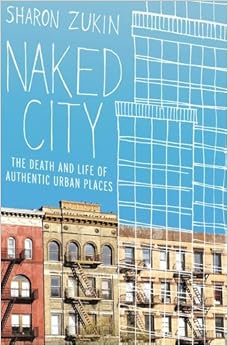
The subtitle of Sharon Zukin’s book, “The Death and Life of Authentic Urban Places,” puts her work directly in line with Jane Jacobs’s work, echoing the title of Jacobs’s most famous book. Zukin isn’t concerned as much about keeping neighborhoods and towns alive as making them feel alive--making them remain true to their soul. She sees a city’s soul as being bound around the concept of authenticity and worries that towns are becoming less authentic the more that they gentrify.
I have big problems with her idea of authenticity, problems that she herself admits to in her introduction. In defining authenticity, she tries to tie the concept into one of origins. An authentic neighborhood is one somehow in touch with its origins. Thus, a chain store has little to do with a neighborhood and is not tied in with the origins of the people in it and thus not authentic. This seems simple in itself. The issue I have is that what we view as “authentic” is itself a construct, which she admits. Our authentic city is the one that was there when we first lived in the area. Thus, Athens, Georgia, where I live, should have a somewhat derelict downtown on the west side, because that’s how it was when I arrived. Now, fifteen years later, that portion of downtown is thriving--in fact, the entire downtown district is thriving. There are no longer many abandoned buildings, and many of the places I would go--my local friends would go--are gone. In their place are some higher priced alternatives, a few chains, a few stores aimed at younger people (people who are the age I was when I moved here). Go back a generation or two before I arrived, and this portion of downtown was the Hot Corner, an African American sector of downtown, only one of whose businesses still exists (a barbershop). Shouldn’t the “authentic” version of this portion of town then be black? Or could we go back before that, to a time when this sector was housing and not part of a business district at all? What is the “origin”? What is authentic? It’s all a matter of perspective.
Despite that criticism, her critique of gentrification and her observations about it in the case studies she does of neighborhoods in New York is fascinating and shows that there is a certain cause for concern. Gentrification comes at price--and any given sector of town goes through a cycle (one explained years ago in a human geography course I took). Perhaps, the neighborhood is largely one of immigrants from Ireland. As they grow more prosperous, they tend to move out or to change the neighborhood itself. Perhaps, another set of immigrants moves in--Italians. In seeking “authenticity”--some kind of unique experience one can’t get elsewhere in the city--hipsters and artists begin to visit the Italian neighborhood. It’s relatively cheap too, so some move there from more expensive districts. Soon, there’s a thriving hipster/art scene among the architecture forged by previous rounds of immigrant families. As the neighborhood becomes more and more popular, commercial elements begin to move in to be a part of it, eventually making it too expensive for the artists who made the neighborhood thrive. The Italian quotient is long since gone, as is what made the neighborhood actually unique. It’s lost its “soul.” (But are commercial ventures necessarily soulless? I ask. Aren’t bright-lit signs and lots of business a sort of spirit inhabiting a district, making it what it is? And when this grows dull, then the area will lose popularity, and the poor and/or immigrant populations will return, and the cycle will start afresh.)
Williams begins her case study with Williamsburg, in Brooklyn. Once an immigrant district for Poles, it was discovered by musicians and artists and became a kind of haven for them from Manhattan, which had become too expensive. With time, as hipster cafes have populated the area, higher rents and more commercial ventures have moved in and is now beginning to push the artists out. We lost the Polish vibe and now the hipster vibe is losing steam too.
Next, Zukin goes to Harlem, the famous black neighborhood. Here she sees an example of a case where the local community and government agents colluded to actually change the neighborhood. As residents worked to get more businesses to move to the area, the very success of the work has led to them being priced out of the neighborhood. Now, white folks are moving in, enjoying the local/originary soul food as well as the new ethnic eateries that have moved in to take advantage of the wealthier clientele.
She then turns her attention to the East Village, an area that has historically included a number of lower class elements and artistic elements, attracted by the lower cost of living. This vibe has attracted an ever more expensive set of commercial forces, which in turn has caused much of what made the village at any one time its unique self to be shut down in favor of the more well-to-do. The cycle is one that is moving to ever more pricey ventures and to ever more standardization.
In the second half of the book, Zukin looks at ventures more than she looks at neighborhoods. She starts with Union Square, telling its history as a center for social protest and community gathering. The area fell into disrepute, however, sometime after World War II, as the city lacked resources to police it and care for it. Local businesses stepped to the fore and created a business improvement district to take care of the park. For a small fee raised by themselves on themselves and paid to the city but fed back to them for the park, they are able to hire park caretakers and make decisions about how the park should look. The issue is that these caretakers are private businesses, so what was once a public park in some sense is now a private venture. Private security forces decide who should be able to gather and protest; parts of the park are sold off for a restaurant venture that the “public” can enjoy. And so on. We have then the privatization of the commons--but one that makes the park safe again and a place of destination. Which is preferred? A dangerous public park that is open to less-welcome sectors of society or a semiprivate safe one that is closed off to those whose voices already are repressed?
Next we move to an area of Brooklyn where Ikea built a new store and where Hispanic immigrants gather each weekend to play soccer and sell authentic Latin American food. Folks had problems with the traffic Ikea would generate and other ways in which the chain was not “true” to the area. And yet, it has brought with it jobs and interest in a derelict part of town. Meanwhile, the immigrant food stands in the park each weekend offer locals good ethnic cuisine. As time has gone on, however, the clientele has changed. Whereas early on the food was made mostly for other immigrants, now a large chunk of the customers are curious foodies from other parts of the city. And as that has happened, the cuisine has changed as well--to appeal to the new audience. “Authenticity” is slowly being lost. And the city itself is now cracking down on the food makers, insisting they follow regulations.
Community gardens get their share of attention in this book as well. Created often in areas that had little development or were actually becoming dis-developed during New York’s days on the skid, the gardens became centers for local residents to get good local produce. However, not being the landowners, as the city has gentrified and the real estate come under demand, many such gardens have been pushed off the land in favor of redevelopment. Now, the poor are less taken care of; and for those from the middle class who enjoyed the local produce, an “authentic” portion of the community is being lost to high rises.
The overall tendency, Zukin points to, is toward homogenization--at the city level. As cities aim to "brand" themselves as cool places, more and more of them offer similar experiences. Every city of note has a modern art museum, for example. I would contend, however, that that is not necessarily a bad thing. Local residents should have access to similar conveniences and experiences. One should not have to travel to New York City for art. And the differences between art museums would still remain--this city has that artwork, this other city has that other artwork--such that people will still travel to destinations, because there is still difference. There is difference--always--because there are different landscapes and climates. Even if all cities offer skyscrapers and parks, few will find the cityscape of one megatown the same as another.
Zukin's main issue, though, is with chains, insofar as they contribute to that homogenization. As they take over a city district, the mom-and-pop stores disappear, and "authenticity" is lost to more of the same. This is where she departs from Jacobs's views. Jacobs, Zukin argues, was arguing from a particular timeframe of gentrification and could not see the whole picture. Jacobs argued that government was the problem and that the private sector community would do a better job of making for livable areas. She did not foresee sky-high rents being levied on "old" buildings such that only chains could afford old or new buildings. Zukin sees government regulation as a solution, but one that is usually not employed. The issue is that the government is usually in cahoots with the moneyed interests, which means that it encourages homogenization because that's more taxes. Rather than helping out the immigrant eateries or the community gardens, it adds regulations and drives those resources away. If on the other hand, the government zoned and regulated to encourage such endeavours, the soul of cities could be maintained.
I'd said that I see the description of gentrification as being simply the upturn of a cycle that goes round and round, but Zukin's point does have some precedent. There are communities that have banned chain and franchise stores. I think of Sedona, Arizona, where chain stores line the city boundaries (or at least they did back in the late 1980s, when I visited); inside the city there are only mom-and-pop places. In this way, the town is kept "authentic." At the same time, I hate to think of property owners having limitations put on them with regard to what can be put on their land or how much they can accrue from that land. If the community--including landowners--agrees to such restrictions, however, then there is little to be miffed about.
I have big problems with her idea of authenticity, problems that she herself admits to in her introduction. In defining authenticity, she tries to tie the concept into one of origins. An authentic neighborhood is one somehow in touch with its origins. Thus, a chain store has little to do with a neighborhood and is not tied in with the origins of the people in it and thus not authentic. This seems simple in itself. The issue I have is that what we view as “authentic” is itself a construct, which she admits. Our authentic city is the one that was there when we first lived in the area. Thus, Athens, Georgia, where I live, should have a somewhat derelict downtown on the west side, because that’s how it was when I arrived. Now, fifteen years later, that portion of downtown is thriving--in fact, the entire downtown district is thriving. There are no longer many abandoned buildings, and many of the places I would go--my local friends would go--are gone. In their place are some higher priced alternatives, a few chains, a few stores aimed at younger people (people who are the age I was when I moved here). Go back a generation or two before I arrived, and this portion of downtown was the Hot Corner, an African American sector of downtown, only one of whose businesses still exists (a barbershop). Shouldn’t the “authentic” version of this portion of town then be black? Or could we go back before that, to a time when this sector was housing and not part of a business district at all? What is the “origin”? What is authentic? It’s all a matter of perspective.
Despite that criticism, her critique of gentrification and her observations about it in the case studies she does of neighborhoods in New York is fascinating and shows that there is a certain cause for concern. Gentrification comes at price--and any given sector of town goes through a cycle (one explained years ago in a human geography course I took). Perhaps, the neighborhood is largely one of immigrants from Ireland. As they grow more prosperous, they tend to move out or to change the neighborhood itself. Perhaps, another set of immigrants moves in--Italians. In seeking “authenticity”--some kind of unique experience one can’t get elsewhere in the city--hipsters and artists begin to visit the Italian neighborhood. It’s relatively cheap too, so some move there from more expensive districts. Soon, there’s a thriving hipster/art scene among the architecture forged by previous rounds of immigrant families. As the neighborhood becomes more and more popular, commercial elements begin to move in to be a part of it, eventually making it too expensive for the artists who made the neighborhood thrive. The Italian quotient is long since gone, as is what made the neighborhood actually unique. It’s lost its “soul.” (But are commercial ventures necessarily soulless? I ask. Aren’t bright-lit signs and lots of business a sort of spirit inhabiting a district, making it what it is? And when this grows dull, then the area will lose popularity, and the poor and/or immigrant populations will return, and the cycle will start afresh.)
Williams begins her case study with Williamsburg, in Brooklyn. Once an immigrant district for Poles, it was discovered by musicians and artists and became a kind of haven for them from Manhattan, which had become too expensive. With time, as hipster cafes have populated the area, higher rents and more commercial ventures have moved in and is now beginning to push the artists out. We lost the Polish vibe and now the hipster vibe is losing steam too.
Next, Zukin goes to Harlem, the famous black neighborhood. Here she sees an example of a case where the local community and government agents colluded to actually change the neighborhood. As residents worked to get more businesses to move to the area, the very success of the work has led to them being priced out of the neighborhood. Now, white folks are moving in, enjoying the local/originary soul food as well as the new ethnic eateries that have moved in to take advantage of the wealthier clientele.
She then turns her attention to the East Village, an area that has historically included a number of lower class elements and artistic elements, attracted by the lower cost of living. This vibe has attracted an ever more expensive set of commercial forces, which in turn has caused much of what made the village at any one time its unique self to be shut down in favor of the more well-to-do. The cycle is one that is moving to ever more pricey ventures and to ever more standardization.
In the second half of the book, Zukin looks at ventures more than she looks at neighborhoods. She starts with Union Square, telling its history as a center for social protest and community gathering. The area fell into disrepute, however, sometime after World War II, as the city lacked resources to police it and care for it. Local businesses stepped to the fore and created a business improvement district to take care of the park. For a small fee raised by themselves on themselves and paid to the city but fed back to them for the park, they are able to hire park caretakers and make decisions about how the park should look. The issue is that these caretakers are private businesses, so what was once a public park in some sense is now a private venture. Private security forces decide who should be able to gather and protest; parts of the park are sold off for a restaurant venture that the “public” can enjoy. And so on. We have then the privatization of the commons--but one that makes the park safe again and a place of destination. Which is preferred? A dangerous public park that is open to less-welcome sectors of society or a semiprivate safe one that is closed off to those whose voices already are repressed?
Next we move to an area of Brooklyn where Ikea built a new store and where Hispanic immigrants gather each weekend to play soccer and sell authentic Latin American food. Folks had problems with the traffic Ikea would generate and other ways in which the chain was not “true” to the area. And yet, it has brought with it jobs and interest in a derelict part of town. Meanwhile, the immigrant food stands in the park each weekend offer locals good ethnic cuisine. As time has gone on, however, the clientele has changed. Whereas early on the food was made mostly for other immigrants, now a large chunk of the customers are curious foodies from other parts of the city. And as that has happened, the cuisine has changed as well--to appeal to the new audience. “Authenticity” is slowly being lost. And the city itself is now cracking down on the food makers, insisting they follow regulations.
Community gardens get their share of attention in this book as well. Created often in areas that had little development or were actually becoming dis-developed during New York’s days on the skid, the gardens became centers for local residents to get good local produce. However, not being the landowners, as the city has gentrified and the real estate come under demand, many such gardens have been pushed off the land in favor of redevelopment. Now, the poor are less taken care of; and for those from the middle class who enjoyed the local produce, an “authentic” portion of the community is being lost to high rises.
The overall tendency, Zukin points to, is toward homogenization--at the city level. As cities aim to "brand" themselves as cool places, more and more of them offer similar experiences. Every city of note has a modern art museum, for example. I would contend, however, that that is not necessarily a bad thing. Local residents should have access to similar conveniences and experiences. One should not have to travel to New York City for art. And the differences between art museums would still remain--this city has that artwork, this other city has that other artwork--such that people will still travel to destinations, because there is still difference. There is difference--always--because there are different landscapes and climates. Even if all cities offer skyscrapers and parks, few will find the cityscape of one megatown the same as another.
Zukin's main issue, though, is with chains, insofar as they contribute to that homogenization. As they take over a city district, the mom-and-pop stores disappear, and "authenticity" is lost to more of the same. This is where she departs from Jacobs's views. Jacobs, Zukin argues, was arguing from a particular timeframe of gentrification and could not see the whole picture. Jacobs argued that government was the problem and that the private sector community would do a better job of making for livable areas. She did not foresee sky-high rents being levied on "old" buildings such that only chains could afford old or new buildings. Zukin sees government regulation as a solution, but one that is usually not employed. The issue is that the government is usually in cahoots with the moneyed interests, which means that it encourages homogenization because that's more taxes. Rather than helping out the immigrant eateries or the community gardens, it adds regulations and drives those resources away. If on the other hand, the government zoned and regulated to encourage such endeavours, the soul of cities could be maintained.
I'd said that I see the description of gentrification as being simply the upturn of a cycle that goes round and round, but Zukin's point does have some precedent. There are communities that have banned chain and franchise stores. I think of Sedona, Arizona, where chain stores line the city boundaries (or at least they did back in the late 1980s, when I visited); inside the city there are only mom-and-pop places. In this way, the town is kept "authentic." At the same time, I hate to think of property owners having limitations put on them with regard to what can be put on their land or how much they can accrue from that land. If the community--including landowners--agrees to such restrictions, however, then there is little to be miffed about.
Labels:
Books,
Five-Star Nonfiction,
Nonfiction,
Sharon Zukin,
Urban Theory
Subscribe to:
Posts (Atom)